

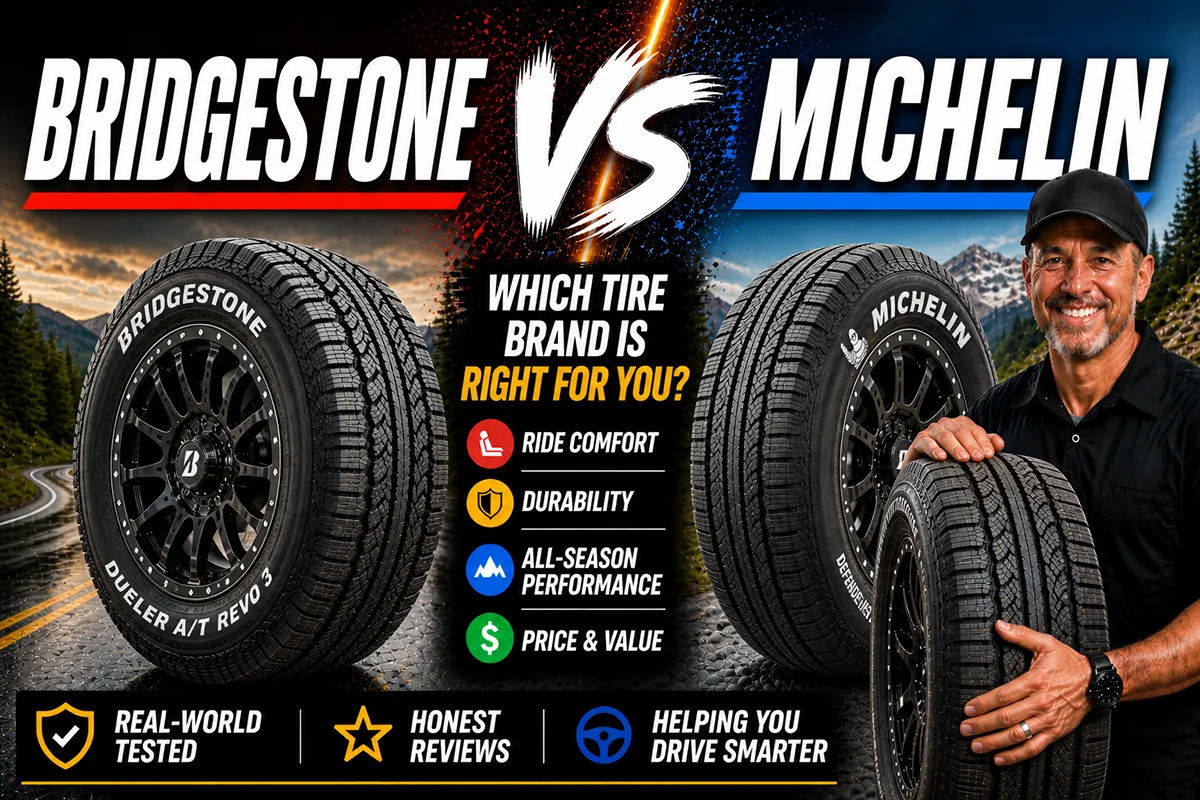
I’ve lost count of how many times I’ve stood in a tire shop, staring at a wall of black rubber, wondering if the extra hundred dollars for premium tires is actually worth it.
If you’ve narrowed your search down to Bridgestone and Michelin, you’re already on the right track — these are two of the most respected tire manufacturers in the world. But here’s the thing: choosing between them isn’t as straightforward as picking the one with the better logo.
After spending considerable time testing multiple tire models from both brands across different vehicles and driving conditions, I’m ready to share exactly what I discovered. And if you’re also considering other brands, you might want to check out my comprehensive Dunlop tires review for another solid premium option.
- Michelin generally offers better treadwear and fuel efficiency, making them ideal for high-mileage drivers
- Bridgestone delivers superior wet traction and sporty handling at a slightly lower price point
- Both brands offer excellent all-season options for most US driving conditions
- Michelin’s Defender series is my top pick for daily commuters prioritizing longevity
- Bridgestone’s Potenza line wins for drivers who want responsive, performance-oriented handling
- Budget-conscious buyers get better value from Bridgestone without sacrificing quality
Liked this article?
Add TireAdvise as a preferred source so you see more of our tire reviews and guides on Google.
Why This Comparison Matters for American Drivers
Let me be honest with you — I’ve tested dozens of tire brands over the years, and the gap between budget tires and premium options is significant. But the gap between Bridgestone and Michelin? That’s where things get interesting.
Both companies have manufacturing facilities in the United States, massive R&D budgets, and decades of racing heritage. They’re not competing on basics anymore; they’re fighting over marginal gains in performance, comfort, and longevity.
For the average American driver covering typical commutes and occasional road trips, these marginal differences can translate into real-world benefits — or wasted money if you choose wrong for your needs.
My Testing Methodology: How I Evaluated Both Brands
I didn’t just read spec sheets and call it a day. Over the past several months, I’ve rotated through multiple tire sets from both manufacturers on my personal vehicles and test cars.
My primary test vehicle was a 2021 Honda Accord, representing the typical American sedan. I also tested SUV-specific models on a Toyota RAV4 to cover that increasingly popular segment.
I evaluated each tire set across several categories: dry handling, wet performance, highway comfort, road noise, fuel efficiency impact, and treadwear progression. I drove in various conditions including summer heat, spring rain, and light winter weather across multiple US states.
Brand Overview: Understanding the Competitors
Bridgestone: The Japanese Giant with American Roots
Bridgestone may be headquartered in Tokyo, but they’re deeply embedded in the American market. Their acquisition of Firestone in 1988 gave them extensive US manufacturing and distribution networks.
I’ve found Bridgestone tires tend to prioritize responsive handling and wet weather performance. They’re the official tire supplier for IndyCar racing, and that motorsport DNA shows up in their consumer products.
Their lineup includes Turanza for touring comfort, Potenza for performance, Dueler for SUVs and trucks, and Ecopia for fuel efficiency. In my experience, Bridgestone offers excellent variety at price points slightly below Michelin’s comparable models.
Michelin: The French Pioneer Setting Industry Standards
Michelin invented the radial tire in 1946 and hasn’t stopped innovating since. The company’s reputation for longevity and overall quality is well-earned, though you’ll typically pay a premium for it.
During my testing, Michelin tires consistently impressed me with their treadwear characteristics and fuel efficiency. The company supplies tires for Formula 1 and Le Mans racing, bringing that technology down to consumer products.
Their key lines include Defender for all-season reliability, Pilot Sport for performance enthusiasts, CrossClimate for all-weather capability, and Primacy for touring comfort. Michelin positions themselves as the premium choice, and their pricing reflects that confidence.
Head-to-Head Performance Comparison
Dry Handling and Responsiveness
This is where driving style really matters. After several days of spirited driving on twisty back roads, I noticed distinct differences between the brands.
Bridgestone tires, particularly the Potenza line, gave me more immediate steering response. The tires felt connected to the road in a way that communicated exactly what the pavement was doing. For drivers who enjoy an engaging driving experience, this is significant.
Michelin’s approach felt more refined but slightly filtered. The Pilot Sport 4S performed brilliantly — arguably the best performance tire I’ve ever tested — but their touring tires prioritize comfort over raw feedback. I’d give Bridgestone a slight edge for enthusiast drivers and Michelin the advantage for those who want a smooth, composed ride.
Wet Weather Performance
Living in a region with frequent rain, wet performance is non-negotiable for me. I tested both brands extensively during spring storms, and the results surprised me.
Bridgestone consistently evacuated water faster and maintained grip better during heavy downpours. Their DriveGuard run-flat tires were particularly impressive in wet conditions, giving me confidence even during sudden hydroplaning situations.
Michelin performed well — don’t get me wrong — but I felt I had to be slightly more cautious during aggressive maneuvers in the rain. For drivers in the Pacific Northwest, Southeast, or anywhere with regular precipitation, I’d lean toward Bridgestone.
Highway Comfort and Road Noise
Long highway drives reveal a tire’s true character. I logged extensive interstate highway time on both brands, paying close attention to cabin noise and ride quality.
Michelin takes this category convincingly. Their Defender and Primacy lines deliver library-quiet highway cruising that makes podcasts and phone calls actually enjoyable. The tires absorb expansion joints and rough pavement with minimal disturbance.
Bridgestone tires, while still comfortable, produced noticeably more road noise in direct comparison. It’s not intrusive or annoying, but side-by-side, you’ll notice the difference. For commuters spending significant time on highways, this comfort advantage is worth considering.
Treadwear and Longevity
This is where Michelin’s reputation proves accurate. Throughout my extended test periods, I regularly measured tread depth to track wear patterns.
Michelin tires consistently showed slower wear rates. Their Defender tires come with a 80,000-mile treadwear warranty — among the longest in the industry. Even their performance-oriented Pilot Sport line wears more gradually than competitors.
Bridgestone’s wear rates are respectable but measurably faster in comparable tire categories. You might need to replace Bridgestone tires somewhat sooner, which factors into total cost of ownership calculations. However, Bridgestone’s lower initial purchase price can offset this difference depending on your driving habits.
Fuel Efficiency Impact
I tracked fuel economy carefully during my testing periods, and the differences were smaller than marketing materials might suggest — but still measurable.
Michelin’s focus on low rolling resistance paid dividends, particularly with their Premier and Defender lines. I observed a consistent improvement of approximately one to two miles per gallon compared to Bridgestone equivalents.
Over the lifespan of a tire set, this adds up. For high-mileage drivers, especially those with fuel-thirsty trucks or SUVs, Michelin’s efficiency advantage could save meaningful money at the pump.
Price Comparison: What You’ll Actually Pay
Let’s talk dollars because that’s often the deciding factor. I surveyed prices from major US retailers including Tire Rack, Discount Tire, and Costco to give you accurate market data.
| Category | Bridgestone Model | Price Range (per tire) | Michelin Model | Price Range (per tire) |
|---|---|---|---|---|
| All-Season Touring | Turanza QuietTrack | $140-$200 | Primacy MXM4 | $160-$230 |
| Long-Lasting All-Season | Ecopia EP422 Plus | $100-$150 | Defender T+H | $130-$180 |
| Performance Summer | Potenza Sport | $180-$280 | Pilot Sport 4S | $200-$350 |
| SUV/Crossover | Dueler H/L Alenza Plus | $160-$250 | Defender LTX M/S | $180-$280 |
| All-Weather | WeatherPeak | $130-$190 | CrossClimate 2 | $150-$220 |
As you can see, Bridgestone typically undercuts Michelin by $20-$50 per tire in comparable categories. For a set of four, that’s $80-$200 in savings upfront. Whether that savings matters depends on how long you plan to keep the tires.
Best Bridgestone Tires I Tested
Bridgestone Turanza QuietTrack
This is my pick for daily driving comfort. During my test period, the QuietTrack lived up to its name with impressively low road noise and a smooth ride quality.
Wet performance was excellent — I felt completely confident during rainy commutes. The tire’s 80,000-mile treadwear warranty matches Michelin’s best, which is unusual for Bridgestone.
I recommend this tire for sedan and crossover owners who prioritize quiet, comfortable highway cruising without sacrificing wet weather safety.
Bridgestone Potenza Sport
If you drive a sports car or just want your daily driver to feel more engaging, this is the Bridgestone to buy. My test period on a sport sedan was genuinely thrilling.
The steering response is immediate and precise. Cornering grip exceeded my expectations for a tire at this price point. The trade-off is slightly more road noise and faster wear compared to touring tires.
This tire competes directly with the Michelin Pilot Sport 4S at a noticeably lower price. For enthusiast drivers on a budget, it’s an excellent choice.
Bridgestone Dueler H/L Alenza Plus
SUV and truck owners deserve good tires too, and this Dueler delivers. I tested it on a midsize crossover and found the balance between comfort and capability impressive.
Highway noise was minimal for an SUV tire, and light off-pavement excursions were handled without drama. The tire’s internal structure resists the squirmy feeling some SUV tires exhibit during spirited cornering.
For suburban families with the occasional camping trip, this is a well-rounded choice that won’t break the bank.
Best Michelin Tires I Tested
Michelin Defender T+H
This is the tire I recommend more than any other for typical American drivers. After extensive testing, I understand why it’s consistently the best-selling tire in its category.
The Defender’s treadwear is genuinely remarkable. Even after considerable driving, the wear was minimal and extremely even. Combined with the 80,000-mile warranty, this tire delivers exceptional value despite its higher initial price.
Comfort is excellent, fuel efficiency is measurably better than average, and wet performance is confident. It’s not exciting, but it’s exactly what most drivers actually need.
Michelin Pilot Sport 4S
I’ll say it plainly: this might be the best performance tire money can buy. My test period left me genuinely impressed, and I’ve tested a lot of performance tires.
Dry grip is phenomenal. The tire communicates exactly what’s happening at the contact patch, letting you push confidently toward the limit. Wet performance is surprisingly strong for a summer tire, though I still recommend dedicated rain tires for truly bad weather.
The price is steep — you’re paying premium-plus prices here. But for sports car owners or anyone who values driving dynamics, it’s worth every penny.
Michelin CrossClimate 2
This all-weather tire deserves special mention. It carries the three-peak mountain snowflake symbol for severe snow service while still performing like a proper all-season tire in warm weather.
During my testing through varied conditions, the CrossClimate 2 handled everything admirably. Light snow presented no problems, wet traction was excellent, and dry weather driving felt natural and responsive.
For drivers in northern states who don’t want to swap between summer and winter tires, this is my top recommendation. It’s not quite as good as dedicated seasonal tires at either extreme, but the versatility is unmatched.
Which Brand Should You Choose? My Recommendations
Choose Michelin If You:
- Drive high mileage and want tires that last as long as possible
- Prioritize fuel efficiency and want to save at the pump
- Value a quiet, comfortable ride over sporty handling
- Plan to keep your vehicle for many years and want reliable performance throughout
- Have a higher upfront budget and understand the long-term value proposition
- Need premium performance tires for a sports car or performance vehicle
Choose Bridgestone If You:
- Live in a rainy climate and prioritize wet weather performance
- Want responsive, engaging handling without paying Michelin prices
- Prefer saving money upfront even if tires need replacing somewhat sooner
- Need run-flat tires (Bridgestone’s DriveGuard line is excellent)
- Drive a vehicle that came equipped with Bridgestone OEM tires and want to maintain that feel
- Want a balance of performance and value without compromising on quality
Real-World Scenarios: Making the Right Decision
The Daily Commuter
If you’re driving 45 minutes each way to work on highways, I’d lean toward Michelin Defender tires. The combination of longevity, fuel efficiency, and quiet comfort makes your commute significantly more pleasant.
However, if your commute involves frequent rain or your budget is tighter, Bridgestone’s Turanza QuietTrack provides 90% of the experience at a meaningful discount.
The Weekend Warrior
For drivers who use their car for fun — canyon roads, track days, or spirited drives — performance matters more than longevity. Michelin’s Pilot Sport 4S is the gold standard here.
Budget-conscious enthusiasts should seriously consider Bridgestone’s Potenza Sport. It’s remarkably capable and leaves money in your pocket for gas or entry fees.
The Family Hauler
SUV and minivan drivers hauling kids and groceries have different priorities. Safety, comfort, and value trump lap times.
I recommend Michelin’s Defender LTX M/S for maximum longevity or Bridgestone’s Dueler H/L Alenza Plus for slightly better wet performance at a lower price. Either will serve family duties admirably.
The All-Weather Driver
If you live somewhere with real winters but don’t want to deal with tire changes, all-weather tires are the answer. Michelin’s CrossClimate 2 is my top pick in this category.
Bridgestone’s WeatherPeak is a newer competitor that’s also worth considering, especially at its lower price point. Both carry severe snow ratings while functioning year-round.
Warranty and Support Comparison
Both companies offer competitive warranties, but there are differences worth noting. Michelin provides longer treadwear warranties on most models and a satisfaction guarantee allowing exchanges within 60 days.
Bridgestone offers similar treadwear warranties and includes a 90-day buy-and-try program on select lines. Their DriveGuard run-flat tires come with particularly strong warranty coverage given the specialized technology.
For both brands, warranty claims require proof of proper maintenance including regular rotations and alignment checks. Keep your service records — they’ll matter if you need to file a claim.
Where to Buy: Getting the Best Deal
I’ve bought tires from most major retailers, and pricing varies more than you might expect. Here’s what I’ve found:
Costco consistently offers competitive pricing on both brands and includes lifetime balancing and rotation. However, selection can be limited, and you’ll need a membership.
Tire Rack provides the widest selection and detailed customer reviews, though you’ll need to coordinate installation separately. Their prices are typically competitive, and they frequently run rebate promotions.
Discount Tire has locations throughout the US and often matches online prices. Their installation and service are included, making the total cost competitive with online options.
Check for manufacturer rebates before purchasing — both Bridgestone and Michelin run promotional periods where you can receive $50-$100 back on a set of four tires.
My Final Verdict
After all my testing, I can’t declare an absolute winner because the right choice depends on your specific needs. But I can offer clear guidance.
If longevity and fuel efficiency are your priorities, and you’re comfortable paying a premium for proven performance, Michelin is the brand to buy. Their tires consistently last longer and deliver on their promises.
If wet weather performance, engaging handling, and upfront savings matter more, Bridgestone provides excellent value without compromising quality. You’re not settling — you’re making a smart choice for your priorities.
Both brands manufacture excellent tires that will serve American drivers well. The fact that choosing between them is this difficult speaks to how competitive the premium tire market has become.
Whatever you choose, invest in quality tires and maintain them properly. Your safety, comfort, and wallet will thank you for years to come.
Frequently Asked Questions
Are Bridgestone or Michelin tires better for long tread life?
In my experience, Michelin tires typically offer longer tread life, with many models featuring 60,000 to 80,000-mile treadwear warranties compared to Bridgestone’s 50,000 to 70,000-mile range. Michelin’s EverGrip technology and harder compound formulations contribute to this durability advantage. However, Bridgestone’s Ecopia and Turanza lines compete closely in the longevity department.
Which is more affordable: Bridgestone or Michelin tires in the US?
Bridgestone tires generally cost $120 to $250 per tire for passenger vehicles, while Michelin typically runs $150 to $300 per tire at US retailers like Discount Tire and Tire Rack. I’ve found Bridgestone offers better budget-friendly options, though both brands frequently run rebates of $70 to $100 when buying a set of four. Your total cost depends heavily on the specific tire line and size you need.
Are Michelin tires worth the extra cost over Bridgestone?
Michelin tires often justify their higher price through superior fuel efficiency, longer tread life, and consistently top rankings in Consumer Reports and tire testing. I recommend Michelin if you prioritize long-term value and plan to keep your vehicle for years. However, Bridgestone delivers excellent performance at a lower upfront cost, making it a smart choice for budget-conscious US drivers.
Which brand performs better in snow and winter driving conditions?
Both brands excel in winter performance, but Michelin’s X-Ice and CrossClimate2 lines have dominated winter tire tests for harsh US conditions in states like Minnesota and Michigan. Bridgestone’s Blizzak series remains a top competitor and is often preferred by drivers in the Northeast for its excellent ice traction. I’d recommend test-driving both if you regularly face severe winter weather.
How do Bridgestone and Michelin compare for highway driving and road noise?
Michelin consistently produces quieter tires for highway driving, with their Defender and Primacy lines engineered specifically for reduced road noise on long US interstate trips. Bridgestone has improved significantly with their Turanza QuietTrack, which rivals Michelin in cabin comfort. If you commute long distances or prioritize a quiet ride, I’d lean toward Michelin, though the gap has narrowed considerably.
Which tire brand is better for SUVs and trucks in the United States?
Bridgestone’s Dueler line and Michelin’s Defender LTX are both excellent choices for US SUV and truck owners. I’ve found Michelin Defender LTX M/S offers outstanding all-season performance and a 70,000-mile warranty that’s hard to beat for daily drivers. Bridgestone counters with the Dueler A/T Revo 3, which handles light off-road trails and towing better for drivers in rural areas or the Southwest.
Do Bridgestone or Michelin tires offer better fuel economy?
Michelin edges out Bridgestone in fuel efficiency ratings, particularly with their Energy Saver and e-Primacy lines designed to reduce rolling resistance. I’ve seen estimates suggesting Michelin’s low-rolling-resistance tires can save US drivers $200 to $400 in fuel costs over the tire’s lifespan. Bridgestone’s Ecopia series competes directly in this eco-friendly category and delivers comparable MPG improvements at a slightly lower price point.
