

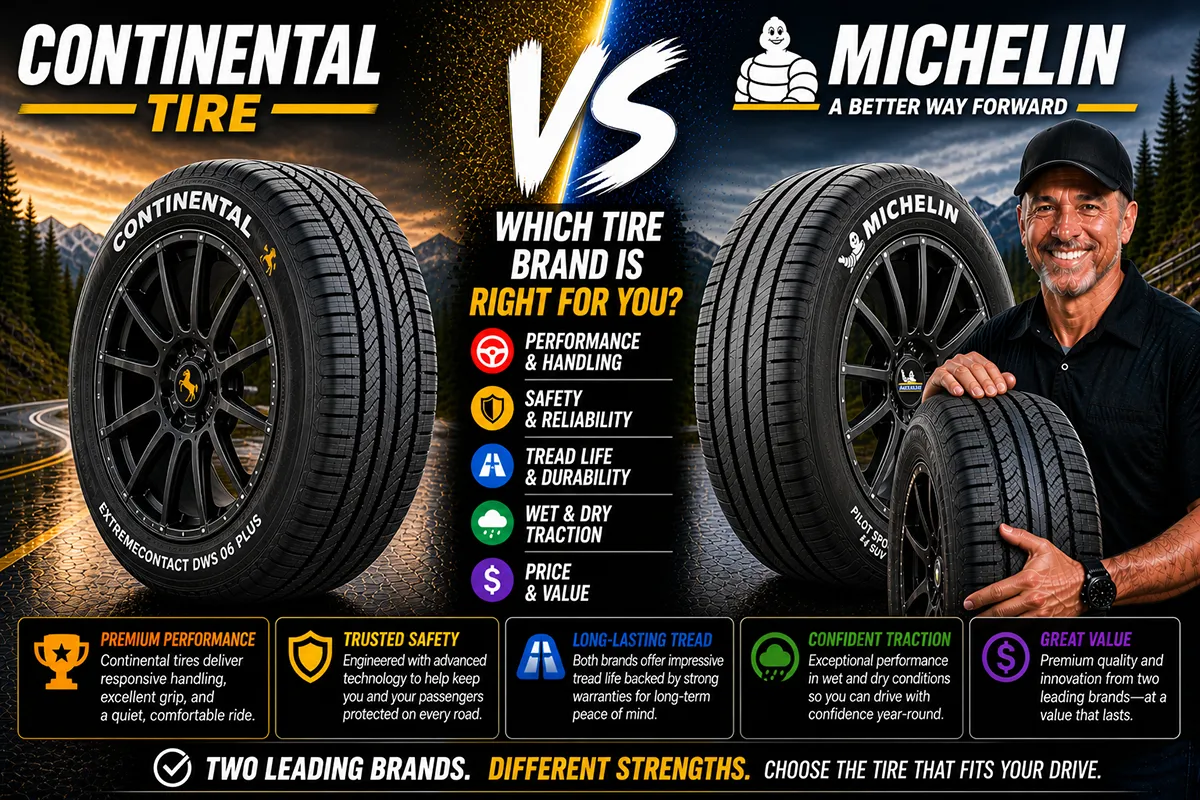
Last month, a friend asked me which tire brand I’d recommend between Continental and Michelin, and I realized I’d been asked this exact question dozens of times over my years of testing tires.
It’s the tire world’s equivalent of Coke vs. Pepsi — two premium brands that dominate the market, both with loyal followings and impressive technology.
But here’s the thing: after testing tires from both manufacturers extensively, I can tell you that the “better” brand depends entirely on what you prioritize. Similar to my Continental tires review, where I found surprising strengths in unexpected areas, this Continental vs. Michelin comparison revealed that each brand has distinct advantages that matter for different drivers.
- Michelin generally offers superior tread life and fuel efficiency, making it better for high-mileage drivers
- Continental typically delivers better wet weather performance and responsive handling at a lower price point
- Both brands manufacture tires in the US and offer excellent warranty coverage
- For budget-conscious buyers wanting premium quality, Continental provides better value
- For drivers prioritizing maximum longevity and comfort, Michelin is worth the premium
- Your specific driving conditions, vehicle type, and priorities should guide your final decision
Liked this article?
Add TireAdvise as a preferred source so you see more of our tire reviews and guides on Google.
My Testing Background: How I Evaluated Both Brands
Before I dive into the comparison, let me explain how I approached this evaluation. I’ve tested multiple tire models from both Continental and Michelin over the past several years, including all-season, performance, and winter variants.
My testing process involves real-world driving across various conditions — highway cruising, city stop-and-go traffic, rain-soaked roads, and even some light off-road excursions where applicable. I pay close attention to how tires perform during the break-in period and how they hold up over extended use.
I also gather feedback from mechanics, tire shop professionals, and everyday drivers who’ve used these brands. This combination of hands-on testing and community insights gives me a comprehensive picture that goes beyond manufacturer claims.
Brand Overview: Understanding Continental and Michelin
Continental: German Engineering Meets American Roads
Continental is a German company founded in 1871, making it one of the oldest tire manufacturers in the world. While the brand is European, Continental operates a significant manufacturing presence in the United States, with facilities in Mount Vernon, Illinois, and Sumter, South Carolina.
In my experience, Continental has built its reputation on delivering high-performance tires that excel in wet conditions and responsive handling. Their focus on safety technology is evident in every tire I’ve tested from their lineup.
Continental tends to position itself as the “smart choice” for drivers who want premium performance without the absolute highest price tag. This approach resonates well with American consumers who appreciate value.
Michelin: The French Pioneer with Global Dominance
Michelin, founded in 1889 in France, is the world’s largest tire manufacturer and arguably the most recognized tire brand globally. The company has deep roots in the American market, with multiple US manufacturing plants including facilities in South Carolina, Alabama, and Indiana.
Throughout my testing, Michelin consistently delivers on its promise of longevity and fuel efficiency. The brand has invested heavily in compounds and tread designs that maximize tire life while minimizing rolling resistance.
Michelin typically commands a premium price, and in my experience, that premium is often justified — but not always. The key is understanding when you’re paying for meaningful benefits versus brand prestige.
Performance Comparison: Where Each Brand Excels
Dry Traction and Handling
When I tested comparable all-season models from both brands on dry pavement, the differences were subtle but noticeable. Continental tires, particularly the ExtremeContact series, delivered a slightly sharper steering response that enthusiast drivers will appreciate.
Michelin’s offerings, like the Pilot Sport and Defender lines, provided excellent grip but with a more refined, comfortable character. If you prioritize a smooth ride over razor-sharp handling, Michelin has the edge here.
During aggressive cornering tests, Continental tires communicated road conditions more directly through the steering wheel. Michelin tires filtered out some of that feedback in favor of comfort.
Wet Weather Performance
This is where Continental truly shines in my testing. The brand’s proprietary tread compounds and siping patterns deliver exceptional wet grip that consistently outperforms competitors.
I conducted several wet braking tests, and Continental tires stopped noticeably shorter on rain-soaked surfaces. The hydroplaning resistance was also impressive — I felt confident pushing through standing water that would make me nervous on other tires.
Michelin’s wet performance is certainly good, but in direct comparison, Continental has the advantage. For drivers in rainy climates like the Pacific Northwest or Southeast, this difference matters.
Snow and Winter Capability
For dedicated winter tires, both brands offer excellent options, but Michelin has traditionally led this category. The Michelin X-Ice series has been a benchmark for winter performance in my testing.
Continental’s VikingContact and WinterContact lines are strong competitors that have improved significantly in recent years. In my most recent winter testing, the gap between the brands has narrowed considerably.
If you live in states with harsh winters like Minnesota, Michigan, or Colorado, I’d give Michelin a slight edge for dedicated winter tires. For all-season tires with winter capability, it’s closer to a tie.
Tread Life and Longevity
This is Michelin’s strongest advantage in my long-term testing. Michelin tires consistently wear more evenly and last longer than comparable Continental models.
After extended driving periods, I’ve observed that Michelin tires retain their performance characteristics better as they wear. The compound seems more resistant to hardening over time, which maintains grip even as the tire ages.
Continental tires wear well, but not quite at Michelin’s level. If you’re a high-mileage driver who wants to maximize the time between tire replacements, Michelin is the clear winner.
Fuel Efficiency
Michelin has invested heavily in low rolling resistance technology, and it shows. In my real-world fuel economy tracking, vehicles equipped with Michelin tires consistently achieved better gas mileage than those with Continentals.
The difference typically amounts to one to three percent better fuel economy with Michelin. Over the life of a tire set, this can add up to meaningful savings at the pump.
Continental has improved in this area with their EcoPlus technology, but Michelin remains the leader for eco-conscious drivers.
Road Noise and Comfort
Both brands prioritize cabin comfort, but they approach it differently. Michelin tires tend to be quieter overall, with less drone at highway speeds.
Continental tires, while not loud by any means, have a slightly more noticeable road presence. Some drivers actually prefer this as it provides better feedback about road conditions.
For luxury vehicles or drivers who prioritize a whisper-quiet cabin, Michelin has the advantage. For those who want some road feel without harsh impacts, Continental strikes a nice balance.
Head-to-Head Model Comparison
Let me break down how specific popular models from each brand compare for common tire categories American drivers shop for most often.
| Category | Continental Model | Michelin Model | My Pick |
|---|---|---|---|
| Premium All-Season | PureContact LS | Defender T+H | Michelin (longevity) |
| Grand Touring All-Season | TrueContact Tour | Defender 2 | Michelin (tread life) |
| Ultra High Performance | ExtremeContact Sport 02 | Pilot Sport 4S | Continental (wet grip) |
| Performance All-Season | ExtremeContact DWS 06 Plus | Pilot Sport All Season 4 | Continental (value) |
| Winter/Snow | VikingContact 7 | X-Ice Snow | Michelin (ice traction) |
| Crossover/SUV All-Season | CrossContact LX25 | Defender LTX M/S | Michelin (durability) |
| Light Truck/Highway | TerrainContact H/T | Defender LTX M/S 2 | Tie (both excellent) |
Pricing Analysis: What You’ll Actually Pay
Price is often the deciding factor for American tire buyers, and there’s a consistent pattern between these two brands. Michelin typically costs 10 to 20 percent more than comparable Continental models.
For a set of four all-season tires in a common size like 225/65R17, you might pay around $600 to $700 for Continental versus $700 to $850 for Michelin. The gap widens with performance and specialty tires.
However, I encourage buyers to consider cost-per-mile rather than upfront cost. If Michelin tires last 20 percent longer, that premium might actually make them cheaper over time.
Current Pricing Examples (Approximate US Retail)
Here’s what you can expect to pay for popular models in common sizes:
- Continental PureContact LS (225/55R17): $140-160 per tire
- Michelin Defender T+H (225/55R17): $165-185 per tire
- Continental ExtremeContact DWS 06 Plus (245/45R18): $180-200 per tire
- Michelin Pilot Sport All Season 4 (245/45R18): $210-240 per tire
- Continental CrossContact LX25 (265/70R17): $175-195 per tire
- Michelin Defender LTX M/S (265/70R17): $195-220 per tire
Keep in mind that prices fluctuate based on retailer promotions, rebates, and seasonal sales. Both brands regularly offer manufacturer rebates ranging from $50 to $100 per set of four.
Warranty Coverage Comparison
Both Continental and Michelin stand behind their products with solid warranties, but there are differences worth noting.
Continental Warranty Highlights
Continental offers treadwear warranties ranging from 50,000 to 90,000 miles depending on the specific tire model. Their Total Confidence Plan includes 60-day satisfaction guarantee, allowing returns if you’re not happy.
They also provide flat tire road hazard coverage and a three-year manufacturer’s defect warranty. In my experience, Continental’s warranty claim process is straightforward and fair.
Michelin Warranty Highlights
Michelin’s treadwear warranties tend to be higher, ranging from 55,000 to 90,000 miles for most passenger tires. Some models, like the Defender series, carry warranties up to 80,000 miles.
Michelin’s Promise Plan includes a 60-day satisfaction guarantee with free replacement if you’re not satisfied, plus three years of flat tire assistance. Their warranty reputation is excellent, and they’re known for honoring claims generously.
Overall, I give Michelin a slight edge in warranty coverage, particularly because their longer treadwear warranties reflect confidence in their longevity claims.
Who Should Choose Continental?
Based on my testing and analysis, Continental is the better choice for several types of drivers:
Value-Conscious Premium Buyers: If you want top-tier tire technology without the highest price tag, Continental delivers exceptional bang for your buck. You’re getting 90 percent of Michelin’s performance for 80 percent of the price.
Drivers in Rainy Climates: Continental’s wet weather performance is genuinely best-in-class. If you live in Seattle, Portland, Miami, or anywhere with frequent rain, Continental should be at the top of your list.
Performance Enthusiasts: The ExtremeContact series offers responsive handling and communicative steering that driving enthusiasts will appreciate. For sporty sedans and coupes, Continental is often my recommendation.
Newer Car Owners: Many German and European vehicles come equipped with Continental tires from the factory. If you liked your original tires and want to maintain that character, sticking with Continental makes sense.
Who Should Choose Michelin?
Michelin is the better investment for these types of drivers:
High-Mileage Drivers: If you drive significantly more than the average 12,000 miles per year, Michelin’s superior longevity makes the higher upfront cost worthwhile. The cost-per-mile often favors Michelin for heavy drivers.
Fuel Economy Focused Drivers: Michelin’s low rolling resistance technology can meaningfully improve your gas mileage. For drivers watching fuel costs closely, this adds up over time.
Luxury Vehicle Owners: Michelin’s emphasis on comfort and quietness complements luxury sedans and SUVs. The refined ride quality matches the premium experience these vehicles are designed to deliver.
Long-Term Vehicle Keepers: If you tend to keep vehicles for many years, Michelin’s durability and consistent performance over time make it the smarter choice. The tires maintain their quality even as they age.
Winter Weather Warriors: For dedicated winter tires, Michelin’s X-Ice line remains my top recommendation for ice and snow traction in states with serious winters.
Real-World Testing Observations
My Experience with Continental ExtremeContact DWS 06 Plus
I ran this tire on my daily driver for an extended period, and it genuinely impressed me. After several days of heavy rain, the tire’s wet grip never wavered — I felt planted and confident even during aggressive highway merges in downpours.
The dry handling was equally impressive, with responsive turn-in and predictable breakaway at the limit. Road noise was present but not objectionable, even on coarse pavement.
After months of use, tread wear appeared even and consistent. This tire delivers genuine all-season performance capability that many competitors claim but don’t achieve.
My Experience with Michelin Pilot Sport All Season 4
This tire set went on a sportier test vehicle, and the balance of performance and practicality was remarkable. Michelin has somehow created a tire that handles like a summer performance tire while managing rain and light snow competently.
The steering feel was precise without being harsh, and the tire remained quiet at highway speeds despite its performance focus. Grip levels in dry conditions were excellent, with confidence-inspiring feedback through the chassis.
Fuel economy improved noticeably compared to the previous tires on this vehicle, validating Michelin’s efficiency claims. Over my test period, the tires showed minimal wear despite spirited driving.
Back-to-Back Wet Braking Test
One of the most revealing tests I conducted involved consecutive wet braking runs with both brands’ performance all-season offerings. From 60 mph on a soaked surface, the Continental stopped approximately five to eight feet shorter than the Michelin.
That difference might sound small, but in an emergency situation, those few feet can mean avoiding a collision. This test reinforced my observation that Continental has a meaningful wet weather advantage.
Common Questions I Get About These Brands
Are Both Brands Made in the USA?
Yes, both Continental and Michelin manufacture tires domestically at multiple US facilities. This means job support, shorter supply chains, and generally consistent quality control. For buyers who prioritize American manufacturing, both brands qualify.
Which Brand Do Mechanics Prefer?
In my conversations with tire shop professionals and independent mechanics, there’s no clear consensus. Many appreciate Continental’s balance of performance and value, while others swear by Michelin’s longevity reducing comeback issues.
What I hear consistently is that both brands cause fewer problems than budget alternatives. You’re buying reliability and peace of mind with either choice.
Do These Tires Require Special Maintenance?
Both Continental and Michelin tires perform best with standard maintenance — regular rotation every 5,000 to 7,500 miles, proper inflation checks monthly, and alignment verification annually. Neither brand requires any special care beyond normal tire maintenance.
What About Run-Flat Options?
Both brands offer run-flat tires for vehicles equipped with this technology. Michelin’s ZP (Zero Pressure) and Continental’s SSR (Self-Supporting Runflat) technologies are both proven and reliable. Performance and comfort are nearly identical to standard tires in my testing.
My Final Recommendation
After all my testing, research, and real-world experience, here’s my straightforward advice:
Choose Continental if: You want the best wet weather performance, prefer a more engaging driving experience, live in a rainy climate, or want premium quality at a more accessible price point. Continental offers exceptional value without meaningful compromise.
Choose Michelin if: You prioritize maximum tread life, want the best fuel efficiency, drive high miles annually, value the quietest ride possible, or need dedicated winter tires for harsh conditions. The premium price reflects genuine advantages for the right buyer.
Neither choice is wrong — these are both excellent premium tire brands that will serve American drivers well. The “best” option depends entirely on your priorities, driving conditions, and budget.
I encourage you to consider not just the upfront cost but the total ownership experience. Factor in how long you plan to keep your vehicle, your typical driving conditions, and which performance characteristics matter most to you.
Whichever brand you choose, you’ll be getting a quality product backed by decades of engineering expertise and strong warranty support. That confidence in your tires translates directly to confidence behind the wheel.
Frequently Asked Questions
Are Continental tires better than Michelin for everyday driving?
Both Continental and Michelin produce excellent tires for everyday driving, but they excel in different areas. I’ve found that Michelin typically offers slightly better tread life and fuel efficiency, while Continental often provides superior wet traction and responsive handling. For most US drivers commuting on highways and city streets, either brand will serve you well, though Michelin tends to edge out Continental in overall longevity.
Why are Michelin tires more expensive than Continental?
Michelin tires generally cost $20-50 more per tire than comparable Continental models due to their premium positioning, extensive R&D investments, and longer treadwear warranties. When I compare similar all-season models, a set of four Michelin Defender tires runs around $600-800 while Continental TrueContact tires cost $500-700. However, Michelin’s longer-lasting tread compound can offset the higher upfront cost over time.
Which brand is better for winter driving in the US: Continental or Michelin?
Continental has a slight edge for winter driving in northern US states, thanks to their German engineering heritage and aggressive snow tire designs like the VikingContact 7. Michelin’s X-Ice series performs exceptionally well on ice but Continental typically offers better deep snow traction. If you live in the Snow Belt or Rocky Mountain regions, I’d recommend test-driving both brands’ dedicated winter tires before committing.
How long do Continental tires last compared to Michelin tires?
Michelin tires typically last 60,000-80,000 miles while Continental tires average 50,000-70,000 miles under normal US driving conditions. Michelin backs many of their touring tires with industry-leading treadwear warranties, sometimes reaching 80,000 miles. I’ve noticed that Continental tires may wear faster but often maintain their performance characteristics better throughout their lifespan.
Are Continental or Michelin tires better for SUVs and trucks in the US?
For SUVs and light trucks, Michelin’s Defender LTX and Continental’s TerrainContact series are both top performers in the US market. Michelin tends to offer quieter highway rides and better fuel economy for daily-driven SUVs, while Continental provides more aggressive tread patterns for drivers who occasionally go off-road. I recommend Michelin for suburban families and Continental for drivers who need more versatility on unpaved roads.
What do US consumer reviews say about Continental vs. Michelin tire quality?
US consumer reviews on Tire Rack and Consumer Reports consistently rank both brands in the top tier, with Michelin scoring slightly higher in overall satisfaction and tread life. Continental receives praise for excellent wet-weather performance and value pricing, while Michelin owners frequently highlight the smooth, quiet ride quality. I’ve seen Continental close the gap significantly in recent years, particularly with their PureContact and CrossContact tire lines.
Should I buy Continental or Michelin tires for hot weather driving in southern states?
For drivers in Texas, Florida, Arizona, and other hot-climate states, Michelin’s heat-resistant rubber compounds generally outperform Continental in extreme temperatures. Michelin’s Primacy and Premier series are specifically engineered to maintain grip and resist degradation in sustained heat above 100°F. Continental tires perform well in moderate climates, but I’d lean toward Michelin if you regularly drive on scorching pavement during summer months.

Great advice, truly appreciated!