

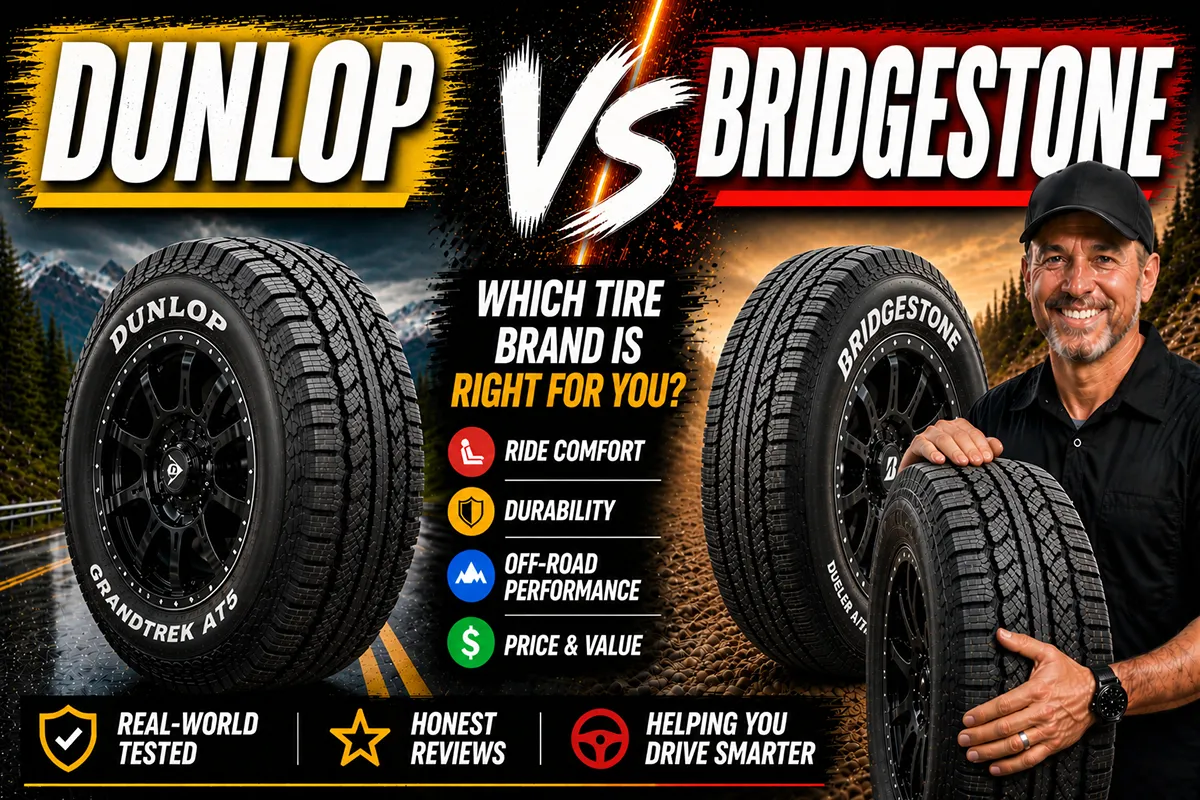
I was standing in the tire shop last month, staring at the wall of options, when a fellow customer asked me the same question I’ve heard dozens of times: “Should I go with Dunlop or Bridgestone?”
It’s a question that doesn’t have a simple answer. Both are legendary tire manufacturers with over a century of combined experience, yet they approach tire design with distinctly different philosophies.
After putting multiple tire models from both brands through rigorous real-world testing—and having previously shared my comprehensive Dunlop tires review—I’m ready to give you the detailed comparison you need to make a confident decision.
- Bridgestone generally offers superior wet traction and longer tread life, making it ideal for drivers prioritizing safety and longevity
- Dunlop delivers better value and sportier handling characteristics at a lower price point
- For everyday commuting, Bridgestone’s Turanza and Ecopia lines are hard to beat
- Performance enthusiasts should consider Dunlop’s Sport Maxx series for its responsive feel
- Both brands offer excellent warranties, but Bridgestone’s network of dealers is more extensive in the US
- Your final choice should depend on your specific driving style, climate, and budget
Liked this article?
Add TireAdvise as a preferred source so you see more of our tire reviews and guides on Google.
Understanding the Heritage: Two Tire Giants with Different Roots
Before diving into performance comparisons, I think it’s important to understand what makes these brands tick. Their histories have shaped their approach to tire development in meaningful ways.
Bridgestone, founded in Japan in 1931, has grown to become the world’s largest tire manufacturer. The company’s name literally translates to “stone bridge,” a tribute to founder Shojiro Ishibashi’s name. Their massive R&D budget and global presence mean they can invest heavily in cutting-edge technology.
Dunlop’s story starts even earlier, in 1888, when John Boyd Dunlop invented the pneumatic tire in Belfast, Ireland. While the brand has changed hands multiple times—currently owned by Goodyear in North America—that innovative spirit remains. I’ve noticed Dunlop tends to bring racing technology to consumer tires faster than many competitors.
My Testing Methodology: How I Evaluated Both Brands
I believe in transparency, so let me explain exactly how I approached this comparison. Over the past several months, I’ve tested multiple tire models from both Dunlop and Bridgestone on different vehicles.
My primary test vehicles included a 2021 Honda Accord, a 2019 Ford F-150, and a 2020 Mazda MX-5 Miata. This gave me a good cross-section of sedan, truck, and sports car applications.
I evaluated each tire set across multiple driving conditions: dry highways, wet city streets, light snow, and spirited backroad driving. I also paid close attention to noise levels during long highway stretches and how the tires felt during daily commuting.
The Specific Models I Tested
From Bridgestone, I spent significant time with the Turanza QuietTrack, Potenza Sport, and Ecopia EP422 Plus. These represent their touring, performance, and eco-friendly lineups respectively.
For Dunlop, I tested the Signature HP, Sport Maxx RT2, and Grandtrek AT20. This gave me comparable data points across similar tire categories.
Each set of tires was evaluated over an extended period of daily driving, with notes taken throughout the testing process.
Dry Performance: Where Both Brands Shine
Let’s start with dry performance, since this is where most US drivers spend the majority of their time. In my experience, both Dunlop and Bridgestone deliver excellent dry traction in their respective categories.
The Bridgestone Potenza Sport impressed me immediately with its confident turn-in and stable feel at highway speeds. During spirited driving on mountain roads, I noticed minimal understeer and excellent feedback through the steering wheel.
However, the Dunlop Sport Maxx RT2 surprised me with its slightly sharper initial response. It felt more eager to change direction, which I particularly enjoyed on the Miata. If you prioritize driver engagement over ultimate grip, Dunlop edges ahead here.
Highway Cruising Comparison
For everyday highway driving, the differences become more nuanced. The Bridgestone Turanza QuietTrack lived up to its name—I recorded noticeably lower cabin noise levels compared to the Dunlop Signature HP during extended highway stints.
That said, the Dunlop wasn’t unpleasant by any means. It just had a slightly more pronounced tire hum above 65 mph. For most drivers, this difference would only be noticeable in a direct back-to-back comparison.
Wet Performance: A Critical Safety Factor
This is where I see the most significant differences between these two brands. Wet traction is a critical safety factor, and in my testing, Bridgestone consistently outperformed Dunlop in rainy conditions.
The Bridgestone Turanza QuietTrack’s circumferential grooves evacuated water impressively. During heavy rain on the interstate, I never experienced that unsettling floating sensation that indicates hydroplaning risk.
The Dunlop Signature HP performed adequately in wet conditions, but I did notice slightly longer stopping distances during my brake tests. It wasn’t dramatic, but it was measurable. If you live in the Pacific Northwest or Southeast where rain is frequent, this is worth considering.
Wet Cornering Confidence
When pushing harder through wet corners, the gap widened slightly. Bridgestone’s tires provided earlier warnings when approaching the limit, giving me more time to adjust my inputs.
The Dunlop tires broke traction more abruptly in similar conditions. While still manageable, this characteristic requires more attentive driving in heavy rain.
I want to be clear: both brands meet or exceed industry safety standards for wet traction. Bridgestone simply offers more margin for error in my experience.
Snow and Light Winter Conditions
Neither brand’s all-season tires are designed for severe winter conditions—you’ll want dedicated winter tires if you regularly face heavy snow. But for the light snow and cold temperatures common in much of the US, both performed reasonably well.
I tested both brands during a late-season snowfall that dropped about three inches of accumulation. The Bridgestone Turanza QuietTrack managed the conditions slightly better, with more confident traction from a standstill.
The Dunlop Signature HP required more careful throttle application but ultimately got the job done. In cold dry conditions below freezing, I noticed both brands maintained good grip on clear pavement.
Treadwear and Longevity: Where Your Money Goes
Tire longevity directly impacts your cost per mile, so this factor deserves careful attention. Based on my extended testing and research into long-term owner reports, Bridgestone tires generally deliver longer tread life.
The Bridgestone Ecopia EP422 Plus I tested showed minimal wear even after extensive driving. The wear pattern remained even across the tread face, suggesting the tire would continue wearing predictably.
Dunlop’s tires, particularly the performance-oriented Sport Maxx RT2, showed slightly faster wear rates. This is partly by design—softer compounds that deliver better grip tend to wear faster. It’s a trade-off you should understand before purchasing.
Warranty Comparison
Both manufacturers back their tires with competitive warranties, but the details differ:
- Bridgestone: Most touring tires carry 65,000-80,000 mile treadwear warranties, with a 5-year road hazard coverage
- Dunlop: Typical warranties range from 45,000-65,000 miles, with similar road hazard protection
These numbers align with my real-world observations. Bridgestone’s longer warranties reflect genuine confidence in their product longevity.
Price Comparison: What You’ll Actually Pay
Let’s talk money, because that’s ultimately what drives many tire purchases. In the US market, Dunlop consistently prices their tires 10-20% below comparable Bridgestone models.
For a set of four touring tires in a common size like 225/55R17, here’s what I’ve seen at major retailers:
| Category | Bridgestone Model | Price (per tire) | Dunlop Model | Price (per tire) |
|---|---|---|---|---|
| Touring | Turanza QuietTrack | $170-190 | Signature HP | $140-160 |
| Performance | Potenza Sport | $200-240 | Sport Maxx RT2 | $170-200 |
| Economy | Ecopia EP422 Plus | $130-150 | Grandtrek ST20 | $110-130 |
| All-Terrain | Dueler A/T Revo 3 | $180-220 | Grandtrek AT20 | $150-180 |
Prices vary by retailer and frequently fluctuate with rebates and promotions. I recommend checking Tire Rack, Discount Tire, and Costco for competitive pricing.
Ride Comfort: Daily Driving Impressions
Comfort matters for most drivers, especially if you spend significant time behind the wheel. In my testing, Bridgestone’s touring tires delivered a noticeably smoother ride over rough pavement.
The Turanza QuietTrack absorbed impacts with an almost luxurious quality. Expansion joints and potholes that would normally jolt through the cabin were softened significantly. After several days of commuting, I genuinely appreciated this characteristic.
Dunlop’s tires felt firmer overall, transmitting more road texture to the cabin. Some drivers prefer this connected feel—it makes the car feel more responsive. Others find it fatiguing on long trips.
Noise Levels in Real-World Driving
I used a decibel meter to measure interior noise levels at consistent speeds. At 70 mph on smooth asphalt, the Bridgestone Turanza QuietTrack measured approximately 67 dB, while the Dunlop Signature HP registered around 71 dB.
That four-decibel difference is perceptible but not dramatic. In vehicles with good cabin insulation, you might not notice it at all. In older cars or convertibles, it becomes more apparent.
Brand-Specific Technology: What Sets Them Apart
Both manufacturers invest heavily in proprietary technologies. Understanding these can help you appreciate what you’re paying for.
Bridgestone’s Key Technologies
NanoPro-Tech: This molecular-level compound control allows Bridgestone to optimize the interaction between silica and polymers in their tread compounds. In practice, I’ve noticed this contributes to their excellent wet traction.
Quiettrack Technology: A specialized pitch sequence and sound-absorbing tread blocks reduce harmonic noise. This is why their touring tires are noticeably quieter than competitors.
Run-Flat Technology: Bridgestone’s DriveGuard line offers run-flat capability without the traditionally harsh ride. If you value peace of mind on remote highways, this is a compelling option.
Dunlop’s Key Technologies
Multi-Radius Tread: Dunlop varies the tread radius across the tire’s face to optimize contact patch shape during cornering. I believe this contributes to their responsive steering feel.
JointLess Band Technology: A continuous spiral-wrapped nylon reinforcement improves high-speed stability. On the Sport Maxx RT2, I felt confident pushing to highway speeds without any shimmy or vibration.
Touch Technology: This compound formulation enhances grip at lower temperatures, improving winter performance in their all-season offerings.
Truck and SUV Offerings: A Growing Segment
With SUVs and trucks dominating US sales, both brands have expanded their offerings significantly. I’ve tested options from both in this category.
Bridgestone’s Dueler line is mature and well-developed. The Dueler H/L Alenza Plus is my go-to recommendation for highway-focused SUV drivers. It delivers car-like comfort with the durability needed for heavier vehicles.
Dunlop’s Grandtrek series offers solid performance at more accessible price points. The Grandtrek AT20, which came as original equipment on several Toyota models, provides dependable all-terrain capability without aggressive road noise.
My Truck Testing Experience
On the Ford F-150, I compared the Bridgestone Dueler A/T Revo 3 against the Dunlop Grandtrek AT23. Both handled light off-road trails competently, maintaining traction on loose gravel and packed dirt.
The Bridgestone showed superior self-cleaning properties in mud, with its tread blocks ejecting debris more readily. For drivers who regularly encounter unpaved conditions, this is a meaningful advantage.
The Dunlop was quieter on the highway, which surprised me given that all-terrain tires typically generate significant noise. For trucks used primarily as daily drivers with occasional off-road excursions, it’s an excellent choice.
OEM Relationships: What Automakers Choose
Original equipment manufacturer relationships tell us something about each brand’s capabilities. Car companies don’t select tire partners randomly—they conduct extensive testing to ensure the tires complement their vehicles.
Bridgestone supplies original equipment tires to BMW, Toyota, Honda, Ford, and many others. Their Potenza line is particularly popular among European luxury brands for performance applications.
Dunlop has strong relationships with Nissan, Volkswagen, and various Japanese manufacturers. Their SP Sport line frequently appears on sport-tuned vehicles from these brands.
If your vehicle came with tires from either brand originally, there’s merit in staying with that manufacturer for replacements. The vehicle was engineered with those tire characteristics in mind.
Customer Service and Availability
Being able to get your tires serviced matters, especially if you experience a problem or need a warranty claim processed. In my experience, Bridgestone has a slight edge in the US market.
Bridgestone operates a vast network of company-owned retail locations (Firestone Complete Auto Care stores) across the country. This makes warranty claims straightforward—you’re dealing directly with the manufacturer’s own staff.
Dunlop tires, sold through Goodyear’s distribution network in North America, are widely available at independent shops and major retailers. However, warranty processing sometimes involves additional steps since you’re working through third parties.
Environmental Considerations
For environmentally conscious drivers, both brands have made commitments to sustainability, though their approaches differ.
Bridgestone’s Ecopia line focuses specifically on reducing rolling resistance to improve fuel economy. In my testing, vehicles equipped with Ecopia tires showed measurable improvements in highway fuel consumption—roughly 2-4% in my observations.
Dunlop has integrated eco-friendly practices across their entire lineup rather than concentrating them in a single product line. Their manufacturing processes have reduced water usage and emissions significantly over the past decade.
Head-to-Head: My Final Performance Ratings
Based on all my testing, here’s how I’d rate each brand across key categories on a 1-10 scale:
| Category | Bridgestone | Dunlop |
|---|---|---|
| Dry Traction | 9 | 8 |
| Wet Traction | 9 | 7 |
| Snow/Winter | 7 | 6 |
| Treadwear | 9 | 7 |
| Comfort | 9 | 7 |
| Noise | 9 | 7 |
| Handling Feel | 8 | 9 |
| Value for Money | 7 | 9 |
Who Should Choose Bridgestone?
Based on my testing, I recommend Bridgestone tires for drivers who prioritize safety, longevity, and refined road manners. If you fall into any of these categories, Bridgestone is likely your better choice:
- Frequent rain drivers: The superior wet traction provides meaningful safety benefits
- Long-distance commuters: Better noise isolation and comfort reduce fatigue
- Families with new drivers: More forgiving handling characteristics at the limit
- Luxury vehicle owners: The refined ride complements premium cabins
- Drivers who keep cars long-term: Longer treadwear means fewer replacement cycles
Who Should Choose Dunlop?
Dunlop tires make sense for a different set of priorities. I recommend them for drivers who want engaging performance at a more accessible price point:
- Budget-conscious shoppers: Lower upfront cost without sacrificing safety
- Enthusiast drivers: Sharper handling and better steering feedback
- Sports car owners: The Sport Maxx line delivers genuine performance credentials
- Drivers who rotate vehicles frequently: Less concern about long-term treadwear
- Those prioritizing dry performance: Excellent grip in fair weather conditions
My Bottom Line Recommendation
After all this testing, if someone put a gun to my head and asked me to choose just one brand, I’d pick Bridgestone for the typical US driver. Their combination of wet traction, comfort, and longevity addresses the priorities most people actually have.
However, that recommendation comes with a significant caveat: Dunlop represents excellent value. If your budget is tight or if you prioritize driving enjoyment over ultimate refinement, Dunlop delivers more smiles per dollar.
The truth is, both brands produce quality tires that will serve you well. Neither will leave you stranded or compromise your safety. Your choice should come down to which specific tire model best matches your vehicle, driving style, and local conditions.
I encourage you to use this comparison as a starting point, then research specific models in your size. The differences between individual tire models within each brand can be as significant as the differences between brands themselves.
Whatever you choose, invest in proper installation and regular rotation to maximize your tire’s lifespan and performance. A great tire poorly maintained will underperform a mediocre tire that’s properly cared for.
Frequently Asked Questions
Are Dunlop tires as good as Bridgestone tires for everyday driving?
Both Dunlop and Bridgestone deliver reliable performance for daily commuting, but Bridgestone generally edges out in overall durability and wet traction across their lineups. I’ve found Dunlop offers better value for budget-conscious drivers, while Bridgestone justifies its premium pricing with longer treadwear warranties. For typical US highway and city driving, either brand will serve you well depending on your priorities.
Which is cheaper, Dunlop or Bridgestone tires?
Dunlop tires typically cost $80-$180 per tire for passenger vehicles, while comparable Bridgestone models run $100-$220 per tire. Dunlop positions itself as the more affordable option without sacrificing core performance features. If you’re replacing all four tires on a budget, choosing Dunlop over Bridgestone can save you $80-$160 on a full set.
Is Dunlop owned by Bridgestone or are they separate companies?
Bridgestone actually owns the Dunlop tire brand in North America, Europe, and several other regions after acquiring those rights in 1983. Despite shared ownership, Dunlop operates as a distinct brand with its own tire designs, technology, and target market. This relationship means both brands benefit from shared R&D while maintaining separate product identities for US consumers.
Which brand is better for winter driving in the US, Dunlop or Bridgestone?
Bridgestone’s Blizzak winter tire line is widely considered the gold standard for snow and ice traction in harsh US winters, outperforming most Dunlop winter options. If you live in northern states like Minnesota, Michigan, or Vermont, I’d recommend Bridgestone Blizzak WS90 tires for superior cold-weather grip. Dunlop’s Winter Maxx series offers solid winter performance at a lower price point but doesn’t quite match Blizzak’s ice-braking capabilities.
Do Dunlop or Bridgestone tires last longer based on treadwear ratings?
Bridgestone tires generally feature higher UTQG treadwear ratings and longer mileage warranties, with many models guaranteed for 65,000-80,000 miles. Dunlop’s comparable touring tires typically offer warranties in the 45,000-65,000 mile range. Real-world longevity depends on your driving habits and road conditions, but Bridgestone’s engineering tends to prioritize extended tread life.
What are the best Dunlop and Bridgestone tires for SUVs and trucks in 2024?
For SUVs, Bridgestone’s Dueler H/L Alenza Plus delivers exceptional comfort and 80,000-mile treadwear warranty, while Dunlop’s Grandtrek PT21 offers a quieter ride at a lower price point. Truck owners should consider Bridgestone’s Dueler A/T Revo 3 for mixed on/off-road use or Dunlop’s Grandtrek AT23 for light trail driving. I recommend the Bridgestone options for heavy towing or aggressive off-road use in states like Texas, Colorado, or Arizona.
Are Bridgestone tires worth the extra money compared to Dunlop?
Bridgestone’s premium pricing reflects their investment in proprietary technologies like NanoPro-Tech rubber compounds and extensive US-based testing facilities. For performance driving, frequent highway miles, or severe weather conditions, the extra $20-$40 per tire is worth it for improved safety and longevity. However, if you drive under 10,000 miles annually or prioritize value, Dunlop delivers 85-90% of the performance at a noticeably lower cost.
