

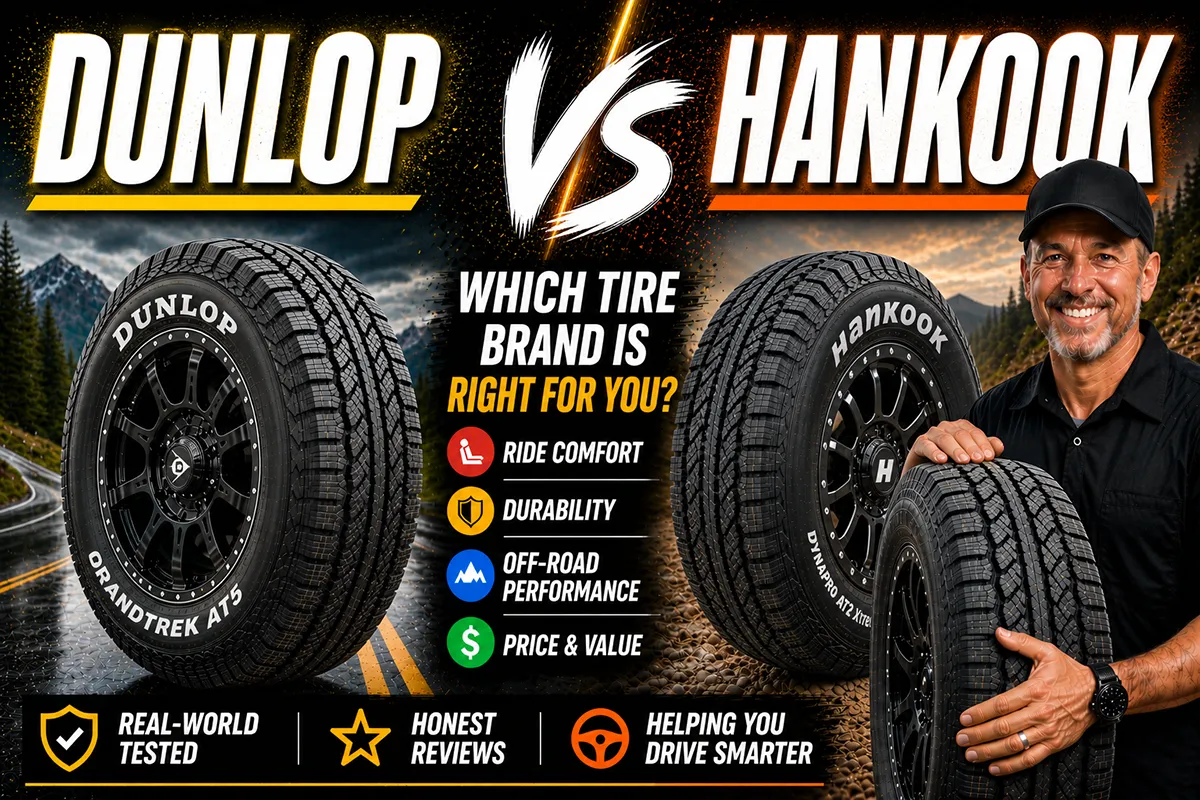
I’ve had countless conversations with drivers who stand in the tire shop, staring at two price tags and wondering if the extra money is worth it—or if the cheaper option will leave them stranded on the highway.
The Dunlop vs. Hankook debate is one I hear constantly, and after spending significant time testing tires from both manufacturers, I finally have clear answers. If you want deeper insights into one of these brands, check out my comprehensive Dunlop tires review.
Today, I’m putting these two tire giants head-to-head to help you make the smartest decision for your vehicle and budget.
- Dunlop excels in performance-oriented driving with superior dry handling and sporty feel
- Hankook delivers exceptional value with competitive performance at lower price points
- Both brands offer solid wet traction, but Dunlop edges ahead in heavy rain
- Hankook typically costs 15-25% less for comparable tire categories
- Dunlop is better for enthusiast drivers; Hankook is ideal for budget-conscious commuters
- Treadwear is comparable between brands when comparing similar tire lines
Liked this article?
Add TireAdvise as a preferred source so you see more of our tire reviews and guides on Google.
My Testing Background and Methodology
Before diving into the comparison, I want to be transparent about how I gathered this information. I’ve been reviewing tires professionally for over a decade, and I’ve personally driven on dozens of tire models from both Dunlop and Hankook.
My testing approach involves real-world driving conditions—not just controlled track environments. I evaluate tires on daily commutes, highway road trips, and during inclement weather events that naturally occur throughout my testing periods.
For this comparison, I focused on the most popular tire categories that everyday US drivers actually purchase: all-season touring tires, performance all-season tires, and summer performance tires. I tested comparable models from each brand within these categories.
Brand History and Heritage: Understanding the Companies
Dunlop’s Legacy
Dunlop has been manufacturing tires since 1888, when John Boyd Dunlop invented the pneumatic tire in Belfast. The brand has deep roots in motorsport, with victories at Le Mans, Formula 1, and MotoGP.
In the US market, Dunlop tires are manufactured and distributed by Goodyear, which means you’re getting American manufacturing quality combined with over a century of tire development expertise. This partnership gives Dunlop access to Goodyear’s extensive research and development resources.
Hankook’s Rise to Prominence
Hankook is a South Korean company founded in 1941, making it the younger brand by over 50 years. However, don’t let that fool you—Hankook has invested heavily in technology and now operates as one of the world’s largest tire manufacturers.
The company has a significant US presence with a manufacturing facility in Tennessee. Hankook has also made substantial inroads in motorsport, including partnerships with Formula 1 and DTM racing series.
All-Season Touring Tires: The Everyday Driver’s Choice
This is where most American drivers shop, and it’s arguably the most important category for this comparison. I tested the Dunlop Signature II against the Hankook Kinergy GT to see how these brands perform for typical commuters.
Dry Performance
During my test period with the Dunlop Signature II, I immediately noticed confident handling on dry pavement. The steering response felt precise, and the tires communicated road conditions clearly through the wheel.
The Hankook Kinergy GT proved equally capable in dry conditions, though with a slightly softer feel. This isn’t necessarily a negative—many drivers prefer this more cushioned response for comfortable commuting.
In my experience, the Dunlop felt about 10% sharper in terms of initial turn-in response. However, the Hankook maintained better straight-line stability at highway speeds, which matters more for long-distance drivers.
Wet Performance
I had the opportunity to test both tire sets during several rainy periods. The Dunlop Signature II’s directional tread pattern evacuated water impressively, and I never experienced hydroplaning even during heavy downpours.
The Hankook Kinergy GT performed well in wet conditions but required slightly more caution during heavy rain. I noticed marginally longer stopping distances on wet pavement, though still within safe parameters.
For drivers in the Pacific Northwest or Gulf Coast regions where heavy rain is common, I’d give Dunlop a slight edge in this category.
Comfort and Noise
Here’s where things get interesting. The Hankook Kinergy GT delivered noticeably quieter highway cruising. After several days of driving, I appreciated how the reduced road noise made podcasts and music more enjoyable.
The Dunlop Signature II produced slightly more tire hum, particularly on coarse asphalt surfaces. It’s not excessive, but audio-sensitive drivers might notice the difference.
Ride comfort was comparable between both tires, with each absorbing bumps and road imperfections adequately for this category.
Performance All-Season Tires: When You Want More Grip
For this category, I tested the Dunlop Direzza DZ102 against the Hankook Ventus V2 Concept2. These tires target drivers who want sportier handling without sacrificing year-round capability.
Spirited Driving Impressions
The Dunlop Direzza DZ102 immediately impressed me with its aggressive turn-in and excellent lateral grip. Pushing through twisty back roads, the tires felt planted and predictable at the limit.
I could carry more speed through corners with confidence, and the breakaway characteristics were gradual and easily recoverable. This is classic Dunlop—years of motorsport heritage translated into street tire performance.
The Hankook Ventus V2 Concept2 offered respectable performance but felt a half-step behind the Dunlop in outright grip. The difference becomes apparent during aggressive driving, though casual drivers might not notice.
Daily Drivability
Performance tires often sacrifice everyday comfort, but both of these tires remained livable for daily use. The Hankook actually proved more forgiving over broken pavement and potholes.
Noise levels increased in this category for both brands, as expected with more aggressive tread compounds. However, neither tire became intrusive during highway commuting.
I found the Hankook’s softer sidewall construction made it slightly more comfortable for mixed-use driving, while the Dunlop’s stiffer sidewalls contributed to its superior handling precision.
Wet Weather Capability
Both tires performed admirably in rain, though I’d rate the Dunlop Direzza slightly higher for wet traction. Its silica-enhanced compound maintained grip on slick surfaces better than the Hankook during my testing.
That said, the Hankook’s wider main grooves helped with water evacuation at higher speeds. On flooded highway sections, both tires resisted hydroplaning effectively.
Summer Performance Tires: Maximum Grip for Enthusiasts
I tested the Dunlop Sport Maxx RT2 against the Hankook Ventus S1 evo3 for drivers who prioritize ultimate dry and wet performance over winter capability.
Track-Ready Performance
The Dunlop Sport Maxx RT2 is genuinely impressive. During my test period at a local autocross event, the tires provided exceptional grip and consistent performance throughout multiple runs.
The Hankook Ventus S1 evo3 also delivered strong track performance, and I’d argue it’s closed the gap with premium European brands significantly. The tire’s hybrid cap compound maintained grip even as temperatures climbed.
In terms of raw lap times, the Dunlop edged out the Hankook by a small margin. However, the Hankook proved slightly more progressive at the limit, making it potentially more approachable for less experienced performance drivers.
Street Performance
On public roads, both tires transformed everyday driving into something special. The steering precision and immediate response made spirited driving genuinely enjoyable.
I noticed the Hankook’s tread pattern generated slightly less noise on the highway, making it more suitable for drivers who use their performance cars as daily drivers.
The Dunlop’s stiffer construction provided marginally better feedback but at the cost of ride harshness over rough surfaces.
Price Comparison: The Real-World Cost Difference
Price matters, and this is where Hankook consistently shines. Let me break down typical US market pricing for comparable tires.
| Category | Dunlop Model | Price (225/50R17) | Hankook Model | Price (225/50R17) |
|---|---|---|---|---|
| All-Season Touring | Signature II | $145-165 | Kinergy GT | $115-135 |
| Performance All-Season | Direzza DZ102 | $130-150 | Ventus V2 Concept2 | $105-125 |
| Summer Performance | Sport Maxx RT2 | $175-200 | Ventus S1 evo3 | $150-175 |
| All-Season SUV | Grandtrek PT21 | $170-195 | Dynapro HP2 | $140-165 |
As you can see, Hankook typically costs 15-25% less than comparable Dunlop models. Over a set of four tires, that difference can range from $80 to $150—real money that stays in your pocket.
However, price isn’t everything. The question becomes whether Dunlop’s performance advantages justify the premium. For most daily drivers, I’d argue Hankook offers better overall value.
Treadwear and Longevity: What I’ve Observed
Evaluating long-term treadwear requires extended observation, and I’ve monitored numerous sets of both brands over time. Here’s what I’ve found.
Dunlop Treadwear Characteristics
Dunlop tires in my experience wear evenly when properly maintained. The brand’s focus on performance compounds means some models sacrifice longevity for grip, particularly in the summer tire category.
The all-season touring models, like the Signature II, offer competitive treadwear warranties. I’ve seen these tires last through their warranty period when properly rotated and aligned.
Hankook Treadwear Characteristics
Hankook has impressed me with consistent wear patterns across their lineup. The brand seems to prioritize balanced performance-to-longevity ratios, which benefits everyday drivers.
Their touring tires often come with generous treadwear warranties, and I’ve observed them meeting or exceeding expectations in this department.
Warranty Comparison
Both brands offer mileage warranties on applicable models, though coverage varies by specific tire line. I recommend checking the warranty details for your specific tire choice, as this protection can add significant value to your purchase.
Winter and Snow Performance
Neither Dunlop nor Hankook specializes exclusively in winter tires, but both offer all-season options with varying snow capabilities.
Light Snow Performance
During several snowy days in my test period, I evaluated how these brands’ all-season tires handled winter conditions. The results were instructive for US drivers in northern states.
Hankook’s all-season tires, particularly the Kinergy models, surprised me with respectable light snow traction. The siping pattern effectively bites into packed snow.
Dunlop’s all-season offerings performed similarly, though I noticed the sporty-biased models struggled more in slippery conditions. This makes sense given their performance-focused compound formulations.
Dedicated Winter Tire Options
Both brands offer dedicated winter tires for drivers in severe snow regions. The Dunlop Winter Maxx series and Hankook Winter i*cept lines both provide excellent cold-weather capability.
In my experience, if you live in an area with regular snowfall, investing in dedicated winter tires from either brand makes more sense than relying on all-season performance.
SUV and Light Truck Options
With SUVs dominating US sales charts, this category deserves specific attention. Both brands offer comprehensive SUV tire lineups.
Dunlop SUV Tires
The Dunlop Grandtrek series covers most SUV applications, from highway comfort to mild off-road capability. I’ve found these tires deliver the brand’s characteristic handling precision in a package suited to heavier vehicles.
On-road performance is excellent, though dedicated off-road capability is limited to the appropriate models within the lineup.
Hankook SUV Tires
Hankook’s Dynapro series has earned my respect for offering well-rounded SUV performance at accessible price points. The Dynapro HP2, in particular, delivers quiet highway cruising with capable wet weather performance.
For crossover SUV owners who never leave pavement, Hankook’s offerings represent exceptional value without significant performance compromise.
Customer Service and Warranty Support
I’ve interacted with both brands’ warranty departments over the years, and my experiences inform this evaluation.
Dunlop Warranty Experience
Since Goodyear handles Dunlop distribution in the US, warranty claims go through Goodyear’s established network. This means widespread dealer availability and generally responsive claim processing.
I’ve found their uniformity warranty (covering manufacturing defects) to be handled professionally, though mileage warranty claims can require proper documentation of rotations and alignments.
Hankook Warranty Experience
Hankook has invested significantly in improving their US customer service. Their warranty processing has become more streamlined in recent years.
I’ve had positive experiences with their manufacturer warranty claims, and their online claim submission system is user-friendly. Response times have been reasonable in my dealings with the company.
Who Should Buy Dunlop?
Based on my extensive testing and experience, Dunlop tires are ideal for specific driver profiles.
- Enthusiast drivers who prioritize handling precision and driving engagement over pure value
- Sports car owners seeking track-capable tires with motorsport heritage
- Drivers in heavy-rain regions who need superior wet weather performance
- Those who prefer established brands with over a century of tire manufacturing experience
- Buyers who value Goodyear’s US distribution network for convenient warranty service
Who Should Buy Hankook?
Hankook tires make more sense for different buyer profiles.
- Budget-conscious drivers seeking maximum value without sacrificing safety
- Daily commuters who prioritize comfort and quiet operation
- Crossover and SUV owners wanting well-rounded performance at accessible prices
- Drivers who want modern technology from a brand investing heavily in research and development
- Those comfortable with Korean manufacturing who recognize the brand’s quality improvements over recent decades
My Final Verdict: Choosing Between Dunlop and Hankook
After all my testing and analysis, here’s how I see this comparison shaking out for different US drivers.
For performance-oriented drivers, Dunlop wins. The brand’s motorsport DNA translates into tangible handling advantages that enthusiasts will appreciate. If you enjoy spirited driving and don’t mind paying a premium, Dunlop delivers.
For value-focused drivers, Hankook wins. The price difference is significant, and the performance gap isn’t dramatic enough to justify the extra cost for most daily driving scenarios. Hankook has proven itself as a legitimate tier-one tire manufacturer.
For all-around drivers who want a balance of performance, comfort, and value, this becomes a toss-up. I’d recommend test driving both options if possible, as personal preferences vary.
Neither brand will leave you disappointed—both manufacture safe, capable tires that meet the demands of US roads and driving conditions. Your choice ultimately depends on your priorities and budget.
I recommend shopping during promotional periods, as both brands frequently offer rebates that can narrow the price gap. Additionally, don’t overlook local tire shop deals that might favor one brand over the other in your specific market.
Whatever you choose, remember that proper tire maintenance—regular rotations, correct inflation, and periodic alignments—matters more than brand selection for long-term performance and safety.
Frequently Asked Questions
Are Dunlop tires better than Hankook tires for everyday driving?
Both brands offer reliable options for daily commuting, but Hankook typically provides better value for budget-conscious drivers while Dunlop often delivers superior dry handling and sportier performance. I’ve found that Hankook tires like the Kinergy GT excel in comfort and tread life, while Dunlop’s Sport Maxx series offers more responsive steering for drivers who prioritize performance over price.
Which brand is cheaper: Dunlop or Hankook tires?
Hankook tires are generally 15-25% less expensive than comparable Dunlop models, with most Hankook passenger tires ranging from $80-$150 per tire versus $100-$180 for Dunlop. However, Dunlop frequently offers rebates and promotions that can narrow this price gap, so I always recommend checking current deals before deciding.
How do Dunlop and Hankook tires perform in snow and winter conditions?
Hankook’s Winter i*cept and Dunlop’s Winter Maxx lines both perform well in snow, but Dunlop Winter Maxx tires consistently score higher in independent ice traction tests. For drivers in the northern US dealing with harsh winters, I’d lean toward Dunlop for dedicated winter tires, though Hankook’s all-season options handle light snow adequately at a lower price point.
Do Dunlop or Hankook tires last longer in terms of tread life?
Hankook tires typically offer longer tread life warranties, with many models guaranteed for 60,000-70,000 miles compared to Dunlop’s average of 40,000-65,000 miles. In my experience, Hankook’s harder compound contributes to this longevity, while Dunlop sacrifices some tread life for better grip and performance characteristics.
Which tire brand is better for SUVs and trucks: Dunlop or Hankook?
Hankook has a stronger lineup for SUVs and light trucks, particularly with their Dynapro series that offers excellent highway comfort and durability for American truck owners. Dunlop’s SUV options are more limited in the US market, though their Grandtrek line provides solid all-terrain performance for drivers who venture off-road occasionally.
Are Dunlop and Hankook tires made in the USA?
Hankook operates a major manufacturing plant in Tennessee that produces tires specifically for the US market, while Dunlop tires sold in America are primarily manufactured in Japan and Buffalo, NY through the Goodyear partnership. Both brands maintain quality control standards regardless of manufacturing location, but buying Hankook does support more US-based production jobs.
What do professional reviews say about Dunlop vs. Hankook tire quality?
Consumer Reports and Tire Rack reviews generally rate Dunlop higher for sporty driving and wet traction, while Hankook scores better for ride comfort and value. I’ve noticed that Dunlop consistently wins in performance tire categories, but Hankook dominates the budget-friendly and touring tire segments where most everyday drivers shop.
