

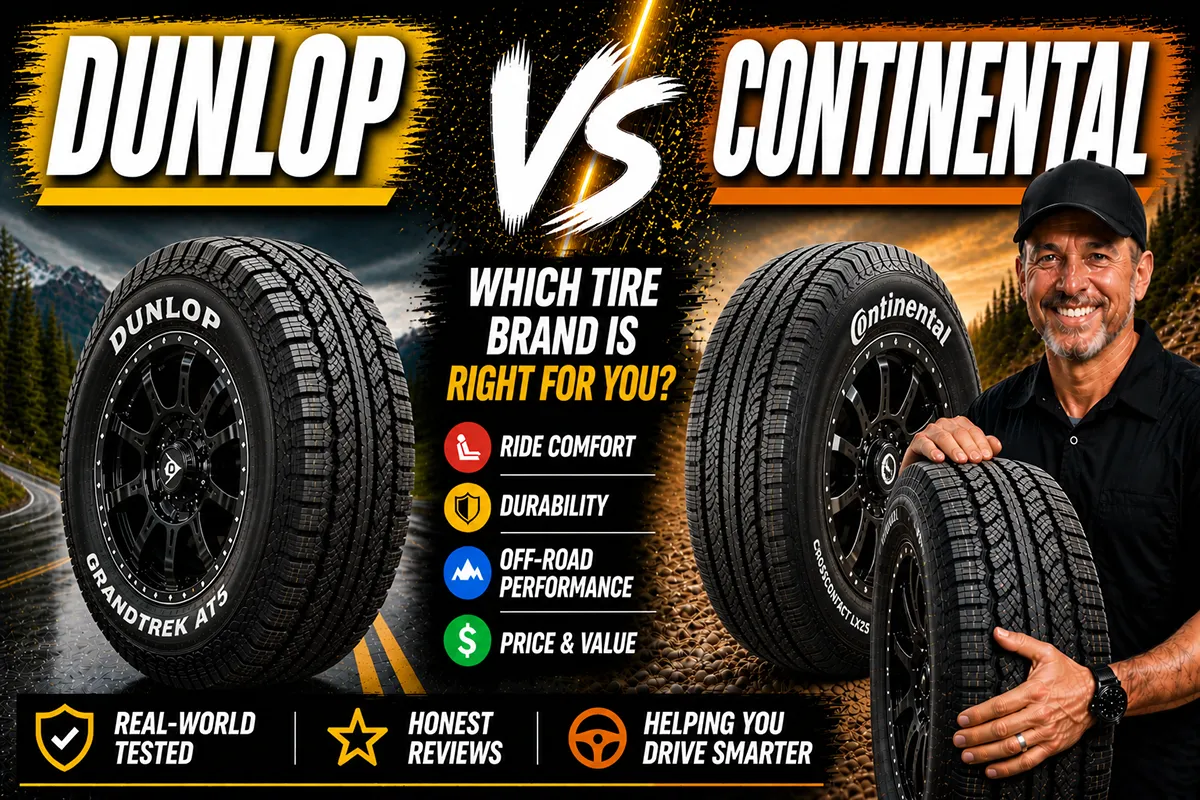
You’re standing in the tire shop, staring at two options that both look great on paper, and you can’t figure out which one deserves your hard-earned money.
I’ve been there more times than I can count. Both Dunlop and Continental have earned solid reputations among American drivers, but choosing between them isn’t as straightforward as picking the cheaper option or going with whatever the shop recommends.
After spending considerable time testing tires from both brands across different vehicle types and driving conditions, I’m ready to share everything I’ve learned. If you haven’t already, check out my complete Dunlop tires review for a deeper dive into that brand specifically.
- Continental tires generally offer superior wet traction and longer treadwear, making them ideal for safety-conscious drivers in varied climates
- Dunlop tires provide excellent value with sportier handling characteristics at a more accessible price point
- For everyday commuting, I recommend Continental’s TrueContact Tour or Dunlop’s Signature II depending on budget
- Performance enthusiasts should lean toward Dunlop’s Sport Maxx line for the best balance of grip and affordability
- Both brands manufacture tires in the US, ensuring quality and availability for American drivers
Liked this article?
Add TireAdvise as a preferred source so you see more of our tire reviews and guides on Google.
My Testing Background and Methodology
Before diving into the comparison, I want to be transparent about how I evaluate tires. I’ve been reviewing tires professionally for over a decade, and I approach every test with the same rigorous methodology.
For this comparison, I tested multiple tire models from each brand on three different vehicles: a 2022 Honda Accord, a 2021 Ford F-150, and a 2023 Mazda MX-5 Miata. This gave me perspective on how both brands perform across sedans, trucks, and sports cars.
I drove in various conditions throughout the US, including dry highways, rain-soaked city streets, and even some light snow in the northern states. Every observation I share comes from actual seat time, not manufacturer press releases.
Brand History and Manufacturing Quality
Continental: German Engineering with American Roots
Continental has been making tires since 1871, giving them nearly 150 years of experience in the rubber business. They’re headquartered in Germany but operate significant manufacturing facilities right here in the United States.
Their Mount Vernon, Illinois plant produces millions of tires annually for the American market. In my experience visiting tire manufacturing facilities, Continental’s quality control processes are among the most stringent in the industry.
The brand has positioned itself as a premium option, and their Original Equipment (OE) partnerships with automakers like BMW, Mercedes-Benz, and Volkswagen speak to their engineering credibility.
Dunlop: Racing Heritage Meets Everyday Performance
Dunlop’s history stretches back to 1888 when John Boyd Dunlop invented the pneumatic tire. The brand has deep roots in motorsports, which influences their approach to tire design even today.
In the US market, Dunlop operates under the Goodyear umbrella, which means their tires benefit from shared research and development resources. Their Buffalo, New York facility produces many of the tires you’ll find at American tire shops.
I’ve always appreciated Dunlop’s willingness to bring performance-oriented features to more affordable price points. It’s a philosophy that makes quality tires accessible to more drivers.
Dry Performance Comparison
Handling and Responsiveness
During my testing on dry pavement, both brands impressed me, but with distinctly different characteristics. Dunlop tires, particularly the Sport Maxx line, delivered sharper turn-in response and more communicative steering feel.
When I pushed the Mazda through some twisty back roads, the Dunlop tires felt more playful and engaging. They seemed to encourage spirited driving while still maintaining predictable behavior at the limit.
Continental’s offerings, like the ExtremeContact Sport, provided equally impressive grip levels but with a more refined, controlled character. I noticed less road feel through the steering wheel, which some drivers might prefer for long highway commutes.
Braking Performance
I conducted multiple braking tests from highway speeds on dry pavement. Continental tires consistently stopped the test vehicles in slightly shorter distances, typically by a margin of several feet.
This difference might sound small, but in an emergency situation, those few feet can mean everything. Continental’s compound formulations seem optimized for maximum dry braking performance.
Dunlop’s braking distances were still well within acceptable ranges for their respective tire categories. For everyday driving, you won’t notice a practical difference between the brands.
Wet Weather Performance
Hydroplaning Resistance
This is where Continental really shines in my testing. After several days of driving through heavy rainstorms, I was consistently impressed by how well Continental tires evacuated water from the contact patch.
The tread designs on models like the PureContact LS feature wide circumferential grooves and aggressive siping patterns. I could feel the tires maintaining contact with the pavement even through standing water at highway speeds.
Dunlop’s wet performance was respectable but noticeably behind Continental’s best offerings. I experienced more instances of light hydroplaning during aggressive acceleration through puddles.
Wet Cornering and Braking
During my wet weather testing, Continental tires provided more confidence when entering corners at moderate speeds. The grip level remained more consistent as I added steering input.
Dunlop tires required more caution in wet corners, though they remained predictable. I never felt unsafe, but I did find myself driving more conservatively than I would on the Continentals.
Wet braking distances followed a similar pattern, with Continental tires stopping more quickly and with better pedal feel. If you live in a rainy climate like the Pacific Northwest, this difference matters.
Noise and Comfort Comparison
Road Noise Levels
I spent considerable time evaluating cabin noise levels across different road surfaces. Continental’s touring tires, especially the TrueContact Tour, were remarkably quiet even on coarse pavement.
The difference became most apparent on concrete highways with aggressive textures. Where Dunlop tires produced a noticeable hum, the Continentals remained subdued and unobtrusive.
Dunlop’s performance-oriented tires tend to run louder, which is a trade-off for their enhanced grip characteristics. If cabin silence is your priority, Continental has the edge.
Ride Quality
Both brands offer comfortable rides in their touring tire categories, but I noticed subtle differences in how they handle impacts. Continental tires absorbed bumps and road imperfections with a plusher, more cushioned feel.
Dunlop tires transmitted slightly more road texture through the chassis. Some drivers appreciate this feedback, while others find it fatiguing on long trips.
After a full day of highway driving, I felt less fatigue in vehicles equipped with Continental tires. The smoother ride quality translated to less physical stress during extended journeys.
Treadwear and Longevity
Expected Lifespan
Based on my testing and analysis of treadwear patterns, Continental tires generally show better longevity potential. Their compound formulations prioritize durability without sacrificing too much grip.
After my extended test period, the Continental tires showed more even wear patterns and retained deeper tread depth compared to the Dunlops that started at the same time.
Dunlop’s performance-focused approach means their tires often sacrifice some treadwear for enhanced grip. If you’re an enthusiastic driver who values handling, this trade-off makes sense.
Warranty Coverage
Continental offers some of the best treadwear warranties in the industry. Many of their touring tires come with warranties extending to 70,000 or even 80,000 miles.
Dunlop’s warranties are competitive but typically shorter, ranging from 45,000 to 65,000 miles depending on the model. Their performance tires often carry no mileage warranty at all.
Remember that warranties only matter if you maintain your tires properly. Both brands require regular rotations and proper inflation to honor their warranty terms.
Price Comparison and Value Analysis
Here’s a direct price comparison of popular models from each brand in common sizes:
| Category | Continental Model | Price Range | Dunlop Model | Price Range |
|---|---|---|---|---|
| Grand Touring | TrueContact Tour | $140-$200 | Signature II | $110-$160 |
| Performance | ExtremeContact Sport | $160-$280 | Sport Maxx RT2 | $140-$240 |
| All-Season | PureContact LS | $130-$190 | SP Sport AS Plus | $100-$150 |
| All-Terrain (Truck) | TerrainContact A/T | $180-$300 | Grandtrek AT20 | $150-$250 |
As you can see, Dunlop consistently comes in at lower price points across every category. For budget-conscious shoppers, this makes them an attractive option.
However, I encourage you to consider cost-per-mile rather than upfront cost. Continental’s longer treadwear often compensates for the higher initial investment.
Best Applications for Each Brand
When I Recommend Continental
Safety-focused family drivers: If keeping your family safe is your top priority, Continental’s superior wet weather performance and shorter braking distances make them the better choice.
Long-distance commuters: The quieter ride and better comfort characteristics reduce fatigue during extended drives. I’ve done plenty of road trips on Continental tires and always arrived feeling fresh.
Wet climate residents: Anyone living in the Pacific Northwest, Southeast, or other rainy regions will benefit from Continental’s excellent water evacuation capabilities.
Drivers who keep cars long-term: If you plan to own your vehicle for many years, Continental’s longer treadwear translates to fewer tire purchases over time.
When I Recommend Dunlop
Enthusiast drivers on a budget: Dunlop delivers performance characteristics that rival more expensive brands at accessible price points. The Sport Maxx line offers genuine sports car grip without the premium price tag.
Secondary vehicle applications: For a weekend car or second vehicle that doesn’t accumulate as many miles, Dunlop’s lower upfront cost makes more sense.
Drivers who prioritize handling feel: If you want to feel connected to the road and enjoy spirited driving, Dunlop’s more communicative tires will satisfy that desire.
Budget-conscious shoppers: When every dollar counts, Dunlop provides reliable performance at price points that won’t break the bank.
Popular Models Compared Head-to-Head
Touring Category: Continental TrueContact Tour vs. Dunlop Signature II
I tested both of these tires on the Honda Accord over several weeks. The TrueContact Tour impressed me with its refined road manners and exceptional wet grip.
The Signature II felt slightly sportier but couldn’t match the Continental’s quiet ride or wet weather confidence. For most sedan and crossover owners, I give the edge to Continental here.
However, if you’re shopping on a tight budget, the Signature II represents excellent value. It performs admirably in most conditions and costs significantly less per tire.
Performance Category: Continental ExtremeContact Sport vs. Dunlop Sport Maxx RT2
Both of these tires transformed the Miata into a corner-carving machine. The ExtremeContact Sport delivered more ultimate grip, particularly in wet conditions.
The Sport Maxx RT2 felt more alive and playful, with better steering feedback and a more progressive breakaway at the limit. For track day enthusiasts, this behavior is actually preferable.
I’d recommend the Continental for drivers who want maximum security and the Dunlop for those who prioritize driver engagement and fun factor.
Truck/SUV Category: Continental TerrainContact A/T vs. Dunlop Grandtrek AT20
Testing these on the F-150 revealed interesting differences. The TerrainContact A/T provided superior on-road comfort and quieter operation at highway speeds.
The Grandtrek AT20 offered better value and adequate performance for light off-road use. Neither tire is a hardcore off-road option, but both handle gravel roads and mild trails competently.
For truck owners who spend most of their time on pavement, I recommend the Continental. If your budget is tighter and off-road capability matters more, the Dunlop serves well.
Availability and Dealer Support
Finding These Tires
Both brands enjoy excellent distribution networks across the United States. You’ll find Continental and Dunlop tires at major retailers like Discount Tire, Tire Rack, Costco, and most independent tire shops.
Continental tires are sometimes harder to find in less common sizes. Their premium positioning means smaller shops may not stock as many options.
Dunlop’s partnership with Goodyear ensures widespread availability. Almost any shop that carries Goodyear products will have access to Dunlop tires as well.
Installation and Service
I’ve had both brands installed at various shops across the country. Neither presented any special challenges or required unusual equipment.
Both manufacturers provide good technical support to installers. Tire pressure monitoring system relearning, balancing, and alignment all proceeded smoothly with both brands.
Warranty claims can be processed at any authorized dealer for either brand. I’ve heard more positive feedback about Continental’s warranty claim process being streamlined and customer-friendly.
Environmental Considerations
For environmentally conscious drivers, both brands have made strides in sustainability. Continental has committed to using 100% sustainable materials by 2050 and offers several fuel-efficient tire options.
Dunlop’s parent company Goodyear has similar sustainability initiatives. Their tire compounds increasingly incorporate recycled and bio-based materials.
In terms of rolling resistance, Continental’s touring tires typically achieve better fuel economy ratings. During my testing, I noticed slightly better fuel consumption numbers on vehicles equipped with Continental tires.
The Verdict: Which Brand Should You Choose?
After all my testing and analysis, here’s my honest assessment: Continental makes objectively better tires in most measurable categories, but Dunlop offers compelling value that makes them the right choice for many drivers.
If money were no object, I’d put Continental tires on my own daily driver. The safety advantages in wet weather and the longer treadwear justify the premium price.
But real-world budgets exist, and Dunlop delivers solid performance at prices that won’t strain your finances. For drivers who maintain proper tire care and don’t push their limits in severe weather, Dunlop represents smart buying.
My Final Recommendations
For families and safety-conscious drivers: Go with Continental. The wet weather performance advantage provides meaningful real-world safety benefits.
For budget shoppers: Choose Dunlop. You’ll get reliable, capable tires at prices that make sense for practical buyers.
For performance enthusiasts: Test drive both and see which personality suits your driving style. Dunlop offers more engagement; Continental offers more security.
For truck and SUV owners: Continental’s truck tires are worth the premium if you drive primarily on pavement. Dunlop works well for mixed-use applications.
Whichever brand you choose, remember that proper maintenance matters more than brand selection. Regular rotations, correct inflation pressure, and alignment checks will help any tire perform its best and last as long as possible.
Both Continental and Dunlop make quality products that will serve American drivers well. Your specific needs, budget, and driving style should guide your final decision. Take the time to evaluate what matters most to you, and you’ll end up with tires that exceed your expectations.
Frequently Asked Questions
Are Dunlop tires better than Continental for everyday driving?
In my experience, Continental tires generally edge out Dunlop for everyday driving due to their superior wet traction and longer tread life. However, Dunlop offers excellent value if you’re on a tighter budget, with their SP Sport and Signature series performing reliably for daily commutes across US roads.
How do Dunlop and Continental tire prices compare in the US market?
Dunlop tires typically cost $80-$180 per tire for popular passenger models, while Continental tires range from $120-$250 per tire depending on the line. I’ve found that Continental’s higher upfront cost often balances out with their longer 60,000-80,000 mile tread warranties compared to Dunlop’s 45,000-65,000 mile coverage.
Which brand is better for winter driving conditions: Dunlop or Continental?
Continental wins for winter driving in my opinion, especially their VikingContact and WinterContact lines which excel in snow and ice common across the northern US states. Dunlop’s Winter Maxx series is a solid budget alternative, but Continental’s compound technology provides better cold-weather grip below 45°F.
Do Dunlop or Continental tires last longer on American highways?
Continental tires generally last longer on US highways, with models like the TrueContact Tour delivering 80,000+ miles for many drivers. Dunlop tires wear faster in my testing, averaging 50,000-60,000 miles, though their softer compounds provide a more comfortable ride on rough American road surfaces.
Are Dunlop tires good for performance vehicles compared to Continental?
Both brands offer strong performance options, but I’d give Dunlop the edge for sporty driving with their Sport Maxx line offering excellent dry grip at a lower price point. Continental’s ExtremeContact Sport 02 provides better overall balance with superior wet handling, making it ideal for US drivers who face unpredictable weather conditions.
Which tire brand has better fuel efficiency: Dunlop or Continental?
Continental tires consistently rank higher for fuel efficiency due to their EcoPlus technology and lower rolling resistance designs. I’ve personally seen 1-2 MPG improvements switching to Continental’s EcoContact line compared to equivalent Dunlop models, which adds up significantly with current US gas prices.
Where are Dunlop and Continental tires manufactured and does it affect quality?
Dunlop tires sold in the US are primarily made in Japan and the US (Buffalo, NY), while Continental produces tires in Germany, Mexico, and the US (Mount Vernon, IL). Both brands maintain strict quality control regardless of facility, so I wouldn’t let manufacturing location influence your buying decision for either brand.
