

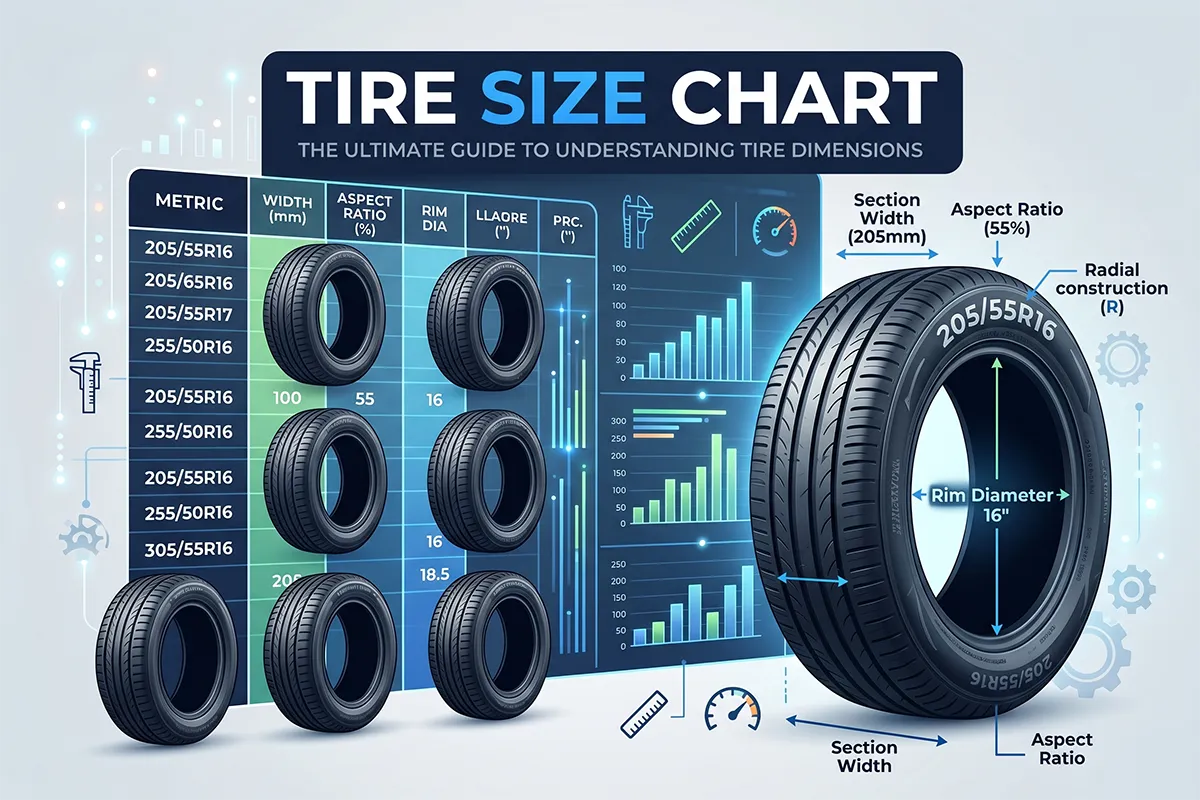
Most drivers stare at that sidewall code and feel like they’re reading a foreign language. After reviewing hundreds of tire sets across every size category, I’m going to make this completely painless.
TL;DR:
A tire size like 235/65R17 breaks down as: 235mm wide, 65% aspect ratio sidewall height, radial construction, fits a 17-inch rim. This guide gives you complete reference tables for every common size, a metric-to-inches conversion chart, a visual breakdown of the sidewall code, and recommendations for specific rim diameters — so you can confidently buy the right tire the first time.
<!– IMAGE PLACEHOLDER Position: Hero image, directly below TL;DR Prompt: “A clean, studio-style close-up photograph of a car tire sidewall showing the size markings ‘235/65R17 104H’ embossed in white lettering on black rubber, shallow depth of field, automotive photography, bright professional lighting, no background clutter” Alt Text: “Close-up of tire sidewall showing tire size markings 235/65R17 104H” Recommended Size: 1200×630px (OG image friendly) –>
Liked this article?
Add TireAdvise as a preferred source so you see more of our tire reviews and guides on Google.
Why Getting Your Tire Size Right Is Non-Negotiable
I’ve seen what happens when someone installs the wrong tire size. Best case: your speedometer reads incorrectly. Worst case: your tires rub against wheel wells at speed, or your load capacity falls short of what your vehicle actually needs.
After years of testing everything from performance summer tires to aggressive all-terrain setups, the one thing I stress above everything else is this — start with the right size.
Your tire size isn’t just a random code. It’s a precise specification that determines how your vehicle handles, how accurate your speedometer is, and how much load your tires can safely carry.
This guide is your one-stop reference, whether you’re replacing stock tires, considering a size upgrade, or just trying to decode what the sidewall on your current tire actually means.
Let’s dig in.
How to Read a Tire Size: The Sidewall Code Explained
Every passenger car and light truck tire sold in the United States uses a standardized sidewall code. Here’s exactly how to read it.
<!– IMAGE PLACEHOLDER Position: After “How to Read a Tire Size” heading Prompt: “A clean infographic-style diagram on a white background showing a tire sidewall with labeled arrows pointing to each part of the size code ‘235/65R17 104H’. Labels should include: Section Width (235mm), Aspect Ratio (65%), Construction Type (R = Radial), Rim Diameter (17 inches), Load Index (104), Speed Rating (H). Use a flat design style with dark blue and orange color scheme, automotive reference chart aesthetic” Alt Text: “Diagram showing how to read a tire size code on the sidewall, with each number explained” Recommended Size: 900×500px –>
Breaking Down “235/65R17 104H”
| Code Component | Example | What It Means |
|---|---|---|
| Service Type | P (optional) | P = Passenger, LT = Light Truck, ST = Special Trailer |
| Section Width | 235 | Width of tire in millimeters from sidewall to sidewall |
| Aspect Ratio | 65 | Sidewall height as a % of section width (65% of 235mm = 152.75mm) |
| Construction | R | R = Radial (virtually all modern tires); B = Bias-ply |
| Rim Diameter | 17 | Wheel diameter in inches |
| Load Index | 104 | Maximum load capacity per tire (104 = 1,984 lbs) |
| Speed Rating | H | Maximum sustained speed (H = 130 mph) |
The “P” vs “LT” vs No-Letter Distinction
This trips people up constantly. Here’s what I’ve learned from running these categories back to back:
- P-metric (e.g., P235/65R17): Standard passenger tires. The “P” is sometimes omitted entirely and the tire is functionally identical.
- LT-metric (e.g., LT265/70R17): Light truck tires with higher load and inflation requirements. If your truck or SUV calls for LT sizing, don’t swap it for P-metric — you’ll be under-loaded.
- Euro-metric (e.g., 235/65R17 with no letter): Manufactured to European standards. Load ratings are slightly different from P-metric, so double-check load indexes if cross-shopping.
Complete Tire Size Chart by Rim Diameter
These are the most common tire sizes you’ll encounter in the US market, organized by rim (wheel) diameter. Use this as your go-to reference chart.
14-Inch Rim Tires
Smaller sedans, economy hatchbacks, and some older vehicles use 14-inch wheels. If you’re shopping in this range, check out my dedicated 14 inch tires guide for tested recommendations.
| Tire Size | Width (mm) | Sidewall Height (mm) | Overall Diameter (in) |
|---|---|---|---|
| 175/65R14 | 175 | 113.8 | 22.0 |
| 185/65R14 | 185 | 120.3 | 22.5 |
| 185/70R14 | 185 | 129.5 | 23.0 |
| 195/60R14 | 195 | 117.0 | 22.7 |
| 195/65R14 | 195 | 126.8 | 23.0 |
| 205/70R14 | 205 | 143.5 | 24.1 |
15-Inch Rim Tires
A very common size for older trucks, compact SUVs, minivans, and base-model mid-size sedans. I’ve run thousands of miles on 15-inch setups — they offer excellent tire value since this size bracket is highly competitive. My full 15 inch tires breakdown covers the best options I’ve tested in this category.
| Tire Size | Width (mm) | Sidewall Height (mm) | Overall Diameter (in) |
|---|---|---|---|
| 185/65R15 | 185 | 120.3 | 23.0 |
| 195/65R15 | 195 | 126.8 | 23.5 |
| 205/65R15 | 205 | 133.3 | 24.0 |
| 205/70R15 | 205 | 143.5 | 24.7 |
| 215/65R15 | 215 | 139.8 | 24.5 |
| 215/70R15 | 215 | 150.5 | 25.3 |
| 225/60R15 | 225 | 135.0 | 23.9 |
| 225/70R15 | 225 | 157.5 | 26.0 |
| 235/75R15 | 235 | 176.3 | 27.7 |
16-Inch Rim Tires
This is the sweet spot for trucks, SUVs, and crossovers. Sixteen-inch is where you start seeing meaningful off-road tire options, and it’s the smallest rim diameter that commonly crosses over into the “high-flotation” sizing system (more on that below).
| Tire Size | Width (mm) | Sidewall Height (mm) | Overall Diameter (in) |
|---|---|---|---|
| 205/55R16 | 205 | 112.8 | 24.8 |
| 215/65R16 | 215 | 139.8 | 25.5 |
| 225/60R16 | 225 | 135.0 | 24.9 |
| 225/65R16 | 225 | 146.3 | 25.6 |
| 235/60R16 | 235 | 141.0 | 25.1 |
| 235/70R16 | 235 | 164.5 | 26.9 |
| 245/70R16 | 245 | 171.5 | 27.4 |
| 265/70R16 | 265 | 185.5 | 28.2 |
| 285/75R16 | 285 | 213.8 | 30.7 |
17-Inch Rim Tires
The most popular rim diameter in the US right now. Nearly every full-size pickup truck, mid-size SUV, and crossover sold in America comes on a 17-inch wheel. I spend more time testing tires in this range than any other. If this is your size, my detailed 17 inch tires guide will save you a lot of research time.
| Tire Size | Width (mm) | Sidewall Height (mm) | Overall Diameter (in) |
|---|---|---|---|
| 215/55R17 | 215 | 118.3 | 26.3 |
| 225/55R17 | 225 | 123.8 | 26.7 |
| 225/65R17 | 225 | 146.3 | 27.5 |
| 235/55R17 | 235 | 129.3 | 26.9 |
| 235/60R17 | 235 | 141.0 | 27.1 |
| 235/65R17 | 235 | 152.8 | 28.0 |
| 245/65R17 | 245 | 159.3 | 28.6 |
| 265/65R17 | 265 | 172.3 | 29.4 |
| 265/70R17 | 265 | 185.5 | 30.6 |
| 275/55R17 | 275 | 151.3 | 28.3 |
| 285/70R17 | 285 | 199.5 | 31.6 |
18-Inch Rim Tires
Common on newer truck trims, performance vehicles, and premium crossovers. Larger rim diameter means less sidewall, which generally means crisper handling but a stiffer ride.
| Tire Size | Width (mm) | Sidewall Height (mm) | Overall Diameter (in) |
|---|---|---|---|
| 225/45R18 | 225 | 101.3 | 25.8 |
| 235/50R18 | 235 | 117.5 | 26.3 |
| 245/60R18 | 245 | 147.0 | 28.6 |
| 255/55R18 | 255 | 140.3 | 28.0 |
| 265/60R18 | 265 | 159.0 | 29.5 |
| 275/65R18 | 275 | 178.8 | 31.8 |
| 285/60R18 | 285 | 171.0 | 30.5 |
20-Inch Rim Tires
Twenty-inch wheels have become standard on many half-ton and three-quarter-ton trucks as well as luxury SUVs. The styling appeal is obvious, but the tire selection is massive in this diameter. I’ve put serious miles on a wide variety of 20-inch setups — see my 20 inch tires guide for what I’d actually put on my own truck.
| Tire Size | Width (mm) | Sidewall Height (mm) | Overall Diameter (in) |
|---|---|---|---|
| 245/50R20 | 245 | 122.5 | 28.6 |
| 255/50R20 | 255 | 127.5 | 28.9 |
| 265/50R20 | 265 | 132.5 | 29.4 |
| 275/55R20 | 275 | 151.3 | 31.0 |
| 285/50R20 | 285 | 142.5 | 30.0 |
| 295/60R20 | 295 | 177.0 | 33.9 |
| 305/55R20 | 305 | 167.8 | 32.4 |
22-Inch Rim Tires
Once reserved for custom builds, 22-inch wheels now come stock on several truck and SUV packages. The tire selection has grown significantly. That said, sidewall height is limited, which makes pothole damage more common — something I note from real-world use. If you’re running or considering these, my 22 inch tires guide covers the trade-offs honestly.
| Tire Size | Width (mm) | Sidewall Height (mm) | Overall Diameter (in) |
|---|---|---|---|
| 265/40R22 | 265 | 106.0 | 29.4 |
| 275/45R22 | 275 | 123.8 | 30.8 |
| 285/45R22 | 285 | 128.3 | 31.1 |
| 295/40R22 | 295 | 118.0 | 30.3 |
| 305/40R22 | 305 | 122.0 | 30.8 |
| 305/45R22 | 305 | 137.3 | 32.2 |
Metric to Inches Tire Size Conversion Chart
If you’ve ever shopped for off-road or mud tires, you’ve seen sizing written in high-flotation format — something like 33×12.50R17 instead of a metric code. These are the same tire, just described differently. Here’s how to convert between the two systems.
The Conversion Formula
To convert metric to inches:
- Overall Diameter (inches) = (Aspect Ratio × Section Width × 2 / 25400) + Rim Diameter
- Section Width (inches) = Section Width (mm) / 25.4
Metric-to-Inches Conversion Reference Table
This table covers the most commonly searched conversions, particularly for trucks and SUV owners sizing up:
| Metric Size | Approx. Inches Equivalent | Overall Diameter | Section Width |
|---|---|---|---|
| 235/75R15 | 29×9.3R15 | 28.9 in | 9.3 in |
| 265/70R16 | 30×10.4R16 | 30.6 in | 10.4 in |
| 285/75R16 | 33×11.2R16 | 32.8 in | 11.2 in |
| 295/70R17 | 34×11.6R17 | 33.3 in | 11.6 in |
| 305/70R16 | 33×12.0R16 | 32.8 in | 12.0 in |
| 315/70R17 | 35×12.4R17 | 34.4 in | 12.4 in |
| 325/60R20 | 34×12.8R20 | 33.9 in | 12.8 in |
| 37×12.50R17 (H-F) | 315/70R17 approx. | 37.0 in | 12.5 in |
| 35×12.50R17 (H-F) | 315/60R17 approx. | 35.0 in | 12.5 in |
| 33×12.50R15 (H-F) | 325/60R15 approx. | 33.0 in | 12.5 in |
| 33×12.50R17 (H-F) | 315/60R17 approx. | 33.0 in | 12.5 in |
H-F = High-Flotation format — common for off-road, mud, and all-terrain tires
33-Inch and 35-Inch Tires: The Most Popular Truck Upgrades
Two sizes deserve special attention because they’re the go-to upgrades for truck owners who want more capability without a massive lift kit.
33-Inch Tires
A 33-inch tire fits most trucks and body-on-frame SUVs with a 2-inch leveling kit or moderate lift. In metric sizing, common 33-inch equivalents include 285/75R16 and 275/70R18. I’ve tested these across gravel, mud, and highway extensively — my 33 inch tires guide covers the top performers I’d actually spend my own money on.
Common 33-inch metric equivalents:
| High-Flotation | Metric Equivalent | Rim Size |
|---|---|---|
| 33×10.50R15 | 265/75R15 | 15″ |
| 33×12.50R15 | 325/60R15 | 15″ |
| 33×12.50R17 | 315/60R17 | 17″ |
| 33×12.50R18 | 305/65R18 | 18″ |
| 33×12.50R20 | 285/60R20 | 20″ |
35-Inch Tires
The 35-inch tire is the sweet spot for serious off-roaders — big enough for meaningful ground clearance, but still streetable without major drivetrain modifications on most trucks.
I’ve run 35s on multiple platforms and the difference in capability over a 33 is genuinely significant on technical terrain. See exactly what I recommend in my 35 inch tires guide.
Common 35-inch metric equivalents:
| High-Flotation | Metric Equivalent | Rim Size |
|---|---|---|
| 35×12.50R15 | 35″ high-flotation | 15″ |
| 35×12.50R17 | 315/70R17 | 17″ |
| 35×12.50R18 | 325/65R18 | 18″ |
| 35×12.50R20 | 325/60R20 | 20″ |
| 35×13.50R17 | 355/65R17 | 17″ |
Lift requirement note: Most trucks need at least a 3.5″ to 4″ lift to clear a true 35-inch tire without rubbing. Always verify fitment for your specific vehicle before purchasing.
Understanding the 305 Tire Size
The 305mm section width is a popular choice for performance trucks and wide-body builds. At just under 12.1 inches wide, a 305 tire provides a planted, aggressive stance.
The aspect ratio dramatically changes the overall diameter and intended application — a 305/70R16 is a tall, off-road-oriented tire, while a 305/35R20 is a low-profile performance fitment. I break down every major 305 application in my dedicated 305 tire size guide.
305 width across aspect ratios:
| Tire Size | Overall Diameter | Best Application |
|---|---|---|
| 305/35R20 | 28.4 in | Performance/Sport |
| 305/40R22 | 30.8 in | Luxury Truck/SUV |
| 305/45R20 | 30.4 in | Street Truck |
| 305/55R20 | 32.4 in | Street/Light Off-Road |
| 305/60R18 | 31.4 in | Crossover/SUV |
| 305/65R17 | 32.6 in | Off-Road Truck |
| 305/70R16 | 32.8 in | Off-Road/AT |
| 305/70R17 | 34.8 in | Serious Off-Road |
Load Index Chart
Your load index tells you the maximum weight each individual tire can support. Running a lower load index than your vehicle requires is a genuine safety issue — not just a warranty concern. Here are the most common load index values you’ll encounter on passenger and light truck tires:
| Load Index | Max Load (lbs) | Load Index | Max Load (lbs) |
|---|---|---|---|
| 82 | 1,047 | 104 | 1,984 |
| 85 | 1,135 | 107 | 2,149 |
| 88 | 1,235 | 110 | 2,337 |
| 91 | 1,356 | 112 | 2,469 |
| 94 | 1,477 | 114 | 2,601 |
| 96 | 1,565 | 116 | 2,756 |
| 98 | 1,653 | 119 | 3,086 |
| 100 | 1,764 | 121 | 3,197 |
| 102 | 1,874 | 123 | 3,417 |
Important: When a tire lists dual load ratings like 104/101, the first number is for single rear (SRW) fitment and the second is for dual rear (DRW) fitment on commercial trucks.
Speed Rating Chart
After testing tires across every speed rating category — from the low-speed S-rated all-terrains I’ve run on trail rigs, all the way up to Y-rated ultra-high-performance summer tires — my honest take is this: match or exceed your OEM speed rating. Going lower than stock, even if you don’t drive at the rated speed, can affect heat buildup, handling dynamics, and in some cases insurance claims.
<!– IMAGE PLACEHOLDER Position: After “Speed Rating Chart” heading, before the table Prompt: “A clean reference infographic on white background showing tire speed ratings from L to Y in a horizontal chart format. Each rating shows the letter code and corresponding max speed in mph. Use a minimal flat design with a dark charcoal and red color scheme, automotive reference style, easy to read at a glance” Alt Text: “Tire speed rating chart showing letter codes L through Y and their maximum speed in mph” Recommended Size: 900×400px –>
| Speed Symbol | Max Speed (mph) | Max Speed (km/h) | Typical Use |
|---|---|---|---|
| L | 75 mph | 120 km/h | Off-road, light truck |
| M | 81 mph | 130 km/h | Temporary spare |
| N | 87 mph | 140 km/h | Spare tires |
| P | 93 mph | 150 km/h | Spare tires |
| Q | 99 mph | 160 km/h | Studdable winter |
| R | 106 mph | 170 km/h | Heavy truck |
| S | 112 mph | 180 km/h | Family sedans, vans |
| T | 118 mph | 190 km/h | Family sedans, minivans |
| U | 124 mph | 200 km/h | Sport sedans |
| H | 130 mph | 210 km/h | Sport sedans, coupes |
| V | 149 mph | 240 km/h | Sport/performance |
| W | 168 mph | 270 km/h | Exotic/ultra performance |
| Y | 186 mph | 300 km/h | Ultra-high performance |
| (Y) | 186+ mph | 300+ km/h | Exotic (verified by manufacturer) |
| Z | 149+ mph | 240+ km/h | High performance (see W/Y for exact) |
Common Tire Sizing Mistakes (And How to Avoid Them)
After talking with and observing countless tire buyers over the years, the same mistakes come up over and over:
1. Ignoring load index when upsizing
You find a great deal on a wider tire. The price is right. But the load index is lower than your OEM spec. I’ve seen this on trucks especially — people upsize to an aggressive AT tire not realizing it’s rated for less load than what the truck requires. Always match or exceed the load index in your owner’s manual.
2. Confusing overall diameter with section width
A 275/70R18 and a 305/55R18 have a similar overall diameter (~33 inches) but very different section widths. They’re not interchangeable. Gear ratios, speedometer calibration, and wheel well clearance are all affected by overall diameter.
3. Mixing P-metric and LT-metric
If your truck or van calls for LT-rated tires, running P-metric tires means you’re running a lower load capacity, period. This is one of the most common mistakes I see on three-quarter-ton and one-ton trucks.
4. Assuming “plus sizing” is always better
Going from a 17-inch to an 18-inch or 20-inch rim can look great, but if you don’t reduce the aspect ratio accordingly, your overall diameter changes — affecting speedometer accuracy and potentially rubbing. Use a tire size calculator to verify your new combo keeps the overall diameter within 3% of OEM.
How to Find Your Correct Tire Size
You don’t need to memorize the sidewall code on your current tires. Here are three reliable ways to confirm your correct size:
- Driver’s door jamb sticker — The most authoritative source. Shows OEM-recommended size and cold inflation pressure.
- Your current tire’s sidewall — Just read the code directly. It’s always molded into the sidewall.
- Owner’s manual — Includes size and sometimes an alternative size for different wheel packages.
- Manufacturer’s website — Most automakers have a configurator where you can look up specs by VIN or year/make/model.
<!– IMAGE PLACEHOLDER Position: After “How to Find Your Correct Tire Size” section Prompt: “A close-up photograph of a car door jamb showing a white sticker label with tire pressure and tire size specifications printed on it. The sticker should show ‘P235/65R17 104H’ and recommended PSI values. Realistic photography, soft automotive lighting, shallow focus on the sticker text” Alt Text: “Car door jamb sticker showing recommended tire size and inflation pressure” Recommended Size: 800×450px –>
Tire Size and Speedometer Accuracy
This is something I always verify when testing an upsized tire. Every change in overall tire diameter affects how fast your speedometer reads versus how fast you’re actually going. Here’s the impact of common changes:
| OEM Size | Replacement Size | Diameter Change | Speedometer Effect |
|---|---|---|---|
| 265/70R17 (30.6″) | 285/70R17 (31.7″) | +1.1″ | Reads ~3.5% slow |
| 265/70R17 (30.6″) | 275/70R17 (31.2″) | +0.6″ | Reads ~2% slow |
| 235/65R17 (28.0″) | 245/65R17 (28.6″) | +0.6″ | Reads ~2% slow |
| 235/65R17 (28.0″) | 255/60R17 (28.0″) | ±0″ | No change |
A speedometer reading slower than actual speed means you’re going faster than you think. In practice, 3-5% difference is generally acceptable and often falls within legal tolerances. Beyond that, I’d recommend a recalibration.
Frequently Asked Questions
What tire size do I need?
Start with the size printed on your driver’s door jamb sticker. That’s your OEM-specified size and the safest starting point. If you want to upsize or change the profile, keep the overall diameter within 3% of stock.
Can I use a different tire size than what’s recommended?
Yes, within limits. Minor section width changes (±10mm) and aspect ratio adjustments that keep overall diameter similar are common and generally fine. Major changes affect handling, speedometer accuracy, load capacity, and clearance.
Is a wider tire always better?
No. Wider tires offer more contact patch on dry pavement, which can improve handling. But they also hydroplane more easily in rain, wear faster in cold climates, and may reduce fuel economy. Match tire width to your actual driving needs.
What’s the difference between 33-inch and 35-inch tires?
Approximately 2 inches of diameter, which translates to about 1 inch more ground clearance. The lift and modification requirements are significantly different though — most trucks need 4″+ of lift for 35s while 33s often fit on 2-3″ lifts.
How do I convert metric tire sizes to inches?
Use this formula: Overall Diameter = ((Aspect Ratio / 100) × Section Width × 2 / 25.4) + Rim Diameter. Or use the conversion table provided above in this article.
Final Thoughts
Tire sizing isn’t complicated once you understand the system. The code on your sidewall gives you everything: width, aspect ratio, construction, rim diameter, load capacity, and speed rating. The tables in this guide give you a complete reference for nearly every size you’ll encounter in the US market.
My biggest piece of advice from years of hands-on testing: don’t just buy the cheapest option in your size. Getting the right size is the floor, not the ceiling. The right size in the wrong tire category (wrong speed rating, wrong load index, wrong tread pattern for your climate) is still a bad choice.
Use this guide to confirm your size, understand your options, and then check my specific rim diameter guides for real-world performance recommendations I’d stand behind:
- 14 inch tires — Best picks for economy and older platforms
- 15 inch tires — Great value, high selection volume
- 17 inch tires — The most popular category I test, with full rankings
- 20 inch tires — Truck and SUV stock sizes with upgrade options
- 22 inch tires — For custom builds and premium truck packages
- 33 inch tires — The go-to first lift upgrade
- 35 inch tires — For serious off-road capability
- 305 tire size — Complete guide to this wide-format size
If you found this reference guide useful, bookmark it — tire shopping is something you’ll do every 3-5 years, and having a reliable chart to come back to makes each purchase decision faster and more confident.

1 Comment