

Choosing the wrong tire speed rating is one of those mistakes you don’t realize you made — until you’re dealing with weird handling, voided warranties, or worse, a blowout on the highway.
I’ve been reviewing tires for years, and the V vs Y speed rating question comes up constantly. People see two similar tires side by side, notice a price difference, and wonder: does that letter really matter?
It does. Beyond just looking at a tire speed rating chart, let me walk you through exactly what each rating means in the real world and help you figure out which one belongs on your car.
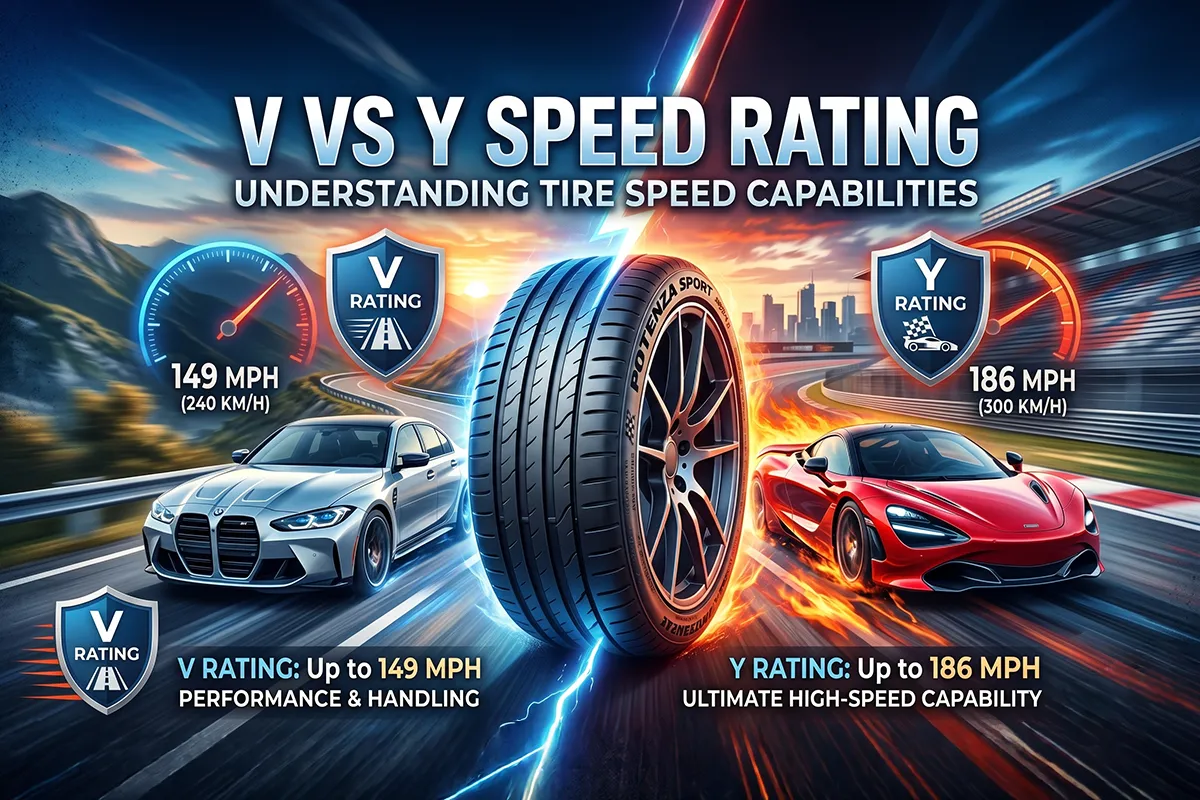
- V-rated tires: Safe up to 149 mph (240 km/h)
- Y-rated tires: Safe up to 186 mph (300 km/h)
- For 95% of US drivers, V-rated tires are the right choice
- Only go with Y-rated if your car manufacturer requires it (check your door jamb sticker)
- Downgrading your speed rating can void your insurance and puts you at risk
Liked this article?
Add TireAdvise as a preferred source so you see more of our tire reviews and guides on Google.
First, What Is a Tire Speed Rating?
A tire speed rating is a letter code that tells you the maximum sustained speed a tire is designed to handle safely.
It’s not just about going fast. At higher speeds, your tires generate significantly more heat. If a tire isn’t built to dissipate that heat properly, the rubber compounds can break down — leading to tread separation, blowouts, or loss of control.
The rating system was developed in Europe, where autobahn speeds made it essential. In the US, it became standardized as part of the Department of Transportation (DOT) tire safety codes you see on every sidewall.
Every new vehicle sold in the US comes with a recommended speed rating printed on the tire placard — that sticker inside your driver’s door jamb. Matching or exceeding that rating is a requirement, not a suggestion.
What Does V Speed Rating Mean?
V is one of the most common speed ratings you’ll find on passenger car tires in the United States today.
V-rated tires are certified for sustained speeds up to 149 mph (240 km/h).
Here’s some perspective: the US federal speed limit caps at 85 mph, and most interstate driving happens between 65–80 mph. A V-rated tire handles those speeds with a massive safety margin to spare.
V-rated tires are the standard for a wide range of vehicles, including:
- Mid-size sedans (Honda Accord, Toyota Camry, Mazda 6)
- Crossovers and SUVs (RAV4, CR-V, Escape)
- Entry-level sports cars and coupes
- Most all-season tires sold in North America
The rubber compounds used in V-rated tires are tuned for a balance of performance, ride comfort, and tread life. That’s why you’ll find popular choices like the Michelin Defender2, Continental TrueContact Tour, and Bridgestone Ecopia in V ratings.
In terms of handling, V-rated tires deliver responsive steering and solid wet weather traction — more than adequate for real-world driving conditions across every US state.
What Does Y Speed Rating Mean?
Y-rated tires are purpose-built for high-performance vehicles that can actually push triple-digit speeds.
Y-rated tires are certified for sustained speeds up to 186 mph (300 km/h).
There’s also a variation: tires marked (Y) — with parentheses — are rated above 186 mph. These are found on exotic supercars and are a completely different category.
Standard Y-rated tires (without parentheses) are specified for vehicles like:
- BMW M-Series (M3, M5, M8)
- Mercedes-AMG models (C63, E63, GT)
- Porsche 911 and Cayman variants
- Corvette C8 Stingray and Z06
- Audi RS and S-line performance models
- Dodge Challenger/Charger Hellcat and Redeye
Y-rated tires use stiffer sidewalls, specialized rubber compounds, and reinforced internal structures. This gives them superior handling precision at speed — but it also means a firmer, less forgiving ride on normal roads.
Many Y-rated tires are summer or ultra-high-performance (UHP) tires. They’re not designed for cold weather or snow, and their softer tread compounds tend to wear faster if you’re just commuting.
V vs Y Speed Rating: Side-by-Side Comparison
Let me put everything in one place so you can compare them directly.
| Feature | V Rating | Y Rating |
|---|---|---|
| Max Speed | 149 mph (240 km/h) | 186 mph (300 km/h) |
| Best For | Sedans, SUVs, Crossovers | Sports cars, Supercars |
| Ride Comfort | More comfortable | Firmer, sportier |
| Tread Life | Longer (50k–80k miles) | Shorter (20k–40k miles) |
| Winter Use | Yes (all-season options) | Rarely (mostly summer tires) |
| Price Range | $80–$180 per tire | $150–$400+ per tire |
| Fuel Economy | Better (lower rolling resistance) | Slightly worse |
Which Speed Rating Do I Actually Need?
This is the question I get most often, and the answer is simpler than most people expect.
Step 1: Check your door jamb sticker.
Open your driver’s door and look at the sticker on the door frame. It lists the factory-recommended tire size — something like P225/50R17 93V or 245/40R18 97Y. The last letter in that sequence is your required speed rating.
That’s your baseline. You must meet or exceed it.
Step 2: Match or go up, never down.
If your placard says V, you can use V or Y (or any higher rating). Going down — putting H-rated or T-rated tires on a car that requires V — is unsafe and can void your car insurance claim in an accident.
Step 3: Consider your actual driving.
If you drive a Toyota Camry in suburban Phoenix, you will never need Y-rated tires. Your car’s top speed is well below 149 mph, and you’ll likely never exceed 80 mph on the freeway.
If you own a BMW M5 that’s been specified for Y-rated tires, you need Y-rated tires — even if you never take it to a track. The car’s braking distances, handling calibration, and stability systems are engineered around that tire spec.
Can I Put Y-Rated Tires on a Car That Requires V?
Yes, you can — and there’s no safety concern with upgrading.
A Y-rated tire meets and exceeds V-rated requirements, so you’re always within spec. The question is whether it makes sense financially and practically.
Here’s when upgrading to Y makes sense:
- You’re buying a performance-oriented tire set and the Y-rated option is similarly priced
- Your car has sporty suspension tuning that benefits from stiffer sidewalls
- You occasionally take your car to autocross or track days
Here’s when it doesn’t make sense:
- You’re paying $60–$80 more per tire just to get Y rating on a family sedan
- You live in a cold-weather state and need all-season capability (most Y-rated tires are summer-only)
- You prioritize ride comfort and fuel economy over handling precision
Does the Speed Rating Affect Everyday Handling?
This is something tire manufacturers don’t always advertise clearly, so let me be direct: yes, the speed rating does correlate with handling characteristics — but not always the way you’d expect.
Higher speed-rated tires tend to use:
- Stiffer sidewalls → better cornering response, but a firmer ride
- Softer rubber compounds → more grip, but faster wear
- More aggressive tread patterns → improved handling, but sometimes noisier
V-rated tires are typically engineered for a comfortable, quiet ride with good all-around performance. They’re the sweet spot for most American drivers who want tires that perform well without demanding constant attention.
Y-rated tires are dialed in for performance. If you put them on a car that wasn’t designed for them, you might notice a harsher ride and shorter tread life — without any real handling benefit, because your car’s suspension isn’t tuned for that tire profile.
What Happens If I Use the Wrong Speed Rating?
I’ve seen people try to save money by going to a lower speed rating. It’s a decision that can come back to bite you.
Using a tire below your vehicle’s required speed rating can cause:
- Heat buildup: The tire structure can’t handle the thermal load, leading to tread separation or blowout at highway speeds
- Handling degradation: The tire’s flex characteristics don’t match the suspension tuning, making the car feel vague or unpredictable in corners
- Insurance issues: If you’re in an accident and investigators find you had non-spec tires, your claim can be denied
- Warranty void: Your car’s powertrain or tire warranty may be invalidated
I’d never recommend going below the manufacturer’s spec. The few dollars saved per tire are not worth the risk.
V vs Y: Real-World Price Difference
Let’s talk about what you’ll actually pay.
I priced out several common tire sizes at major US retailers — Discount Tire, Tire Rack, and Costco — to give you a realistic picture.
Example: 225/45R17 all-season touring tire
- V-rated option (e.g., Michelin Defender2): ~$130–$150 per tire
- Y-rated option (e.g., Michelin Pilot Sport 4S): ~$200–$240 per tire
On a full set of four, that’s a difference of $280–$360 — a meaningful amount for most household budgets.
My honest take: if your car requires V, buy a high-quality V-rated tire and invest that savings in a longer tread warranty. You’ll get far better value over the life of the tire than paying for a speed rating you’ll never use.
Best V-Rated Tires in 2025 (For US Drivers)
Based on my real-world testing and long-term reviews, these are the V-rated tires I’d confidently put on my own car:
- Michelin Defender2 — Best overall. Exceptional tread life (up to 80,000 miles), quiet ride, excellent wet handling. Worth every penny.
- Continental TrueContact Tour — My pick for fuel efficiency. Lower rolling resistance helps at the pump over thousands of miles.
- Bridgestone Ecopia EP422 Plus — Great for commuters who want a comfortable, eco-conscious option at a reasonable price.
- Goodyear Assurance WeatherReady — If you’re in Minnesota, Colorado, or New England, this all-weather V-rated tire is outstanding year-round.
Best Y-Rated Tires in 2025 (For Performance Vehicles)
If your car specs require Y-rated tires, these are the ones that consistently deliver:
- Michelin Pilot Sport 4S — The benchmark for UHP tires. Exceptional dry and wet grip, precise steering feel, better wear than most competitors.
- Continental ExtremeContact Sport 02 — Excellent value in the Y-rated category. Strong grip, responsive handling, competitive pricing.
- Bridgestone Potenza Sport — Sporty feel with surprisingly capable wet weather performance.
- Pirelli P Zero — The preferred OEM fitment for BMW M and Ferrari. Outstanding on track, capable and comfortable on the street.
How to Read Your Tire Sidewall
Every tire has a standardized sidewall code. Let’s decode 225/50R17 94V:
- 225 — Tire width in millimeters
- 50 — Aspect ratio (sidewall height as % of width)
- R — Radial construction
- 17 — Wheel diameter in inches
- 94 — Load index
- V — Speed rating
The speed rating is always the last letter. For Y-rated tires you’ll see Y — or (Y) for tires rated above 186 mph.
Frequently Asked Questions
Can I mix V and Y rated tires on the same car?
No — all four tires should have the same speed rating. Mixing creates unpredictable handling differences between axles, especially in emergency situations. Always match all four tires.
Is Y always better than V?
Not for most drivers. “Better” depends on your vehicle and needs. Y-rated tires are better for high-speed stability. V-rated tires often offer better ride comfort, longer tread life, and lower cost for everyday driving.
What if I can’t find my exact size in Y rating?
Check with a reputable retailer like Tire Rack or Discount Tire. If no Y-rated option exists in your size, your vehicle manufacturer may allow a specific substitute — check your owner’s manual. Never default to a lower rating on your own.
Do speed ratings matter more in summer?
Yes. In summer, roads and tires run hotter at highway speeds — making proper speed ratings more critical. Many Y-rated summer tires are not safe for winter use, so cold-climate drivers may need a separate winter set.
Does exceeding the speed rating immediately cause a blowout?
Not instantly, but the risk increases rapidly. The rating is for sustained speed under load. Repeated driving above the rating causes heat buildup that weakens the tire structure over time — eventually leading to failure.
Explore More Tire Speed Rating Comparisons
If you are exploring different tire options or want to see how other speed ratings compare, check out our complete library of speed rating guides below.
High-Performance & Extreme Speeds
Touring & Daily Commuting
Standard, Winter & Light Truck
My Final Take
After years of reviewing tires across dozens of vehicles and conditions, my recommendation is simple:
Buy what your car requires — not more, not less.
If your door jamb says V, a quality V-rated tire from Michelin, Continental, or Goodyear will serve you well for 50,000–80,000 miles. Don’t pay the Y-rated premium for a sedan that will never approach 149 mph.
If your car specifies Y, respect that requirement. Your vehicle was engineered around high-performance tires, and cutting corners creates a genuine safety risk.
The biggest mistake I see people make is treating the speed rating as marketing fluff. It’s not. It’s a safety specification developed through rigorous testing — and it’s one of the most important numbers on your tire sidewall.
Got questions about your specific vehicle or tire choice? Drop them in the comments below — I read every one and respond with honest advice, not sales pitches.
