

A client called me last year after buying a used BMW 5-Series. He had a slow leak and three shops had already quoted him a replacement because the tire “can’t be repaired.”
Nobody had actually told him why — and he wasn’t even sure whether his tires were run flats to begin with. Turns out one of his four tires was a conventional replacement someone had swapped in at some point, mixed right in with three original run flats.
Understanding what he was actually looking at changed every decision that followed. If you’re in that same fog of uncertainty, this guide will get you out of it in about five minutes — and if you want the full picture on what run flat tires actually are and how they work, start with my complete run flat tire guide before coming back here.
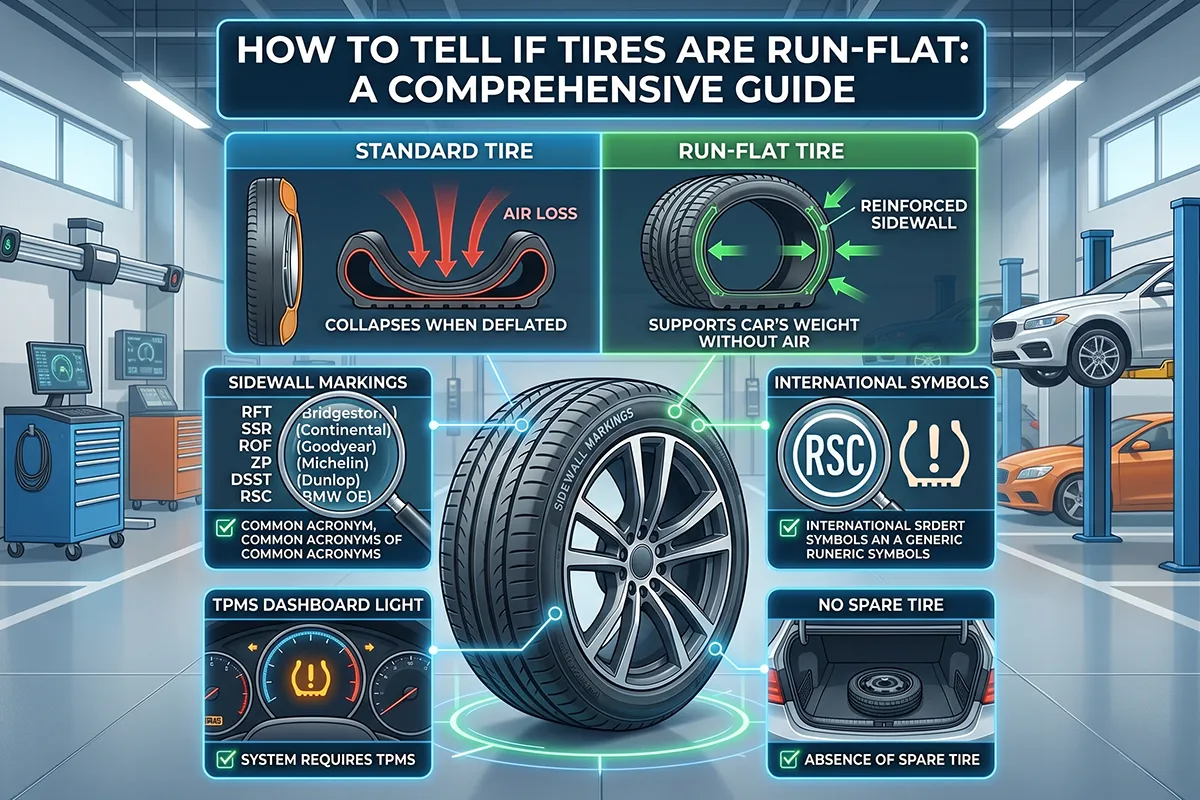
Every run flat tire has a specific sidewall marking that identifies it as such — but each brand uses a different code. Look at your tire’s sidewall near the size markings and find the brand-specific designation: SSR (Continental), ZP (Michelin), RFT or ROF (Bridgestone, Dunlop, Goodyear), r-f (Pirelli), ZPS (Yokohama), or HRS (Hankook). If the markings are worn or unclear, check your owner’s manual, the door jamb sticker, or use your VIN to look up factory specifications. This guide covers every method, with brand-by-brand photos and markings.
Liked this article?
Add TireAdvise as a preferred source so you see more of our tire reviews and guides on Google.
Why Knowing Your Tire Type Actually Matters
Before I walk you through the identification methods, I want to make the case for why this isn’t just tire-nerd trivia. Knowing whether you have run flats or conventional tires has real, practical consequences in at least four common situations.
Situation 1: You have a puncture and need to decide whether to drive on it. If you have run flats and a TPMS warning, you have up to 50 miles at 50 mph to reach a shop safely. If you have conventional tires and you didn’t notice a slow leak, you may have been driving on a compromised tire for days. The response is completely different depending on what you’re working with.
Situation 2: A shop tells you the tire can’t be repaired. Knowing whether you have a run flat — and whether it was ever driven on at zero pressure — determines whether that shop’s “replace it” recommendation is legitimate or premature. My run flat tire repair guide goes deep on exactly when repair is actually possible, but you can’t even start that conversation without knowing what type of tire you have.
Situation 3: You’re buying a used car. This is the scenario I encounter most often. A used BMW, Mini, Cadillac, or Mercedes comes with the original run flat equipment — or it doesn’t, because a previous owner swapped them out for conventional tires. This matters enormously because: run flat-equipped vehicles typically lack a spare tire and the jack/tool kit that goes with it. If the run flats have been replaced with conventional tires and nobody added a spare, you’re in trouble the first time you have a puncture.
Situation 4: You need to buy replacement tires. Ordering the wrong type — conventional when you need run flat, or vice versa — is an expensive mistake that some online tire retailers make surprisingly easy to make. Knowing exactly what you have means you order with confidence.
With that context established, here are every method for identifying run flat tires, starting with the most reliable.
Method 1: Read the Sidewall Markings (Most Reliable)
This is the primary method and the one you should start with. Every run flat tire sold in the United States carries a manufacturer-specific designation on its sidewall. The challenge is that the tire industry never standardized on a single code — every brand has its own marking, and some brands have used multiple different codes over the years.
Here’s the complete reference, brand by brand:
Bridgestone and Firestone
Bridgestone uses two codes depending on the product line:
RFT — Run Flat Technology. Found on Bridgestone’s Potenza RFT, Turanza RFT, and DriveGuard RFT lines. The most common code you’ll see on Bridgestone run flats in the US market.
ROF — Run on Flat. An older designation that appears on some Bridgestone and Firestone run flat tires, particularly those used as OEM fitment on earlier BMW models from the mid-2000s to early 2010s.
Where to find it: Look for the code on the lower sidewall, typically printed in a band of text near the bead area, usually adjacent to the size marking (e.g., 225/45R18 91W RFT). It’s often in a slightly smaller font than the size designation.
Continental
Continental’s run flat designation is one of the clearest and most commonly asked about:
SSR — Self Supporting Runflat. This is Continental’s current standard designation across their run flat lineup, including the ContiSportContact SSR, ContiProContact SSR, and various OEM fitment tires for BMW, Mercedes, and Audi.
How to know if a Continental tire is run flat: Look for the letters “SSR” printed on the sidewall. On most Continental tires, this appears near the size code, often in a box or highlighted section. It’s usually quite prominent — Continental does a better job than most brands of making the designation visible.
Some older Continental run flat tires may be marked FR (Flat Run) instead of SSR. This designation was phased out as SSR became the standard.
Note for BMW owners: Continental is one of the most common OEM run flat suppliers for BMW. If you’re driving a 3-Series, 5-Series, or X-series BMW with Continental tires, SSR is almost certainly what you’re looking for.
Dunlop
Dunlop has used multiple run flat designations over the years:
DSST — Dunlop Self-Supporting Technology. Their primary run flat designation on performance-oriented tires like the SP Sport Maxx DSST.
ROF — Run on Flat. Used on some Dunlop OEM fitment tires, particularly those supplied to BMW as original equipment. If you have an older BMW with Dunlop tires, ROF is likely what you’ll see.
Where to find it: Typically on the lower sidewall in the same text band as the tire’s name and size markings. On Dunlop performance tires, DSST often appears prominently in the tire’s branding area near the top of the sidewall.
Goodyear
RunOnFlat — Goodyear’s current primary run flat designation. Written out in full, sometimes with a small ® symbol. Found on the Eagle F1 RunOnFlat, Eagle LS2 RunOnFlat, and other lines.
ROF — The shortened version of the same designation. Both appear on Goodyear tires depending on the product line and model year.
Where to find it: On the sidewall near the size code and load/speed rating. Goodyear typically places the RunOnFlat or ROF designation in the same line as the size marking.
Michelin
Michelin uses one of the most distinctive and easily recognized run flat designations:
ZP — Zero Pressure. The “ZP” marking appears inside an asterisk-like symbol or adjacent to the size code on Michelin run flat tires. Found on the Michelin Primacy MXM4 ZP, Pilot Sport PS2 ZP, Pilot Sport 4S ZP, and other ZP-series products.
Where to find it: Look for “ZP” in a circle or near the size designation. On many Michelin tires, the ZP is prominent and clearly printed. The size marking might read something like 225/45R18 91W * ZP where the asterisk and ZP appear together.
Important note: Michelin’s ZP designation specifically means the tire has never been driven on and is at zero pressure — it’s a product line name, not a status indicator. A Michelin Pilot Sport with ZP on the sidewall is a run flat tire in its normal state, fully capable of operating after pressure loss.
Pirelli
Pirelli’s run flat designation is smaller and easier to miss than most:
r-f — Run Flat. Printed in lowercase, typically in a small font on the lower sidewall. Pirelli uses this marking on their Cinturato P7 r-f, P Zero r-f, Sottozero Winter 210 r-f, and several OEM fitment tires.
Are P Zero tires run flat? Not automatically. Pirelli’s P Zero family includes both standard and run flat versions. The standard P Zero will not have the “r-f” marking. The run flat version will. Always check the sidewall — the tire name alone doesn’t tell you enough. If you’re shopping for P Zero replacements online, verify that “r-f” or “run flat” appears in the product title or specifications before purchasing.
Where to find it: This is the most easily missed marking of the major brands. It typically appears on the lower sidewall in a condensed text block alongside other tire specifications. Look carefully — “r-f” in small lowercase letters can blend into the surrounding text, especially on a dark sidewall or a tire with significant road grime.
Pro tip for Pirelli identification: Wipe the sidewall with a damp cloth before looking for markings. Road grime and brake dust accumulation on the lower sidewall frequently obscures markings on tires that have been in use for a season or more.
Yokohama
ZPS — Zero Pressure System. Yokohama’s run flat designation, used on the ADVAN Sport V103 ZPS and several other models.
Which Yokohama tires are run flat? The ZPS designation narrows it considerably. In the US market, Yokohama’s run flat lineup is smaller than Bridgestone’s or Continental’s — primarily the ADVAN Sport V103 ZPS, which is used as OEM fitment on some BMW models and available aftermarket. If you have Yokohama tires without a ZPS marking, they are conventional tires.
Hankook
HRS — Hankook Runflat System. Used on the Hankook Ventus S1 evo2 HRS and other Hankook run flat products, which are used as OEM fitment on some BMW and Mini models.
Nokian
i3 — Used specifically on Nokian run flat tires designed for urban and touring applications. Less common in the US market but worth knowing if you’re driving a European import with the original tire fitment intact.
Toyo
Toyo marks their run flat tires with RF on the sidewall. Their run flat lineup is limited in the US market, but the designation appears on applicable models.
Method 2: Check Your Owner’s Manual
If the sidewall markings are worn, obscured, or you simply can’t locate them, your owner’s manual is the definitive secondary source.
The tire specification section of the owner’s manual will indicate whether the factory fitment is run flat or conventional. For vehicles that came from the factory with run flat tires, this section will typically specify the required tire type for replacement and often include the relevant designation codes.
Where in the manual to look:
- “Tires and Wheels” section
- “Vehicle Specifications” section
- “Emergency Information” or “Flat Tire” section (vehicles with run flats often have specific instructions here about operating limits)
For digital owner’s manuals, search the PDF for “run flat,” “ROF,” or “zero pressure” — one of those terms will appear in the tire specifications section if the vehicle was equipped with run flats.
Method 3: The Door Jamb Sticker
Every vehicle sold in the US has a tire placard affixed to the driver’s door jamb (or occasionally on the fuel door or inside the glove box). This sticker specifies the factory-recommended tire size and inflation pressure.
While the door jamb sticker doesn’t always explicitly say “run flat,” the specified tire size combined with a quick online search will tell you whether that size was originally supplied as a run flat fitment for your specific vehicle.
How to use it:
- Note the tire size exactly as printed (e.g., 245/40R19)
- Search “[your vehicle year/make/model] [tire size] OEM run flat”
- Vehicle-specific forums, tire manufacturer OEM fitment databases, and tire retailer fitment guides will confirm whether that size came with run flat equipment on your model
Method 4: Use Your VIN to Look Up Factory Specifications
Every vehicle has a Vehicle Identification Number (VIN) — a 17-character code printed on the driver’s side dashboard (visible through the windshield) and on the door jamb sticker. This number encodes detailed factory specification information, including tire equipment.
Three ways to decode your VIN for tire specs:
Option 1 — Manufacturer websites. BMW, Mercedes, Mini, and most luxury brands that commonly use run flat tires have online VIN decoders or owner portals where you can look up factory specifications by VIN. These are the most authoritative source.
Option 2 — NHTSA VIN decoder. The National Highway Traffic Safety Administration maintains a free VIN decoder at vpic.nhtsa.dot.gov that includes basic specification data.
Option 3 — Tire retailer fitment tools. Major online tire retailers (Tire Rack, Discount Tire, SimpleTire) have fitment tools where you can enter your VIN or year/make/model to see what tires are compatible. These tools typically flag run flat requirements — tires will be listed as “run flat” or “standard” with a filter option for each.
Method 5: Physical Characteristics (Use as a Last Resort)
I want to address this method honestly: physical characteristics alone are not reliable for identifying run flat tires, and I wouldn’t recommend making any important decision based on look-and-feel alone. But as a supplementary check, here’s what experienced eyes look for:
Sidewall stiffness: Run flat tires have noticeably stiffer sidewalls than conventional tires of the same size. If you press firmly with your thumb against the sidewall of a properly inflated run flat tire, it resists in a way that feels almost rigid. A conventional tire’s sidewall will flex more perceptibly under thumb pressure. This is a relative comparison — it’s most useful if you have both tire types available to compare side by side.
Sidewall height and profile: Because run flat sidewalls contain reinforcement material, they sometimes appear slightly more upright and “boxy” in profile compared to conventional tires of the same aspect ratio. This is subtle and not reliable for identification on a single tire.
Weight: Run flat tires are heavier than comparable conventional tires — sometimes significantly so (3–5+ lbs per tire). If you’re holding a dismounted tire, a run flat will feel noticeably heavier. This is only useful if you’re comparing tires off the vehicle.
The bottom line on physical characteristics: use them to confirm what you’ve already established through sidewall markings and documentation — not as your primary identification method.
What to Do If You Can’t Identify Your Tires
If you’ve checked the sidewall thoroughly, reviewed the owner’s manual, and still can’t determine whether your tires are run flat — here’s the practical path forward:
Step 1: Take the vehicle to a reputable tire shop and ask them to assess the tires. An experienced technician can identify run flat tires reliably by the sidewall markings, the physical construction, and the tire model — even if the markings are partially worn.
Step 2: Contact the tire manufacturer directly. If you can read the tire’s name (e.g., “Continental ContiSportContact 5”) and the size, the manufacturer’s customer service line or website can confirm whether that specific product is a run flat.
Step 3: Search your vehicle-specific owner forums. BMW owners, for example, have extremely detailed forum communities where questions like “does a 2019 530i xDrive come with run flat tires” are answered definitively within minutes.
A Note on Mixed Fitments: The Used Car Problem
I mentioned this in the intro, but it deserves its own section because it’s more common than you’d expect and more consequential than it might seem.
On a used vehicle, there is no guarantee that all four tires are the same type. A previous owner may have replaced one or two tires with conventional tires (usually because they were cheaper or more readily available) while leaving the remaining original run flats in place.
This creates a dangerous situation in two ways:
First, as I cover in detail in my run flat vs regular tire guide, mixing run flat and conventional tires on the same vehicle creates handling inconsistencies due to the dramatic difference in sidewall stiffness. Most manufacturers explicitly prohibit this.
Second, the driver may not be aware of which tires are which — and may operate under the false assumption that all four tires offer run flat capability, when in reality only two or three do.
If you’re buying a used vehicle that originally came with run flats, inspect all four sidewalls individually and verify they all carry the appropriate run flat designation. Don’t assume uniformity because the tires look identical from a distance.
BMW owners specifically deal with this issue frequently, because replacement run flats are expensive and some owners switched to conventional tires at some point during ownership.
If you’re buying or currently driving a used BMW and need to sort out your tire situation specifically, my run flat tires for BMW guide addresses the full replacement and upgrade landscape for that platform.
FAQ: Identifying Run Flat Tires
My tire has “ZP” on the sidewall. Does that mean it’s flat?
No — ZP stands for Zero Pressure, which is Michelin’s designation for their run flat tire product line. It’s stamped on the tire from the factory and indicates the tire is capable of operating at zero pressure, not that it currently is flat. A Michelin tire with ZP on the sidewall is a run flat tire in its normal state.
How do I know if a Continental tire is run flat?
Look for “SSR” on the sidewall — it stands for Self Supporting Runflat. On most Continental tires, SSR appears near the size code (e.g., 225/45R17 91W SSR). Some older Continentals may say “FR” instead. If neither marking is present, it’s a conventional tire. This is one of the clearest and most consistent run flat markings across any brand.
My BMW has Pirelli tires. Are they run flat?
Not necessarily. Pirelli’s run flat tires carry “r-f” in lowercase on the sidewall. Check carefully near the size markings — the text is small and easy to miss, especially on a dirty sidewall. BMW frequently uses Pirelli run flats as OEM fitment, but if a tire was replaced at some point, it may have been replaced with a conventional Pirelli. Look for “r-f” specifically.
I can’t find any special markings on my tires. Does that mean they’re conventional?
Likely yes, but do a thorough check before concluding that. Markings can be on either side of the tire (the side facing the vehicle may have markings not visible without lifting the car), can be obscured by road grime, and can wear somewhat on high-mileage tires. Wipe the sidewall clean and look at both the inboard and outboard faces before deciding the markings aren’t there.
The previous owner told me the tires are run flat but I can’t find a marking. What should I do?
Take it to a reputable tire shop and ask them to verify. An experienced technician can confirm run flat construction from the tire model name and physical construction even if specific codes are worn. This is worth verifying definitively — as I’ve established above, operating under wrong assumptions about your tire type has real safety implications.
My Yokohama tires don’t say ZPS. Are they regular tires?
Yes. If your Yokohama tires don’t carry the ZPS designation, they are conventional tires. Yokohama’s run flat lineup in the US market is limited to specific ZPS-marked products. No ZPS = conventional construction.
I have a nail in my tire but I’m not sure if it’s a run flat. What should I do right now?
If you’re unsure, treat it as a conventional tire for safety purposes — don’t drive on it at zero pressure. Get it safely to a tire shop before the pressure drops further. Once you’re there, the technician can identify the tire type immediately and advise you on repair vs. replacement options. My run flat tire repair guide walks through that entire decision process once you know what you’re dealing with.
The Bottom Line: Look for the Code, Then Verify
After helping dozens of drivers through this exact confusion, here’s what I tell everyone: the sidewall marking is your primary answer, and it’s almost always there if you look carefully in the right place.
The codes aren’t hidden — the tire industry has an interest in you knowing what type of tire you have, because that knowledge drives correct decisions about repair, replacement, and safe operation.
But because each brand uses a different code and the markings aren’t always prominently placed, you need to know what you’re looking for before you look.
Bookmark this guide, run through the brand-by-brand section for your specific tire, and clean that sidewall before you conclude anything. The answer is almost certainly stamped right there in rubber — it just needs someone who knows the language.
Found a run flat marking on a brand I didn’t cover here? Drop the brand and code in the comments. I update this guide regularly as manufacturers revise their designation systems, and reader submissions have helped catch several updates over the years.
Related Guides:
- Run Flat Tires: The Complete Guide Before You Buy
- Can You Repair, Patch, or Plug a Run Flat Tire? Everything You Need to Know
- Run Flat Tires for BMW: What You Need to Know Before You Replace
Author has personally inspected run flat tires across all major brands and consulted manufacturer specification databases. No tire manufacturers paid for or influenced this content.
