

The first time I drove a BMW 3-Series on conventional tires after years of run flats, I genuinely wasn’t sure if something was wrong with the suspension. The car felt looser, more wallowy in corners, and the steering had a slightly different weight to it.
Nothing was wrong — that’s just what BMW’s suspension geometry does when you remove the stiff sidewall the engineers designed around.
That experience taught me more about the BMW run flat relationship than any spec sheet, and it’s exactly the kind of thing nobody tells you before you make a $1,200 tire decision.
If you’re brand-new to run flat tires and want the full picture first, start with my complete run flat tire guide — then come back here for everything specific to your BMW.
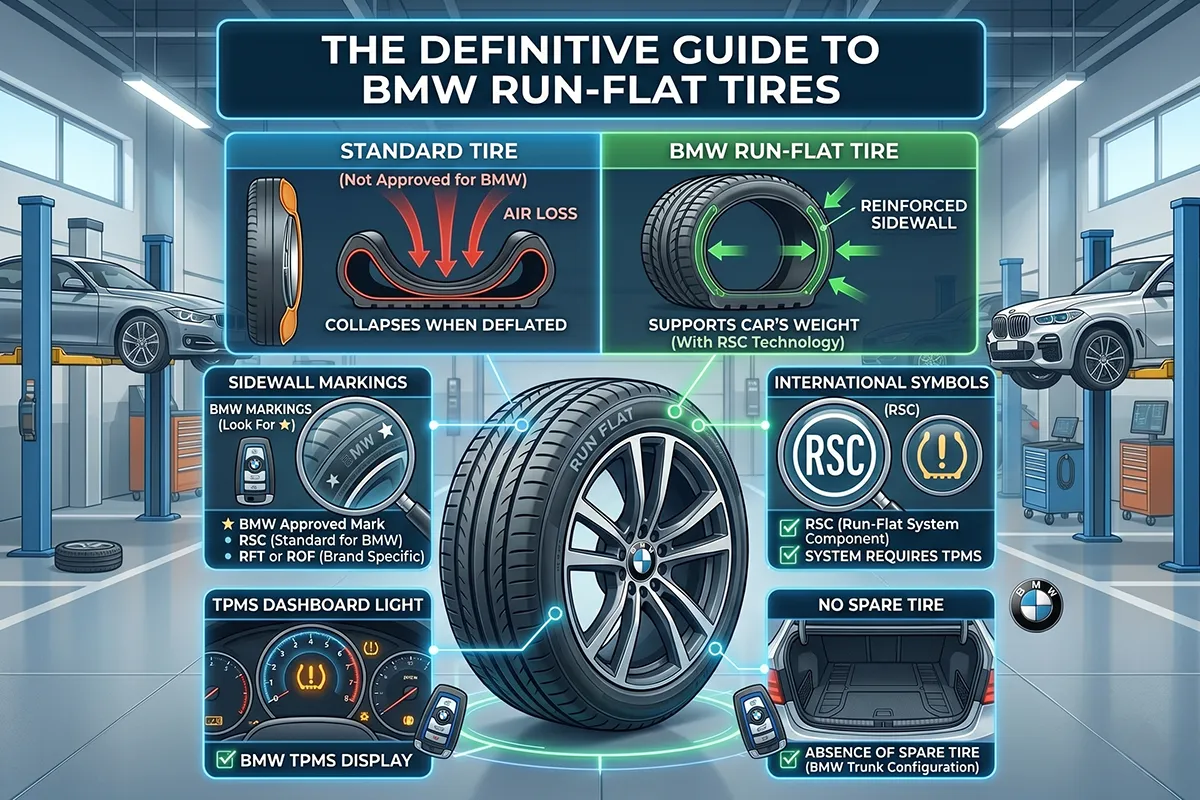
BMW has used run flat tires as standard equipment across nearly their entire lineup since the mid-2000s, eliminating the spare tire entirely. Your BMW’s suspension was specifically tuned around run flat sidewall stiffness — which means switching to conventional tires changes how the car handles, not always for the better. OEM run flat suppliers include Continental, Pirelli, Bridgestone, Dunlop, Michelin, Yokohama, and Goodyear depending on model and year. Replacement run flats cost $150–$500+ per tire. Switching to conventional tires is possible but requires careful planning, a spare tire solution, and understanding the handling tradeoffs for your specific model.
Liked this article?
Add TireAdvise as a preferred source so you see more of our tire reviews and guides on Google.
Why BMW Chose Run Flat Tires — And Why They’ve Stuck With Them
BMW’s commitment to run flat tires isn’t accidental or arbitrary. It reflects a specific engineering philosophy that traces back to the late 1990s, and understanding it changes how you think about every tire decision on your BMW.
The starting point is weight. BMW’s engineers are obsessive about weight distribution and unsprung mass — the weight of components not supported by the suspension springs.
A conventional spare tire, jack, and tool kit adds 30–50 lbs depending on the vehicle. That weight sits low in the trunk, affecting both the 50/50 front-rear weight distribution BMW is famous for and the rotational inertia of the chassis. Eliminating it entirely was attractive from a pure engineering standpoint.
But the spare tire deletion was only viable if they could guarantee the driver wouldn’t be stranded by a puncture. Run flat tires provided that guarantee: 50 miles at 50 mph after complete pressure loss, enough to reach a service location from virtually anywhere in a populated area.
The third piece of the puzzle is safety. At highway speeds, a conventional blowout is one of the most dangerous tire events a driver can experience — the sudden loss of pressure, the violent pull, the risk of losing control.
A run flat tire under the same circumstances maintains its shape and keeps the vehicle manageable. For a brand that markets heavily on driving dynamics and safety, this matters.
These three factors — weight savings, roadside confidence, and blowout safety — created the case for run flats. BMW was one of the first mass-market automakers to standardize them across an entire lineup, and they committed fully: no spare tire, no jack in most models, just the run flat system and TPMS.
That commitment created the situation BMW owners face today when tires need replacing: a highly specific requirement with premium pricing and more complexity than a standard tire swap.
Which BMW Models Come With Run Flat Tires?
The short answer: nearly all of them, for nearly two decades. But let me be specific.
BMW began transitioning to run flat standard equipment in the early 2000s, with widespread adoption across the lineup by approximately 2003–2006 depending on the model. Models and model years that standardized run flats include:
BMW 3-Series (E90/E91/E92/E93, F30/F31/F34, G20/G21): Run flat standard from the E90 generation onward (2006+). This is the model I’ve had the most hands-on experience with, and the one where the suspension-tuning question comes up most frequently.
BMW 5-Series (E60/E61, F10/F11, G30/G31): Run flat standard from the E60 generation (2004+). Heavier vehicle than the 3-Series, which affects how aggressively the stiff sidewall impacts ride quality.
BMW 7-Series (E65/E66, F01/F02, G11/G12): Run flat standard from similar era. Luxury-focused buyers on the 7-Series tend to notice the ride quality compromise most acutely, given the segment expectations.
BMW X3, X4, X5, X6, X7: Run flat standard on most variants from mid-2000s onward. SUV run flats carry higher load ratings than their sedan equivalents, which affects both cost and available options.
BMW 1-Series, 2-Series, 4-Series, 6-Series, 8-Series: Run flat standard across the lineup.
BMW M Models: M3, M4, M5, M8, and the M-packaged versions of X models — these come with performance-oriented run flats tuned specifically for the higher cornering loads and speeds these cars generate. The performance run flat market is narrower, and OEM-equivalent replacements are fewer and more expensive.
Mini (BMW Group): Mini Coopers, Countrymans, and Clubmans also use run flat tires as standard equipment and share many of the same OEM suppliers as BMW.
Important exception: Some early-2000s BMWs and some run-out models in specific markets were sold with conventional tires and a spare. If you have an older BMW or purchased in a non-US market, verify before assuming run flat. My guide on how to tell if your tires are run flat covers exactly how to check your sidewall markings and confirm via owner’s manual and VIN.
OEM Run Flat Tire Brands for BMW: Who Makes What
One thing that surprises many BMW owners is that there’s no single “BMW run flat tire.” BMW sources OEM tires from multiple manufacturers, and the specific brand on your car depends on your model, trim level, build date, and in some cases which factory the car was assembled at.
Here’s the full breakdown of brands you’ll encounter:
Continental (SSR)
Continental is one of BMW’s most significant OEM run flat suppliers, particularly for the standard production lineup. The ContiSportContact SSR and ContiProContact SSR are common OEM fitments on 3-Series, 5-Series, and X-model BMWs.
The SSR designation (Self Supporting Runflat) is clearly stamped on the sidewall — one of the easier OEM run flat markings to spot.
Continental’s run flat compound is well-regarded among technicians for predictable wear and a reasonable balance between ride quality and run flat capability. Of the OEM options I’ve evaluated, Continental tends to produce some of the more comfortable run flat experiences within the BMW context.
Pirelli (r-f)
Pirelli is BMW’s primary performance run flat supplier, particularly for M models, the sportier variants of the mainstream lineup, and many X-model performance packages. The P Zero r-f is the most commonly seen Pirelli run flat on BMWs, though the Cinturato P7 r-f appears on comfort-focused trim levels.
Are P Zero tires run flat?
Not automatically — and this is a question I get constantly. The P Zero is Pirelli’s flagship performance tire family and comes in both standard and run flat versions. The run flat version carries “r-f” in lowercase on the sidewall.
The standard version does not. When ordering replacement P Zero tires for a BMW, you must specifically select the run flat (r-f) version. Ordering the standard P Zero for a BMW that requires run flats leaves you without run flat capability and without a spare — a dangerous situation.
The Pirelli r-f marking is also the smallest and easiest to miss of all the major brands, as I cover in detail in the how to identify run flat tires guide. On a dirty sidewall, “r-f” in lowercase can completely disappear. Clean the sidewall before checking.
Bridgestone (RFT / ROF)
Bridgestone supplies run flat tires to BMW across multiple product lines. The Potenza RFT appears on sportier BMW variants, while the Turanza RFT targets the touring and comfort-oriented models.
Older BMWs from the mid-2000s are more likely to carry Bridgestone tires marked ROF (Run on Flat) — the earlier designation that Bridgestone phased out in favor of RFT.
Bridgestone’s DriveGuard RFT line, introduced in the mid-2010s, represents their most ride-comfort-focused run flat engineering and is worth considering as an aftermarket replacement if ride quality is a priority.
Dunlop (ROF / DSST)
Dunlop was one of BMW’s earliest and most significant run flat partners. Many E90 3-Series and E60 5-Series BMWs from the mid-2000s came from the factory on Dunlop SP Sport Maxx ROF tires. The ROF designation (Run on Flat) is the Dunlop/Goodyear Group standard.
Dunlop’s DSST (Dunlop Self-Supporting Technology) appears on more recent Dunlop run flat products. If you have a 2005–2012 BMW, there’s a reasonable probability your original tires were Dunlop.
Michelin (ZP)
Michelin’s ZP (Zero Pressure) run flat tires appear on some BMW models, particularly in comfort-focused configurations and on certain X-model SUVs.
The Michelin Primacy MXM4 ZP is a common OEM fitment on 5-Series and 7-Series BMWs prioritizing ride quality. The Pilot Sport PS2 ZP and Pilot Sport 4S ZP appear on sportier configurations.
Michelin’s ZP tires are widely regarded as among the best-riding run flat tires available — a meaningful differentiator in a category where ride quality is a common complaint.
Yokohama (ZPS)
Which Yokohama tires are run flat?
n the context of BMW fitment, the relevant Yokohama product is the ADVAN Sport V103 ZPS — the ZPS designation (Zero Pressure System) identifying it as run flat capable. Yokohama’s run flat lineup for passenger cars is narrower than Bridgestone’s or Continental’s, but the ADVAN Sport V103 ZPS appears as OEM fitment on select BMW models and is available as an aftermarket replacement.
If you have Yokohama tires on your BMW without the ZPS designation, they were either fitted aftermarket as conventional tires (a previous owner swap) or you have a model/year that wasn’t equipped with run flats from the factory. Check the sidewall carefully.
Goodyear (ROF / RunOnFlat)
Goodyear’s Eagle F1 Asymmetric ROF and Eagle F1 Asymmetric 2 ROF tires appear on some BMW models, particularly in European market configurations that also sold in the US. Goodyear uses either “ROF” or the full “RunOnFlat” text on the sidewall.
The BMW Suspension Geometry Question: The Conversation Most Shops Skip
This is the most important section of this guide and the one I find almost never gets an honest treatment in tire buying conversations.
BMW engineers designed the suspension geometry of run flat-equipped vehicles with the stiffer run flat sidewall as a known variable.
The suspension tuning — spring rates, damper settings, anti-roll bar stiffness, steering calibration — was developed and validated with run flat tires fitted. The lateral stiffness of a run flat sidewall becomes part of how the suspension system behaves in corners, over bumps, and at highway speeds.
When you remove that stiffness by switching to conventional tires, you change the effective spring rate of the tire-suspension system. The car responds differently:
Handling changes: The steering may feel slightly lighter, turn-in response slightly less crisp, and the car may exhibit more body roll in aggressive cornering. Some drivers find this more comfortable and natural. Others — particularly those who’ve developed a feel for their BMW’s dynamics — find it disconcerting and interpret it as degraded handling.
Ride quality changes: Counterintuitively, switching to conventional tires doesn’t always produce the dramatic comfort improvement people expect. BMW’s suspension is tuned firm to match the run flat sidewall’s stiffness. In some cases, a conventional tire on BMW’s stiff suspension produces similar or even harsher ride quality than a modern high-quality run flat. The softer tire works with a stiffer suspension, and the result doesn’t always equal comfort.
Noise changes: Run flats can be noisier on rough surfaces due to the stiffer sidewall transmitting more road noise into the cabin. Conventional tires may reduce this — though BMW cabin insulation is already quite good, and the difference varies significantly by specific tire choice.
I have driven the same BMW 3-Series (F30 platform) back-to-back on OEM Continental SSR run flats, a set of Michelin Pilot Sport 4S ZP run flats, and a set of conventional Michelin Pilot Sport 4S.
The conventional tires produced a slightly more compliant ride on rough surfaces and a fractionally softer steering feel. The run flat versions delivered sharper initial turn-in.
Neither was dramatically better overall — it was a matter of preference, and the handling difference was far smaller than the forums would lead you to believe.
My honest conclusion: the suspension geometry concern is real but often overstated. Modern high-quality run flats have narrowed the ride quality gap substantially.
If you’re switching to conventional tires primarily to improve ride quality, test drive your specific BMW on the specific conventional tires you’re considering before committing — because the result may surprise you.
Should You Switch Your BMW From Run Flats to Conventional Tires?
This is the question I get asked more than any other in the BMW tire conversation. Here’s how I actually think through it, because the right answer is different for every driver.
Reasons to stay with run flats:
Your BMW’s suspension was designed for them. If you’re satisfied with how your car drives and you just need to replace worn tires, staying with run flat equipment is the path of least surprise. The handling will remain consistent with what you’re used to.
You drive significant highway miles alone. The safety case for run flats is strongest for solo highway driving. If a blowout happens at 75 mph on a dark stretch of interstate, run flat capability is not trivial — it can be the difference between maintaining control and a serious accident.
You don’t have a spare solution. If you switch to conventional tires without adding a spare tire, jack, and lug wrench — which your BMW almost certainly doesn’t have — you’ve traded run flat security for nothing but lower tire cost and a puncture that now requires a flatbed tow.
Reasons to consider switching:
Ride quality is genuinely bothering you. If your BMW feels harsh and fatiguing over rough surfaces to the point where you don’t enjoy driving it, trying high-quality conventional tires is worth considering. Do this methodically: research the specific conventional tire for your model, understand that the suspension will behave differently, and budget for a spare tire setup.
Cost is a serious constraint. Quality conventional tires in your BMW’s size will generally cost 30–50% less per tire than equivalent run flats. Over the ownership period of a vehicle, this adds up to real money. If budget is the primary driver, the math may favor conventional with a quality spare.
You primarily drive in urban areas at lower speeds. The run flat safety advantage is most meaningful at highway speeds. Urban driving at 25–40 mph with multiple service stations and shops nearby changes the calculus. A flat in the city is an inconvenience; a flat at 70 mph is potentially much more.
The non-negotiable if you switch: Add a spare tire. This is not optional. A space-saver spare (donut), a full-size spare, or a run flat spare — any of these options works. But driving a BMW on conventional tires with no spare and no run flat capability means a single puncture strands you and requires a tow. Budget $150–$400 for the spare, jack, and lug wrench that BMW deleted when they spec’d your car with run flats.
Best Run Flat Tire Replacements for BMW by Priority
If you’re staying with run flats — which I recommend for most BMW owners — here are the replacement options I’d evaluate first, organized by what matters most to you:
If ride comfort is your top priority: Michelin Primacy MXM4 ZP (touring models) or Michelin Pilot Sport 4S ZP (performance models). Michelin’s ZP engineering is consistently among the most comfortable in the run flat category. Premium priced, but worth it for the reduction in harshness.
Bridgestone DriveGuard RFT. Bridgestone’s specific ride-comfort-focused run flat line. Noticeably more compliant than their older Potenza RFT. A strong choice for 5-Series and 7-Series owners where comfort is paramount.
If performance and driving dynamics are your priority: Pirelli P Zero r-f. The OEM choice for M models and performance packages for a reason. Exceptional cornering grip and lateral stiffness. Ride quality takes the back seat, but driving feel on a back road or track day is outstanding.
Continental ContiSportContact SSR. A strong all-around performance run flat that also offers good everyday usability. Often slightly more affordable than Michelin and Pirelli premium options at the same size.
If value is your priority: Bridgestone Potenza Sport RFT. A competitive performance run flat at a price point below Michelin and Pirelli. Good dry performance, adequate wet traction, and a narrower premium over conventional tires than the top-tier brands.
Goodyear Eagle F1 Asymmetric 3 ROF. An underrated option that regularly performs well in independent testing. Often priced more competitively than Michelin or Pirelli equivalents.
BMW Run Flat Tire Replacement Costs: What to Actually Budget
One of the most common shocks BMW owners face is opening a quote for four run flat tires. Let me set honest expectations by size category:
Smaller BMWs (1-Series, 2-Series, compact 3-Series with 17–18″ wheels):
- Economy/OEM-equivalent run flats: $130–$180 per tire
- Mid-range (Bridgestone DriveGuard, Goodyear Eagle): $180–$250 per tire
- Premium (Michelin, Pirelli P Zero): $250–$380 per tire
- Full set installed: $600–$1,600 depending on brand
Mid-size BMWs (3-Series, 4-Series, X3, X4 with 18–19″ wheels):
- Economy/OEM-equivalent: $160–$220 per tire
- Mid-range: $220–$310 per tire
- Premium: $300–$460 per tire
- Full set installed: $750–$2,000+
Larger BMWs (5-Series, X5, X6, M models with 19–21″ wheels):
- Mid-range: $280–$400 per tire
- Premium: $400–$600+ per tire
- Full set installed: $1,400–$2,800+
M Model performance run flats (M3, M4, M5 with staggered fitment): These use different front and rear sizes (staggered fitment), which means you’re buying two different sizes. Premium run flats in these sizes can exceed $500 per tire.
A full staggered set of M-spec run flats from Michelin or Pirelli can approach or exceed $3,000 installed. If a shop quotes you significantly below these ranges for brand-name run flats, verify exactly which product you’re getting.
Gray market imports, lower tier product lines marketed under premium brand names, and outright counterfeit tires are real concerns in the tire market. Buy from reputable sources and confirm the exact model and specification before authorizing work.
What Happens When You Need a Repair: The BMW-Specific Reality
BMW owners dealing with run flat punctures face the same repair vs. replace calculation as any other run flat driver, but with one additional layer: dealership service departments.
BMW dealerships have strong financial and liability incentives to recommend replacement rather than repair. A service advisor who tells you to replace a $400 tire earns the dealership significantly more revenue than one who authorizes a $60 repair.
This is not a conspiracy — it’s just how service department economics work.
My guidance: if your TPMS caught the puncture before significant pressure loss, and the damage appears to be a small tread-area puncture, do not accept a replacement recommendation at a dealership without asking specifically whether an internal inspection was performed and what it showed.
The full decision framework — exactly how to evaluate whether your run flat can be repaired, what questions to ask, and how to find a shop that will do it right — is in my run flat tire repair and patching guide.
That post was written specifically to help drivers navigate this situation without unnecessarily spending on replacement tires.
FAQ: BMW Run Flat Tire Questions
My BMW doesn’t have a spare tire. What do I do if I get a flat on conventional tires?
You’re stranded and need a tow — unless you’ve added a spare solution. Before switching to conventional tires on any BMW, purchase a space-saver spare in the correct bolt pattern for your model, a compatible jack, and a lug wrench. BMW deleted these when they committed to run flat equipment. Some BMW owners also carry a quality tire inflator/sealant kit as a backup for minor punctures, though this won’t help with a significant blowout. Do not drive conventional tires on a BMW without a spare tire plan.
Can I use non-BMW-approved run flat tires on my BMW?
Yes, as long as the tires meet your vehicle’s specifications: correct size, load rating, speed rating, and run flat construction. BMW does not require you to use BMW-branded or BMW-approved tires, and many of the best run flat replacements are simply standard commercial products from Michelin, Continental, Pirelli, and Bridgestone. Verify the specifications against your door jamb sticker and owner’s manual before purchasing.
Are run flat tires on my BMW covered under warranty?
Tires are not covered under BMW’s vehicle warranty — they’re consumables warranted by the tire manufacturer, not BMW. BMW does offer a road hazard protection program in some markets (BMW Tire and Wheel Protection), and some new BMWs come with a limited tire protection package. Check your specific purchase documentation and contact your dealer for details on what coverage, if any, applies to your tires.
My BMW M3/M4 has staggered tires. Can I rotate them?
No — staggered fitment (different front and rear sizes) means front-to-rear rotation is not possible. This means your rear tires will wear faster than fronts since they handle most of the acceleration and cornering loads on a rear-wheel-drive M car. Monitor wear carefully and replace in axle pairs when needed. This is one reason M model tire costs are higher over time than equivalent standard BMW models.
Are Pirelli P Zero tires always run flat on a BMW?
No. BMW uses P Zero tires in both standard and run flat configurations depending on model and market. The run flat version is marked “r-f” in lowercase on the sidewall. If you’re buying replacement P Zero tires for a BMW that requires run flats, explicitly confirm you’re purchasing the r-f version. Online listings don’t always make this clear, and the standard P Zero and P Zero r-f look nearly identical without reading the sidewall.
Which Yokohama tires are run flat and can I use them on my BMW?
In the context of BMW fitment, Yokohama’s run flat-capable tires carry the ZPS (Zero Pressure System) designation. The primary product is the ADVAN Sport V103 ZPS. If your BMW’s size and specification matches what the ADVAN Sport V103 ZPS is offered in, it’s a legitimate OEM-quality run flat replacement. If your Yokohama tires don’t carry the ZPS marking, they are conventional tires — not appropriate as a sole tire without a spare solution.
My BMW rides really harshly. Will switching to run flat from older run flats help, or should I just go conventional?
Before switching to conventional tires, try replacing with a modern comfort-focused run flat. Tire technology has improved significantly in the past five to seven years, and older OEM run flats — particularly those from 2010–2016 — are noticeably harsher than current offerings. A set of Michelin Primacy ZP or Bridgestone DriveGuard RFT on a BMW that’s been running decade-old OEM Dunlops or Bridgestones can feel like a different car. Try an updated run flat before making the architectural decision to switch types entirely.
My Verdict After Years of BMW Tire Decisions
I’ve been through this decision on enough BMWs to have a clear point of view: for most BMW owners, staying with run flats is the right call — but it matters enormously which run flats you choose.
The gap in ride quality between a 2010 OEM Dunlop ROF and a 2024 Michelin Pilot Sport 4S ZP or Bridgestone DriveGuard RFT is dramatic.
Many BMW owners who are frustrated with their ride quality are frustrated with their specific aging tires, not with run flat technology as a category. Upgrading within the run flat category frequently addresses the complaint without the complexity of switching types.
If you’ve genuinely evaluated modern run flats and still want to switch to conventional, go in with eyes open: have your spare tire situation sorted before the conventional tires go on, understand your suspension may behave differently, and don’t expect a dramatically more comfortable car if your suspension is doing most of the harshness work to begin with.
And whatever you choose — make sure what you’re putting on your BMW matches the specifications the car was engineered for. The tires are the only contact between a remarkable piece of engineering and the road. That connection deserves the same attention you’d give any other part of the driving experience.
Driving a specific BMW model and want a more tailored recommendation? Drop your year, model, current tire size, and primary concern (ride quality, performance, cost) in the comments and I’ll give you a specific direction.
Related Guides:
- Run Flat Tires: The Complete Guide Before You Buy
- Can You Repair, Patch, or Plug a Run Flat Tire?
- How to Tell If Your Tires Are Run Flat (Any Brand)
Author has personally evaluated run flat tire performance across multiple BMW platforms including F30, F10, G20, and X5. No tire manufacturers or BMW paid for or influenced this content.
