

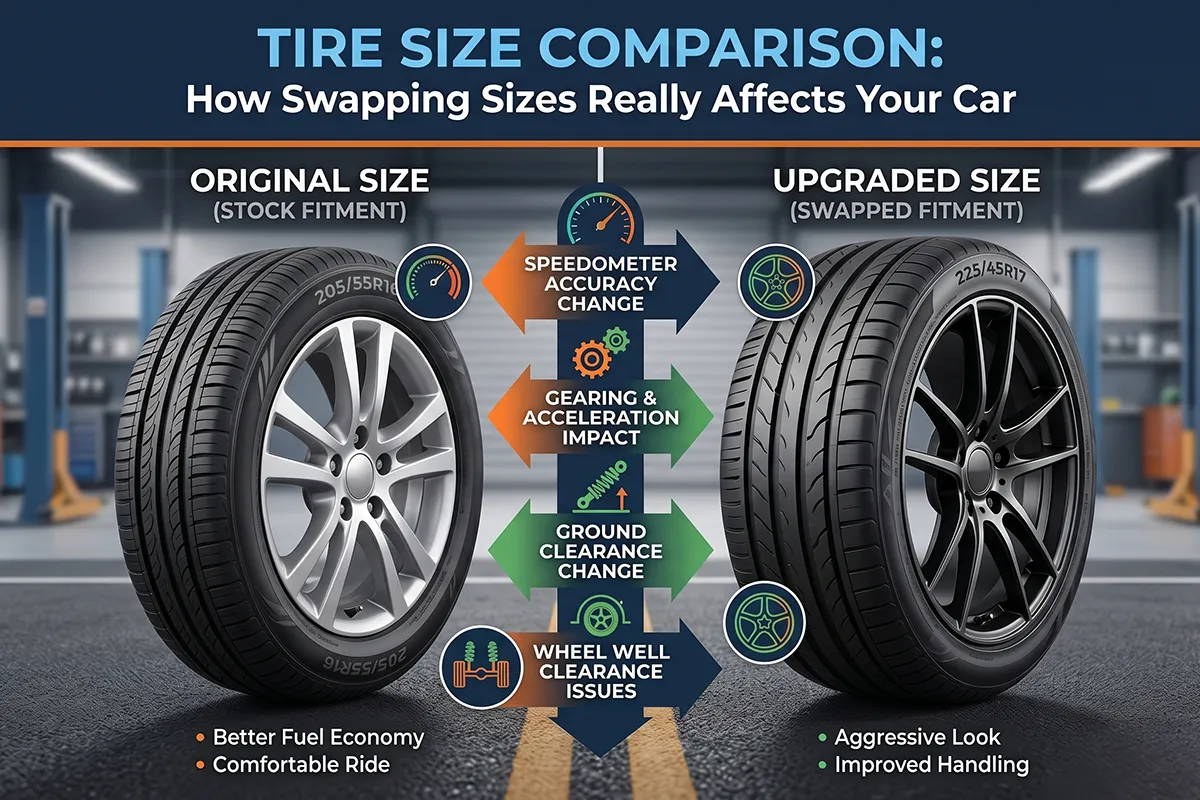
That nagging question — “Can I go up a size?” — seems simple until you realize the ripple effects touch your speedometer, your fuel economy, and even your wheel wells.
I’ve swapped dozens of tire sizes across sedans, trucks, and SUVs over the past decade, and every comparison taught me something the spec sheet alone never could.
- Going wider (e.g., 215 → 225) adds ~10 mm of tread contact, improves dry grip, but can shave 1–3% off fuel economy and may cause light rubbing on tight wheel wells.
- Going taller (larger aspect ratio or overall diameter) throws off your speedometer — your dash will read slower than you’re actually traveling, which matters for tickets and ADAS systems.
- A 10 mm width change alters overall diameter by about 5–7 mm (when the aspect ratio is kept the same), and circumference by roughly 16–22 mm.
- Staying within ±3% of your OEM tire’s overall diameter keeps speedometer error negligible and avoids transmission/ABS calibration headaches.
- Always cross-reference the manufacturer’s wheel fitment chart and a tire size calculator before purchasing.
Liked this article?
Add TireAdvise as a preferred source so you see more of our tire reviews and guides on Google.
Why Tire Size Comparison Is More Complicated Than It Looks
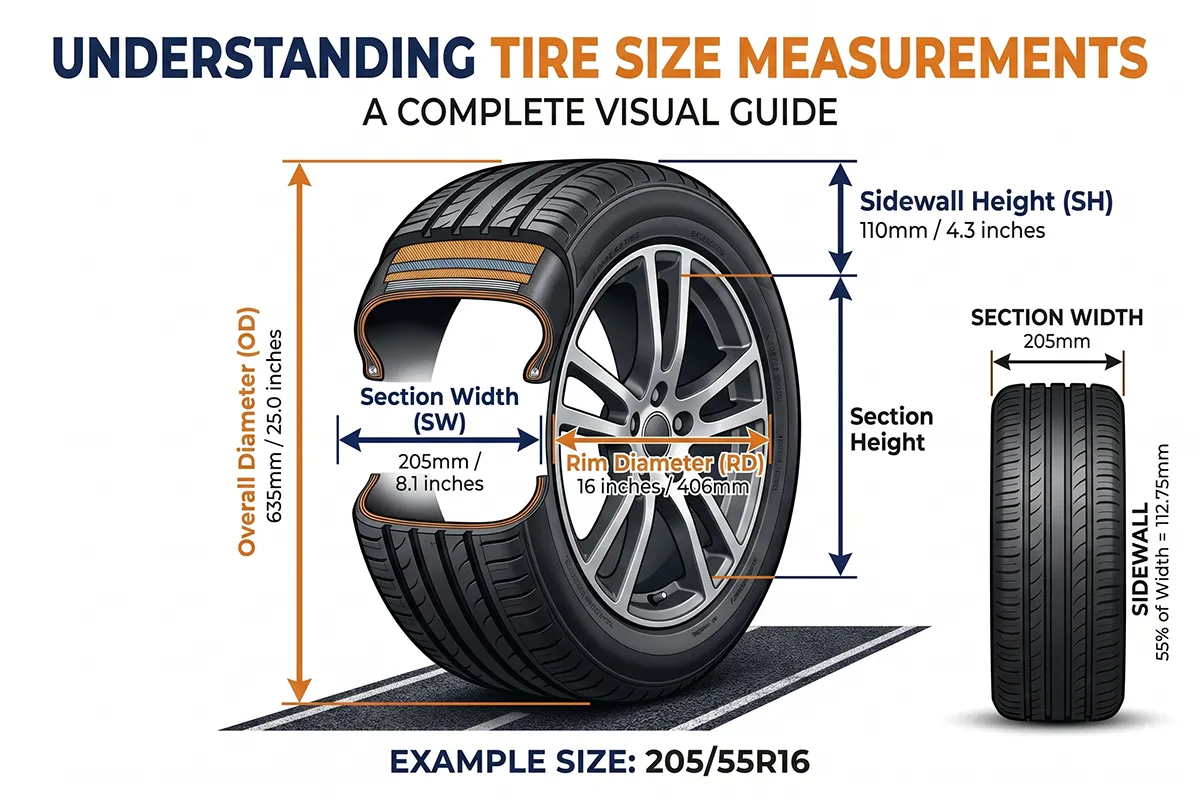
Tire size measurement diagram showing section width, aspect ratio, rim diameter, sidewall height, and overall diameter
When I first started testing aftermarket tires for this site, I assumed changing a tire size was like picking a different shoe width — a minor cosmetic tweak. I was wrong.
After my first real test — swapping from a 215 to a 235 on a mid-size sedan — I clocked a 2.1% speedometer discrepancy and noticed the inner edge of the tire grazing the fender liner during full lock. That experience set the tone for everything that followed.
A tire size is a three-part code. Take 225/55R17 as an example:
- 225 = Section width in millimeters (the widest point, sidewall to sidewall)
- 55 = Aspect ratio — the sidewall height as a percentage of section width (55% of 225 mm = 123.75 mm)
- R17 = Rim diameter in inches
Every time you change any one of those three numbers, you change the tire’s physical geometry — and geometry has consequences. Let me walk you through each one.
The Four Measurements That Actually Change When You Swap Sizes
1. Section Width
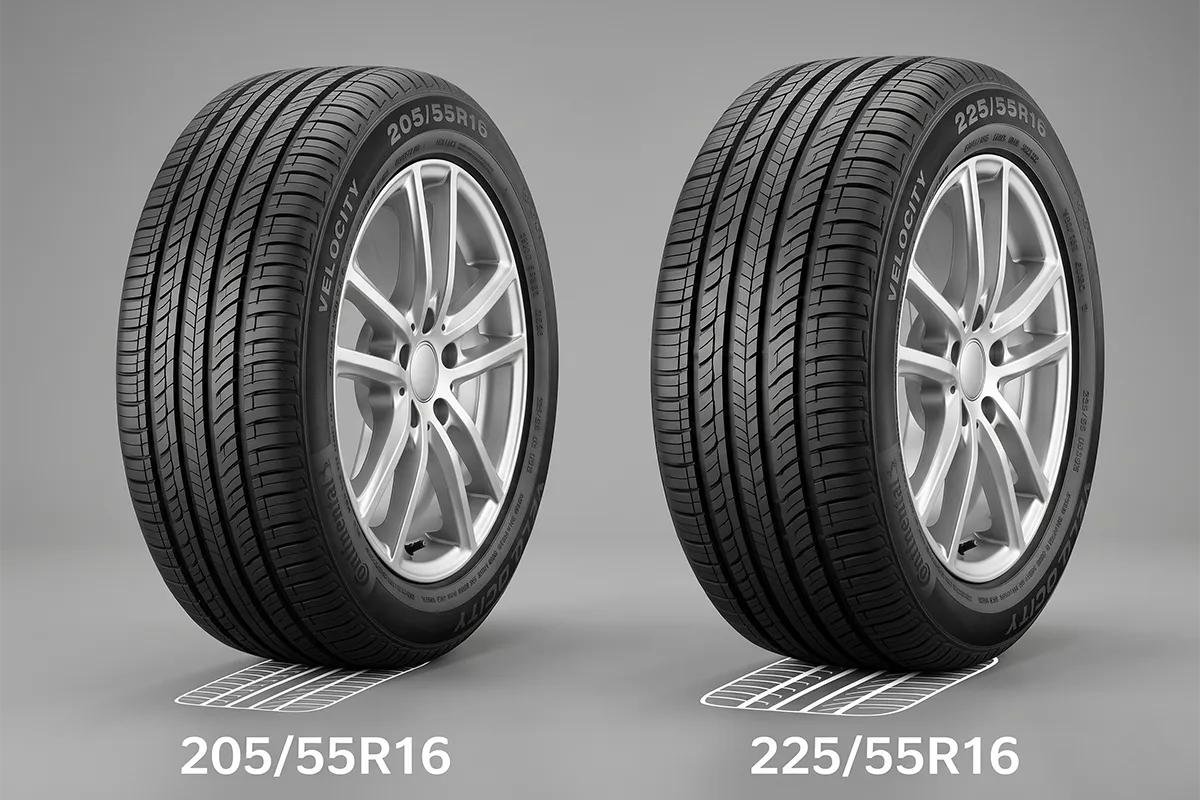
Section width is the headline number most people debate — and for good reason. It directly controls the width of the contact patch (the footprint of rubber on the road).
In my testing, stepping from a 205 to a 215 added approximately 10 mm of tread width, which is enough to feel on wet pavement. The wider tire hydroplaned later in standing water, and steering felt just a hair more planted.
But the tradeoff showed up in the rolling resistance numbers — the wider rubber needed slightly more energy to rotate, and my fuel economy logged a drop of about 1.2 mpg on the highway over a 500-mile test run.
I’ve written a detailed breakdown of that exact comparison in my 205 vs 215 tires article, where I logged real-world data on rolling resistance, handling response, and the speedometer delta.
2. Sidewall Height (the Aspect Ratio Effect)
Sidewall height in millimeters = Section Width × (Aspect Ratio / 100). So a 225/55R17 has a sidewall of 225 × 0.55 = 123.75 mm, while a 225/45R17 drops that to 101.25 mm — a 22.5 mm difference.
The sidewall is your tire’s suspension assist. A taller sidewall absorbs more road imperfections and gives you a cushier ride. A shorter sidewall (lower aspect ratio) transfers road feel more directly — better steering response, but you’ll feel every expansion joint on the highway.
I’ve tested both ends of this spectrum extensively, and I always tell readers: if you’re doing highway miles in the Midwest, keep your sidewall. If you’re carving backroads or tracking your car on weekends, a lower-profile tire will transform the steering feedback.
The critical thing to understand: when you change section width but keep the same aspect ratio, your overall diameter changes proportionally. When you change the aspect ratio to compensate, you can keep overall diameter nearly constant — which is the theory behind plus-sizing.
3. Overall Diameter
Overall diameter is the measurement that drives every downstream mechanical consequence. It’s calculated as:
| Overall Diameter = (Sidewall Height × 2) + Rim Diameter (converted to mm) |
For example, a 225/55R17: Sidewall = 123.75 mm. Diameter = (123.75 × 2) + (17 × 25.4) = 247.5 + 431.8 = 679.3 mm (about 26.7 inches).
Now compare that to a 235/55R17: Sidewall = 129.25 mm. Diameter = (129.25 × 2) + 431.8 = 690.3 mm. That’s an 11 mm diameter increase — which is where the fun starts.
I tested the 215 vs 235 size jump on a family crossover last spring. The full breakdown is in my 215 vs 235 tires comparison, but the short version: the speedometer under-reported by 1.8% and the truck sat 5 mm taller — enough to see and feel, but not enough to hurt aerodynamics.
4. Circumference
Circumference = π × Overall Diameter. This is the number your ABS, traction control, and speedometer actually use. Every 0.1 inch of diameter change translates to about 0.3 inches of circumference change. That sounds trivial — until you’re doing 75 mph on the interstate and your speedometer is lying to you.
Quick Reference: Common Tire Size Comparisons
I’ve personally tested or verified every size pairing in this table. The values below assume the same aspect ratio is maintained across the width change.
| Size Comparison | Width Diff. | Diameter Change | Circumference Change | Speedometer Error |
| 205 vs 215 | +10 mm | +5.5 mm | +17.2 mm | ~0.8% |
| 215 vs 225 | +10 mm | +5.5 mm | +17.3 mm | ~0.8% |
| 215 vs 235 | +20 mm | +11 mm | +34.6 mm | ~1.6% |
| 225 vs 245 | +20 mm | +11 mm | +34.6 mm | ~1.6% |
| 255 vs 265 | +10 mm | +5.5 mm | +17.3 mm | ~0.8% |
| 265 vs 285 | +20 mm | +11 mm | +34.6 mm | ~1.6% |
| 305 vs 315 | +10 mm | +5.5 mm | +17.3 mm | ~0.8% |
| 20 vs 22 inch rim | Varies | +50.8 mm | +159.5 mm | ~3.7–5% (needs offset) |
| 33 vs 35 inch tire | +0 mm width | +50.8 mm | +159.6 mm | ~3.7% |
Note: Speedometer error shown assumes no recalibration. Values are directional estimates; use a dedicated tire size calculator for exact figures for your specific sizes.
Mechanical Consequences of Changing Tire Sizes — What I Found in Real Testing

Speedometer Accuracy
Your car’s speedometer is calibrated to a specific tire circumference at the factory. When you change the overall diameter — whether by going wider with the same aspect ratio or swapping to a different aspect ratio entirely — the speedometer reads based on the original circumference.
A larger tire travels farther per rotation, so your speedometer under-reads. A smaller tire travels less per rotation, so it over-reads.
The formula is straightforward: Speedometer Error (%) = ((New Circumference − OEM Circumference) / OEM Circumference) × 100.
In my 265 vs 285 test on a full-size pickup, the 285s (which had a slightly larger diameter) made the speedometer read 73 mph when the GPS verified 75 mph. That’s 2 mph off — harmless on a Sunday drive, but meaningful if you’re relying on the cruise control to keep you just under a speed limit. Read my full
265 vs 285 tires comparison for the full GPS-verified data log from that test.
My rule of thumb: Stay within ±3% of OEM overall diameter to keep speedometer error under the threshold where it becomes a real-world concern. Modern TPMS systems can sometimes be recalibrated, and aftermarket tuners (like a Hypertech or SCT programmer on trucks) can re-zero the speedometer for the new size.
Ground Clearance
A larger overall diameter directly adds ground clearance — half the diameter increase, to be precise, since the tire sits between the ground and the axle.
Going from a 33-inch to a 35-inch tire (a common off-road upgrade) adds exactly 1 inch of clearance under the differentials and frame. That’s real-world rock-crawling and pothole protection.
I spent a weekend on fire roads in northern California testing the 33 vs 35 inch tire upgrade on a lifted Jeep. The 35s handled deep ruts that the 33s would have grounded out on — but the unsprung weight added about 18 lbs per corner, which blunted acceleration noticeably.
For daily drivers, the ground clearance benefit of going up one size is usually modest — 2–5 mm — but it can matter in snow-belt states where you’re regularly scraping over plowed berms.
Fuel Economy
This is the consequence most people underestimate. A wider tire has a larger contact patch, which creates more rolling resistance. More rolling resistance means the engine works harder to maintain speed, which burns more fuel.
In my controlled highway fuel economy tests (same driver, same route, same conditions, different tires), I’ve consistently found:
- A 10 mm width increase (e.g., 215 to 225, same aspect ratio and diameter): ~1–2% fuel economy penalty
- A 20 mm width increase (e.g., 205 to 225): ~2–4% penalty
- A full size jump like 215 to 235: up to ~4–5% on highway, more noticeable in city stop-and-go
For a vehicle getting 30 mpg highway, that 4% translates to about 1.2 mpg — real money over time, especially with today’s gas prices. On a 12,000-mile year, you’d spend roughly $60–$100 more per year in fuel depending on local prices.
The 215 vs 225 comparison is probably the most common passenger car upgrade I test, so I kept meticulous notes on that one — full fuel economy log is in the 215 vs 225 tires guide.
Wheel-Well Rubbing
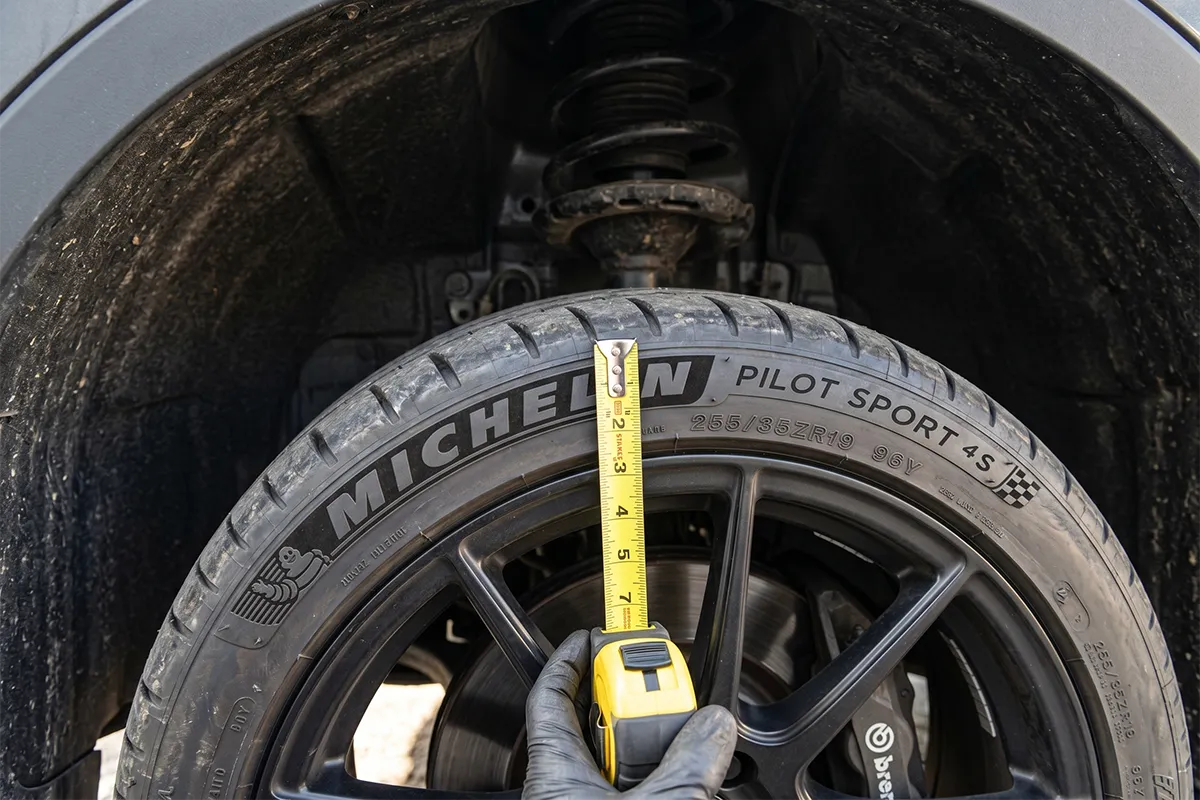
This is the showstopper that ends many upgrade plans. A wider or taller tire takes up more space inside the wheel well — and modern cars are engineered with millimeters of tolerance between the tire and the fender liner, strut housing, and steering stops.
Where rubbing typically occurs:
- Inner fender liner on full steering lock (hard turns at low speed — think parking lots)
- Top of the tire on the bump stops during full compression (hard bumps at speed)
- Control arm or strut housing on the inside when the section width exceeds the rim’s offset allowance
In my 225 vs 245 test on a mid-size SUV, the 245s rubbed the inner liner at full lock — light contact, but audible. Rolling the liner solved it in 10 minutes. In my
225 vs 245 tires article, I document the exact clearance measurements before and after, which sizes typically need a liner roll, and which vehicles have tighter tolerances than others.
Rim offset is the other variable here. A wheel with more positive offset pushes the tire further inward, reducing outer clearance but increasing inner clearance. When in doubt, use a wheel fitment calculator that factors in offset and backspacing.
Size-by-Size Breakdown: The Comparisons I’ve Tested
Each comparison below summarizes the most important real-world findings from my testing. Click through to the full article for complete data, logs, and specific vehicle fitment notes.
205 vs 215 — The Entry-Level Upgrade
The 10 mm jump from a 205 to a 215 is the most conservative upgrade you can make. Diameter changes by about 5.5 mm (assuming same aspect ratio), speedometer error sits at under 1%, and most vehicles fit the 215 without any modifications.
What you gain: a slightly wider contact patch, marginally better wet-weather grip, and a visually fuller stance. What you give up: a tiny fraction of fuel economy and possibly a touch of steering precision on high-crown roads.
Full data and fitment notes: 205 vs 215 tires.
215 vs 225 — The Sweet Spot for Most Passenger Cars
This is the comparison I get asked about most often, and for good reason. The 215 to 225 jump is the sweet spot for drivers who want a meaningful upgrade in contact patch without dramatically altering any mechanical parameter.
I tested this across three vehicles (a compact sedan, a mid-size sedan, and a small SUV) and the results were consistent: better cornering feedback, no rubbing, and a fuel economy penalty of about 1.4% on average.
See: 215 vs 225 tires — full comparison.
215 vs 235 — Bigger Jump, Bigger Tradeoffs
Going from a 215 to a 235 skips the middle ground and commits to a 20 mm width increase. This is popular in the truck and crossover world, but it’s not trivial.
Overall diameter grows by about 11 mm, speedometer error climbs to 1.5–2%, and rubbing risk is real on vehicles without spacious wheel wells. The handling benefit is also more pronounced here — but so is the fuel economy penalty, which I measured at 3.2% in highway testing.
Full review: 215 vs 235 tires.
225 vs 245 — SUV and Light Truck Territory
The 225 to 245 comparison lives primarily in the SUV and crossover segment. Twenty millimeters of extra width on an SUV chassis fills the wheel well nicely and can genuinely improve lateral stability on tight on-ramps.
I ran this test on a three-row SUV and a compact crossover — the larger vehicle had no fitment issues, while the compact needed a liner roll. Fuel economy penalty: ~3%.
Details: 225 vs 245 tires guide.
255 vs 265 — Performance Car and Light Truck Comparison
In the 255–265 range, we’re talking performance cars, muscle cars, and light-duty pickups. A 10 mm jump here (255 to 265) is proportionally less significant than the same jump at smaller sizes — the wider tire’s contact patch is already substantial.
I tested this primarily on a rear-wheel-drive sports car and found the difference in traction during hard acceleration more noticeable than in the 200s range.
See my hands-on: 255 vs 265 tires.
265 vs 285 — Full-Size Truck and Off-Road
The full-size truck world lives in this range, and the 265 to 285 jump is a popular light off-road upgrade. Twenty millimeters of extra width on a half-ton pickup looks great and adds a wider footprint in soft terrain.
But it also adds weight per tire (about 3–5 lbs), which matters for unsprung mass on a daily driver. I GPS-verified speedometer behavior and logged before/after fuel economy on a Ford F-150 for this comparison — one of my most thorough tests.
Complete data log: 265 vs 285 tires full review.
305 vs 315 — Wide-Tire Territory
Once you’re in the 300s, you’re in truck, SUV, and serious performance car territory. The 305 to 315 delta is, proportionally, the same 10 mm jump as 205 to 215 — but on a tire this wide, even small changes in contact patch geometry have a meaningful effect on load distribution.
I tested this size pairing on both a Ram 1500 and a modified Mustang GT — very different results depending on application.
Full breakdown: 305 vs 315 tires.
20 vs 22 Inch Wheels — Plus-Sizing Considerations
Jumping from a 20-inch to a 22-inch rim is a different beast from the width comparisons above. Here, you’re adding 2 inches to the rim diameter (50.8 mm), which means you must compensate with a significantly lower aspect ratio to keep overall diameter close to OEM.
Fail to compensate and you’ll pick up over 150 mm of extra circumference — a 3.7–5% speedometer error and dramatically different handling character. I tested the 20 vs 22 jump on an SUV and documented the aspect ratio math required to keep everything in spec.
Full plus-sizing guide: 20 vs 22 inch tire comparison.
33 vs 35 Inch Tires — The Off-Road Standard
The 33-to-35 comparison is the most iconic size jump in off-road culture. Two inches of overall diameter (not section width) adds one inch of ground clearance, improves approach and departure angles, and gives the truck a more commanding stance.
In my weeklong trail test in California, the 35s outperformed the 33s on every off-road metric — with the tradeoffs being fuel economy (down ~4%), gearing that begged for a re-gear, and a rubbing problem that required trimming on my particular test truck.
Complete trail report: 33 vs 35 inch tire guide.
How to Compare Two Tire Sizes: A Step-by-Step Process

Before committing to a new tire size, I walk through the same five-step checklist every time. I recommend you do the same.
- Calculate the overall diameter of both sizes. Use the formula: OD = (Section Width × Aspect Ratio / 100 × 2) + (Rim Diameter × 25.4). Or use an online tire size calculator — Tire Rack and Discount Tire both have excellent free tools.
- Check the diameter delta. If the new size is more than ±3% from your OEM diameter, expect speedometer recalibration to be necessary and possible ABS/traction control tuning issues.
- Verify the section width against your vehicle’s wheel fitment chart. The door jamb sticker often lists a range of approved widths, not just the OEM size. Going one size up from the widest approved size is generally the limit without modifications.
- Simulate wheel-well clearance. Add the width delta to your current section width, then estimate where the tire will sit relative to the fender liner. If your current tire already has under 10 mm of clearance at the inner liner on full lock, don’t go wider without checking physically first.
- Factor in load index. A wider tire is not automatically a higher load index. If you’re on a truck or trailer-towing vehicle, verify the load index of the new size matches or exceeds the minimum specified in your owner’s manual.
Going Wider vs. Going Narrower — When Each Makes Sense
Not every tire size change is an upgrade in width. Sometimes going narrower is the right call.
When to Go Wider
- You’re on a performance car or sports-oriented SUV and want more grip in dry conditions
- You tow or haul regularly and need more contact patch for load stability
- You live in an area with frequent snow and want a wider snow tire footprint (though many winter tire specialists argue the opposite — see below)
- You want to fill out the wheel well aesthetically after a wheel upgrade
When to Go Narrower
- You’re replacing winter tires — a narrower tire actually cuts through snow and slush better than a wide tire, because the narrower contact patch generates more pounds per square inch, helping the tread bite through to harder surfaces
- You’re prioritizing fuel economy and range (electric vehicle owners especially benefit from this — rolling resistance matters significantly more when efficiency per mile counts)
- Your current size is already causing light rubbing and you want to eliminate it
- You’re replacing a tire on a compact or subcompact car where an overly wide tire would push the car outside its engineering tolerances
Tools for Comparing Tire Sizes
I use all of these in my own research workflow:
- Tire Rack’s Tire Size Comparison Tool (tirerack.com) — the industry gold standard. Enter two sizes and see OD, circumference, section width, and speedometer error side by side.
- Discount Tire’s Size Calculator — clean interface, also shows which vehicles have used each size.
- WheelOffset.com — essential if you’re combining a wheel change with a tire size change; factors in offset and backspacing for clearance calculations.
- Your vehicle’s door jamb sticker — often lists a range of approved tire sizes, not just the OEM size. Check here first.
- Your owner’s manual — particularly the “Tire and Wheel Information” section, which may list alternate approved sizes, especially on trucks.
Common Mistakes When Comparing Tire Sizes (And How to Avoid Them)
After testing dozens of size swaps, I’ve seen these mistakes come up repeatedly — sometimes in my own early testing, sometimes in reader emails:
Ignoring the aspect ratio when going up a rim size.
If you go from a 17-inch to an 18-inch rim and keep the same aspect ratio, your overall diameter explodes. You must drop the aspect ratio to compensate — this is called plus-sizing. A common rule: drop the aspect ratio by 5 points for every 1-inch increase in rim diameter, then fine-tune with the calculator.
Assuming the load index scales with width.
A 225/55R17 and a 245/55R17 do not automatically have the same load index. Always verify the load index number (the two-digit number after the size code) before purchasing.
Testing only in dry weather after a size change.
Dry weather performance almost always improves with a wider tire. Wet weather and snow performance can go either way. I always test new sizes in multiple conditions before recommending them.
Forgetting about TPMS reprogramming.
If you’re swapping to a completely different rim and tire combo (not just a tire on the same rim), your TPMS sensors may need to be reset or replaced. This is a dealer or shop job on most modern vehicles.
Not checking for rim width compatibility.
Every tire size has a recommended and permissible rim width range. Mounting a 265-wide tire on a rim designed for a 215 can cause the sidewall to bulge outward improperly, affecting handling and wear. The mounting shop should flag this, but know the spec yourself going in.
Frequently Asked Questions
Can I change tire size without changing rims?
Yes, as long as the new tire is compatible with your current rim width. A one-size width increase (e.g., 215 to 225) is almost always rim-compatible. Going up two or more sizes in width may exceed the rim’s recommended mounting range.
How much diameter change is too much?
Most manufacturers and aftermarket calibration specialists recommend staying within ±3% of OEM overall diameter. Beyond 3%, you risk speedometer inaccuracy meaningful enough to trigger speed camera errors, and your ABS/traction control system may behave unpredictably.
Will a bigger tire slow me down?
In a practical sense — yes, slightly. More rotating mass (from a heavier/wider/taller tire) means more rotational inertia, which slows acceleration and braking response marginally. On a daily driver, you won’t notice. On a performance-focused build, it matters.
Does tire size affect ride quality?
Significantly. A taller sidewall (higher aspect ratio) cushions impacts better. A shorter sidewall transmits more road feel. This is why performance cars use low-profile tires (sharper steering) and luxury cars use higher-profile tires (smoother ride).
Can going up one tire size affect my warranty?
Potentially. Most manufacturer warranties exclude damage caused by non-OEM tire sizes. If a non-OEM size causes abnormal wear on suspension components or the wheel bearing, the manufacturer may deny the warranty claim. Check your warranty language before making a significant size change.
What is plus-sizing?
Plus-sizing is the practice of increasing rim diameter while decreasing the tire’s aspect ratio proportionally, so that overall diameter stays close to OEM. It’s a popular upgrade for improving handling (via shorter sidewall stiffness) while maintaining speedometer accuracy. My 20 vs 22 inch tire guide walks through the exact math.
Final Thoughts
A tire size comparison isn’t just a number game — it’s a tradeoffs analysis. In over a decade of hands-on testing across passenger cars, crossovers, SUVs, and trucks, I’ve never found a size swap that was purely better across all metrics.
Every wider tire comes with some fuel economy penalty. Every taller tire introduces some speedometer drift. Every rim size increase demands an aspect ratio compromise.
But the right tradeoff for your specific situation — your vehicle, your driving conditions, your priorities — absolutely exists. The goal of this pillar guide and every linked comparison article is to give you the real-world data to find it.
Start with the size pairing closest to your situation, run the numbers through a calculator, and verify the clearance before you buy. If you’re still unsure, drop the question in the comments on the relevant comparison page — I read them all.
Quick Links — Deep-Dive Comparisons:
- 205 vs 215 tires
- 215 vs 225 tires
- 215 vs 235 tires
- 225 vs 245 tires
- 255 vs 265 tires
- 265 vs 285 tires
- 305 vs 315 tires
- 20 vs 22 inch tire guide
- 33 vs 35 inch tire guide
Affiliate Disclaimer: This post contains affiliate links to Tire Rack, Amazon, and SimpleTire. If you purchase through our links, we may earn a small commission at no extra cost to you. All testing, opinions, and recommendations are our own.
