

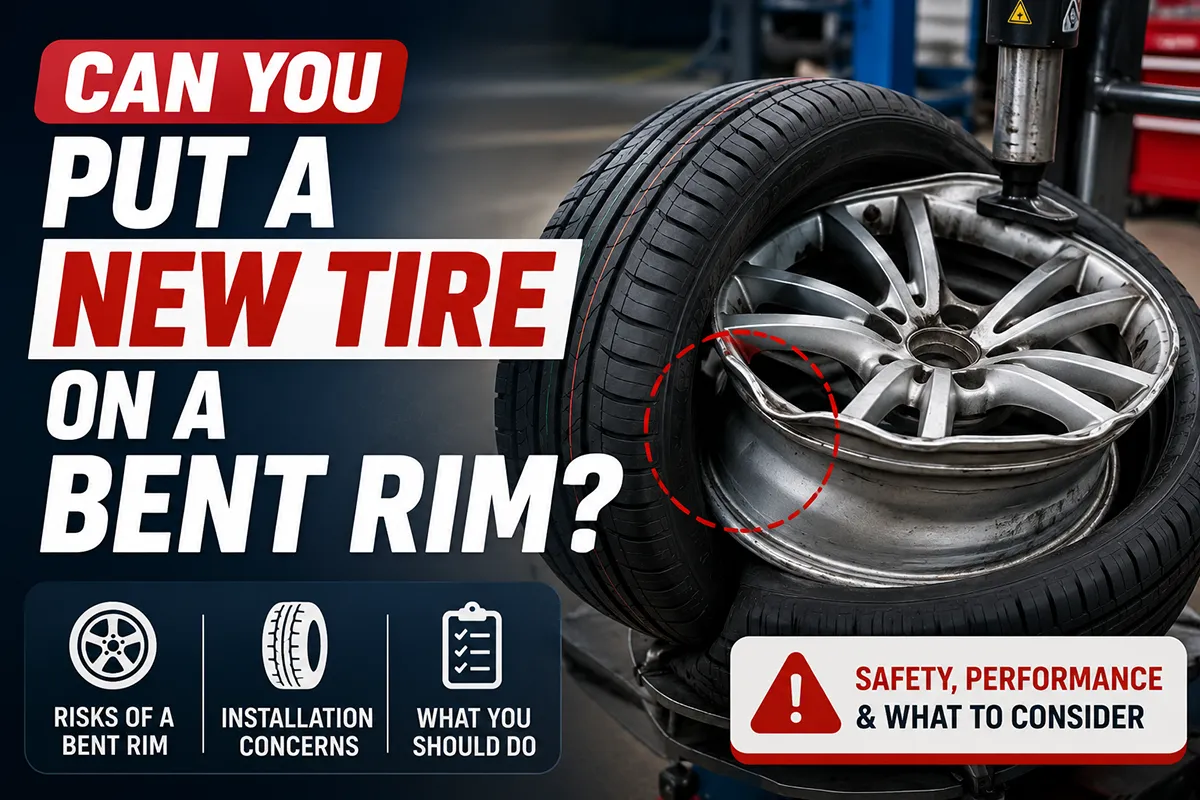
I hit a pothole on I-95 last winter that I never even saw coming. One second I was cruising, the next I felt that unmistakable wobble in my steering wheel — the kind that makes your stomach drop because you know something just went wrong.
When I pulled over and inspected the wheel, the rim had a visible dent along the inner lip. The tire was losing air fast. And the first question that popped into my head was the same one you’re probably asking right now: can I just throw a new tire on this thing and keep driving?
It’s a question I’ve heard from dozens of readers, friends, and family members over the years. And the answer isn’t as simple as a yes or no. So I’m going to walk you through everything I’ve learned — from my own bent-rim experience, from consulting with tire shop technicians, and from years of reviewing tires and watching how they perform on compromised wheels.
- Technically, you can mount a new tire on a bent rim — but whether you should depends entirely on the severity and location of the bend.
- Minor bends on steel rims can often be repaired safely at a wheel repair shop for $75–$150.
- Alloy rims with significant bends are harder to fix and may need full replacement ($150–$500+ per wheel).
- A new tire on a bent rim will wear unevenly, may not seal properly, and can create dangerous vibrations at highway speeds.
- Always get the rim inspected by a professional before mounting any new rubber — it could save you money and keep you safe.
Liked this article?
Add TireAdvise as a preferred source so you see more of our tire reviews and guides on Google.
What Exactly Is a Bent Rim?
Before we dive into whether you can mount a new tire on one, let’s make sure we’re on the same page about what a “bent rim” actually means. A rim — or wheel — is the metal component your tire sits on. It has an inner and outer lip, and those lips are what create the airtight seal with the tire bead.
A bent rim occurs when that metal gets deformed. This usually happens from hitting a pothole, curb, railroad track, or road debris at speed. Sometimes it’s dramatic — you can see the bend with your naked eye. Other times, it’s subtle, and you only notice it through vibration or a slow air leak.
I’ve seen both extremes. I once inspected a rim that looked perfectly fine from the outside but was bent just enough on the inner lip to cause a persistent slow leak. That’s the sneaky kind that’ll drive you crazy.
Common Signs of a Bent Rim
- Steering wheel vibration — especially at highway speeds between 55-70 mph
- Persistent slow air leak — you keep adding air but it doesn’t hold
- Visible damage — a dent, flat spot, or waviness along the rim lip
- Uneven tire wear — one section of tread wearing down faster than the rest
- Vehicle pulling to one side — though this can also be an alignment issue
If you’re experiencing any of these symptoms, I’d strongly recommend getting the wheel inspected before buying a new tire. There’s no point mounting fresh rubber on a compromised wheel.
Can You Physically Mount a New Tire on a Bent Rim?
Let’s answer the literal question first: yes, in most cases, a tire technician can physically mount a new tire onto a bent rim. The tire machine doesn’t care if the rim is perfectly round — it’ll stretch the bead over the lip regardless.
I’ve watched technicians do this plenty of times. The tire goes on. It inflates. It looks normal at first glance.
But here’s where it gets complicated — and where I have to be honest with you as someone who’s seen the consequences firsthand.
The Tire May Not Seal Properly
The bead of a tire is designed to seat against a perfectly round, smooth rim lip. When that lip is bent, there’s a gap. Sometimes it’s microscopic, sometimes it’s significant. Either way, that gap can allow air to escape slowly.
I’ve personally dealt with a tire that would lose about 5 PSI every few days because the rim had a slight bend I initially dismissed. I kept thinking there was a puncture. Two patch jobs later, a technician finally told me it was the rim, not the tire.
You Won’t Get a Proper Balance
Even if the tire seals, a bent rim can’t be balanced correctly. The wheel is no longer a perfect circle, so no amount of wheel weights will eliminate the vibration completely. I tried this myself — had a new tire mounted and balanced on my bent rim as a temporary fix. The vibration at 60 mph was noticeable from day one and only got more annoying over time.
The Tire Will Wear Unevenly
A bent rim changes the contact patch of the tire — the area where rubber meets road. Instead of a uniform patch, you get inconsistent pressure across the tread. I noticed accelerated wear on one shoulder of my new tire after just a few weeks. That’s money wasted on a tire that should have lasted much longer.
Minor Bend vs. Major Bend: Where I Draw the Line
Not all bent rims are created equal, and I think this is the most important distinction that most articles overlook. The severity of the bend determines everything.
Minor Bends (Often Repairable)
A minor bend is one where the deformation is small — maybe a quarter inch or less — and localized to one section of the rim lip. In my experience, these are usually caused by moderate pothole hits or clipping a curb while parallel parking.
Here’s what I’ve found with minor bends:
- Steel rims with minor bends can almost always be repaired. A good wheel repair shop can hammer or hydraulically press them back into shape for $75–$150.
- Alloy rims with minor bends can sometimes be repaired, but it depends on the specific alloy and the location of the bend. I’ve had success with cosmetic-level bends on alloy wheels.
- A new tire mounted on a rim with a minor bend may seal and function adequately — but I still recommend getting it straightened first.
Major Bends (Replace the Rim)
A major bend is one where the deformation is significant — a large flat spot, a crack forming along the bend, or warping that extends beyond just the lip into the barrel of the wheel. These are usually caused by high-speed impacts with deep potholes or large debris.
For major bends, my advice is unequivocal: do not mount a new tire on it. Replace the rim.
I once saw a reader who ignored a badly bent rim and mounted a new tire anyway. The tire blew out on the highway within a couple of weeks. The bent lip had been cutting into the bead slowly, weakening the tire until it failed catastrophically. That’s not a risk worth taking.
| Factor | Minor Bend | Major Bend |
|---|---|---|
| Visible deformation | Small dent, barely noticeable | Obvious flat spot, crack, or large warp |
| Air leak severity | Slow leak or none | Rapid air loss or unable to hold air |
| Vibration level | Mild vibration at high speed | Severe vibration at any speed |
| Repair possibility | Usually repairable ($75–$150) | Not safely repairable |
| Safe to mount new tire? | Possible after repair | No — replace the rim first |
| Typical repair cost | $75–$150 for straightening | $150–$500+ for a new rim |
Steel Rims vs. Alloy Rims: How Material Matters
The type of rim you have plays a huge role in what happens after a bend and whether repair is viable. I’ve worked with both extensively, and here’s what I’ve learned.
Steel Rims
Steel rims are the workhorses of the wheel world. They’re heavier, cheaper (typically $50–$100 each), and most importantly — they bend rather than crack. This makes them much more forgiving when you hit a pothole.
In my experience, steel rims with minor to moderate bends can almost always be straightened by a professional. I’ve had two steel rims repaired over the years, and both came back perfectly round. The cost was about $80 each time, and the repaired rims held tires with zero leaks afterward.
If you drive in the Northeast, Midwest, or anywhere with harsh winters and pothole-riddled roads, steel rims with winter tires are a smart setup partly because they’re so affordable to repair or replace.
Alloy (Aluminum) Rims
Alloy rims look great and are lighter than steel, which is why they come standard on most modern cars. But they have a significant downside: they’re more brittle. Instead of bending gradually like steel, alloy rims tend to crack at the point of impact.
I’ve seen alloy rims that looked like they had a minor bend but actually had hairline cracks running from the deformation point. Those cracks are invisible to the naked eye and can only be caught with a proper inspection. A cracked alloy rim is not repairable — it needs to be replaced, period.
Alloy rim repair is possible for cosmetic bends and minor lip damage, but I recommend being very cautious. Always ask the repair shop if they perform a runout test (measuring how round the wheel is) after the repair. If they don’t, find a shop that does.
What Happens If You Ignore the Bend and Mount a New Tire Anyway
I know some of you reading this are thinking: “It’s a small bend, the tire holds air, I’ll just deal with it.” I get it — new rims are expensive, and life is busy. But let me walk you through the consequences I’ve either experienced personally or witnessed.
Accelerated Tire Wear
I mounted a brand-new Michelin Defender on a rim with what I thought was a negligible bend. Within several weeks, the inside shoulder was wearing noticeably faster than the rest of the tread. That tire should have lasted me through multiple seasons of driving. Instead, I had to replace it much sooner than expected. The cost of ignoring the bend ended up being far more than what a rim repair would have cost.
Persistent Vibration and Ride Discomfort
A bent rim creates an out-of-round condition that no balancing can fully correct. During my time driving on the bent rim, the vibration through the steering wheel was constant above 55 mph. It wasn’t violent, but it was there — a constant reminder that something wasn’t right. Over time, that kind of vibration can also wear out wheel bearings and suspension components prematurely.
Risk of Sudden Air Loss
This is the one that keeps me up at night. A compromised bead seal can fail suddenly, especially during high-speed driving or when hitting another road imperfection. I’ve read enough incident reports and spoken to enough tire technicians to know this isn’t hypothetical. A blowout at 70 mph on the highway is genuinely life-threatening.
Damage to the New Tire
The sharp edge of a bent rim lip can actually cut into the tire bead over time. The bead is the reinforced inner edge of the tire that creates the seal — and once it’s compromised, the tire is toast. You can’t repair bead damage. So now you’ve destroyed a perfectly good new tire because you didn’t want to fix or replace a $150 rim.
How Much Does It Cost to Fix or Replace a Bent Rim?
Let me break down the real-world costs I’ve encountered, because I think this is where a lot of the decision-making happens.
Rim Repair (Straightening)
- Steel rim straightening: $75–$150 at most wheel repair shops
- Alloy rim straightening: $100–$200, depending on severity and wheel size
- Cosmetic alloy rim repair (curb rash + minor bend): $125–$250
I’ve used local wheel repair specialists for this work — not the big chain tire shops, which often don’t offer rim straightening in-house. Search for “wheel repair” or “rim straightening” in your area. Many mobile wheel repair services will even come to your home or workplace.
Rim Replacement
- New OEM (original equipment) alloy rim: $200–$500+ depending on make and model
- New aftermarket alloy rim: $100–$300
- New steel rim: $50–$120
- Used OEM rim from a salvage yard: $50–$150
One of my favorite money-saving tips: check salvage yards and online marketplaces like eBay Motors or Facebook Marketplace for used OEM wheels. I once found a perfect matching alloy rim for my Honda Accord for $75 from a local salvage yard. It was in better condition than the one it replaced.
Just make sure any used rim you buy gets inspected for straightness and cracks before you mount a tire on it. A reputable tire shop will check this for free or for a small fee.
My Step-by-Step Recommendation
Based on everything I’ve experienced, here’s the exact process I’d follow — and recommend to any reader — if you suspect a bent rim.
Step 1: Get the Rim Professionally Inspected
Don’t guess. Take the wheel to a tire shop or wheel repair specialist and have them check it. They’ll typically do a visual inspection and put it on a balancing machine to measure runout (how far off from perfectly round it is). Many shops do this for free if you’re also buying a tire.
Step 2: Determine the Severity
Ask the technician to be honest about the severity. Runout of 0.030 inches or less is generally considered acceptable. Anything over 0.040 inches is going to cause problems. If the technician says the bend is repairable, ask what the cost would be.
Step 3: Repair or Replace the Rim First
If the bend is minor and repairable, get it straightened before mounting the new tire. If it’s too severe to repair — or if there are any cracks — replace the rim.
Step 4: Then Mount the New Tire
Once you have a straight, undamaged rim, mount your new tire. Get it properly balanced and have your alignment checked as well — because the same pothole that bent your rim may have knocked your alignment out of spec.
Step 5: Keep the Receipt and Monitor
After everything is done, check your tire pressure daily for the first few days, then weekly for a couple of weeks. If the pressure holds steady and there’s no vibration, you’re good to go.
Can a Tire Shop Refuse to Mount a Tire on a Bent Rim?
Yes, and in my experience, reputable shops will. I’ve been at Discount Tire locations where the technician flagged a bent rim during a tire change and recommended against mounting the new tire until the rim was addressed.
This isn’t them trying to upsell you — it’s a liability issue. If they mount a tire on a known-damaged rim and something goes wrong, they could be held responsible. I actually appreciate it when a shop pushes back on this. It tells me they care more about safety than about making a quick sale.
That said, not every shop will catch it. Some budget shops or quick-service places may mount the tire without a second thought. That’s why I always advocate being your own advocate — if you know the rim is bent, speak up.
What About Run-Flat Tires on a Bent Rim?
I’ve gotten this question a few times from readers who drive BMWs, Minis, and other vehicles that come equipped with run-flat tires. The thinking is: “Run-flats are tougher, so they can handle a bent rim better, right?”
Not exactly. Run-flat tires have reinforced sidewalls that allow you to drive a short distance after losing air pressure. But they still rely on the same bead-to-rim seal as conventional tires. A bent rim will compromise that seal just as much — and run-flat tires are significantly more expensive to replace (often $200–$350+ per tire).
In my view, putting a premium run-flat tire on a bent rim is an even bigger waste of money than doing it with a standard tire. Fix the rim first.
How to Prevent Bent Rims in the First Place
Prevention is always cheaper than repair. Here are the strategies I personally use to minimize the risk of bending a rim — especially living in an area where potholes appear every spring like clockwork.
Maintain Proper Tire Pressure
An underinflated tire provides less cushion between the rim and the road. I check my tire pressure every two weeks and always before road trips. Keeping your tires at the manufacturer’s recommended PSI (found on the driver’s door jamb sticker) gives the sidewall enough structure to absorb impacts before they reach the rim.
Avoid Potholes and Road Debris
I know this sounds obvious, but being vigilant really helps. I keep more following distance in bad weather so I have time to see and avoid potholes. When I can’t avoid one, I slow down as much as safely possible before impact. Speed is the enemy — a pothole at 30 mph is far less damaging than the same pothole at 60 mph.
Consider Tires with Taller Sidewalls
Low-profile tires look great but offer very little protection for your rims. If you live in an area with rough roads, consider going up one sidewall size (if your vehicle allows it). I’ve personally switched to a slightly taller sidewall for my winter tire setup, and it’s saved my rims more than once.
Upgrade to Steel Rims for Winter
I mentioned this earlier, but it bears repeating. A dedicated set of steel rims for winter tires is one of the best investments I’ve made. Steel rims are cheap, tough, and easy to repair if they do get bent. Save your nice alloy wheels for the warmer months when roads are in better shape.
Real-World Scenarios: What I’d Do in Your Shoes
Let me give you some specific scenarios based on situations I’ve actually encountered or been asked about.
Scenario 1: You hit a pothole and noticed a vibration, but the tire holds air.
I’d get the rim inspected as soon as possible. There may be a minor bend that hasn’t caused a leak yet but is affecting balance. If the bend is small, a $100 repair solves the problem. Don’t wait until the tire starts leaking or wearing unevenly.
Scenario 2: Your tire went flat and you can see a dent in the rim.
Put on your spare tire (or call roadside assistance) and get to a tire shop. Have them assess whether the rim is repairable. If your tire was damaged by the impact, you’ll need both a new tire and a repaired or replaced rim. Don’t mount the new tire until the rim situation is resolved.
Scenario 3: A tire shop tells you your rim is bent but wants to charge $400 for a new OEM wheel.
Get a second opinion. Check if a wheel repair shop can straighten it for a fraction of the cost. If it truly needs replacement, shop around — salvage yards, online retailers like TireRack.com or eBay Motors, and even dealer parts departments during sales can all offer better prices than the first quote you get.
Scenario 4: You’re on a tight budget and can’t afford a new rim right now.
I understand — I’ve been there. If the bend is genuinely minor (the tire holds air and vibration is minimal), you can drive carefully for a short time while you save up. But monitor your tire pressure daily, avoid highway speeds when possible, and make the repair a priority. This is not a long-term solution.
My Final Take: Don’t Skip This Step
I’ve reviewed hundreds of tires over the years, and one thing I’ve learned is that even the best tire in the world can’t perform properly on a damaged wheel. It’s like putting premium fuel in a car with a broken engine — you’re wasting the investment.
If you’ve got a bent rim, address it before you spend $100–$200 on a new tire. A straightened or replaced rim costs less than a wasted tire, and it costs infinitely less than the consequences of a blowout at highway speed.
I always tell my readers: your tires are the only thing between your car and the road. Make sure the foundation they sit on is solid. Get the rim checked, get it fixed, and then mount that new tire with confidence.
Your wallet — and your family’s safety — will thank you.
Frequently Asked Questions
Can you put a new tire on a bent rim safely?
You can physically mount a new tire on a bent rim, but it’s generally not safe or recommended. A bent rim prevents the tire bead from sealing properly, which leads to slow air leaks, uneven tire wear, and potential blowouts at highway speeds. I always recommend having the rim repaired or replaced before investing in a new tire, otherwise you’re wasting money on a tire that will wear out prematurely.
How do I know if my rim is bent and not just the tire?
The most common signs of a bent rim include vibration in the steering wheel at speeds above 40 mph, visible wobbling of the wheel, and recurring slow air leaks even with a brand-new tire. You can visually inspect the rim by looking along the lip for dents or waves, but a tire shop can spin-balance it on a machine to confirm the bend. Many US tire retailers like Discount Tire and Tire Rack offer free rim inspections when you bring your vehicle in.
How much does it cost to fix a bent rim vs. buying a new one?
Bent rim repair typically costs between $75 and $250 per wheel depending on the severity and whether it’s a steel or alloy rim. Replacing a rim entirely can range from $150 for a basic steel wheel to $500 or more for OEM alloy wheels from brands like OZ Racing or factory replacements. If the bend is minor, repair is usually the more cost-effective route, but severely cracked or bent rims should always be replaced for safety.
Will a bent rim cause a brand-new tire to lose air?
Yes, a bent rim is one of the most common causes of a new tire losing air. When the rim is warped, the tire bead cannot form a complete airtight seal against the wheel flange, resulting in a slow leak that may lose 5-15 psi per week. I’ve seen customers buy new tires thinking their old tire was the problem, only to discover the rim was bent all along. Always have the rim checked before mounting a new tire to avoid this costly mistake.
Can a pothole bend my rim enough to ruin a new tire?
Absolutely — hitting a deep pothole at speed is the number one cause of bent rims in the US, especially in states with harsh winters like Michigan, Pennsylvania, and New York where road conditions deteriorate. Even a single hard pothole strike can bend an alloy rim enough to cause vibration, air leaks, and sidewall damage to a new tire. If you hit a bad pothole and notice any shaking or pulling, get your wheels inspected before it damages your new tires beyond repair.
Should I repair a bent rim or just buy a new rim and tire together?
It depends on the severity of the bend and the type of wheel. Minor bends on alloy rims can often be professionally straightened for $75-$150, which saves you the cost of a new wheel and makes mounting a new tire worthwhile. However, if the rim has cracks, a severe bend, or is a basic steel wheel, buying a new rim and tire package from retailers like Discount Tire or America’s Tire is usually the smarter long-term investment. I recommend getting a quote for both options before deciding.
Is it illegal to drive on a bent rim with a new tire in the US?
While there’s no specific federal law against driving on a bent rim, most US states have vehicle safety regulations that require tires and wheels to be in safe operating condition. If a bent rim causes a tire failure that leads to an accident, you could be found liable for negligent vehicle maintenance. Additionally, a bent rim can cause your vehicle to fail state safety inspections in states like Texas, Virginia, and New York, so it’s best to address the issue before mounting new tires.
