

I was 40 minutes from the nearest tire shop when I heard that unmistakable hissing sound coming from my rear passenger tire. It was a Sunday evening, nothing was open, and I had my family in the car.
That experience changed everything about how I approach tire maintenance. Since then, I’ve repaired more flat tires than I can count — on my own vehicles, for friends, and even for strangers in parking lots.
Today, I’m sharing everything I’ve learned about DIY tire repair so you can handle the same situation with confidence instead of panic.
- Not all tire damage is repairable — punctures in the tread area that are 1/4 inch or smaller are generally safe to fix at home.
- A basic plug kit costs $8-$15 and can get you back on the road in under 30 minutes.
- Patch-plug combos are the gold standard for permanent repair, but they require demounting the tire.
- Sidewall damage, large gashes, and punctures near the shoulder should NEVER be repaired — replace the tire.
- Always carry a portable air compressor and a plug kit in your trunk — it’s cheaper and more reliable than a can of Fix-a-Flat.
- When in doubt, drive to a professional. A $25-$35 shop repair is always worth it over risking a blowout.
Liked this article?
Add TireAdvise as a preferred source so you see more of our tire reviews and guides on Google.
Should You Even Repair a Tire Yourself?
Let me be upfront: not every tire should be repaired, and not every repair should be done at home. Understanding the difference could save your life.
The U.S. Tire Manufacturers Association (USTMA) has clear guidelines about what constitutes a repairable tire. I follow these religiously, and so should you.
When DIY Repair Is Appropriate
In my experience, a tire is a good candidate for DIY repair when all of the following conditions are met:
- The puncture is in the tread area only — the flat, road-contacting surface of the tire.
- The puncture is 1/4 inch (6mm) in diameter or smaller — typically caused by a nail, screw, or small piece of metal.
- The tire has not been driven flat for an extended distance — if you drove on it completely deflated for more than a mile, the internal structure may be compromised.
- The tire has adequate tread depth remaining — at least 2/32 of an inch, which is the legal minimum in most US states. I personally won’t repair a tire with less than 4/32.
- There are no other visible signs of damage — no bulges, cracks, or prior repairs in the same area.
When You Should NOT Repair a Tire
This is arguably more important than knowing when you can repair. I’ve turned down repair attempts many times because the risk simply wasn’t worth it.
- Sidewall punctures or damage: The sidewall flexes constantly while driving, and any repair here will eventually fail. Period.
- Shoulder area punctures: The shoulder is the transition zone between the tread and sidewall. Repairs in this area are unreliable.
- Punctures larger than 1/4 inch: Large holes compromise the steel belts and can’t be sealed safely.
- Multiple punctures close together: If two punctures are within 16 inches of each other, the structural integrity between them is questionable.
- Previously repaired tires (in the same area): Stacking repairs on top of each other is a recipe for failure.
- Run-flat tires driven past their limit: If you’ve driven on a run-flat after it reached zero PSI for a significant distance, the reinforced sidewall may be damaged internally even if it looks fine.
Understanding the Different Types of Tire Repair
Not all repairs are created equal. I’ve used every method out there, and I want to break down the pros, cons, and real-world reliability of each.
Method 1: Tire Plug (Rope Plug / String Plug)
This is the most common DIY method, and the one I reach for in roadside emergencies. A tire plug is a sticky, tar-coated rope that gets inserted directly into the puncture from the outside of the tire.
I’ve used plugs as temporary fixes dozens of times, and they work remarkably well for what they are. After several days of driving on plugged tires, I’ve rarely had one fail — but I always follow up with a proper patch-plug combo as soon as I can get to a shop.
Pros: Fast, cheap, doesn’t require removing the tire from the wheel. Perfect for roadside emergencies.
Cons: Not considered a permanent repair by industry standards. The plug doesn’t seal the inner liner, so slow air loss can occur over time.
Method 2: Internal Patch
An internal patch is applied to the inside of the tire after it’s been demounted from the wheel. The patch seals the inner liner, which is the airtight barrier that keeps air inside the tire.
This method requires a tire machine or at least the ability to break the bead and access the inside of the tire. I’ve done this at home with bead breaker tools, but honestly, it’s a lot of work for a home mechanic.
Pros: Properly seals the inner liner. More reliable than a plug alone.
Cons: Doesn’t fill the puncture channel, so moisture and debris can still get between the steel belts.
Method 3: Patch-Plug Combination (The Gold Standard)
This is the method recommended by the USTMA and the Rubber Manufacturers Association (RMA). A patch-plug is a single unit: a plug that fills the puncture channel and a patch that seals the inner liner.
In my experience, a properly installed patch-plug is as reliable as a new tire in that area. I’ve had patch-plug repairs last for the remaining life of the tire without any issues whatsoever.
Pros: Industry-approved permanent repair. Seals both the puncture channel and the inner liner.
Cons: Requires demounting the tire. Most home mechanics will need to visit a shop for this (typically $25-$35 at most US tire shops).
Method 4: Aerosol Sealant (Fix-a-Flat, Slime, etc.)
I’m going to be honest here: I’m not a fan. Products like Fix-a-Flat and similar aerosol sealants have their place, but they come with significant downsides that most people don’t realize.
I’ve used Fix-a-Flat exactly twice. Both times, it got me to a tire shop — but both times, the shop charged me extra to clean out the sealant goo from inside the tire before they could do a proper repair. One shop told me the sealant had masked damage that would have been immediately visible otherwise.
Pros: Extremely easy to use. No tools required. Good for absolute emergencies.
Cons: Can mask internal damage. Makes a mess inside the tire. May damage TPMS sensors. Some shops will refuse to repair a tire that’s been treated with aerosol sealant. Not a permanent fix.
Tire Repair Methods Comparison
| Method | Cost | Difficulty | Permanent? | Requires Tire Removal? | My Rating |
|---|---|---|---|---|---|
| Rope Plug | $8–$15 | Easy | No (temporary) | No | ⭐⭐⭐⭐ (for emergencies) |
| Internal Patch | $10–$20 (DIY) / $25–$35 (shop) | Hard | Mostly | Yes | ⭐⭐⭐ |
| Patch-Plug Combo | $25–$35 (shop) | Shop-level | Yes | Yes | ⭐⭐⭐⭐⭐ |
| Aerosol Sealant | $8–$14 | Very Easy | No | No | ⭐⭐ |
What You Need: The Essential DIY Tire Repair Kit
Over the years, I’ve refined my tire repair kit down to exactly what I need — nothing more, nothing less. Here’s what I keep in every vehicle I own.
Must-Have Items
- Tire plug kit: I use the Boulder Tools Heavy Duty Tire Repair Kit (around $10-$13 on Amazon). It comes with rope plugs, a reaming tool, an insertion tool, and rubber cement. I’ve tried at least five different brands, and this one is the most consistent.
- Portable air compressor: I carry an AstroAI or EPAuto 12V portable compressor ($30-$40). It plugs into your car’s 12V outlet and inflates a passenger tire in about 5-8 minutes. This is the single most important tool in your kit.
- Tire pressure gauge: I prefer a digital gauge like the Accutire MS-4021B ($8). Pencil gauges are fine in a pinch, but digital gauges are more accurate and easier to read.
- Pliers or needle-nose pliers: Essential for pulling out the nail or screw that caused the puncture.
- A good flashlight or headlamp: Because flats never happen at convenient times or in well-lit areas.
- Spray bottle with soapy water: The fastest way to find a slow leak. Spray the tire and look for bubbles.
Nice-to-Have Additions
- Valve core removal tool: A tiny tool (usually included in plug kits) that lets you remove the valve core for faster deflation when needed.
- Extra valve cores and caps: These cost practically nothing and can save you a trip to the shop if a valve core goes bad.
- Rubber gloves: Rubber cement and plug tar are messy. Your hands will thank you.
- Reflective triangles or flares: If you’re doing a roadside repair, visibility is crucial for safety.
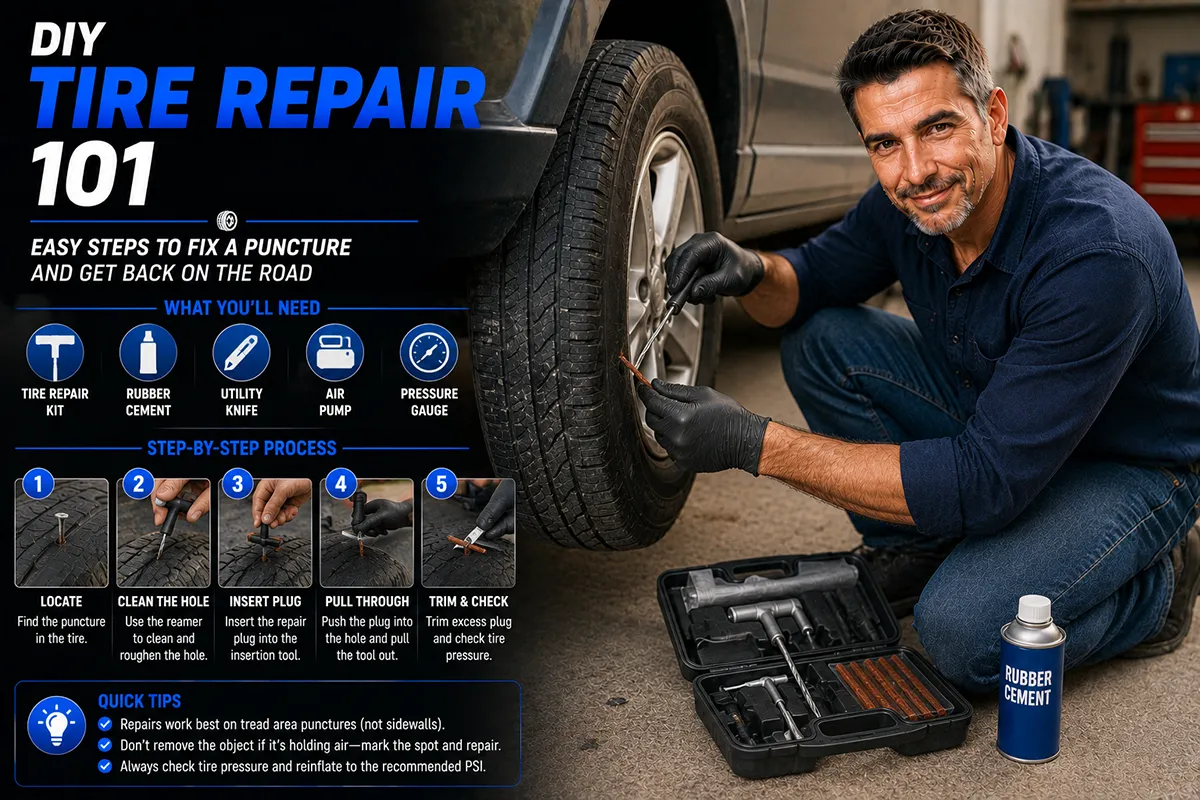
Step-by-Step: How to Plug a Tire (My Proven Method)
This is the repair method I use most often, and the one I recommend for most US drivers as an emergency fix. I’ve walked dozens of people through this process, and I’ve never had someone tell me they couldn’t do it.
Let me take you through it exactly as I do it.
Step 1: Find the Puncture
If the nail or screw is still embedded in the tire, finding the puncture is easy — just look for the foreign object sticking out of the tread.
If you can’t see anything obvious, inflate the tire to its recommended pressure (check the driver’s side door jamb sticker) and spray it with soapy water. Bubbles will form right at the leak location. I usually start with the tread area and work outward because that’s where 90% of punctures occur.
Step 2: Assess Whether It’s Repairable
Before you touch anything, confirm the puncture meets the criteria I outlined above. Is it in the tread? Is it 1/4 inch or smaller? Is the tire in otherwise good condition?
If the answer to any of these is “no,” stop here. Put on your spare or call for a tow. I know it’s frustrating, but I’d rather you be frustrated than risk a blowout at highway speed.
Step 3: Remove the Foreign Object
Grab your pliers and pull the nail, screw, or debris straight out. Don’t angle it — you want to disturb the puncture channel as little as possible.
You’ll likely hear a rush of air when you pull it out. That’s normal and expected. Work quickly through the next steps.
Step 4: Ream the Hole
Take the reaming tool (it looks like a round file with a handle) from your plug kit. Insert it into the puncture and work it in and out several times.
This step does two things: it cleans the puncture channel of debris, and it slightly enlarges the hole so the plug can fit. I usually ream the hole 8-10 times, rotating the tool as I go. Don’t be gentle — you need to rough up the rubber so the plug will bond properly.
Step 5: Thread the Plug
Take one rope plug from your kit and thread it through the eye of the insertion tool. Center the plug so equal lengths hang on each side of the tool.
Apply a generous amount of rubber cement to the plug. Some kits include rubber cement, some don’t — if yours doesn’t, pick up a small tube from any auto parts store for about $3. I coat the plug liberally and also squeeze some cement directly into the puncture hole.
Step 6: Insert the Plug
Push the insertion tool straight into the puncture with firm, steady pressure. You’ll feel resistance — that’s normal. Keep pushing until only about 1/2 inch of plug material sticks out above the tread surface.
Now here’s the critical part: pull the insertion tool straight out with a quick, firm yank. The tool’s eye is designed to release the plug material, leaving it embedded in the tire. The plug should stay in place with a little bit poking out.
The first time I did this, I was nervous I’d pull the plug back out. I didn’t, and neither will you — just commit to a confident, straight pull.
Step 7: Trim the Excess
Use a razor blade or sharp knife to trim the protruding plug material flush with the tread surface. Don’t cut it below the tread — you want it perfectly level.
Step 8: Inflate and Check
Use your portable compressor to inflate the tire to the manufacturer’s recommended PSI. Then spray the repaired area with soapy water and watch closely for at least 30 seconds.
No bubbles? You’re good. If you see small bubbles forming, the plug may not have seated correctly. In my experience, you can often fix this by inserting a second plug right alongside the first one — though at that point, I’d recommend heading to a shop for a proper patch-plug.
Step 9: Drive and Monitor
After the repair, I drive at moderate speeds for the first few minutes, then stop and recheck the pressure. I check it again after a few hours and then once more the next morning.
If the tire is holding pressure with no loss, the plug is doing its job. I still recommend getting to a tire shop within a week or two for a permanent patch-plug repair, but a good plug will get you there safely and reliably.
Common Mistakes I See (and How to Avoid Them)
After helping so many people with tire repairs, I’ve seen every mistake in the book. Here are the ones that come up most often.
Mistake #1: Not Reaming the Hole Properly
Many beginners skip the reaming step or do it too gently. If you don’t ream the hole adequately, the plug won’t grip, and it’ll leak or blow out. I can’t stress this enough — ream aggressively.
Mistake #2: Leaving the Nail In and Adding Sealant
I’ve seen people spray Fix-a-Flat over a nail that’s still embedded in the tire. This accomplishes almost nothing. The nail will continue to work its way in and out as the tire flexes, and the sealant can’t form a proper bond around a foreign object.
Mistake #3: Repairing Sidewall Damage
Every few months, someone asks me to plug a sidewall puncture. I always refuse, and so should you. The sidewall is the structural backbone of the tire, and no repair method can safely restore its integrity. I don’t care what your uncle’s friend says — replace the tire.
Mistake #4: Not Checking Pressure After the Repair
A repair isn’t complete until you’ve confirmed the tire holds pressure over time. I check at least three times in the first 24 hours. If I see even 1-2 PSI of loss, I know the repair needs to be redone or upgraded to a patch-plug.
Mistake #5: Ignoring the TPMS Light
If your TPMS (Tire Pressure Monitoring System) light comes on after a repair, don’t ignore it. It might mean the repair is leaking, or it might mean the TPMS sensor was damaged during the puncture. Either way, it needs attention.
When to Skip the DIY and Go to a Shop
I love a good DIY project, but I also know my limits. Here are the situations where I always recommend going to a professional tire shop.
You’re not confident in your assessment of the damage. If you’re unsure whether the puncture is in the tread or the shoulder, let a pro look at it. They can demount the tire and inspect the inside for hidden damage that you can’t see from the outside.
The tire has been driven flat for a significant distance. Internal damage from driving on a flat tire isn’t always visible externally. Steel belts can separate, and the inner liner can be shredded. A shop can inspect this properly.
It’s a high-performance or specialty tire. If you’re running UHP (Ultra High Performance) tires, low-profile tires, or run-flats, the stakes are higher. I wouldn’t DIY a repair on my summer performance tires — the speed ratings and the consequences of failure make professional repair worthwhile.
You need the repair to be permanent. A rope plug is a temporary fix. If you want a repair that will last the life of the tire, you need a patch-plug combo installed from the inside, and that means a tire shop with mounting equipment.
For context, most shops in the US charge between $25 and $35 for a patch-plug repair. Many tire retailers like Discount Tire, Costco, and America’s Tire will repair punctures for free if you purchased the tires from them. I always ask about this — it’s saved me money more than once.
A Word About Tire Repair Kits That Come With New Cars
If you’ve bought a new car in the last several years, you may have noticed something missing from the trunk: a spare tire. Many manufacturers now ship cars with a tire inflator kit and a can of sealant instead of a spare.
I have mixed feelings about this. On one hand, I understand the weight savings and packaging benefits. On the other hand, those kits are limited in what they can fix, and the sealant creates the same cleanup problems I mentioned earlier.
My recommendation? Keep the manufacturer’s kit in your trunk, but supplement it with a proper plug kit and a 12V compressor. The total investment is under $50, and it gives you far more capability than the OEM kit alone.
If your car has the space and you can find the right fit, I also recommend buying a compact spare tire from a junkyard or online. Having a real spare is still the best safety net.
How to Build the Habit of Tire Awareness
The best tire repair is the one you never have to make. I’ve developed a few habits over the years that have helped me catch problems early and avoid unexpected flats.
Do a Visual Walk-Around Weekly
Every Sunday morning when I walk to my car, I take 30 seconds to look at all four tires. I’m checking for obvious low pressure, embedded objects, sidewall damage, and uneven wear. This simple habit has caught multiple nails before they became full-blown flats.
Check Tire Pressure Monthly
I check my tire pressure on the first of every month. It takes two minutes with a digital gauge. Tires naturally lose 1-2 PSI per month, and the change of seasons can cause bigger swings (air contracts in cold weather, expands in heat).
Proper tire pressure isn’t just about avoiding flats — it affects fuel economy, tire wear, handling, and braking. In my experience, maintaining correct pressure has visibly extended the life of every set of tires I’ve owned.
Avoid Debris When Possible
I actively scan the road ahead for nails, screws, metal debris, and construction materials. I know this sounds obvious, but I’m amazed at how many drivers don’t pay attention to what’s on the road surface. If I see a construction zone, I’m extra vigilant and try to drive in the center of my lane away from the shoulders where debris accumulates.
Rotate Your Tires on Schedule
Regular tire rotation ensures even wear across all four tires. Even wear means consistent performance and fewer weak spots where damage can occur. I rotate my tires at regular intervals following the manufacturer’s schedule, and I inspect each tire closely during the process.
What About Tire Repair on the Highway?
This deserves its own section because the stakes are so much higher. I’ve done roadside repairs on busy highways, and safety is the number one concern — not the tire.
Pull as far off the road as possible. I mean as far as you can go — onto the shoulder, onto the grass, into a parking lot if one is nearby. Distance from traffic is everything.
Turn on your hazard lights immediately. Set out reflective triangles or flares if you have them. I keep a set of triangles in every vehicle.
If you don’t feel safe, don’t attempt the repair. Call for roadside assistance instead. AAA membership is about $60-$140 per year depending on your plan, and many auto insurance policies include roadside assistance. Your safety is worth more than saving money on a tow.
If you do decide to make the repair, work on the side of the vehicle that faces away from traffic whenever possible. Stay low and move deliberately. And keep your phone on and nearby in case you need to call 911.
My Final Thoughts on DIY Tire Repair
After years of doing this, I genuinely believe every driver in the US should know how to plug a tire. It’s a basic skill that takes 20 minutes to learn and could save you hours of waiting for a tow truck, hundreds of dollars in tow fees, or a dangerous situation on a dark highway.
But I want to be clear: a plug is a temporary fix, not a permanent solution. Every plugged tire should eventually get a proper patch-plug repair from a qualified tire shop. And any tire with sidewall damage, large punctures, or structural compromise should be replaced, no exceptions.
The best investment you can make right now is a $50 kit — a plug kit, a portable compressor, and a pressure gauge — stored in your trunk. After several days of just knowing it’s there, you’ll feel a level of confidence and preparedness that’s hard to put a price on.
I’ve personally used these tools and techniques in rain, in cold, in the dark, and in parking lots across multiple states. They work. And once you’ve done your first successful repair, you’ll wonder why you ever felt anxious about a flat tire.
Stay safe out there, keep your tires in good shape, and remember: the road doesn’t care about your schedule. Be prepared.
Frequently Asked Questions
Can I repair a tire myself or do I need to go to a shop?
You can absolutely handle a basic DIY tire repair at home if the puncture is in the tread area and smaller than 1/4 inch in diameter. A quality tire plug kit from brands like Slime or Boulder Tools costs between $8 and $15 at most auto parts stores and includes everything you need. However, if the damage is on the sidewall, near the shoulder, or larger than a quarter inch, you should replace the tire entirely rather than risk a blowout on the highway.
What is the best DIY tire repair kit for a punctured tire?
For most US drivers, a plug-and-patch combination kit offers the most reliable DIY tire repair. The Boulder Tools Heavy Duty Tire Repair Kit ($12–$20 on Amazon) and the Slime Tire Plug Kit are two of the most popular options and include reaming tools, insertion needles, rubber cement, and multiple plug strips. I always recommend keeping one of these kits in your trunk alongside a portable 12V tire inflator, which typically runs $30–$50 and saves you from being stranded.
Is it safe to drive on a plugged tire long-term?
A properly installed tire plug can safely last the remaining life of the tread in many cases, but most tire professionals and the US Tire Manufacturers Association recommend following up with an internal plug-patch combo for a permanent fix. I would avoid relying on a plug alone for sustained highway driving above 65 mph or in extreme weather conditions common in states with harsh winters. If you plan to keep the tire long-term, budget $20–$40 for a shop to apply a proper internal patch over your plug.
How do I find a nail or screw in my tire before it goes flat?
The easiest method is to spray the entire tire surface with soapy water and look for bubbles forming around the puncture site, which indicates escaping air. You can also listen for a faint hissing sound in a quiet garage or visually inspect the tread by slowly rotating the tire and checking for any embedded nails, screws, or glass. If your TPMS warning light comes on but you cannot see obvious damage, check your tire pressure with a gauge since a slow leak may lose only 1–2 PSI per day and the object may be nearly flush with the tread.
When should I replace a tire instead of trying a DIY repair?
You should skip the DIY repair and shop for a replacement tire if the puncture is in the sidewall, if the damage is larger than 1/4 inch, or if the tire has already been repaired twice before. Tires with tread depth below 3/32 of an inch are also not worth repairing since they are close to the legal minimum in most US states and will need replacing soon anyway. A single new all-season tire from brands like Cooper, General, or Hankook typically costs $80–$150 installed and balanced, which is a worthwhile investment over risking a compromised repair.
How do you use a tire plug kit step by step?
Start by locating the puncture and removing the nail or screw with pliers, then insert the reaming tool into the hole and work it in and out several times to clean and widen the channel. Next, thread a plug strip through the eye of the insertion needle, apply rubber cement to the plug, and push the needle straight into the hole until about half an inch of plug remains visible above the tread surface. Pull the needle out quickly, trim the excess plug flush with the tread, and reinflate the tire to the PSI listed on your driver-side door jamb sticker — the entire process typically takes under 15 minutes.
Does a DIY tire repair void my tire warranty?
Most major tire manufacturers like Goodyear, Michelin, and Bridgestone will still honor tread-life warranties if the repair was done correctly in the repairable area of the tread, but a plug-only fix without an internal patch may give them grounds to deny a claim. I recommend saving your purchase receipt and having a tire shop apply a proper internal patch over your DIY plug if you want to keep your warranty fully intact. Always check the specific warranty terms that came with your tires, since policies vary between brands and some require that repairs be performed by certified dealers.
