

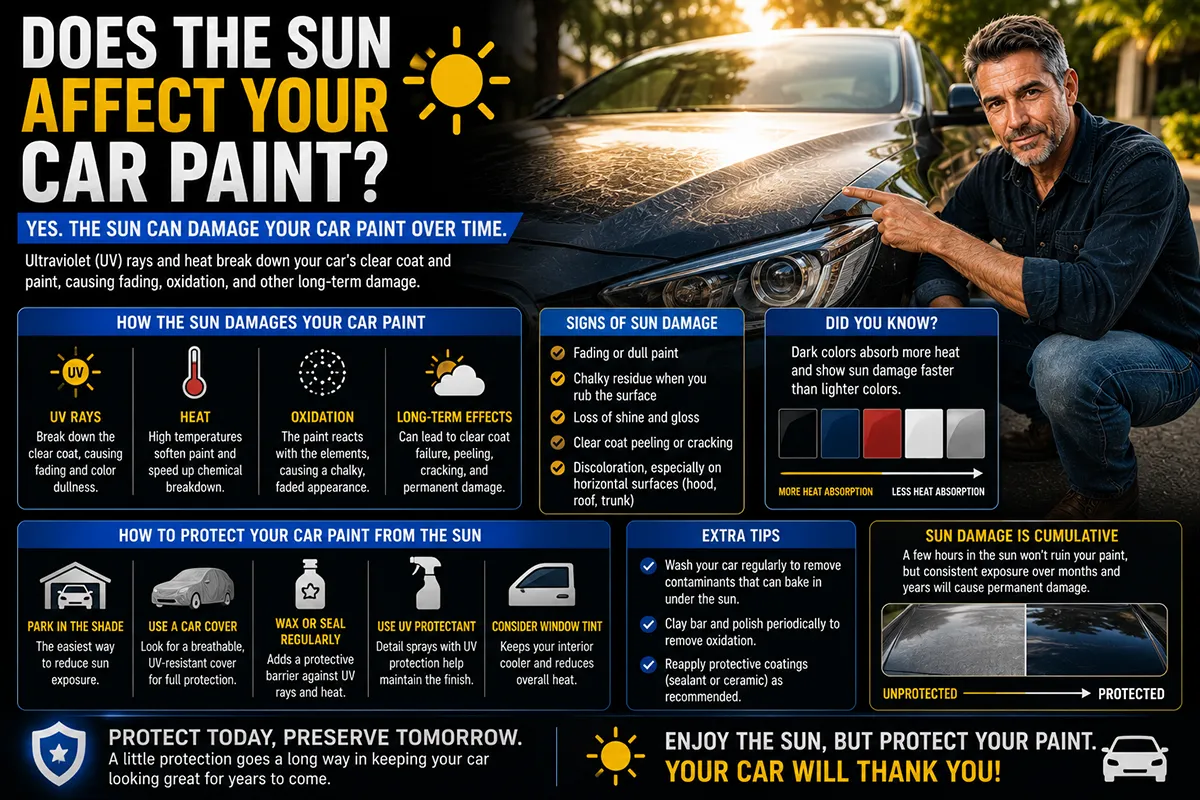
I parked my black sedan outside a Phoenix office building for an entire summer, and when fall arrived, the hood looked like it had aged a decade.
The clear coat was flaking, the color had faded from a deep obsidian to a chalky gray-black, and the roof felt rough to the touch like fine sandpaper.
That was my wake-up call — and it’s the reason I now obsess over how the sun destroys car paint and what you can actually do about it.
- UV radiation from the sun breaks down your car’s clear coat and pigment molecules, causing fading, oxidation, peeling, and cracking.
- Dark-colored cars and vehicles parked outdoors in Sun Belt states are most vulnerable.
- Regular washing, waxing, ceramic coatings, paint protection film, and covered parking are the most effective defenses.
- Your tires are also affected — UV degrades rubber compounds, which is why tire dressings and proper storage matter.
- Protecting your car’s exterior is an investment that preserves resale value and keeps your vehicle looking sharp for years.
Liked this article?
Add TireAdvise as a preferred source so you see more of our tire reviews and guides on Google.
Yes, the Sun Absolutely Damages Your Car Paint
Let me be blunt: the sun is the single biggest environmental threat to your vehicle’s exterior finish. I’ve seen it firsthand on my own cars and on hundreds of vehicles I’ve inspected over the years while reviewing tires and automotive products.
The culprit is ultraviolet (UV) radiation — the same invisible energy that gives you a sunburn. It penetrates your car’s clear coat and attacks the molecular bonds in the paint beneath.
Over time, this UV exposure causes a process called photo-oxidation. The paint’s pigments break down, colors fade, and the once-glossy finish turns dull and chalky. I’ve watched this happen on my own daily driver in as little as one harsh summer when I neglected proper protection.
How UV Radiation Damages Paint at a Molecular Level
I’m not a chemist, but I’ve spent enough time talking to detailers, body shop technicians, and paint protection specialists to understand the basic science. Here’s what actually happens when sunlight hits your car.
Clear Coat Degradation
Your car’s finish typically has four layers: the metal body panel (or substrate), a primer layer, the base coat (color), and the clear coat on top. The clear coat is your paint’s first line of defense against UV, and it’s the first thing the sun destroys.
UV rays cause the chemical bonds in the clear coat to break apart. In the industry, this is called “chain scission.” As these polymer chains shatter, the clear coat becomes brittle, develops micro-cracks, and eventually peels off entirely.
I’ve seen cars where the clear coat failure was so severe that the base color was exposed directly to the elements. At that point, you’re looking at a respray — and that’s a $3,000 to $7,000 bill depending on your vehicle and paint quality.
Pigment Fading
Once UV penetrates through a weakened clear coat, it starts attacking the pigment molecules in the base coat. Red pigments are notoriously vulnerable — which is why I’ve noticed red cars tend to fade to a pinkish hue faster than other colors.
The energy from UV photons breaks apart the chromophore structures that give paint its color. This process is irreversible without repainting.
Oxidation
UV exposure also accelerates oxidation, which is essentially the paint reacting with oxygen in the air. The result is that powdery, chalky film you can sometimes wipe off a neglected car’s surface with your finger.
In my experience, oxidation is the most common form of sun damage I see on vehicles in the southern United States. Cars parked permanently outdoors in states like Texas, Arizona, Florida, and California show signs of oxidation far earlier than vehicles in the Pacific Northwest or Northeast.
Which Colors Are Most Vulnerable to Sun Damage?
I get asked this question all the time, and the answer surprised me when I first learned it. Here’s a breakdown based on what I’ve observed and what the science supports.
| Paint Color | UV Vulnerability | Why | My Observation |
|---|---|---|---|
| Red | Very High | Red pigments absorb more UV energy and break down fastest | I’ve seen red trucks in Texas fade to pink in just a couple of years of outdoor parking |
| Black | High | Absorbs maximum heat and UV; clear coat stress is amplified | My black sedan’s clear coat failed on the roof and hood first — the flattest, most sun-exposed panels |
| Dark Blue | High | Similar UV absorption characteristics to black | Dark blue vehicles show swirl marks and fading more visibly than lighter shades |
| Yellow / Orange | Moderate-High | Organic pigments used in these colors degrade faster | Less common, but I’ve noticed fading on yellow sports cars left in dealer lots |
| Silver / Gray | Low | Metallic flakes reflect UV; lighter color absorbs less heat | Silver cars hide sun damage better than any other color I’ve worked with |
| White | Lowest | Reflects most UV radiation; stays coolest | White vehicles still get oxidation, but fading is far less noticeable |
If you drive a dark-colored vehicle and live in the Sun Belt, you need to be especially proactive about paint protection. I learned this the hard way.
The Heat Factor: It’s Not Just UV
Something a lot of people overlook is that it’s not only UV radiation doing the damage — it’s also the sheer heat generated by direct sunlight. On a summer day in Phoenix, Las Vegas, or Dallas, a car’s exterior surface temperature can exceed 200°F.
That kind of heat causes the clear coat and paint to expand and contract repeatedly. Over time, this thermal cycling creates micro-fractures that allow moisture, dirt, and more UV to penetrate deeper into the paint system.
I’ve measured surface temperatures on black cars in direct Arizona sun using an infrared thermometer, and the numbers are genuinely alarming. The roof of a black SUV I was testing hit 197°F in July. Meanwhile, a white sedan parked next to it measured about 140°F — still hot, but a massive difference in thermal stress.
Where Sun Damage Shows Up First
In my experience inspecting vehicles, sun damage doesn’t appear uniformly. It targets specific areas first, and knowing where to look can help you catch problems early.
Roof and Hood
These are the two flattest, most horizontally oriented panels on your car. They receive the most direct sunlight, especially during peak UV hours between 10 AM and 4 PM. Every car I’ve seen with serious sun damage had it worst on the roof and hood.
Trunk Lid and Rear Deck
Same principle — these surfaces face the sky and catch maximum UV exposure. On sedans, the trunk lid is often the third area to show fading after the roof and hood.
Upper Door Panels and A-Pillars
The upper portions of doors and the pillars around the windshield get consistent sun exposure throughout the day as the sun moves across the sky.
Headlights and Trim
While we’re talking about sun damage, I want to mention that UV doesn’t just attack paint. I’ve noticed headlight lens yellowing, rubber trim cracking, and plastic molding fading on cars that spend their lives outdoors. The sun degrades virtually every exterior material on your vehicle.
How Sun Damage Affects Your Tires Too
Since TireAdvise.com is my home base, I’d be remiss if I didn’t connect this to tires — because UV radiation is one of the most underappreciated enemies of tire rubber.
The same UV photons that destroy your paint also break down the polymer chains in tire rubber through a process called UV-initiated oxidation. This causes dry rot, sidewall cracking, and premature hardening of the rubber compound.
I’ve reviewed tires that looked like they had plenty of tread depth left but were completely unsafe because the rubber had dried out from prolonged sun exposure. This is especially common on vehicles that sit for extended periods — RVs, trailers, classic cars, and daily drivers owned by people who work from home and don’t drive often.
Here’s what I recommend for protecting your tires from the sun:
- Use a quality UV-protectant tire dressing. I’ve had great results with products like 303 Aerospace Protectant and Chemical Guys VRP. They leave a protective barrier that blocks UV rays without that overly shiny, greasy look.
- Park in the shade whenever possible. This protects both your paint and your tires simultaneously.
- Use tire covers for stored vehicles. If you have an RV, trailer, or any vehicle that sits for weeks at a time, invest in a set of tire covers. They cost $25 to $50 for a set of four and can add years to your tires’ life.
- Rotate your tires on schedule. While this doesn’t prevent UV damage directly, it ensures even wear so you’re not running on one set of sun-damaged tires longer than the others.
7 Proven Ways to Protect Your Car Paint From the Sun
Now let’s get into the solutions. I’ve personally tried every method on this list, and I’ll share what worked, what didn’t, and what I think is worth the money.
1. Wash Your Car Regularly
This sounds basic, but it’s foundational. Dirt, bird droppings, tree sap, and road grime contain acidic compounds that accelerate sun damage. When UV hits a dirty surface, it essentially bakes those contaminants into the clear coat.
I wash my daily driver every two weeks and my weekend car every week during summer. I use a pH-neutral car wash soap (Meguiar’s Gold Class is my go-to) and the two-bucket method to avoid swirl marks.
A clean car is a car that’s better equipped to resist UV. It’s that simple.
2. Apply Wax or Sealant Every 2-3 Months
Car wax creates a sacrificial layer between the sun and your clear coat. I’ve tested dozens of waxes over the years, and for UV protection specifically, I recommend carnauba-based waxes for the best results.
My favorites include Collinite No. 845 Insulator Wax (about $18 for a can that lasts forever) and P21S Carnauba Wax (around $35 but easier to apply). Both provide excellent UV shielding and water beading.
Synthetic paint sealants last longer than traditional waxes — typically three to six months versus six to eight weeks for carnauba. If you want maximum durability with less frequent application, consider a sealant like Jescar Power Lock Plus.
I personally use a sealant as a base layer and then top it with carnauba wax for the best of both worlds. The sealant provides long-term UV protection, and the wax adds depth and gloss.
3. Invest in Ceramic Coating
Ceramic coatings are the gold standard for paint protection in my book. I had a professional ceramic coating applied to my current daily driver, and after several years of daily outdoor parking, the paint still looks factory-fresh.
A ceramic coating creates a semi-permanent chemical bond with your clear coat. It provides UV protection, hydrophobic properties (water beads and rolls off), and chemical resistance against bird droppings, bug splatter, and industrial fallout.
Professional-grade ceramic coatings from brands like Gtechniq, Ceramic Pro, and Modesta typically cost $800 to $2,500 depending on the package and your vehicle’s size. DIY options like Adam’s UV Ceramic Paint Coating Kit or CarPro CQuartz run $50 to $100 and deliver solid results if you’re comfortable doing the prep work.
I’ve used both professional and DIY coatings, and here’s my honest take: professional coatings are worth it if you plan to keep your vehicle for many years. The prep work (clay bar, paint correction, panel wipe) is what makes or breaks a ceramic coating, and professionals simply do it better.
4. Use Paint Protection Film (PPF)
Paint Protection Film is a clear, thermoplastic urethane film that’s applied directly to your car’s painted surfaces. It provides the ultimate physical barrier against UV rays, rock chips, scratches, and staining.
I had XPEL Ultimate Plus applied to the full front end of my vehicle (hood, fenders, bumper, mirrors) and it runs about $1,500 to $2,500 for partial coverage. Full-body PPF can cost $5,000 to $8,000 depending on the vehicle and installer.
Is it expensive? Yes. Is it worth it? For high-value vehicles or cars you plan to keep long-term, absolutely. The film itself has built-in UV inhibitors that protect both itself and the paint underneath. Modern PPF from top brands like XPEL, SunTek, and 3M also has self-healing properties — light scratches in the film disappear with heat exposure.
5. Park in the Shade or Use a Car Cover
This is the most cost-effective protection available. I always look for covered parking, shade trees, or parking garages when I’m out during the day. It’s a habit that takes zero extra money and massively reduces UV exposure.
When covered parking isn’t available, I use a quality car cover for my weekend car. I recommend the Covercraft Block-It 380 (around $150 to $250) or the California Car Cover Superweave (around $200 to $350). Both provide excellent UV protection, breathability, and soft inner linings that won’t scratch your paint.
One tip I’ve learned: never put a car cover on a dirty car. Dust and debris trapped between the cover and the paint act like sandpaper when the cover moves in the wind. Always wash and dry your car before covering it.
6. Use a Windshield Sunshade
While this primarily protects your interior from UV fading and heat damage, a windshield sunshade also reduces the overall temperature inside and on the surface of your vehicle. This means less thermal stress on the paint and trim around the windshield area.
I use the WeatherTech TechShade (about $60 to $80) because it’s custom-fit to my windshield and actually stays in place. Generic accordion-style sunshades work too, but they never fit properly and tend to fall down.
7. Apply UV-Protectant Products to Trim and Rubber
Your painted surfaces aren’t the only things at risk. Black plastic trim, rubber seals, and weatherstripping all degrade from UV exposure. I apply Cerakote Ceramic Trim Coat (about $15) to all exterior black trim every six months or so. It restores faded trim to a deep black and provides UV protection that lasts impressively long.
For rubber door seals and weatherstripping, I use 303 Aerospace Protectant. A quick wipe-down during every wash keeps rubber supple and prevents cracking.
How Much Does Sun Damage Cost to Repair?
If you’ve already got sun damage, here’s what you’re looking at for repair costs based on my conversations with body shop professionals and my own experiences getting quotes.
- Light oxidation (dull, hazy finish): A professional paint correction with a dual-action polisher can restore this. Cost: $200 to $500 depending on severity and vehicle size. I’ve done this myself with a Griots Garage G9 polisher and Meguiar’s compound — it’s satisfying work if you have patience.
- Moderate clear coat failure (peeling on one or two panels): The affected panels need to be sanded, primed, and re-cleared. Cost: $300 to $800 per panel at a quality body shop.
- Severe fading and oxidation (entire vehicle): A full repaint is often the only option. A quality single-stage respray costs $1,500 to $3,500 at shops like Maaco (base level) to Earl Scheib. A high-quality basecoat/clearcoat respray at a reputable body shop runs $3,000 to $7,000 or more.
- Show-quality or factory-match repaint: $7,000 to $15,000+ depending on the color, number of coats, and level of prep work.
When you compare these repair costs to the cost of prevention — a $20 can of wax, a $150 car cover, or even a $1,500 ceramic coating — the math is overwhelmingly in favor of proactive protection.
Sun Damage and Resale Value: What the Numbers Say
I’ve sold several vehicles over the years, and paint condition is one of the first things buyers and dealers evaluate. A car with faded, oxidized, or peeling paint will sell for significantly less than an identical vehicle with a well-maintained finish.
According to industry data from Kelley Blue Book and NADA guides, a vehicle in “Fair” condition (which includes visible paint deterioration) can be worth 20% to 30% less than one in “Good” or “Excellent” condition. On a vehicle worth $20,000, that’s a $4,000 to $6,000 difference.
I’ve personally experienced this gap. When I sold my sun-damaged black sedan, I was offered $3,500 less than comparable models in better cosmetic shape. That’s a painful lesson I only needed to learn once.
Regional Considerations Across the US
Sun damage isn’t equal across the country. Where you live and drive plays a huge role in how aggressively you need to protect your paint.
Sun Belt States (Arizona, Nevada, Texas, Florida, Southern California)
These states get the most intense UV exposure in the country. I’ve lived and driven in both Arizona and Texas, and the sun is relentless. If you live in these areas and park outdoors, I’d consider paint protection film or ceramic coating as essential — not optional.
The combination of extreme UV, high temperatures, and (in coastal Florida) salt air creates a triple threat for your car’s finish.
Mountain West (Colorado, Utah, New Mexico)
Higher elevation means thinner atmosphere and more intense UV radiation. Denver, for example, receives about 25% more UV than cities at sea level. If you live in the mountain states, don’t assume your cooler temperatures protect your paint — the UV is actually stronger.
Pacific Northwest and Northeast
These regions get less UV exposure overall, but summer months can still be harsh. More importantly, these areas have other environmental threats like road salt, acid rain, and tree sap that work in tandem with whatever UV exposure your car does get.
I recommend at minimum a quality wax or sealant applied regularly, even in less sunny climates. UV is present year-round — even on cloudy days, about 80% of UV radiation passes through clouds.
A Year-Round Sun Protection Schedule
Based on everything I’ve learned from personal experience and talking with professional detailers, here’s the protection schedule I follow and recommend:
Spring
- Full wash and clay bar treatment to remove winter contaminants
- Apply paint sealant as a base layer
- Apply carnauba wax on top
- Treat all exterior trim with UV protectant
- Apply UV-protectant tire dressing
Summer
- Wash every one to two weeks
- Reapply spray wax or quick detailer after every wash
- Park in shade whenever possible
- Use windshield sunshade daily
- Inspect for new paint damage monthly
Fall
- Full wash to remove summer bug splatter, bird droppings, and tree sap
- Reapply paint sealant
- Reapply wax
- Retreat exterior trim
- Check tires for signs of UV degradation (sidewall cracking)
Winter
- Wash regularly to remove road salt and brine (if applicable)
- Apply spray sealant or spray wax as a touch-up
- Store vehicle under a cover if not driving regularly
- Use tire covers on stored vehicles
Common Myths About Sun Damage to Car Paint
I want to address a few myths I hear constantly, because misinformation can lead to wasted money or neglected protection.
Myth: “Garage-kept cars don’t need wax or coating.”
Wrong. Even if you park in a garage at home, your car is exposed to UV every time you drive it. Unless your car literally never sees sunlight, it needs protection. I keep my garage-stored weekend car waxed and coated because even weekend drives accumulate UV exposure over time.
Myth: “Modern clear coats are UV-proof.”
Modern clear coats are better than those from the 1980s and 1990s, but they are absolutely not UV-proof. They contain UV absorbers and hindered amine light stabilizers (HALS), but these additives deplete over time with sun exposure. Think of them as sunscreen that slowly wears off.
Myth: “Dark cars get hotter, so light cars are always better.”
While it’s true that dark colors absorb more heat, light-colored cars still suffer from UV damage. White cars can develop yellowing and oxidation. Silver cars show less visible damage, but their clear coats still degrade. Color choice can reduce the rate of damage, but it doesn’t eliminate it.
Myth: “Dish soap is fine for washing your car.”
Dish soap strips wax, sealant, and even ceramic coating protection. Every time you wash with dish soap, you’re removing the UV barrier you spent time or money applying. Use a pH-neutral automotive wash soap. Always.
My Final Recommendation
After years of testing products, dealing with sun damage on my own vehicles, and talking to professional detailers and body shop technicians across the country, here’s my bottom line.
If you live anywhere in the United States, your car’s paint is at risk from the sun. Period. The degree of risk varies by region, color, and how you store your vehicle, but no car is immune.
The minimum you should do is wash regularly with proper soap and apply wax or sealant every two to three months. If you want better protection, add a ceramic coating. If you want the best protection money can buy, combine ceramic coating with paint protection film on high-impact areas.
And don’t forget your tires. UV degrades rubber just as surely as it degrades paint. A quality tire dressing with UV protection, shade parking, and tire covers for stored vehicles will keep your rubber in safe, reliable condition far longer.
The sun isn’t going anywhere, but with the right habits and products, your car’s finish doesn’t have to suffer because of it. I’ve made every mistake in the book — parking uncovered in the desert, skipping wax for months, even using dish soap — and I’ve paid for every one of those shortcuts. You don’t have to.
Protect your paint. Protect your tires. Protect your investment.
Frequently Asked Questions
Does the sun really damage your car paint over time?
Yes, prolonged UV exposure breaks down your car’s clear coat and base paint through a process called photo-degradation. Over months and years of parking in direct sunlight, especially in states like Arizona, Texas, and Florida, you’ll notice fading, oxidation, and a chalky appearance. This damage is cumulative, so even short daily exposures add up significantly over a vehicle’s lifetime.
How does UV damage to car paint compare to UV damage on tires?
UV rays attack both your paint and your tires through similar oxidation processes, but tires suffer structural damage that directly impacts safety. While faded paint is cosmetic, UV-degraded tires develop dry rot and sidewall cracking that can lead to blowouts at highway speeds. If your paint is visibly sun-damaged, it’s a strong sign you should also inspect your tires for UV-related wear and consider shopping for replacements.
What color car paint fades the fastest in the sun?
Red and black car paint tend to fade the fastest under direct sunlight because red pigments absorb more UV radiation and black surfaces reach higher temperatures, accelerating oxidation. White and silver vehicles hold up better in sunny climates but are not immune to clear coat damage. Regardless of color, regular waxing or ceramic coating every 3-6 months can significantly slow sun damage and keep your finish looking new.
Can parking in the sun damage more than just my car’s paint?
Absolutely. Direct sun exposure degrades your dashboard, causes rubber seals and weather stripping to crack, and significantly shortens tire lifespan through UV-induced dry rot. Interior temperatures in a parked car can exceed 170°F in US summer conditions, warping plastics and damaging electronics. I always recommend a combination of covered parking, a quality car cover, and UV-protectant products for both your exterior and tires.
How can I protect my car paint and tires from sun damage in hot US states?
The best protection strategy includes parking in shade or using a UV-reflective car cover, applying a ceramic coating or quality wax to your paint at least twice a year, and using a tire protectant with UV blockers on your sidewalls monthly. In extreme-sun states like Nevada, California, and Texas, these steps can extend your paint life by years and help prevent premature tire sidewall cracking. Budget around $30-$50 for a good tire UV protectant and $20-$80 for quality car wax or sealant.
How do I know if sun damage on my tires means I need replacements?
Check your tire sidewalls for visible cracking, a grayish-brown discoloration, or a brittle texture when you press on the rubber — these are classic signs of UV-induced dry rot. If cracks are deeper than 1/16 of an inch or you see cracking along the tread grooves, it’s time to replace them regardless of remaining tread depth. Tires older than 5-6 years in sunny US climates are especially vulnerable, and I recommend brands like Michelin, Bridgestone, or Continental that use advanced UV-resistant rubber compounds for hot-weather driving.
Does waxing your car actually prevent sun damage to the paint?
Yes, a quality car wax or paint sealant creates a sacrificial barrier that absorbs UV rays before they reach your clear coat, much like sunscreen protects your skin. For best results, I apply a UV-protective wax every 2-3 months or invest in a professional ceramic coating that can last 2-5 years and costs between $500 and $2,000 depending on your area. Pairing paint protection with tire-specific UV treatments ensures your entire vehicle stays protected from the harsh US sun.
