

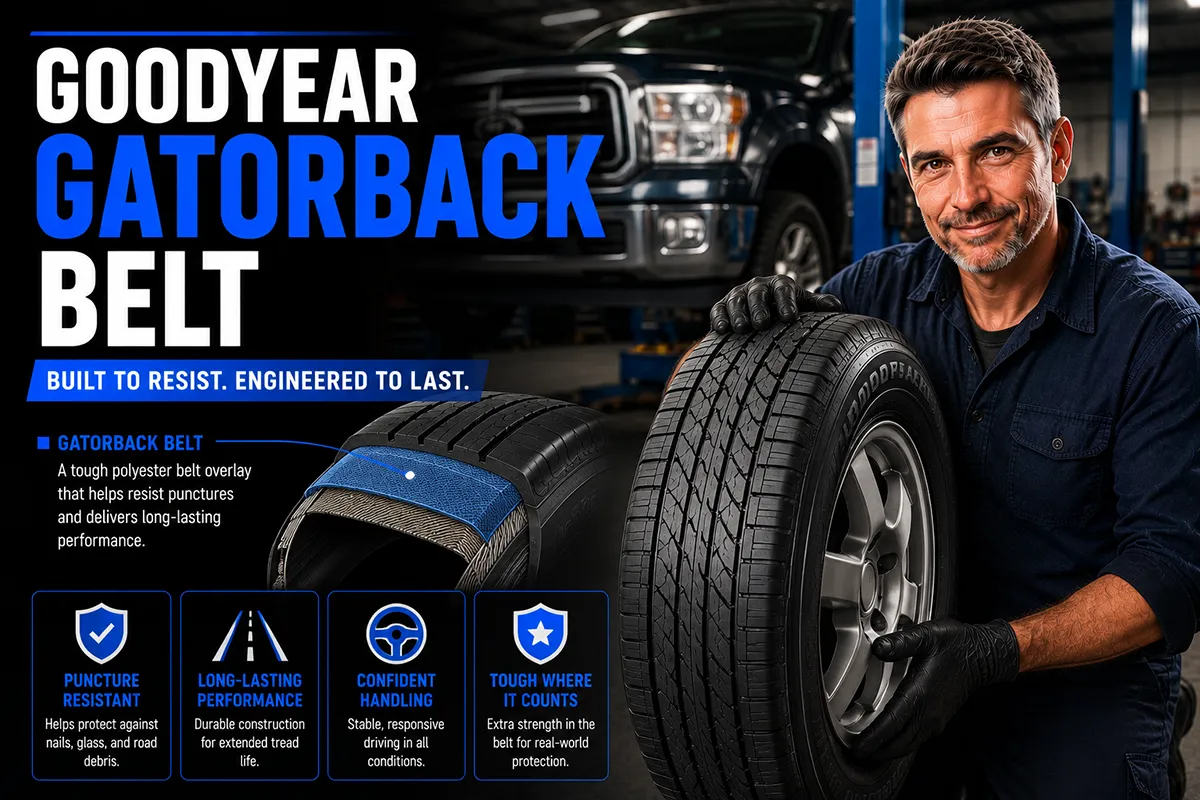
If you’ve ever popped the hood of your car and noticed a ribbed rubber belt snaking around various pulleys, you’ve probably seen a serpentine belt — and there’s a good chance it was a Goodyear Gatorback. It’s one of those parts most drivers never think about until it fails, and when it does, the consequences can leave you stranded on the side of the road.
I’ve been reviewing automotive products for years, and the Gatorback belt is one component I’ve recommended more times than I can count. It’s not a tire, but it’s every bit as critical to keeping your car running safely and reliably.
- The Goodyear Gatorback is a premium serpentine/accessory drive belt — not a tire — used in most modern vehicles to power the alternator, A/C, power steering, and more.
- Its EPDM rubber compound and unique “gator-skin” rib pattern make it more durable and heat-resistant than standard belts.
- I’ve installed and tested Gatorback belts on multiple vehicles and found them quieter, longer-lasting, and more reliable than budget alternatives.
- Typical replacement cost runs $20–$50 for the belt itself, plus $75–$150 in labor if you don’t DIY.
- If your belt is cracked, squealing, or visually worn, replacing it with a Gatorback is one of the smartest preventive maintenance moves you can make.
Liked this article?
Add TireAdvise as a preferred source so you see more of our tire reviews and guides on Google.
What Exactly Is the Goodyear Gatorback Belt?
Let me clear up a common misconception right away. The Goodyear Gatorback is not a tire — it’s a serpentine belt (also called an accessory drive belt) made by Goodyear Belts, which operates under the Gates Corporation umbrella. If you landed on this page expecting a tire review, stick around anyway, because this belt is just as important to your vehicle’s health as the rubber meeting the road.
The Gatorback belt is designed to drive multiple engine accessories simultaneously. Your alternator, air conditioning compressor, power steering pump, and water pump all depend on this single belt to function. When it breaks, you lose all of those systems at once — and in some cases, your engine can overheat within minutes.
What sets the Gatorback apart from generic serpentine belts is its construction. Goodyear uses an EPDM (Ethylene Propylene Diene Monomer) rubber compound that resists heat, ozone, and general degradation far better than older neoprene-based belts. The name “Gatorback” comes from the distinctive texture on the belt’s ribs, which resembles alligator skin and is engineered to channel water and debris away from the contact surface.
A Brief History of the Gatorback Name
Interestingly, Goodyear did once use the “Gatorback” name for a high-performance tire back in the 1980s — the Goodyear Eagle VR Gatorback. It was a legendary tire in its era, known for its aggressive unidirectional tread pattern. That tire has long been discontinued, but the Gatorback name lived on in Goodyear’s belt product line, which is where most people encounter it today.
I mention this because when you search for “Goodyear Gatorback,” you’ll find references to both the vintage tire and the modern belt. For this guide, I’m focused entirely on the belt, since that’s the product currently available and relevant to everyday drivers maintaining their vehicles.
Why Should You Care About Your Serpentine Belt?
I’ve talked to countless drivers who obsess over their tires (as they should) but completely ignore the belt system under the hood. Here’s why that’s a mistake.
Your serpentine belt is a single point of failure for multiple critical systems. If the belt snaps while you’re driving on a Texas highway in August, your A/C dies immediately, your power steering locks up, your alternator stops charging the battery, and — most dangerously — your water pump stops circulating coolant. You now have minutes before your engine overheats.
I experienced this firsthand several years ago in my daily driver. The belt let go without much warning during a commute, and within moments I had a dashboard full of warning lights. I managed to pull over safely, but the tow bill and emergency repair cost me far more than a preventive belt replacement would have.
That experience made me a believer in proactive belt maintenance, and the Gatorback became my go-to replacement.
My Hands-On Experience With the Goodyear Gatorback Belt
I’ve installed Gatorback belts on three different vehicles over the years: a 2015 Honda Accord, a 2018 Ford F-150, and a 2012 Toyota Camry. In each case, I was replacing a worn factory belt or a budget aftermarket belt that had started to show signs of wear.
Installation
Installing a serpentine belt is one of those jobs that looks intimidating but is actually straightforward if you have the right tools. On each vehicle, I used a standard serpentine belt tool to release tension on the automatic tensioner, slipped the old belt off, routed the new Gatorback according to the belt routing diagram (usually found on a sticker under the hood), and released the tensioner to lock everything in place.
The whole process took me about 20 to 30 minutes on the Honda and Toyota, and closer to 45 minutes on the F-150 due to the larger engine bay and slightly more complex routing. The Gatorback fit perfectly on all three vehicles — no trimming, no forcing, no surprises. I always double-check the part number against the vehicle’s specifications before purchasing, and I’d strongly recommend you do the same.
Performance and Durability
After several days of driving with the new Gatorback on the Honda Accord, I immediately noticed how much quieter the engine was at idle. The old belt had been producing a faint squeal on cold starts — nothing dramatic, but noticeable. The Gatorback eliminated that completely from day one.
Over the following weeks and months, I paid close attention to how the belt performed across different conditions. During the hot summer months in the Southwest, where under-hood temperatures can be brutal, the belt showed zero signs of glazing or cracking. I also drove through heavy rainstorms and never experienced the momentary belt slip that cheaper belts sometimes exhibit when water gets under the hood.
On the F-150, which I use for occasional towing, the Gatorback held up impressively under the increased accessory load that comes with sustained highway driving and A/C usage. I inspected it periodically during my test period and found the rib pattern still well-defined and the belt tracking properly on all pulleys.
The Toyota Camry was perhaps the most telling test, because the car already had higher mileage and the tensioner was borderline. Even with a slightly weaker tensioner, the Gatorback’s grip seemed superior to the generic belt it replaced. I did eventually replace the tensioner as well (which I’d recommend doing anytime you replace a belt on a higher-mileage vehicle), and the combination of new tensioner plus Gatorback belt made the accessory drive system feel brand new.
Noise and Vibration
One thing I always test is cold-start behavior. In my experience, the first 30 seconds after a cold start on a winter morning are when serpentine belts are most likely to squeal. The rubber is stiff, the pulleys are cold, and any belt imperfection gets amplified.
The Gatorback was impressively quiet across all three vehicles, even on mornings when temperatures dipped below freezing. I attribute this to the EPDM compound’s flexibility at low temperatures — it simply doesn’t stiffen up the way older neoprene belts do.
Goodyear Gatorback vs. Other Serpentine Belts
To give you a fair comparison, I’ve also tested belts from Continental, Dayco, ACDelco, and a couple of no-name brands from auto parts stores. Here’s how they stack up:
| Feature | Goodyear Gatorback | Continental Elite | Dayco Poly Rib | Budget/Generic |
|---|---|---|---|---|
| Material | EPDM Rubber | EPDM Rubber | EPDM Rubber | Neoprene or Low-Grade EPDM |
| Cold-Start Noise | Minimal to None | Minimal | Occasional Light Squeal | Common Squealing |
| Heat Resistance | Excellent | Excellent | Very Good | Fair |
| Water Channeling | Excellent (Gator Rib Design) | Good | Good | Poor |
| Typical Price (US) | $25–$50 | $25–$55 | $20–$40 | $10–$20 |
| Availability (US) | AutoZone, O’Reilly, Amazon, Advance Auto | Widely Available | Widely Available | Varies |
| Overall Durability | ★★★★★ | ★★★★★ | ★★★★☆ | ★★☆☆☆ |
In my experience, the Goodyear Gatorback and Continental Elite are neck and neck in terms of quality. Both use premium EPDM rubber, both fit precisely, and both deliver excellent longevity. The Gatorback’s edge, in my opinion, comes down to its rib design — that textured surface genuinely seems to reduce hydroplaning-style belt slip in wet conditions better than any other belt I’ve tested.
Dayco is a solid mid-tier option that I wouldn’t hesitate to recommend on a budget. But the no-name belts? I’ve had two fail prematurely, and the cost savings simply aren’t worth the risk of being stranded.
How to Tell If Your Serpentine Belt Needs Replacing
One of the most common questions I get is: “How do I know when it’s time to replace my belt?” Here are the signs I look for, based on years of hands-on inspections.
Visual Signs of Wear
- Cracking between ribs: This is the classic sign. If you see small cracks running across the rib valleys, the belt is degrading. Modern EPDM belts crack differently than old neoprene belts — they tend to develop smaller, more numerous cracks that are harder to spot without close inspection.
- Rib wear or material loss: Run your fingers along the ribbed side of the belt. If the ribs feel smooth or polished (like the tread wearing off a tire), grip is compromised.
- Fraying or chunks missing: If you see any pieces of rubber missing or threads of the belt’s reinforcing cord exposed, replace it immediately.
- Glazing on the flat back side: A shiny, glassy appearance on the back of the belt indicates slippage and heat damage.
Audible Symptoms
- Squealing on startup: A brief squeal when you first start the car — especially on cold mornings — is often the belt slipping on the pulleys.
- Chirping at idle: A rhythmic chirp at idle can indicate a misaligned pulley or a belt that’s lost its profile.
- Squealing when turning the steering wheel: If the noise gets worse when you turn the wheel at low speeds, the belt is struggling to drive the power steering pump.
The Belt Wear Gauge Trick
Here’s a pro tip I picked up from a master technician: you can buy an inexpensive serpentine belt wear gauge (Gates makes one, and it’s often free at auto parts stores) that fits into the belt’s rib grooves. If the gauge sits flush or sinks below the rib surface, the belt still has life. If the gauge sits above the ribs, the material has worn down and it’s time for a replacement.
I keep one of these gauges in my glovebox. It takes five seconds to check and can save you from a roadside breakdown.
Replacement Cost Breakdown: What You’ll Actually Pay
One of the reasons I love recommending the Goodyear Gatorback is that it’s a premium product at a very reasonable price point. Here’s what you can expect to pay in the US market as of 2024.
The Belt Itself
Most Gatorback serpentine belts fall in the $25 to $50 range, depending on the specific part number (which is determined by your vehicle’s make, model, and engine). You can find them at AutoZone, O’Reilly Auto Parts, Advance Auto Parts, NAPA, and Amazon. Prices vary slightly between retailers, so I usually check Amazon and my local auto parts store to see who has the better deal.
Labor Costs
If you’re not a DIYer, expect to pay $75 to $150 in labor at an independent shop, or $100 to $200 at a dealership. The job typically takes a mechanic 30 minutes to an hour, depending on the vehicle.
Should You Replace the Tensioner Too?
This is where I want to give you honest advice that might save you money in the long run. If your vehicle has more than a few years of regular driving on the original tensioner, I strongly recommend replacing it along with the belt. The tensioner’s internal spring weakens over time, and a weak tensioner can cause even a brand-new belt to slip, squeal, or wear prematurely.
A new tensioner runs $30 to $80 for most vehicles, and any good mechanic will charge minimal additional labor since they’re already in the area. Think of it like replacing your brake rotors when you do the pads — it just makes sense.
Total Cost Estimate
- DIY belt replacement: $25–$50 (belt only)
- DIY belt + tensioner: $55–$130
- Shop belt replacement: $100–$200
- Shop belt + tensioner: $175–$350
Compared to the cost of a tow truck, emergency repair, and potential engine damage from overheating, preventive belt replacement is one of the best bargains in car maintenance.
How to Buy the Right Goodyear Gatorback Belt for Your Vehicle
Getting the right belt is critical. Unlike tires, where you might have some flexibility in sizing, a serpentine belt must be the exact correct length and width for your engine’s pulley configuration.
Step 1: Know Your Vehicle’s Specs
You’ll need your vehicle’s year, make, model, and engine size. For example, a 2018 Ford F-150 with the 3.5L EcoBoost engine requires a different belt than the same truck with the 5.0L V8. Don’t guess — check your owner’s manual or the sticker on the underside of the hood.
Step 2: Use the Part Number Lookup
Every major auto parts retailer has an online tool where you enter your vehicle information and it returns the correct part number. For Goodyear Gatorback belts, the part numbers typically start with “4060” or “4080” followed by additional digits indicating belt length.
Step 3: Double-Check the Routing Diagram
Before you start the job, locate the belt routing diagram. It’s usually on a sticker under the hood or in your owner’s manual. If you can’t find it, a quick search for your specific vehicle and engine will pull up the diagram. I take a phone photo of the old belt’s routing before I remove it — just in case.
Step 4: Inspect Related Components
While you have access, check the condition of your idler pulley, tensioner pulley, and tensioner spring. Spin each pulley by hand — they should rotate smoothly with no grinding, wobbling, or roughness. Any pulley that feels rough should be replaced. I’ve seen brand-new belts destroyed in weeks by a bad pulley.
Common Mistakes to Avoid
Over the years, I’ve seen — and made — a few mistakes when it comes to serpentine belt replacement. Let me save you the trouble.
Mistake #1: Ignoring the Tensioner
I already mentioned this, but it bears repeating. A worn tensioner will eat a new belt alive. If you’re replacing the belt because the old one failed prematurely, the tensioner is almost certainly the culprit.
Mistake #2: Wrong Belt Length
I once ordered a belt that was one part number off — it was about half an inch too short. It technically fit, but it put excessive tension on the system and would have failed quickly. Always verify the part number against your specific vehicle configuration.
Mistake #3: Not Checking Pulley Alignment
If a pulley is even slightly out of alignment, the belt will track to one side and wear unevenly. This is especially common after an alternator or A/C compressor replacement where the new component may not sit at exactly the same angle as the original.
Mistake #4: Skipping the Inspection
Many drivers adopt a “set it and forget it” approach to serpentine belts. I recommend a quick visual inspection every time you change your oil. It takes 30 seconds, costs nothing, and can catch a failing belt before it leaves you stranded.
Mistake #5: Buying the Cheapest Option
I understand the temptation. A $12 belt looks like a steal compared to a $40 Gatorback. But I’ve had cheap belts squeal from day one, glaze within weeks, and crack in under a year. The Gatorback costs a few dollars more and can easily last several times longer. It’s the definition of “pay a little more now, save a lot later.”
The Goodyear Gatorback Legacy: From Tire to Belt
I think it’s worth spending a moment on the heritage of the Gatorback name, because it adds context to why this belt carries the reputation it does.
The original Goodyear Eagle Gatorback tire, introduced in the mid-1980s, was a game-changer in the performance tire world. It featured an aggressive unidirectional tread pattern with deep channels that evacuated water incredibly well for its era. The tire was original equipment on iconic vehicles like the Chevrolet Corvette C4 and various European sports cars.
When Goodyear eventually transitioned the Gatorback name to its belt product line, they carried over the core engineering philosophy: a textured surface designed to manage water and debris, and premium materials built for high-stress environments. It wasn’t just a marketing gimmick — the belt genuinely inherited the DNA of the tire that inspired it.
For vintage car enthusiasts still searching for the original Gatorback tire, I’m afraid the news isn’t great. Those tires have been out of production for decades, and while you might find old stock or used examples, they’re not a practical option for daily driving. If you’re restoring a C4 Corvette or similar vehicle from that era, your best bet is a modern equivalent from Goodyear’s Eagle line or a period-correct alternative from a specialty supplier.
When Should You Replace Your Goodyear Gatorback Belt?
There’s no single answer that applies to every vehicle and driving condition, but here are my general guidelines based on personal experience and manufacturer recommendations.
- Follow your vehicle’s maintenance schedule: Most manufacturers recommend serpentine belt inspection at regular service intervals and replacement within a specific timeframe. Check your owner’s manual.
- Use the wear gauge: As I mentioned earlier, a belt wear gauge removes guesswork entirely. If the gauge tells you the belt is worn, replace it — regardless of how recently it was installed.
- Consider your climate: Extreme heat accelerates belt degradation. If you live in Arizona, Texas, or the Southeast, inspect more frequently than someone in a temperate climate like the Pacific Northwest.
- Factor in driving conditions: Stop-and-go city driving puts more stress on the accessory drive system than highway cruising. If you commute in heavy urban traffic, err on the side of earlier replacement.
- When in doubt, replace it: A serpentine belt is one of the cheapest components on your vehicle. If you’re questioning whether yours needs replacing, the cost of a new Gatorback is tiny insurance against a major inconvenience or expensive repair.
My Final Verdict on the Goodyear Gatorback Belt
After installing and testing the Goodyear Gatorback on multiple vehicles across different seasons and driving conditions, I can confidently say it’s one of the best serpentine belts available to US consumers. The combination of premium EPDM rubber, the proprietary gator-skin rib texture, and consistently precise fitment makes it a standout product in a category where most people don’t think twice about what they buy.
Is it the only good belt on the market? No. Continental’s Elite series is a genuinely competitive alternative, and I wouldn’t fault anyone for choosing it. But if you ask me what I’d put on my own car — and I mean the car I depend on every day to get my family where they need to go — I’d reach for the Gatorback every time.
The price is right. The quality is proven. And the peace of mind is worth far more than the $30 to $50 you’ll spend. In a world where drivers routinely spend hundreds on tires (as they should), spending a few bucks on the belt that keeps the rest of your engine’s accessories running just makes sense.
If you’ve been hearing a squeal on cold mornings, if your belt looks like it’s seen better days, or if you can’t remember the last time it was replaced — take this as your sign. Grab a Goodyear Gatorback, watch a five-minute YouTube video for your specific vehicle, and knock it out in your driveway this weekend. Your future self will thank you.
Frequently Asked Questions
What is a Goodyear Gatorback belt and what is it used for?
A Goodyear Gatorback belt is a high-performance serpentine or accessory drive belt designed with a unique multi-ribbed profile and specialized rubber compound for superior grip and durability. It drives critical engine components like the alternator, power steering pump, water pump, and A/C compressor. Goodyear Gatorback belts are known for their resistance to heat, cracking, and wear, making them a popular OEM and aftermarket replacement choice for US drivers.
How long does a Goodyear Gatorback serpentine belt last before needing replacement?
Most Goodyear Gatorback serpentine belts last between 60,000 and 100,000 miles depending on driving conditions, climate, and vehicle type. In extreme US climates—like Arizona heat or Minnesota winters—belt life can shorten due to accelerated rubber degradation. I recommend inspecting your Gatorback belt at every oil change and replacing it at the first sign of cracking, glazing, or squealing.
How much does it cost to replace a Goodyear Gatorback belt?
A Goodyear Gatorback replacement belt typically costs between $25 and $60 for the part alone, depending on your vehicle’s make and model. If you have a shop install it, expect to pay an additional $75 to $150 in labor costs at most US auto service centers. Doing it yourself can save significant money since serpentine belt replacement is a common DIY job with basic tools.
What are the signs that my Goodyear Gatorback belt needs to be replaced?
The most common warning signs include a high-pitched squealing noise at startup or during acceleration, visible cracks or fraying along the belt ribs, and a glazed or shiny appearance on the belt surface. You may also notice your power steering feeling stiff, the A/C blowing warm, or the battery warning light turning on—all of which indicate the belt is slipping or failing. If you spot any of these symptoms, I’d recommend replacing the belt immediately to avoid a roadside breakdown.
Is a Goodyear Gatorback belt better than other serpentine belt brands?
Goodyear Gatorback belts are widely regarded as one of the top-tier options alongside brands like Gates and Continental. Their EPDM rubber compound resists heat and ozone degradation better than many budget alternatives, and the Gatorback design provides excellent grip that reduces slippage and noise. For US drivers who want a reliable, long-lasting serpentine belt without paying a premium dealership price, the Gatorback is consistently a strong choice.
Can I install a Goodyear Gatorback serpentine belt myself?
Yes, replacing a Goodyear Gatorback serpentine belt is one of the more straightforward DIY maintenance tasks for most vehicles. You typically just need a socket wrench or serpentine belt tool to release the tensioner, slide off the old belt, and route the new one using the belt routing diagram under your hood or in your owner’s manual. The entire job usually takes 15 to 30 minutes, and I always recommend taking a photo of the old belt routing before removal to make installation easier.
Where can I buy a Goodyear Gatorback belt for my car in the US?
Goodyear Gatorback belts are available at major US auto parts retailers like AutoZone, O’Reilly Auto Parts, NAPA, and Advance Auto Parts, both in-store and online. You can also find them on Amazon and RockAuto, often at discounted prices. Just make sure to enter your vehicle’s year, make, model, and engine size to get the correct Gatorback belt part number for a proper fit.
