

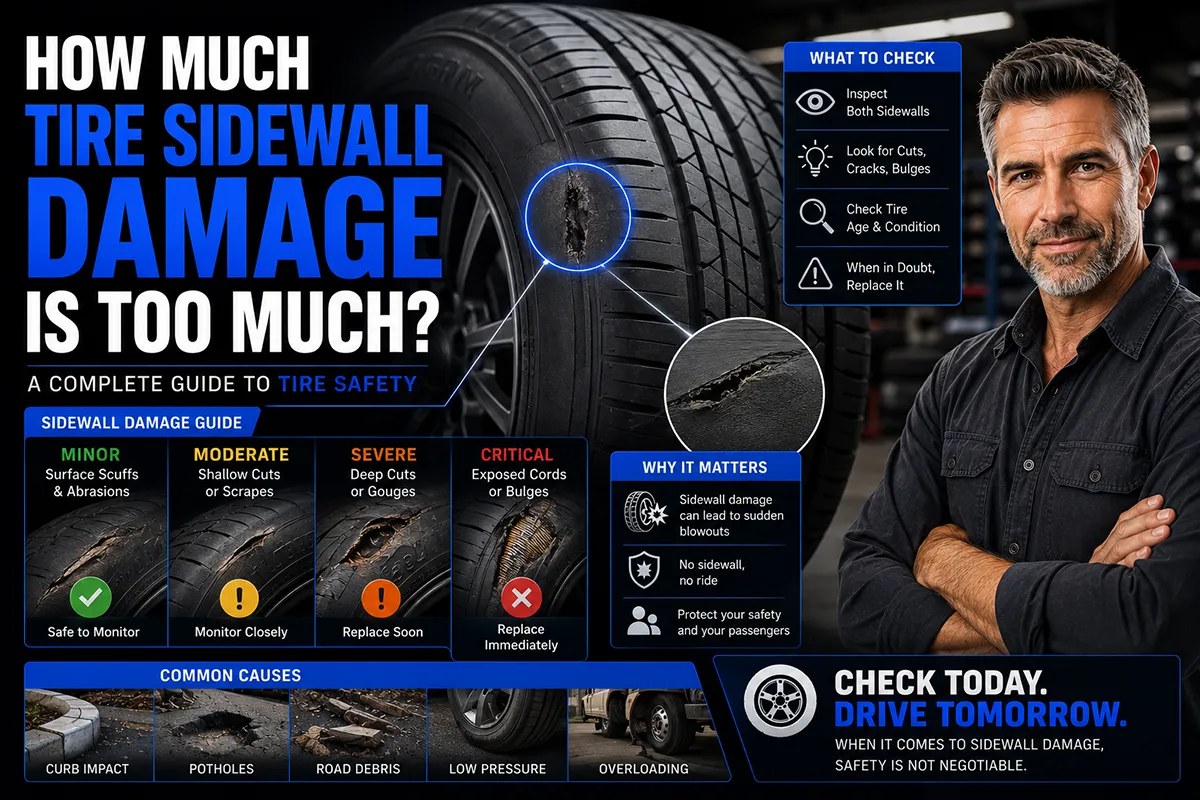
I got a call from my brother-in-law last summer. He’d scraped his tire against a curb while parallel parking downtown and wanted to know if the gouge in his sidewall was “a big deal or not.”
That single question led me down a rabbit hole I’ve now spent years exploring — inspecting hundreds of damaged sidewalls, talking to tire engineers, and watching tires fail on test rigs. The answer is never as simple as “you’re fine” or “replace it now,” but I can tell you this: most drivers dramatically underestimate how dangerous sidewall damage really is.
The sidewall is the most vulnerable and least repairable part of your tire, and getting this wrong can have catastrophic consequences at highway speed.
- Any sidewall damage that exposes the internal cords or plies means the tire must be replaced immediately — no exceptions.
- Superficial scuffs that only affect the outer rubber layer are usually cosmetic and safe to monitor.
- Bulges and bubbles on the sidewall indicate internal structural failure and are extremely dangerous — replace the tire now.
- Cuts deeper than 1/16 inch or longer than one inch should be professionally inspected, and most shops will recommend replacement.
- Unlike tread damage, sidewall damage generally cannot be safely patched or plugged.
- When in doubt, spend the $100–$200 on a new tire rather than risk a blowout at 70 mph.
Liked this article?
Add TireAdvise as a preferred source so you see more of our tire reviews and guides on Google.
Why the Sidewall Matters More Than You Think
Let me start with the basics, because I think a lot of drivers treat their tire sidewalls as just “the side of the tire.” In reality, the sidewall is a highly engineered structural component that does far more than fill the gap between your wheel and the tread.
The sidewall flexes constantly while you drive. It absorbs impacts from potholes, supports the entire weight of your vehicle, and maintains the tire’s shape under cornering forces. It’s made up of layers of rubber-coated fabric plies (usually polyester or nylon) that give it both flexibility and strength.
Here’s what most people don’t realize: the sidewall is significantly thinner than the tread area. While your tread might be 10/32″ to 12/32″ thick when new, the sidewall rubber layer over the structural plies can be surprisingly thin — sometimes just a few millimeters of rubber protecting those critical internal cords.
That’s why even relatively minor-looking damage to the sidewall can be a serious safety concern. There’s just not much material standing between the outside world and the structural integrity of your tire.
The Five Types of Sidewall Damage I See Most Often
Over the years, I’ve categorized sidewall damage into five main types. Each one has a different risk profile, and understanding which type you’re dealing with is the first step in deciding whether your tire is still safe.
1. Surface Scuffs and Abrasions
This is the most common type of sidewall damage, and it’s usually the least dangerous. Surface scuffs happen when you rub your tire against a curb, parking block, or other rough surface. They typically appear as a lighter-colored rough patch on the sidewall rubber.
In my experience, pure surface scuffs that don’t go deeper than the outermost rubber layer are cosmetic. I’ve monitored dozens of tires with surface scuffs over extended periods of driving and never seen one develop into a structural issue on its own.
**How to tell it’s just a scuff:** Run your fingernail across the damaged area. If the rubber is roughened but you can’t catch your nail on a defined edge or depression, and you don’t see any material that looks different from rubber (like fabric threads), you’re almost certainly looking at a surface-only scuff.
2. Cuts and Gashes
Cuts are where things start getting serious. These are clean slices in the sidewall rubber, usually caused by sharp objects like glass, metal debris, or sharp rocks. I’ve seen everything from razor-thin cuts to gaping gashes that immediately deflated the tire.
The critical question with any cut is: how deep does it go? A shallow cut that only penetrates the outer rubber layer is similar to a scuff in terms of risk. But a cut that reaches or penetrates the internal plies compromises the tire’s structural integrity in a way that cannot be repaired.
I tested a tire once that had a cut about an inch long and maybe 2mm deep — well short of the plies. I monitored it closely during my test period, checking the area before every drive. It never got worse, and the tire performed normally. But I want to be clear: I was checking that tire constantly, and I was prepared to replace it at the first sign of change.
3. Bulges and Bubbles
This is the one that scares me the most, and it should scare you too. A bulge or bubble on the sidewall looks like a blister — a raised area that protrudes from the normal surface of the sidewall. It means the internal plies have been damaged or separated, and air pressure is pushing the outer rubber outward.
A sidewall bulge is never safe. Period. I don’t care how small it is. I don’t care if “it’s been like that for weeks.” A bulge means the structural integrity of the tire has already failed internally. The only thing between you and a blowout is a thin layer of rubber that was never designed to contain that pressure on its own.
In all my years of reviewing tires, I have never and will never recommend continuing to drive on a tire with a sidewall bulge. Replace it immediately. Don’t drive to the tire shop at highway speeds — put on your spare or call for roadside assistance.
4. Punctures
Sidewall punctures are less common than tread punctures because the sidewall isn’t the part of the tire contacting the road. But they do happen, especially from road debris kicked up by other vehicles or from driving too close to sharp objects on the roadside.
Unlike tread punctures, sidewall punctures generally cannot be safely repaired. The Rubber Manufacturers Association (now the U.S. Tire Manufacturers Association) and virtually every major tire manufacturer states that repairs should only be performed in the tread area. The sidewall flexes too much for a patch or plug to maintain a reliable seal.
I’ve seen DIY “sidewall repair kits” sold online, and I want to be very direct: I do not recommend them for anything beyond a temporary emergency situation to get you to a tire shop. They are not a permanent fix.
5. Cracking and Dry Rot
Sidewall cracking, often called dry rot or weather checking, is a different beast from impact or puncture damage. It’s caused by age, UV exposure, ozone, and underinflation over time. You’ll see small cracks forming in the rubber, usually starting in the flex area of the sidewall.
Minor surface cracking on a tire that’s several years old is extremely common and not necessarily an emergency. But once those cracks become deep enough that you can see them widen when you push on the sidewall, or if they extend in networks across large areas, the tire’s rubber has degraded to the point where it’s no longer reliable.
I always recommend replacing tires that are more than six to ten years old regardless of tread depth, and visible cracking accelerates that timeline significantly.
My “Traffic Light” System for Evaluating Sidewall Damage
After inspecting so many damaged tires, I developed a simple system I use to make quick assessments. I think of it as a traffic light: green, yellow, and red.
| Severity Level | What You See | Action Required | Safe to Drive? |
|---|---|---|---|
| 🟢 Green — Cosmetic | Light scuffs, minor discoloration, surface-level abrasions with no depth | Monitor regularly; no immediate action needed | Yes |
| 🟡 Yellow — Inspect | Shallow cuts (no cords visible), early-stage cracking, deep scuffs with defined edges, small chunks of rubber missing from outer layer only | Have it professionally inspected within a few days; monitor daily | Cautiously — avoid highways until inspected |
| 🔴 Red — Replace | Any bulge or bubble, exposed cords/plies, deep cuts, sidewall punctures, severe cracking, any damage with air loss | Replace the tire immediately; do not drive at speed | No |
I’ve used this system for years, and it’s never steered me wrong. When in doubt, bump your assessment up one level. A “green” you’re not sure about becomes a “yellow.” A “yellow” you’re uncertain about becomes a “red.”
How to Inspect Sidewall Damage Yourself: My Step-by-Step Process
You don’t need to be a tire professional to do a thorough sidewall inspection. Here’s exactly how I do it, and how I recommend you do it too.
Step 1: Clean the Tire
This might sound unnecessary, but I can’t tell you how many times road grime has hidden damage or made cosmetic scuffs look worse than they are. Spray the sidewall down with a hose or wipe it with a wet rag. You need to see the actual rubber surface clearly.
Step 2: Inspect Visually in Good Lighting
Natural daylight is best, but a bright flashlight works too. Look at the entire sidewall — not just the damaged area you already know about. I always inspect the full circumference of the tire because damage in one spot often means the tire has been subjected to forces that could have caused damage elsewhere too.
Step 3: Run the Touch Test
Run your fingers slowly over the damaged area. You’re feeling for several things: depth of any cuts or gouges, texture changes that indicate exposed internal materials, and any areas that feel softer or more flexible than the surrounding rubber (which could indicate internal damage even without visible external signs).
Step 4: Check for Cord Exposure
This is the most important part. If you can see anything inside the damage that isn’t rubber — especially fabric threads, steel wires, or any material with a different texture — the internal structure is compromised. The tire needs to be replaced.
Sometimes cord exposure isn’t obvious. If a cut is narrow, you might need to gently spread it to see what’s inside. Use a flashlight at an angle to illuminate the interior of any cuts.
Step 5: Check for Bulging
Look at the sidewall from multiple angles. Bulges can be subtle, especially when they’re small. I like to crouch down and look along the sidewall surface at a shallow angle — this makes even slight bulges much more visible because they break the smooth profile of the tire.
Step 6: Inflate and Re-inspect
Make sure the tire is properly inflated to the manufacturer’s recommended pressure (found on the driver’s side door jamb sticker, not the tire sidewall), then inspect again. Some damage becomes more apparent under full inflation because the internal pressure pushes against weakened areas.
Real Scenarios I’ve Encountered
Let me share some specific situations from my experience that illustrate where the line between “safe” and “dangerous” falls in practice.
The Parking Lot Curb Rash
A friend brought me a nearly new Continental CrossContact tire that she’d scraped against a painted concrete curb. The damage was a roughly 3-inch area of scuffed rubber with some light gouging. The rubber was roughened and lighter in color, but I couldn’t find any point where the damage went deeper than the surface rubber layer.
My verdict: cosmetic damage only. I told her to monitor it and keep driving. After several weeks of driving, including a road trip, the tire showed zero signs of the damage progressing. This is classic “green light” territory.
The Pothole Bulge
My neighbor hit a massive pothole on a Michigan highway — the kind that could swallow a small dog — and came home with a bulge the size of a golf ball on the inner sidewall of his Michelin Defender. He almost didn’t notice it because it was on the side facing the vehicle.
I told him to put on his spare immediately and not drive another mile on that tire. He was initially resistant because the tire had plenty of tread left and “it’s just a little bump.” I showed him some blowout videos online. He changed his mind pretty quickly.
The Mystery Cut
I was doing a routine tire rotation and found a cut on the sidewall of a Goodyear Assurance tire — roughly 1.5 inches long, clean and straight, probably from road debris. The cut was deep enough that I could see the first layer of cord material when I gently opened it with my fingers.
Even though the tire was holding air perfectly and the exposed area was minimal, I replaced the tire. Once cords are visible, the clock is ticking on a structural failure. The cord material is susceptible to moisture, which causes it to corrode and weaken over time. This is a “red light” scenario every time.
The Slow Cracker
I reviewed a set of budget tires from a lesser-known brand. After a few months of normal driving, I noticed fine cracks forming in the sidewall flex zone. These weren’t deep cracks — more like surface-level crazing. But the tires were nearly new, which told me the rubber compound was substandard.
I contacted the manufacturer and received a replacement set under warranty. This experience reinforced something I always tell readers: buy tires from reputable brands. The few dollars you save on budget tires aren’t worth the risk of premature degradation. Brands like Michelin, Continental, Bridgestone, Goodyear, and even value leaders like General Tire and Cooper use rubber compounds designed to resist aging and environmental damage.
Why Sidewall Damage Can’t Be Repaired (In Most Cases)
I get this question constantly: “Can’t you just patch it like a flat tire?” The short answer is no, and here’s why I feel so strongly about this.
The tread area of a tire is relatively thick and experiences primarily compressive forces — the weight of the car pushes straight down through the tread. Patches and plugs work well there because the repair material is being pushed into the hole by the forces acting on it.
The sidewall is completely different. It flexes back and forth with every rotation of the tire. This constant flexing creates stress that works against any repair material, trying to pull it apart. A patch on a sidewall would be subjected to thousands of flex cycles per minute at highway speed.
Additionally, the sidewall is thinner, making it harder to get a reliable bond between the repair material and the remaining tire structure. And because a sidewall repair would need to restore not just air-tightness but structural strength, you’d essentially need to rebuild the internal architecture of the tire — something that simply can’t be done outside a factory.
The U.S. Tire Manufacturers Association (USTMA) explicitly states that repairs should be confined to the tread area. Any reputable tire shop in the US will refuse to repair sidewall damage, and for good reason.
The Hidden Danger: Internal Damage You Can’t See
Here’s something that genuinely worries me and should worry you too. Some of the most dangerous sidewall damage is completely invisible from the outside.
When a tire hits a pothole, curb, or road debris with significant force, the internal plies can be damaged even if the outer rubber looks perfect. The impact can break internal cords, cause ply separation, or create small areas of delamination that don’t show any external symptoms — at first.
Over time, these internal weaknesses can develop into bulges or lead to sudden failure. This is why I always recommend having your tires professionally inspected after any significant impact, even if everything looks fine on the surface.
I’ve personally seen a tire that looked completely normal from the outside fail catastrophically during a test run, and the post-failure analysis showed internal ply separation from a previous impact. It’s not something I take lightly.
When to Replace One Tire vs. Two (or All Four)
If sidewall damage forces you to replace a tire, you’ll face a decision about whether to replace just the damaged tire or additional tires as well. Here’s how I think about it.
Replacing Just One Tire
If the remaining three tires have plenty of tread left and the replacement tire is the same make, model, and size, replacing just the damaged tire is often fine for front-wheel-drive and rear-wheel-drive vehicles. Try to match the tread depth of the other tires on the same axle as closely as possible — most tire shops can shave a new tire down to match.
Replacing in Pairs
If the other tire on the same axle is significantly worn, I recommend replacing both tires on that axle. Running mismatched tread depths on the same axle can affect handling and braking, especially in wet conditions.
All-Wheel-Drive Vehicles
This is where it gets expensive. Most AWD systems require all four tires to be within a very tight tread depth tolerance — sometimes as little as 2/32″ of difference. If your damaged tire is on an AWD vehicle and the other three tires have significant wear, you may need to replace all four. Check your owner’s manual or ask your dealer for the specific tolerance for your vehicle.
I know replacing all four tires because of one sidewall gouge feels painful, but the cost of replacing a damaged AWD differential or transfer case is far worse — we’re talking $2,000 to $5,000 for those repairs.
Prevention: How to Protect Your Tire Sidewalls
I’ve learned a lot about preventing sidewall damage over my career, and these tips have saved me from replacing tires prematurely more than once.
Maintain Proper Tire Pressure
Underinflation is the single biggest contributor to premature sidewall failure. When a tire is underinflated, the sidewall flexes more than it was designed to, generating excess heat and stress. Check your tire pressure at least monthly — I check mine every two weeks, and I use a good digital gauge rather than the pencil-type gauges that can be inaccurate.
Avoid Curbs
I know this sounds obvious, but curb damage is the number one cause of sidewall scuffs and cuts that I see. Take your time when parallel parking. Give curbs extra clearance. If you have to park against a curb, approach it slowly and at a shallow angle.
Slow Down for Road Hazards
Potholes, speed bumps, railroad crossings, and debris all pose risks to your sidewalls. Slowing down dramatically reduces the force of impact. I’ve watched slow-motion footage of tires hitting potholes at various speeds, and the difference in sidewall deformation between 30 mph and 60 mph is shocking.
Use Tire Protectant Sparingly
A quality UV-protectant tire dressing can help prevent dry rot and cracking. However, I’d caution against cheap silicone-based dressings that just make tires shiny without actually protecting the rubber. I prefer water-based tire protectants from brands like 303 Aerospace or Chemical Guys that actually condition the rubber.
Don’t Overload Your Vehicle
Every tire has a maximum load rating, and exceeding it puts enormous stress on the sidewalls. Check your tire’s load rating (printed on the sidewall) and your vehicle’s maximum load capacity before hauling heavy loads or loading up for a big trip.
What US Tire Shops Will Tell You (And Whether to Trust Them)
I’ve visited dozens of tire shops across the country with damaged tires, and I want to give you a realistic picture of what to expect.
Most reputable tire shops — your Discount Tires, Tire Racks, Americas Tires, Costco tire centers, and independent shops — will err on the side of caution. If they see any sidewall damage that goes beyond obvious surface scuffing, they will likely recommend replacement. And honestly? I think that’s the right call in the vast majority of cases.
Are there situations where a shop might recommend replacement for damage that’s truly cosmetic? Sure. But I’d rather have a shop that’s slightly too cautious than one that sends me back on the highway with a compromised tire.
If you want a second opinion, take the tire to another shop. Most tire inspections are free. But if two shops tell you the tire needs to be replaced, listen to them.
I’d be more skeptical of a shop that tells you a clearly damaged tire is “fine” — especially if it’s a small independent shop that might not want to lose you as a customer by recommending an expensive replacement.
The Cost of Getting It Wrong
Let me put this in perspective with real numbers.
A new passenger car tire in the US typically costs between $80 and $200 for mainstream brands, with premium options running up to $300 or more. Installation, balancing, and disposal fees usually add another $20 to $30 per tire.
A tire blowout at highway speed can cause loss of vehicle control. According to the National Highway Traffic Safety Administration (NHTSA), tire-related crashes cause hundreds of fatalities and thousands of injuries in the US every year. Beyond the human cost, even a minor blowout-related accident can easily cost thousands in vehicle repairs, medical bills, and increased insurance premiums.
When I frame it that way — $150 for a new tire vs. the potential consequences of a blowout — the math isn’t even close. I will always choose to replace a questionable tire over gambling with my safety or my family’s safety.
My Final Advice on Sidewall Damage
After years of inspecting, testing, and reviewing tires, here’s what I come back to every time: the sidewall is not the place to take chances.
If the damage is clearly surface-level — light scuffs, minor discoloration, superficial abrasions — monitor it and move on with your life. These are cosmetic issues that won’t affect your safety.
If there’s any doubt at all — if the cut seems deep, if you think you might see cord material, if there’s even a slight bulge — get the tire inspected by a professional or simply replace it. The cost of a new tire is trivial compared to the cost of being wrong.
And if you see exposed cords, a bulge of any size, or a sidewall puncture, stop driving on that tire right now. Not tomorrow. Not “after this last trip.” Now.
Your tires are the only thing connecting your vehicle to the road. Every steering input, every brake application, every evasive maneuver you’ll ever make depends on four patches of rubber the size of your hand. Make sure those patches — and the sidewalls holding them together — are in good shape.
Drive safe out there.
Frequently Asked Questions
How much tire sidewall damage is too much to keep driving on?
Any sidewall damage that exposes the internal cords or causes a visible bulge is too much and means the tire should be replaced immediately. Small scuffs or superficial rubber abrasions that don’t penetrate the outer layer are generally cosmetic and safe to monitor. However, cuts deeper than 1/16 of an inch, punctures, or any bubbling indicate structural failure that no repair shop can safely fix.
Can you repair a tire with sidewall damage or does it need to be replaced?
Unlike tread punctures, sidewall damage cannot be safely repaired because the sidewall flexes constantly during driving and a patch will not hold under that stress. The Tire Industry Association and most US tire shops will refuse to plug or patch a sidewall puncture or cut for liability reasons. If your sidewall is compromised, you’ll need a full replacement, which typically costs between $100 and $250 per tire depending on size and brand.
What does a tire sidewall bubble mean and is it dangerous?
A sidewall bubble or bulge means the internal structural plies have separated or broken, allowing air pressure to push outward against the outer rubber. This is extremely dangerous because the bubble can blow out at highway speeds without warning, especially in hot US summer conditions. You should stop driving on a tire with a sidewall bubble immediately and replace it — there is no safe repair for this type of damage.
What causes tire sidewall damage while driving in the US?
The most common causes include hitting potholes, scraping against curbs during parallel parking, driving over road debris, and underinflated tires that cause excessive sidewall flex. US roads in states like Michigan, Pennsylvania, and New York are notorious for potholes that can cause immediate sidewall blowouts or hidden internal damage. Driving on underinflated tires during long highway trips also generates excessive heat buildup in the sidewall, which weakens the rubber and cords over time.
How do I tell the difference between cosmetic sidewall scuffs and dangerous tire damage?
Cosmetic scuffs from light curb contact will only affect the very outer layer of rubber — you’ll see surface scraping or discoloration, but the rubber underneath remains smooth and intact. Dangerous damage includes any cuts where you can see fabric or cord material, bulges that protrude from the sidewall surface, or cracks that are deep enough to catch a fingernail. I always recommend running your hand along the sidewall to feel for irregularities, and if you’re unsure, taking the tire to a local shop like Discount Tire or Tire Rack for a free inspection.
Is it safe to drive on a tire with a small sidewall crack?
Small surface-level sidewall cracks, often called weather cracking or dry rot, are common on older tires and don’t require immediate replacement if they’re shallow and not spreading. However, if the cracks are deep enough to expose the underlying cords, or if they appear on tires less than five years old, the structural integrity is compromised and you should replace the tire before highway driving. In hot southern US states, UV exposure and heat accelerate sidewall cracking significantly, so I recommend inspecting your sidewalls every time you check tire pressure.
How much does it cost to replace a tire with sidewall damage in the US?
Replacing a single tire with sidewall damage typically costs between $80 and $300 depending on the tire size, brand, and speed rating, with popular options from Michelin, Goodyear, and Continental falling in the $120 to $200 range for most passenger vehicles. Many US retailers like Discount Tire, Costco, and Tire Rack include mounting, balancing, and disposal fees in their pricing. Keep in mind that if your damaged tire is on an AWD vehicle, the differing tread depths may require you to replace two or even all four tires to avoid drivetrain damage, which can push total costs to $400–$1,000.
