

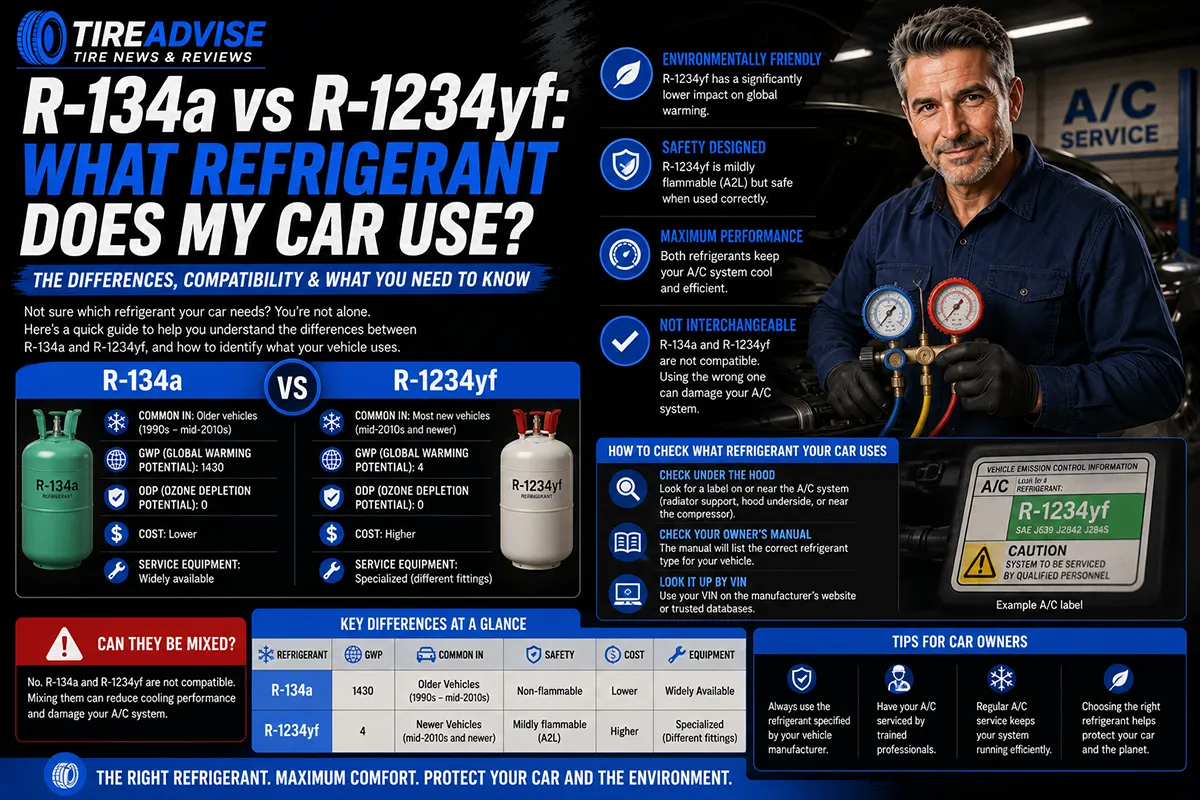
I’ve watched a lot of DIYers make this exact mistake: they walk into an AutoZone, grab a $35 AC recharge kit, spend twenty minutes hooking it up — and then realize they’ve just tried to charge an R-1234yf system with R-134a. The fitting doesn’t connect. The kit is useless. And they’re standing in a hot parking lot on the worst possible day.
If your car is a 2013 or older, it almost certainly uses R-134a. If it’s 2021 or newer, it uses R-1234yf — federally mandated for all new vehicles from that year forward. If it’s anywhere in the 2014–2020 window, you need to check the under-hood label before buying anything. The easiest way: open the hood and look for the refrigerant sticker near the AC compressor or radiator support. It will say exactly which type your car needs.
Liked this article?
Add TireAdvise as a preferred source so you see more of our tire reviews and guides on Google.
Why This Matters More Than You Think
Refrigerant identification feels like a small, boring detail right up until it costs you money. I’ve seen it go wrong in two specific ways:
The first is the scenario I described above — a DIYer buys the wrong recharge kit and the fitting physically won’t couple to the service port. That’s actually the good outcome, because R-1234yf service ports are intentionally designed to reject R-134a equipment. Nature stops the error before it starts.
The second way is worse: a shop technician who isn’t paying attention connects an R-134a recovery machine to an R-1234yf system. Now you’ve got mixed refrigerant in the recovery tank, contaminated refrigerant in the vehicle, and an EPA violation to boot. Recovery equipment for mixed refrigerants is expensive and specialized, and many shops simply don’t have it.
Understanding your refrigerant type isn’t just about buying the right can. It determines which compressor oil your system uses, what service equipment the shop needs, what a recharge will cost you, and whether a DIY recharge is even viable for your car. Let’s break all of that down.
R-134a vs R-1234yf: The Core Differences
These are not simply different brands of the same thing. They are chemically distinct refrigerants with different physical properties, environmental profiles, and servicing requirements.
| Feature | R-134a | R-1234yf |
|---|---|---|
| Chemical Family | HFC (Hydrofluorocarbon) | HFO (Hydrofluoroolefin) |
| Global Warming Potential (GWP) | ~1,430 | ~4 |
| Ozone Depletion Potential | Zero | Zero |
| Atmospheric Lifespan | ~13 years | ~11 days |
| Flammability | Non-flammable (A1) | Mildly flammable (A2L) |
| Cooling Performance | Baseline | ~95–98% of R-134a |
| Service Port Size | Smaller (standard) | Larger (unique, keyed) |
| Compatible Compressor Oil | PAG 46 or PAG 100 (per OEM) | PAG 46 YF only |
| DIY Recharge Kit Cost | $25–$50 | $60–$120+ |
| Professional Recharge Cost | $100–$150 | $200–$350 |
| Required in New US Vehicles From | 1994–2020 | 2021+ (EPA mandate) |
| Dominant Vehicle Era | 1994–2020 | 2014–present (transition), 2021+ (all new) |
The cooling performance difference is negligible in a properly functioning system — R-1234yf delivers 95 to 98 percent of R-134a’s cooling capacity, and in real-world driving you won’t feel the difference on a hot August afternoon. The big differences are environmental impact, cost to service, and the oil compatibility requirements.
The Refrigerant Timeline: How We Got Here
To understand where we are now, it helps to know the thirty-year arc of automotive refrigerant history.
R-12 (pre-1994): The original automotive refrigerant, trade-named Freon. Excellent at cooling, but catastrophic for the ozone layer. Phased out under the Montreal Protocol. If you own a pre-1994 vehicle with an original AC system, it uses R-12 — which is now extremely expensive and regulated. Retrofitting these to R-134a is a common solution.
R-134a (1994–2020): The global replacement for R-12. Non-toxic, non-flammable, zero ozone impact — and for two decades, universally used in every new car sold in the United States. Its downside: a Global Warming Potential of approximately 1,430 times that of CO₂. If it leaks into the atmosphere, it lingers for up to 13 years.
R-1234yf (2013–present): Developed jointly by Honeywell and DuPont (now Chemours, who markets it as Opteon YF), R-1234yf was engineered specifically to solve R-134a’s GWP problem. Its GWP of roughly 4 represents a 99.7% reduction. It breaks down in the atmosphere in about 11 days. The European Union mandated it for all new vehicles starting in 2017; the US EPA phased it in with a full mandate for model year 2021 and beyond.
How to Tell Which Refrigerant Your Car Uses — Right Now
Before anything else — before reading any year chart, before Googling your make and model — do this. It takes 60 seconds and gives you a definitive answer.
Step 1: Open the hood. Look at the area near the AC compressor (typically on the passenger side of the engine bay, low on the engine block), along the firewall, or on the underside of the hood itself. You are looking for an AC specification sticker.
Step 2: Read the sticker. It will say one of the following:
- “Refrigerant: R-134a” — you have an R-134a system
- “HFO-1234yf” or “R-1234yf” — you have an R-1234yf system
- Older vehicles may show R-12 or say “Freon”
The sticker also tells you the exact refrigerant capacity in ounces or grams — save that number. You’ll need it if you’re doing a full recharge.
Step 3: If there’s no sticker, check the service ports. R-134a and R-1234yf systems use different service port fittings that are physically keyed to prevent cross-contamination. R-1234yf uses a larger, distinct quick-connect port that cannot accept standard R-134a service equipment. If your car’s low-side port looks oversized or unfamiliar compared to standard R-134a fittings, you almost certainly have an R-1234yf system.
Step 4: Check your owner’s manual. Under “Air Conditioning Specifications” or the maintenance section, it will list the refrigerant type and system capacity.
Step 5: Use an online AC spec database. If your sticker is missing or unreadable, A/C Pro’s free online database (acprocold.com) and most parts store databases (AutoZone, O’Reilly, NAPA) will look up the refrigerant type by year, make, model, and engine. This is the most reliable fallback if you can’t find the sticker.
Which Refrigerant Does My Car Use? Brand-by-Brand Guide
Here is the most important caveat before using any year chart: the 2014–2020 transition years are genuinely mixed. Within the same model year, the same nameplate — even the same trim level — could roll off the assembly line with either refrigerant depending on production date and regional specifications. A 2017 Chevy Silverado built in Q1 might have R-134a while one built in Q3 has R-1234yf. Always check the sticker. Use this table as a starting point, not a final answer.
General Motors (Chevrolet, GMC, Buick, Cadillac)
GM was one of the earliest US adopters. Cadillac introduced R-1234yf in select models for the 2013 model year — the first domestic brand to do so. By model year 2017, GM had broadly rolled out R-1234yf across most of its lineup including the Camaro, Colorado, Malibu, Silverado, Suburban, Tahoe, Yukon, Acadia, Canyon, and Sierra, plus multiple Buick and Cadillac nameplates.
| Model Year | Likely Refrigerant |
|---|---|
| 2012 and older | R-134a |
| 2013–2016 | Mixed — check sticker (Cadillac often R-1234yf; others mostly R-134a) |
| 2017 and newer | Mostly R-1234yf (verify sticker) |
| 2021 and newer | R-1234yf |
Chrysler / Dodge / Jeep / Ram (Stellantis)
Stellantis brands were also early adopters, beginning the transition around the 2014 model year in select platforms including Jeep and Ram. By 2016–2018 most Chrysler, Dodge, Jeep, and Ram vehicles had moved to R-1234yf.
| Model Year | Likely Refrigerant |
|---|---|
| 2013 and older | R-134a |
| 2014–2017 | Mixed — check sticker |
| 2018 and newer | Mostly R-1234yf |
| 2021 and newer | R-1234yf |
Ford (Ford, Lincoln)
Ford was a later mover on R-1234yf in most of its mainstream lineup. Many Ford products used R-134a through 2018 or 2019, with the broader transition to R-1234yf happening around 2019–2020 depending on the model.
| Model Year | Likely Refrigerant |
|---|---|
| 2018 and older | R-134a (most models) |
| 2019–2020 | Mixed — check sticker |
| 2021 and newer | R-1234yf |
Toyota / Lexus
Toyota began rolling out R-1234yf in select models around 2016–2017, with wider adoption through 2018–2019. Most Toyota and Lexus vehicles from 2019 onward use R-1234yf, though some models lingered on R-134a into 2020.
| Model Year | Likely Refrigerant |
|---|---|
| 2016 and older | R-134a |
| 2017–2019 | Mixed — check sticker |
| 2020 and newer | Mostly R-1234yf |
| 2021 and newer | R-1234yf |
Honda / Acura
Honda similarly began its transition around 2017–2018, with widespread R-1234yf adoption by 2019.
| Model Year | Likely Refrigerant |
|---|---|
| 2017 and older | R-134a |
| 2018–2019 | Mixed — check sticker |
| 2020 and newer | Mostly R-1234yf |
Nissan / Infiniti, Hyundai / Kia
These brands followed a similar 2017–2020 transition window, with most models landing on R-1234yf by 2019–2020.
| Model Year | Likely Refrigerant |
|---|---|
| 2018 and older | Mostly R-134a |
| 2019–2020 | Mixed — check sticker |
| 2021 and newer | R-1234yf |
European Brands (BMW, Mercedes-Benz, Audi/Volkswagen, Volvo)
European automakers faced an EU mandate requiring R-1234yf by January 2017 for new vehicle models. Most transitioned earlier — BMW, Mercedes, and Audi/VW began appearing with R-1234yf in certain models as early as 2013–2015. By 2016–2017, European brands sold in the US were largely on R-1234yf.
| Model Year | Likely Refrigerant |
|---|---|
| 2014 and older | R-134a |
| 2015–2017 | Mixed — check sticker |
| 2018 and newer | Mostly R-1234yf |
The Compressor Oil Connection — Don’t Overlook This
If you’re recharging your AC or replacing a compressor, the refrigerant type doesn’t just determine which refrigerant can you buy — it determines which compressor oil you must use.
R-134a systems use standard PAG oil — PAG 46 for most passenger cars, PAG 100 for many trucks and Chrysler platforms. These have been around for decades and are widely available.
R-1234yf systems require PAG 46 YF — a specially formulated version that is chemically compatible with R-1234yf. Standard PAG 46 designed for R-134a is NOT a substitute. The two look nearly identical in packaging, which is exactly why this mistake gets made so often.
Additionally, some GM and Chrysler R-1234yf platforms specify their own proprietary compressor oil rather than generic PAG 46 YF. Check your compressor label and OEM service manual before adding any oil to an R-1234yf system.
For a deeper look at choosing the right compressor oil — including a vehicle-by-vehicle breakdown of PAG 46 vs PAG 100 — see our full guide: PAG 100 vs PAG 46: Which AC Compressor Oil Does Your Car Actually Need?
The Cost Difference — What R-1234yf Service Will Actually Cost You
This is the number that surprises most car owners the first time they take a late-model vehicle in for an AC service. R-1234yf refrigerant costs significantly more than R-134a — and that gap flows straight through to your repair bill.
DIY recharge kits:
- R-134a kit (12 oz with gauge): $25–$50 at any auto parts store
- R-1234yf kit (8–12 oz with gauge): $60–$120+ at retail; some platforms require professional equipment
Professional AC recharge:
- R-134a full recharge: $100–$150 at most shops (parts + labor)
- R-1234yf full recharge: $200–$350 depending on your system’s capacity and local shop rates
Why is R-1234yf so much more expensive? Two main reasons. First, it is produced by fewer manufacturers (Chemours dominates with Opteon YF) under a patented process, limiting supply competition. Second, R-1234yf service requires dedicated recovery and recharge equipment that cannot be shared with R-134a — shops that invested in R-1234yf equipment pass that infrastructure cost along.
The price gap has been narrowing as production scales up and more manufacturers enter the market, but as of 2026 you should budget at least double the R-134a cost for any R-1234yf service.
One thing to know: R-1234yf systems are designed to require less frequent service than R-134a systems, which partly offsets the higher per-service cost over the life of the vehicle.
Can You DIY an R-1234yf Recharge?
For R-134a systems, DIY recharging is straightforward and widely supported — recharge kits from A/C Pro, Arctic Freeze, or similar brands are available at every auto parts store and require no special certification.
R-1234yf is more complicated:
What you can do as a DIYer: Purchase an R-1234yf recharge kit (they exist — EZ Chill and A/C Pro make R-1234yf versions) and add refrigerant if your system is slightly low. The port fittings are keyed to prevent mistakes. You do not need EPA certification to purchase or add R-1234yf refrigerant as a vehicle owner servicing your own car.
What requires a shop: Recovering refrigerant from an R-1234yf system requires dedicated, expensive recovery equipment. This means any time your system needs to be opened — compressor replacement, hose replacement, evaporator work — a shop with R-1234yf-certified recovery equipment must handle the refrigerant portion. You cannot legally or safely vent R-1234yf into the atmosphere.
My honest recommendation: For a simple top-off of a system that’s slightly undercharged, a DIY R-1234yf kit is a reasonable option if you’re comfortable with basic AC service. For anything more involved, bring it to a shop. R-1234yf systems are more sophisticated than their R-134a predecessors, and the compressor oil compatibility issue means getting the wrong product into the system is a costly mistake.
What About R-1234yf’s Flammability?
This comes up constantly and deserves a straight answer.
R-1234yf is classified as ASHRAE Class A2L — meaning mildly flammable. It has a low burning velocity and a high lower flammable limit, which means it requires specific concentrations and an ignition source to combust. In practice, its flammability risk under normal driving conditions is extremely low — lower than the gasoline in your tank, lower than the brake fluid in your lines, lower than the power steering fluid in your reservoir.
Automakers have engineered R-1234yf systems with refrigerant leak detection sensors, directed venting away from hot components, and reinforced hose routing to mitigate risk. Real-world incidents involving R-1234yf combustion under normal vehicle operation have been essentially nonexistent in the decade-plus it has been in production vehicles.
The flammability classification generates outsized concern relative to the actual risk level. It’s worth knowing about, but it’s not a reason to avoid or distrust vehicles that use R-1234yf.
Should You Retrofit an R-134a Car to R-1234yf?
The short answer: almost never.
A proper R-1234yf retrofit on an R-134a vehicle requires replacing the compressor, AC hoses, fittings, accumulator/drier, and all the oil — and converting to the unique R-1234yf service port fittings. Total cost typically runs $1,500 or more. There is no meaningful advantage to a DIYer or typical vehicle owner that justifies this expense.
The only scenario where conversion makes sense is for a specialty vehicle or fleet operation where R-134a is no longer available for a specific service requirement — and even then, it’s a niche case.
What you can do is convert an older R-12 system to R-134a — that retrofit is well-established, relatively affordable, and widely supported with drop-in conversion kits.
Who This Guide Is For
You drive a 2013 or older vehicle: You’re almost certainly on R-134a. Any standard AC recharge kit works. Compressor oil is either PAG 46 or PAG 100 depending on your OEM spec. Service is inexpensive and widely supported.
You drive a 2014–2020 vehicle: Stop and check the sticker before buying anything. You could be on either refrigerant. Getting this wrong wastes money at minimum and damages your AC system at worst.
You drive a 2021 or newer vehicle: You’re on R-1234yf, full stop. Budget accordingly for AC service, and make sure any shop you use has R-1234yf-certified recovery equipment.
You’re buying a used vehicle in the 2014–2020 range: Add “what refrigerant does this car use?” to your pre-purchase checklist. It affects the cost of ongoing AC maintenance, and it’s one of those details sellers rarely volunteer.
You’re a DIYer doing your own compressor replacement: Refrigerant type determines your compressor oil selection. Do not buy PAG oil until you know which refrigerant your system uses. Read our guide on PAG 100 vs PAG 46 compressor oil before you start.
Frequently Asked Questions
How do I know if my car uses R-134a or R-1234yf?
Open the hood and find the AC specification sticker near the compressor or on the radiator support. It will explicitly state the refrigerant type. The service ports are also physically different — R-1234yf uses a larger, keyed fitting that won’t accept R-134a equipment.
What year did cars switch from R-134a to R-1234yf?
The US EPA mandated R-1234yf for all new vehicles starting with the 2021 model year. However, many brands transitioned earlier — GM started with select Cadillacs in 2013 and went broad in 2017. The 2014–2020 period is a genuine mix, varying by brand and even by individual model.
Can I use R-134a in a car that takes R-1234yf?
No. The service ports are physically incompatible to prevent this. Mixing refrigerants contaminates the system, risks compressor damage, and violates EPA regulations. Never substitute one for the other.
Is R-1234yf more expensive than R-134a?
Yes — substantially. DIY R-1234yf recharge kits run $60–$120 vs $25–$50 for R-134a. A professional recharge with R-1234yf typically costs $200–$350 vs $100–$150 for R-134a. The price gap is narrowing but remains significant.
Is R-1234yf flammable?
It is classified as mildly flammable (A2L), but the real-world risk under normal driving conditions is extremely low — lower than gasoline, brake fluid, or motor oil. OEM systems are designed with leak detection and directed venting to manage any risk.
Can I retrofit my R-134a car to use R-1234yf?
Technically yes, but it costs $1,500 or more and there is almost no practical benefit for a typical vehicle owner. Not recommended.
What oil does an R-1234yf system use?
PAG 46 YF — a specially formulated oil not interchangeable with standard PAG 46. Some OEMs specify proprietary oils. Never use standard R-134a PAG oil in an R-1234yf system.
The Bottom Line
The refrigerant in your car’s AC system is one of those details that sits quietly in the background — until it suddenly becomes very expensive. Buying the wrong recharge kit, or letting a shop use the wrong oil, can cascade into compressor damage that costs hundreds to fix.
The good news: identifying your refrigerant takes 60 seconds. Pop the hood, find the sticker, write down the type and capacity. That two-line note will save you from the parking lot frustration, the wasted kit, and the repair bill that follows a mismatched service.
If you’re in the transition window (2014–2020), check every time — not just once. Replacement compressors, fleet service histories, and past shop errors mean you can’t assume the sticker matches what’s actually in the system without a proper refrigerant identifier if anything looks off.
When in doubt, your shop’s refrigerant identifier tool takes the guesswork out completely. Thirty seconds on the machine tells you exactly what’s in there, in what quantity, and whether it’s been contaminated. For any AC work beyond a simple top-off, that check is worth every penny.
Rob Miller is a Senior Technical Editor at Tire Advise with a background in automotive engineering and hands-on shop experience across domestic and import vehicles.
