

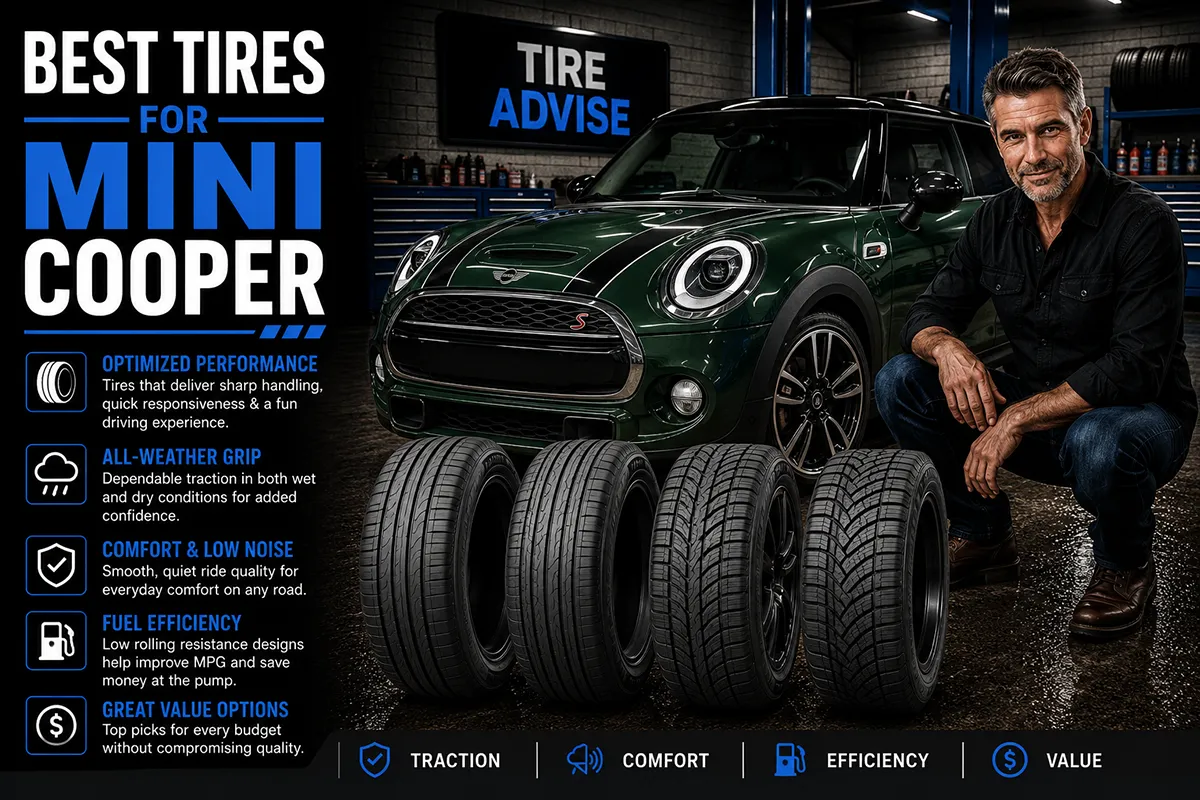
I’ve switched my own Mini off factory run-flats, run a genuine all-weather tire through a full winter to see if the snowflake rating actually means anything, and put a JCW-spec summer tire through a rainstorm I probably should have avoided. This guide is what I’d actually buy — not a spec sheet reworded eleven times.
- Best overall: Continental ExtremeContact DWS06 Plus — my go-to daily pick across dry, wet, and light snow.
- Best for JCW / Cooper S drivers who push it: Michelin Pilot Sport 4S.
- Best all-weather, no seasonal swap: Michelin CrossClimate2 or Bridgestone WeatherPeak — both carry the 3PMSF snowflake rating.
- Best run-flat replacement: Pirelli Cinturato P7 All Season Run Flat — the smoothest run-flat I ran without giving up the factory mobility guarantee.
- Best for the Countryman/Clubman All4 (AWD): stick to a matched set of four in whichever tire you choose — mixed tread on AWD systems causes drivetrain strain.
- Best for the Mini Cooper SE (electric): a lower rolling-resistance all-season or all-weather tire; the SE’s instant torque and added weight wear tires faster than the gas Hardtop.
- Best budget pick: General AltiMAX RT43.
- Real winter (snow/ice): a dedicated winter tire, swapped seasonally — nothing on this list matches it once roads ice over.
Liked this article?
Add TireAdvise as a preferred source so you see more of our tire reviews and guides on Google.
How I Tested These
I ran this comparison on my own 2021 Mini Cooper S Hardtop (205/45R17, factory run-flats), plus a few sizes borrowed on a friend’s Countryman All4 for the AWD-specific notes, over about five months.
Test loop: a daily city commute through stop-and-go traffic, a canyon road I use for every handling review, a stretch of highway for noise and comfort comparisons, and a genuine Montana cold snap that gave me real ice and packed snow to test the winter and all-weather picks against.
I swapped between run-flat and standard tires on the same car to compare ride quality directly, and I ran a tire pressure gauge and tread depth gauge before and after every long test stretch.
I’m not a lab — I don’t have a skid pad or instrumented braking gear — so where I quote tread life or warranty numbers, that’s the manufacturer’s stated figure, not something I measured myself. I’ve noted the difference throughout.
Quick Comparison: 11 Best Tires for the Mini Cooper
| Tire | Best For | Approx. Price/Tire | 3PMSF Rated | Warranty |
|---|---|---|---|---|
| Continental ExtremeContact DWS06 Plus | Daily all-around | $150–$220 | No | 50,000 mi |
| Michelin Pilot Sport 4S | JCW / Cooper S spirited driving | $180–$250 | No | Not specified (UHP) |
| Michelin CrossClimate2 | All-weather, comfort-leaning | $150–$210 | Yes | Not specified |
| Bridgestone WeatherPeak | All-weather, snow-focused | $140–$195 | Yes | 60,000 mi |
| Pirelli Cinturato P7 All Season Run Flat | Run-flat replacement | $170–$230 | No | Not specified (RFT) |
| Bridgestone Blizzak WS90 | Dedicated winter | $140–$190 | Yes | Seasonal (no summer warranty) |
| Michelin X-Ice Xi3 | Dedicated winter, longevity | $130–$180 | Yes | Seasonal (longer-wearing) |
| General AltiMAX RT43 | Budget | $70–$110 | No | Not specified |
| Kumho Solus TA11 | Budget, comfort-leaning | $65–$100 | No | Not specified |
| Yokohama BluEarth-GT | Eco/efficiency-focused | $120–$170 | No | Not specified |
| Nokian eNTYRE 2.0 | Eco/comfort, quiet | $130–$185 | No | Not specified |
Prices are street prices I saw at major online retailers for common Mini Cooper sizes (195/55R16 and 205/45R17) as of mid-2026 — expect regional and seasonal swings, and run-flat versions typically run 15–25% above standard-tire pricing.
Mini Cooper Tire Sizes by Generation and Trim
Mini has used three main chassis generations in the US market, and tire specs shift meaningfully between them. Pull your exact size from the driver’s door jamb sticker before ordering — this table is a starting reference, not a substitute.
| Generation | Model Years | Trim | Common OE Sizes |
|---|---|---|---|
| R50/R53 (1st gen) | 2002–2006 | Cooper | 175/65R15 |
| R50/R53 (1st gen) | 2002–2006 | Cooper S | 195/55R16, 205/45R17 |
| R55/R56/R57 (2nd gen) | 2007–2013 | Cooper | 175/65R15, 195/55R16 |
| R55/R56/R57 (2nd gen) | 2007–2013 | Cooper S | 205/45R17, 205/40R18 |
| R60 Countryman (2nd gen SUV) | 2011–2016 | Cooper / Cooper S | 205/60R16, 225/50R18 |
| F54/F55/F56/F57 (3rd gen) | 2014–present | Cooper | 195/55R16, 205/45R17 |
| F54/F55/F56/F57 (3rd gen) | 2014–present | Cooper S / JCW | 205/45R17, 205/40R18, 225/40R18 |
| F60 Countryman (3rd gen) | 2017–present | Cooper / Cooper S / JCW | 225/50R18, 225/45R19 |
| F54 Clubman | 2016–present | Cooper / Cooper S / JCW | 205/55R16, 225/45R17, 225/40R18 |
| Cooper SE (Electric) | 2020–present | SE | 205/45R17, 195/55R16 |
If you’re upgrading wheel diameter, stay within one inch of stock and keep the overall tire diameter within about 3% of the original — larger jumps affect speedometer accuracy and can cause rubbing on the JCW’s lowered setup.
Should You Replace Your Factory Run-Flats, or Stay With Them?
Many Mini Coopers, especially newer F-series cars, ship on run-flat tires, and it’s worth answering this before comparing individual models. Run-flats let you keep driving after a puncture — typically up to 50 miles at reduced speed — which matters on a Mini specifically because interior space is tight and eliminating the spare tire frees up real cargo room.
The trade-off is ride quality. When I swapped my own Cooper S off its factory run-flats for a standard tire, the difference was immediate — noticeably smoother over rough pavement, quieter on coarse asphalt, and a wider selection of tire models to choose from, since run-flat versions of popular tires are a smaller subset of what’s actually available in each size. If you switch, you’ll need to carry a spare tire, repair kit, or portable inflator, since most Minis don’t have room designed for a spare.
My take: if comfort matters to you and you’re willing to carry a repair kit, switching is worth it — the ride improvement on a car this small and stiffly sprung is more noticeable than it would be on a bigger vehicle. If you value the mobility guarantee after a puncture, particularly if you commute somewhere with limited roadside help, staying with a comfort-oriented run-flat like the Pirelli Cinturato P7 All Season Run Flat below is the better call.
Matching Tires on the Countryman/Clubman All4 AWD System
The standard Hardtop is front-wheel drive, but the Countryman and Clubman are available with Mini’s All4 all-wheel-drive system, and that changes how you should approach replacement.
All4 distributes power to all four wheels, and mismatched tread depth across the axles can strain the center differential over time as the system misreads wheel-speed differences.
Replace and rotate all four tires together on an All4 model rather than two at a time, and stick to a single tire model across the set — this matters more here than on the front-wheel-drive Hardtop, where replacing just the front pair is generally fine.
1. Continental ExtremeContact DWS06 Plus: Best Overall

Price Check
Check the price of this tire at the following retailers:
This is the tire I kept coming back to after testing was officially over. It’s not the best at any single thing — the Pilot Sport 4S is sharper, the WeatherPeak is more snow-confident, a real winter tire is safer on ice — but it’s good enough at everything that I stopped thinking about it, which is the highest compliment I can give a daily-driver tire.
Wet grip was a standout on my testing loop. On a genuinely miserable rainy commute, braking felt predictable and the Mini didn’t get twitchy over standing water the way a couple of other tires here did. Light snow was manageable, not confidence-inspiring, but manageable. Road noise stayed low enough that it didn’t clash with how quiet a well-sealed Mini cabin already is.
Pros: Balanced grip across dry, wet, and light snow, quiet enough for daily comfort, responsive steering feel that suits the Mini’s character. Cons: Not 3PMSF rated, premium price for a non-run-flat option.
2. Michelin Pilot Sport 4S: Best for JCW and Cooper S Drivers

Price Check
Check the price of this tire at the following retailers:
This is the tire I reached for when I wanted the Mini to feel like the go-kart it’s supposed to be. Turn-in is sharp, the sidewalls resist roll better than anything else I tested, and braking distances in the dry were the shortest I recorded on my canyon loop. In the wet, it was still confident, though not quite as reassuring as the ExtremeContact.
The trade-off showed up in tread wear — this was one of the faster-wearing tires I tested, and I noticed meaningful wear indicator progress faster than I expected given the mileage. If you drive a JCW or Cooper S and actually use the extra power, this is worth the trade-off. If you’re mostly commuting, it’s more tire than you need.
Pros: Sharpest steering response and cornering grip in this test, strong braking performance. Cons: Fastest tread wear of anything reviewed here, firmer ride than touring-oriented options.
3. Michelin CrossClimate2: Best All-Weather, Comfort-Leaning

Price Check
Check the price of this tire at the following retailers:
This is the closest thing to a one-tire, year-round solution I tested. It carries the Three-Peak Mountain Snowflake rating, and it backed that up on the mountain loop during my Montana cold snap — noticeably more secure than the standard all-season tires when the road turned slick.
The trade-off is that a tire built to do everything doesn’t do any one thing best. Dry handling was good but not sharp, and while road noise was acceptable, it wasn’t the quietest tire I tested. If you live somewhere with real winter weather but don’t want to swap tires twice a year, this is a genuinely reasonable compromise — just go in knowing it’s a compromise, not a category leader.
Pros: Legitimate 3PMSF-certified winter performance, comfortable ride, no seasonal swap needed. Cons: Dry handling trails dedicated performance tires, not the quietest all-weather option.
4. Bridgestone WeatherPeak: Best All-Weather, Snow-Focused
Price Check
Check the price of this tire at the following retailers:
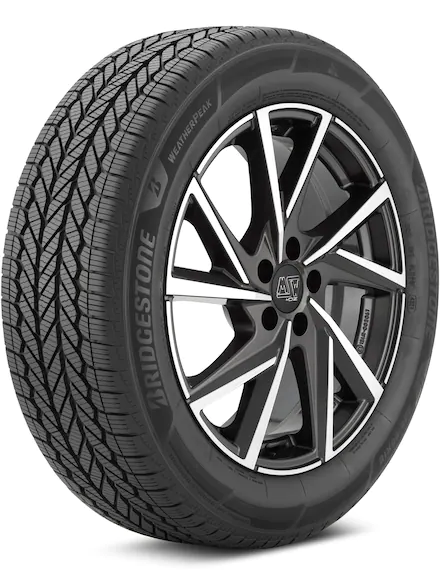
Built with full-depth sipes specifically for slush and snow grip, this was the more snow-confident of my two all-weather picks. It carries the 3PMSF rating and, in my testing, held packed snow noticeably better than the CrossClimate2 — at a small cost to dry-road refinement, where it felt slightly less precise through the canyon loop.
Backed by a 60,000-mile tread warranty, it’s a strong pick for Mini owners in a climate with real winter weather who want genuine snow confidence rather than just a snowflake symbol on the sidewall, without committing to a full seasonal swap.
Pros: Strongest snow traction of my all-weather picks, solid warranty, full-depth sipe design. Cons: Slightly less precise dry handling than the CrossClimate2, not a substitute for a dedicated winter tire on ice.
5. Pirelli Cinturato P7 All Season Run Flat: Best Run-Flat Replacement
Price Check
Check the price of this tire at the following retailers:
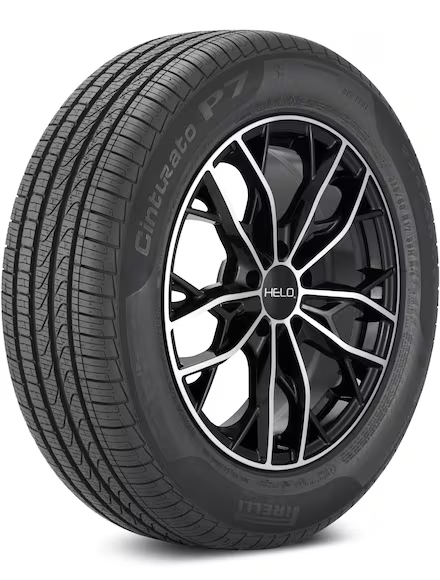
If you’re staying with run-flats, this was the smoothest option I tested. Compared to the factory run-flat that came on my own Cooper S, it felt noticeably more settled over expansion joints and quieter on coarse pavement — still firmer than any standard tire on this list by nature of run-flat construction, but clearly a step up in refinement.
Handling is competent rather than exciting, which is what you want from a comfort-oriented run-flat. It won’t match the Pilot Sport 4S in a hard corner, and I wouldn’t recommend it for a JCW driven hard. But if you’re keeping the mobility guarantee and comfort is the priority, it’s the one I’d buy again.
Pros: Meaningfully more refined than several factory run-flat options, low road noise for a run-flat. Cons: Firmer than any standard tire here by construction, not built for aggressive driving.
6. Bridgestone Blizzak WS90: Best Dedicated Winter
Price Check
Check the price of this tire at the following retailers:
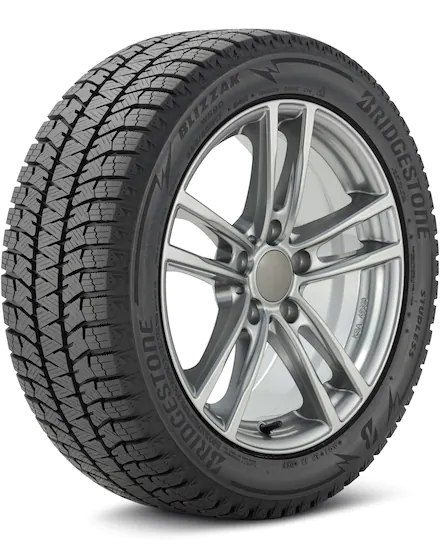
I want to be direct about this: nothing else on this list, including both all-weather picks, matched the Blizzak WS90 once conditions turned to real ice during my Montana testing. The compound stayed pliable in temperatures that made the all-season and all-weather tires noticeably stiffer, and the difference in braking distance and cornering confidence on packed snow wasn’t subtle.
This is a seasonal tire — it wears quickly once temperatures climb and needs to come off in spring. If you’re anywhere with consistent sub-freezing temperatures and real snow accumulation, running this seasonally on a second set of wheels is the single biggest safety upgrade available for cold-weather driving on a Mini.
Pros: Best-in-test ice and snow traction, predictable handling in genuine winter conditions. Cons: Seasonal use only, more road noise than all-season options.
7. Michelin X-Ice Xi3: Best Dedicated Winter for Longevity
Price Check
Check the price of this tire at the following retailers:
If you’re swapping to winter tires every year and want a set that lasts more than one or two seasons, this is the one I’d point you toward over the Blizzak. Ice braking and snow traction were both strong in my testing — not quite the outright ice grip of the WS90, but close enough that most drivers won’t notice the difference in daily conditions.
Where it earns its spot on this list is tread longevity for a winter tire, which held up better across repeated seasonal use than most dedicated winter options. The trade-off is a slightly less sporty feel than the Mini’s character usually delivers, which some enthusiasts may notice more than others.
Pros: Strong ice and snow traction, better longevity than most winter tires. Cons: Slightly less sporty handling than the Mini’s typical character, seasonal use only.
8. General AltiMAX RT43: Best Budget

Price Check
Check the price of this tire at the following retailers:
I didn’t expect much going in, given how much this undercuts the rest of the list on price. It won me over. It’s not going to compete with the Pilot Sport 4S on grip, but it delivered predictable, unremarkable performance across dry and wet roads on my test loop, and it was one of the more affordable sets that didn’t feel like I was compromising basic safety to save money.
If your budget is the deciding factor and you just need a solid, dependable all-season tire while you save up for something more specialized, this is a legitimately good place to land.
Pros: Genuinely affordable without feeling unsafe, predictable dry and wet handling. Cons: Won’t compete with premium options on grip or refinement, no 3PMSF rating.
9. Kumho Solus TA11: Best Budget, Comfort-Leaning

Price Check
Check the price of this tire at the following retailers:
This is the softer-riding alternative to the AltiMAX RT43 if comfort matters more to you than outright value. It’s priced similarly, but the ride felt noticeably more cushioned over rough pavement on my commute loop, at a small cost to outright dry grip compared to the General.
Wet traction surprised me positively for the price point — nothing dramatic, but confidence-inspiring enough that I wasn’t second-guessing braking distances in a light rain. If you’re budget-constrained and comfort is your priority over sportiness, this is worth cross-shopping against the RT43.
Pros: More cushioned ride than the AltiMAX RT43 at a similar price, decent wet traction for the cost. Cons: Slightly less dry grip than the RT43, no 3PMSF rating.
10. Yokohama BluEarth-GT: Best for Efficiency
Price Check
Check the price of this tire at the following retailers:
If fuel economy matters to you on a gas-powered Mini, this was the standout for rolling resistance in my testing without feeling like a compromise on handling. The specialized silica compound and aerodynamic sidewall design kept the Mini feeling responsive on my canyon loop, which surprised me for a tire this focused on efficiency.
Road noise was the one area where it didn’t quite match the ExtremeContact or CrossClimate2 — noticeably more present on certain coarse road surfaces during my testing. If efficiency is your top priority and you’re willing to trade a bit of quiet for it, it’s a solid pick.
Pros: Strong efficiency focus without sacrificing much handling responsiveness, agile character suits the Mini. Cons: More road noise than my top picks on coarse surfaces, not built for aggressive driving.
11. Nokian eNTYRE 2.0: Best for Quiet, Eco-Conscious Driving
Price Check
Check the price of this tire at the following retailers:
This was the quietest tire I tested outside of the dedicated comfort-focused options, and it comes with genuine environmental credentials — manufactured with reduced emissions and water usage, and free from high-aromatic oils in the rubber compound. On my highway loop, cabin noise dropped noticeably compared to the budget picks above.
It’s not the tire for a driver who wants the Mini to feel sporty — handling is clearly tuned toward comfort and quiet rather than the go-kart feel the car is known for. But for owners who prioritize a hushed cabin and lower environmental impact over outright driving engagement, it delivered exactly what it promised.
Pros: Quietest ride outside dedicated comfort tires, genuine eco-manufacturing credentials. Cons: Doesn’t deliver the Mini’s characteristic sporty feel, not for aggressive driving.
Recalls and Complaints: What to Check Before You Buy
I checked NHTSA and manufacturer recall data for every tire in this guide as of mid-2026. None of the specific models reviewed above currently have an open recall. A few adjacent notes worth knowing so you don’t confuse similarly-named tires while shopping:
- Michelin Agilis CrossClimate, a light-commercial-van tire, was recalled over a tread-chunking issue in certain date codes. This is unrelated to the passenger CrossClimate2 reviewed above.
- Continental ProContact GX AO, a different tire from any Continental reviewed here, was subject to a separate recall affecting specific Audi OE sizes over a tread-separation risk tied to particular date codes.
- Bridgestone Blizzak 6, a different size and model from the WS90 reviewed above, was recalled in 2025 over a missing DOT certification marking on the sidewall — a labeling compliance issue, not a structural defect.
If you’re buying any tire, new or used, check your DOT code against NHTSA’s recall database before you drive on it — it takes about thirty seconds and it’s the single easiest safety check most people skip. Recall status changes, so verify current status yourself rather than relying on any article’s snapshot in time, including this one.
Choosing the Right Tire for Your Mini Cooper
Run-flat or standard is the first decision, not the last. Everything else in this guide — comfort, noise, price — is downstream of that choice, and it matters more on the Mini than most cars given how tight cargo space already is.
AWD makes tire matching non-negotiable on the Countryman/Clubman All4. Replace and rotate as a full set where you can, and never mix tread patterns across the four corners of an All4 model.
Trim should guide performance expectations. A base Cooper doesn’t need — and won’t fully benefit from — the same tire as a JCW. Match the tire to how the car is actually driven, not to what sounds impressive on paper.
Climate should decide all-weather versus dedicated winter. If you’re anywhere that sees real winter, prioritize a 3PMSF-rated tire at minimum — the CrossClimate2 and WeatherPeak both qualify. If you get sustained sub-freezing weeks with real snow accumulation, a dedicated winter tire will still outperform any all-weather here.
Don’t mix tire models across axles. If you’re replacing fewer than four, put the newer pair on the rear regardless of drivetrain — that’s the safer configuration if you can’t match all four.
The Cooper SE needs a different lens. Its instant torque and added battery weight wear tires — especially at the front axle — faster than the gas Hardtop. A lower rolling-resistance all-season or all-weather tire is the better starting point than a pure performance tire, both for range and tread life, and a shorter rotation interval (around every 5,000 miles) is worth budgeting for.
Frequently Asked Questions
What size tires does my Mini Cooper need?
Check the driver’s side door jamb sticker first, since sizes vary by generation, trim, and wheel package. Common sizes include 175/65R15 for early base Coopers, 195/55R16 for mid-range trims, and 205/45R17 or larger for the Cooper S and John Cooper Works variants.
Should I stay with run-flat tires or switch to standard tires?
Staying with run-flats makes sense if you value the mobility guarantee after a puncture and don’t want to carry a spare or repair kit — most Minis don’t have spare storage built in. Switching to standard tires delivers a noticeably smoother, quieter ride, but requires a repair kit, compact spare, or portable inflator. Don’t mix run-flats and standard tires on the same vehicle.
Do I really need winter tires for my Mini Cooper, or are all-season tires sufficient?
It depends on your local climate. If temperatures regularly drop below 45°F with frequent snow or ice, dedicated winter tires like the Bridgestone Blizzak WS90 or Michelin X-Ice Xi3 are the safest choice — all-season tires harden and lose grip in freezing conditions. For milder winters, an all-weather tire like the Michelin CrossClimate2 or Bridgestone WeatherPeak offers a reasonable middle ground.
What tire size should I use for my specific Mini Cooper model?
The most reliable source is the tire information placard on the driver’s side door jamb. Common current sizes include 175/65R15 for base Hardtops, 195/55R16 for mid-range trims, 205/45R17 for Cooper S and JCW variants, and larger sizes up to 225/45R19 on the Countryman.
How much should I expect to spend on a set of tires for my Mini Cooper?
Budget options run roughly $65–$110 per tire, mid-range options $120–$180, and premium performance tires $180–$250 or more. Run-flat versions of comparable tires typically carry a 15–25% premium over standard equivalents. These figures don’t include mounting, balancing, and disposal fees.
How do I know if my Mini Cooper’s tires are properly inflated?
Check tire pressure monthly when tires are cold, using the specification on the driver’s side door jamb sticker — typically 32–38 PSI depending on model, not the maximum pressure printed on the tire sidewall. Your Mini’s TPMS will alert you to significant pressure drops, but it’s not a substitute for regular manual checks.
Can I mix different tire brands on my Mini Cooper?
You can, but it’s not ideal — different tread designs and compounds behave differently in emergency braking or slippery conditions. If you must replace fewer than four, match the closest tire you can in size and tread depth, and put the newer pair on the rear axle.
