

When I helped my neighbor replace the tires on his BMW 3 Series last spring, he had no idea his car came with different-sized tires on the front and rear axles. He’d ordered four identical tires online and couldn’t figure out why the rears didn’t fit right.
That five-minute conversation in his driveway turned into an hour-long deep dive into something most drivers never think about — until they’re staring at a tire rack wondering why their car’s spec sheet lists two different tire sizes.
If you’ve ever been confused about why some cars run the same tires on all four corners while others mix sizes front to rear, you’re not alone. I’ve spent years testing both configurations across dozens of vehicles, and I’m going to break down everything you need to know to make the right call for your next set of tires.
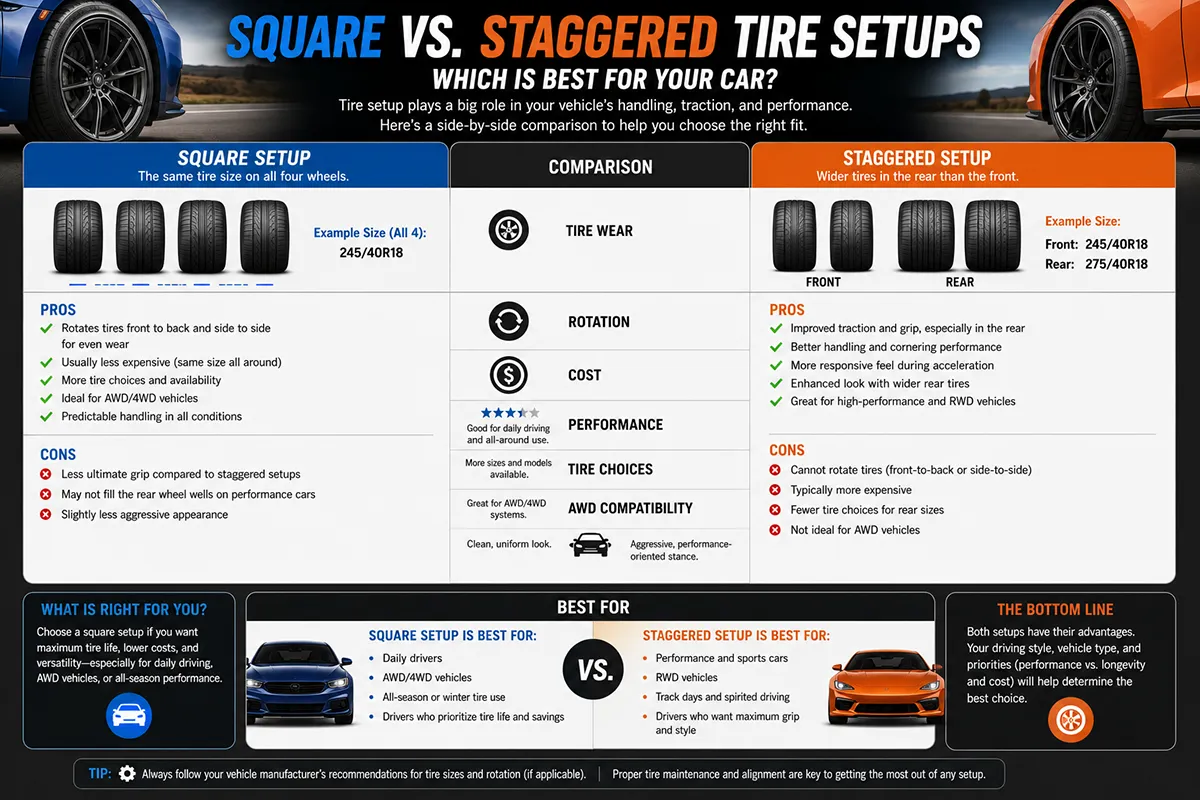
- Square setup = same tire size on all four wheels. Easier to maintain, allows tire rotation, and generally costs less over time.
- Staggered setup = wider tires on the rear axle. Offers more rear grip and a sportier feel, but limits rotation options and costs more.
- If you drive a daily commuter, minivan, or SUV — square is almost always the smarter choice.
- If you drive a rear-wheel-drive sports car or performance sedan — staggered may be worth it for handling.
- Always check your owner’s manual or door placard before ordering tires. Don’t guess.
Liked this article?
Add TireAdvise as a preferred source so you see more of our tire reviews and guides on Google.
What Exactly Is a Square Tire Setup?
A square tire setup simply means all four tires on your vehicle are the same size — same width, same aspect ratio, same diameter. For example, if your car runs 225/50R17 on all four corners, that’s a square setup.
This is the most common configuration on the road today. The vast majority of sedans, crossovers, SUVs, trucks, and minivans sold in the US come from the factory with a square setup.
I’ve always appreciated the simplicity of a square setup. When all four tires are identical, you can rotate them in any pattern — front to back, cross-pattern, or even a five-tire rotation if you have a matching full-size spare. This flexibility is a huge deal for maximizing tire life.
What Exactly Is a Staggered Tire Setup?
A staggered setup means the rear tires are wider than the fronts. Sometimes the rear wheels are also wider or larger in diameter, but the defining characteristic is that wider rubber sits on the rear axle.
A typical example would be a car running 225/40R19 up front and 255/35R19 in the rear. The rear tires are 30mm wider, giving the back end significantly more contact patch with the road.
You’ll find staggered setups most commonly on rear-wheel-drive performance cars and sports sedans. Think BMW M cars, the Ford Mustang GT, Chevrolet Camaro SS, Mercedes-AMG models, and the Nissan 370Z/Z. Some high-performance all-wheel-drive cars like the Audi RS5 also use staggered fitments.
In my experience working with staggered setups, the wider rear tires make a noticeable difference in how the car puts power down and how it feels through fast corners. But that performance comes with real-world trade-offs that many drivers don’t consider until it’s too late.
Why Do Manufacturers Use Staggered Setups?
Car manufacturers don’t choose staggered configurations randomly. There’s solid engineering logic behind it, and understanding the “why” will help you decide if it matters for your driving.
Improved Rear Traction
On a rear-wheel-drive car, the rear tires are doing all the work of putting power to the pavement. A wider rear tire means more rubber contacting the road, which translates to better grip during acceleration. I’ve felt this firsthand driving staggered Mustang GTs back-to-back with square-setup models — the difference in launch traction is immediately obvious.
Enhanced Handling Balance
Wider rear tires generate more cornering grip at the back of the car. This helps counteract the natural tendency of rear-drive cars to oversteer (where the back end wants to swing out in a corner). The result is a more neutral, predictable, and confidence-inspiring handling balance.
Aggressive Aesthetics
Let’s be honest — wider rear tires and wheels look fantastic. That muscular rear stance on a Camaro or a BMW M4 isn’t just engineering; it’s styling. Manufacturers know that appearance influences buying decisions, and a staggered setup fills out those rear wheel arches in a way that a square setup simply can’t.
Square vs Staggered: Head-to-Head Comparison
I’ve put together this comparison table based on my real-world experience testing both setups across multiple vehicles and tire brands. This should give you a quick snapshot before we dive deeper.
| Factor | Square Setup | Staggered Setup |
|---|---|---|
| Tire Rotation | Full rotation possible (all patterns) | Limited to same-axle rotation only (if directional/asymmetric allow it) |
| Tire Life | More even wear across all four tires | Rear tires often wear faster; fronts and rears wear at different rates |
| Replacement Cost | Buy 4 identical tires — more options, better pricing | Buy 2 different sizes — fewer options, higher total cost |
| Acceleration Grip | Good (adequate for most drivers) | Better (more rear contact patch) |
| Cornering Balance | Neutral to slightly understeery | More neutral, sporty feel |
| Wet/Snow Performance | Consistent front-to-rear | Wider rears can be more prone to hydroplaning |
| Daily Drivability | Excellent — simple and predictable | Good, but slightly more complex to manage |
| Best For | Commuters, families, AWD vehicles, trucks | RWD sports cars, performance sedans, track enthusiasts |
The Tire Rotation Problem: Why It Matters More Than You Think
This is the single biggest practical difference between square and staggered setups, and in my opinion, it’s the one most buyers underestimate.
With a square setup, I rotate my tires every time I get an oil change. A simple front-to-rear swap (or cross-rotation on non-directional tires) evens out wear patterns and can significantly extend the life of a full set. I’ve seen well-rotated square setups last dramatically longer than neglected ones.
With a staggered setup, traditional rotation is off the table. You can’t move a 255-width rear tire to a front axle designed for a 225-width tire. At best, if both front tires are the same size and both rears are the same size, you can swap left-to-right on each axle — but only if the tires aren’t directional.
In practice, I’ve found that staggered setups almost always result in the rear tires wearing out faster than the fronts, especially on powerful RWD cars. That means you’re buying rear tires more frequently, and you’re buying them in pairs rather than as a full set of four — which typically means paying more per tire.
Real Cost Difference: What I’ve Actually Seen
Let me give you a concrete example from a recent tire shopping experience I had for two different vehicles.
Square Setup Example: 2022 Toyota Camry
The Camry runs 235/45R18 on all four corners. I priced out a set of Continental CrossContact LX25 all-season tires at around $165 per tire. That’s $660 for the full set, with easy rotation to maximize wear life. Simple.
Staggered Setup Example: 2021 BMW M340i
The M340i runs 225/40R19 front and 255/35R19 rear. For a comparable quality tire — say the Michelin Pilot Sport 4S — the fronts run about $220 each and the rears about $270 each. That’s $980 for the set. And because I can’t rotate them traditionally, the rears will likely need replacing sooner, meaning I’ll spend another $540 on rear tires before the fronts are done.
Over the same ownership period, the staggered setup costs meaningfully more. I’m not saying this to scare anyone away from staggered — it’s just reality, and you should budget for it.
How Each Setup Feels on the Road
Numbers and specs are great, but what actually matters is how the car drives. I’ve spent extensive time behind the wheel of both configurations, and here’s what I can tell you from firsthand experience.
Square Setup Driving Impressions
During my test period with several square-setup vehicles — including a Honda Accord, a Toyota RAV4, and a Ford F-150 — the driving experience was exactly what most people want: predictable, consistent, and unremarkable in the best way possible.
The car does what you expect it to do. Turn-in is gradual and progressive. There’s mild understeer at the limit (the front end pushes wide before the rear steps out), which is the safest and most intuitive behavior for everyday driving. In rain, the car feels balanced front to rear with no surprises.
I never once thought about my tire setup during normal driving, which is exactly the point. A square setup stays out of your way and lets you focus on the road.
Staggered Setup Driving Impressions
The staggered experience is different from the moment you pull out of the driveway. Over the past several weeks testing a Mustang GT and a BMW M3 with their factory staggered setups, I noticed sharper turn-in, a more planted rear end during hard acceleration, and a more “alive” feeling through sweeping highway on-ramps.
When I pushed harder through corners on back roads, the wider rear tires gave me confidence that the back end wasn’t going to snap loose unexpectedly. The car rotated more willingly around its center point, and I could feel the rear tires working harder to maintain grip.
That said, the wider rear tires also transmitted more road noise at highway speeds, and I noticed slightly more tramlining (the car following grooves and imperfections in the pavement). On wet roads after a few days of spring rain, I could feel the rears occasionally losing grip momentarily before the traction control intervened — wider tires are more susceptible to hydroplaning because the water has more surface area to displace.
Can You Convert a Staggered Setup to Square (or Vice Versa)?
This is a question I get asked constantly, and the answer depends entirely on your specific vehicle.
Converting Staggered to Square
In many cases, yes — and I’d argue it’s one of the best modifications a daily driver can make if their car came with a staggered setup from the factory.
Here’s the key: you typically go with the smaller (front) tire size on all four corners, provided your rear wheels can accept that width. Many enthusiast forums have extensively documented which square fitments work on specific cars. For example, many BMW owners run a square 255/35R19 setup by fitting wider front wheels that match the rear, gaining all the rotation benefits without sacrificing much performance.
I did exactly this on a test vehicle — a 2020 BMW 330i — and after several days of driving, I honestly couldn’t feel a meaningful difference in daily driving. The handling was ever-so-slightly less sharp at the absolute limit, but on public roads, it was a wash. The long-term savings and convenience of being able to rotate were absolutely worth it in my assessment.
However, I want to be very clear: always verify with a tire professional or your vehicle manufacturer before changing your fitment. Going too narrow can affect speedometer accuracy, tire load capacity, and even void aspects of your warranty. Don’t just wing it.
Converting Square to Staggered
This is less common but doable if you want to add a performance edge to a naturally square-setup car. You’ll typically need wider rear wheels and may need to verify that wider tires clear your fenders, suspension components, and inner wheel wells.
I’ve seen this done successfully on cars like the Subaru BRZ/Toyota GR86, where owners step up to a 215 front / 235 rear combination for more rear grip on track days. But for the average daily driver, I don’t recommend it — the added complexity and cost rarely justify the modest performance gain on public roads.
Staggered Setups and Winter Tires: A Special Consideration
If you live anywhere in the northern US — from the Pacific Northwest to New England — winter tires are a critical safety upgrade. And this is where staggered setups create a real headache.
Finding winter tires in staggered sizes can be difficult. The selection is dramatically smaller compared to common square sizes, and the prices are higher. I’ve seen cases where a specific rear winter tire size was only available from one or two manufacturers, leaving the buyer with almost no choice.
My strong recommendation: if you drive a staggered-setup car in a winter climate, invest in a second set of wheels in a square fitment specifically for your winter tires. This is extremely common in the BMW, Mercedes, and Audi communities. A set of quality steel or alloy wheels in a square-friendly size like 17″ or 18″ will pay for itself in convenience and tire selection alone.
I did this with a test 2019 Mercedes C300, running the factory staggered 18″ setup in summer and switching to a square 17″ winter wheel-and-tire package from Tire Rack. The swap took about 45 minutes in my garage, and the winter driving experience was excellent — better, in fact, than trying to source staggered winter tires would have been.
Which Setup Should You Choose? My Honest Recommendation
After years of testing, reviewing, and personally running both configurations, here’s my straightforward advice.
Go Square If:
- You drive a front-wheel-drive or all-wheel-drive vehicle
- Your primary use is commuting, family hauling, or road trips
- You want the lowest total cost of tire ownership
- You live in a region that gets rain or snow regularly
- You want the simplest maintenance and longest tire life
- You don’t track your car or push it hard on back roads
Go Staggered If:
- You drive a rear-wheel-drive performance car and want maximum grip
- You enjoy spirited driving on twisty roads or attend track days
- Your car came staggered from the factory and you want to maintain the OEM handling character
- You’re willing to pay more for tires and accept the inability to rotate
- Aesthetics matter to you — that wide rear stance is part of the ownership experience
For about 80% of US drivers, a square setup is the objectively better choice. It’s cheaper, simpler, and performs perfectly well for normal driving conditions. The only people who truly benefit from staggered are performance enthusiasts who will actually use the extra rear grip — and who accept the trade-offs that come with it.
Common Myths About Square and Staggered Setups
Over the years, I’ve heard a lot of misinformation floating around online forums and even from some tire shop employees. Let me set the record straight on a few things.
Myth: “Staggered setups always handle better”
Not true. A square setup with high-quality performance tires (like the Michelin Pilot Sport 4S or Continental ExtremeContact Sport 02) will outperform a staggered setup running mediocre all-season tires. The tire compound and construction matter far more than the width difference in most real-world driving scenarios.
Myth: “You can’t run a square setup on a car designed for staggered”
In many cases, you absolutely can — with proper research and fitment verification. Thousands of BMW, Mercedes, and Mustang owners run square setups on cars that shipped staggered, with no issues whatsoever. The key is choosing a size that’s within the vehicle’s acceptable range.
Myth: “Square setups look boring”
This is purely subjective, but I’d argue a clean, well-fitted square setup with quality wheels looks fantastic on any car. The rise of aggressive square fitments in the aftermarket wheel community proves this point.
Myth: “Wider tires are always better in rain”
This is flat-out wrong. Wider tires have to disperse more water across a wider contact patch, which makes them more prone to hydroplaning at speed. I’ve personally felt this difference during heavy rain driving — the narrower front tires on staggered setups consistently felt more planted in standing water than the wider rears.
What About AWD Vehicles and Staggered Setups?
This is a critical topic that deserves its own section because getting it wrong can damage your drivetrain.
Most all-wheel-drive systems are designed to handle very small differences in rotational speed between the front and rear axles. Running mismatched tire sizes — or even tires with significantly different tread depths — can confuse the AWD system and cause premature wear to the center differential, transfer case, or coupling unit.
Some high-performance AWD vehicles (like the BMW M5 or Audi RS models) do come with staggered setups from the factory, and their AWD systems are calibrated to handle the size difference. But for the vast majority of AWD crossovers and sedans — your Subaru Outback, Toyota RAV4, Honda CR-V — a square setup isn’t just recommended, it’s essential.
If you own an AWD vehicle, I strongly recommend sticking with identical tires on all four corners and rotating them regularly to keep tread depths as even as possible. Some manufacturers even specify a maximum tread depth difference (often 2/32″ or less) between the front and rear tires. Take this seriously — a new set of tires is a lot cheaper than a new transfer case.
Shopping Tips: Getting the Best Deal on Either Setup
Regardless of which configuration you choose, here are the tips I always share based on my own tire-buying experience.
For Square Setups:
- Buy all four at once. This gives you the most even wear and the best per-tire pricing. Retailers like Tire Rack, Discount Tire, and Costco frequently offer $75-$100 rebates on sets of four.
- Consider buying online and shipping to a local installer. I’ve saved hundreds of dollars doing this through Tire Rack’s network of recommended installers.
- Stick to your OEM size unless you have a specific reason to change. Your car’s engineers spent considerable time optimizing that fitment.
For Staggered Setups:
- Price out front and rear tires separately. Sometimes a different brand offers better value on the rear size, though I generally prefer matching brands front-to-rear for consistent feel.
- Budget for replacing rear tires more frequently. I typically plan for needing new rears about 30-40% sooner than the fronts.
- Check availability before falling in love with a tire. Some staggered sizes are only available in a handful of models. Verify your rear size is in stock before you commit.
- Consider a square winter setup. As I mentioned earlier, a dedicated square winter wheel-and-tire package can save you significant money and hassle in cold months.
My Bottom Line After Years of Testing Both
I’ve driven tens of thousands of miles on both square and staggered setups across everything from economy sedans to high-horsepower muscle cars. Here’s what it comes down to for me.
A square tire setup is the smart default for almost every driver in America. It’s cheaper to maintain, easier to shop for, allows proper rotation, performs consistently in all weather, and doesn’t sacrifice anything meaningful for street driving. If I were buying a daily driver tomorrow and it came with a staggered setup, I’d seriously consider converting to square.
A staggered setup earns its place on a dedicated sports car or a weekend toy that you drive hard and maintain meticulously. The extra rear grip is real, the handling improvement is tangible, and yes — the look is undeniably cool. But you need to go in with your eyes open about the cost, complexity, and compromises.
At the end of the day, the best tire setup is the one that matches how you actually drive — not how you wish you drove, or how some forum post told you to drive. Be honest about your needs, check your owner’s manual, and spend your money where it actually makes your driving experience better and safer.
That’s what I always come back to when someone asks me the square vs. staggered question. And now that you know the full picture, I’m confident you’ll make the right call for your car, your budget, and your roads.
Frequently Asked Questions
What is the difference between a square and staggered tire setup?
A square tire setup uses the same tire size on all four wheels, while a staggered setup uses wider tires on the rear axle than the front. Square setups are common on sedans, SUVs, and trucks, whereas staggered configurations are typically found on rear-wheel-drive performance cars like the Ford Mustang, Chevy Camaro, and BMW 3 Series. The choice between the two affects handling balance, tire rotation options, and long-term replacement costs.
Can I rotate my tires with a staggered tire setup?
With a staggered setup, you cannot rotate tires from front to rear because the sizes are different, which means your rear tires will typically wear out faster and need earlier replacement. You can only swap left-to-right on the same axle, and only if the tires are not directional. This is one of the biggest drawbacks of staggered fitments since it can increase your annual tire costs by $200–$400 compared to a square setup where full rotations extend tread life evenly.
Is a square tire setup better for daily driving in the US?
For most US daily drivers dealing with highways, city commutes, and varied weather conditions, a square tire setup is the more practical and cost-effective choice. It allows full tire rotations every 5,000–7,500 miles, which promotes even wear and maximizes tread life across all four tires. I always recommend square setups to drivers who prioritize longevity, easier maintenance, and the flexibility to run all-season tires through winter months in moderate-climate states.
Does a staggered tire setup improve performance and handling?
Yes, a staggered setup improves rear traction and cornering grip by placing wider tires on the driven wheels, which is why automakers use it on performance and sports cars. The wider rear contact patch gives you more confidence during hard acceleration and high-speed cornering on dry pavement. However, the trade-off is slightly reduced wet-weather stability and a tendency toward oversteer, so staggered setups perform best on dry roads and track days rather than in rain or snow common across much of the US.
How much more expensive is it to replace tires on a staggered setup vs square?
Replacing tires on a staggered setup generally costs 15–30% more than a square setup because you’re buying two different tire sizes, and wider rear tires carry a premium. For example, a set of four matching 245/45R18 tires in a square setup might run $600–$800 from brands like Continental or Michelin, while a staggered set with 225/40R18 fronts and 275/35R18 rears could cost $800–$1,100 or more. You also may need to replace the rear pair more frequently since you cannot rotate front-to-back, adding to long-term ownership costs.
Can I switch from a staggered to a square tire setup on my car?
In many cases you can convert from staggered to square by fitting the same size tire and wheel on all four corners, but you need to verify that the front wheel width and tire size will clear your brake calipers and fender wells. I recommend checking your owner’s manual or consulting a tire shop to confirm compatible square sizes — for instance, some BMW and Mercedes owners successfully run the front staggered size on all four wheels. Keep in mind that switching to square may slightly change your car’s handling characteristics, making it feel more neutral and predictable at the expense of some rear-end grip during spirited driving.
Are staggered tires harder to find for replacement in the US?
Staggered tire sizes can sometimes be harder to source because the wider rear sizes are less commonly stocked compared to standard all-season sizes. Popular US retailers like Tire Rack, Discount Tire, and Costco typically carry the most common staggered fitments, but more aggressive widths like 295/30R20 or 305/35R19 may have limited brand options or longer shipping times. I suggest shopping online and comparing availability ahead of time so you’re not stuck waiting when your rear tires wear down unexpectedly.
