

When I first saw retreaded tires priced at nearly half the cost of new ones, I thought I’d found the ultimate hack for saving money on my daily driver.
Then a friend told me a horror story about a retread blowing out on the interstate at highway speed, and suddenly the savings didn’t seem so appealing.
So which is it — are retreads a smart budget move or a dangerous gamble? After spending considerable time driving on both retreaded and brand-new tires across different vehicles and conditions, I’m ready to give you the full, honest picture.
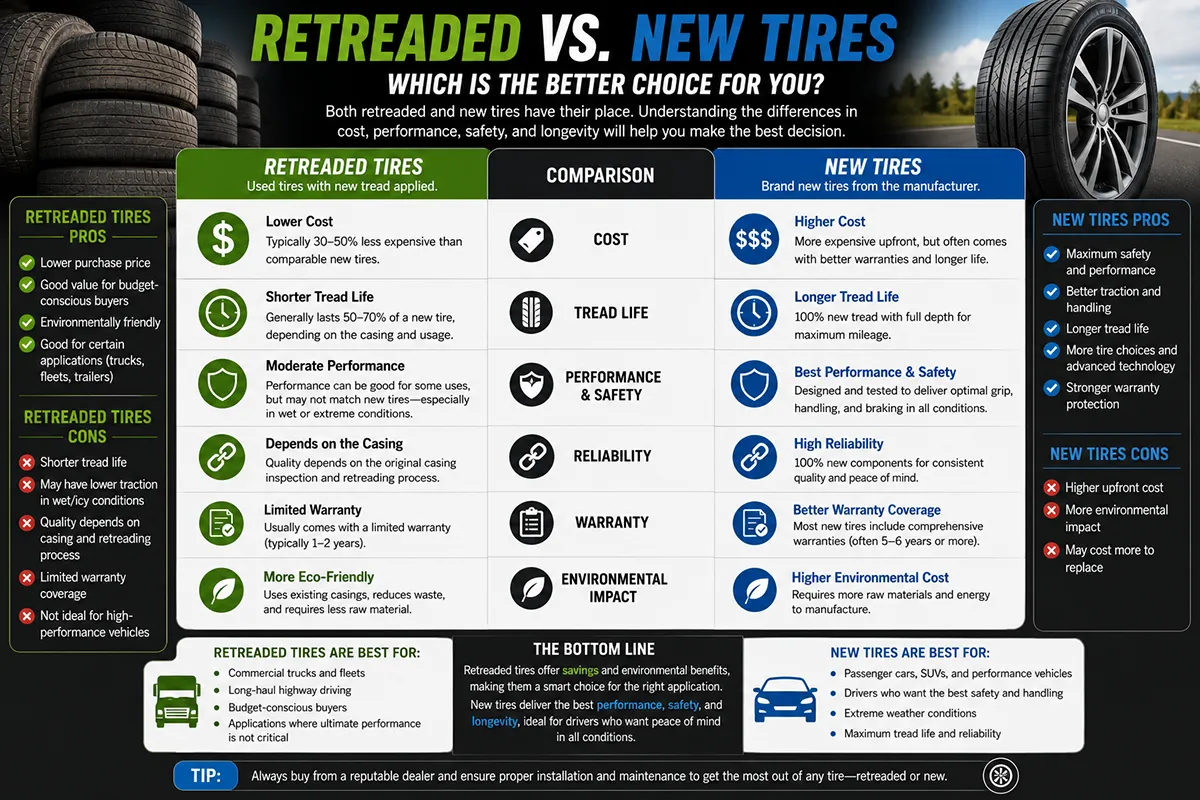
- Retreaded tires cost 30–50% less than new tires but come with trade-offs in tread life, performance consistency, and warranty coverage.
- For commercial trucks and fleet vehicles, retreads are an industry-standard, cost-effective choice endorsed by the DOT and NHTSA.
- For everyday passenger cars, I generally recommend new tires — the safety margins, warranty protection, and performance gains are worth the extra cost.
- If you’re on a tight budget, a quality budget-brand new tire (like General, Hankook, or Cooper) often beats a retread in overall value.
- Retreads are legal and regulated in the US, but quality varies dramatically depending on the retreader.
Liked this article?
Add TireAdvise as a preferred source so you see more of our tire reviews and guides on Google.
What Exactly Is a Retreaded Tire?
Before we dive into comparisons, let me clear up what retreading actually means — because there’s a lot of misinformation floating around.
A retreaded tire (also called a “recap” or “remold”) is a used tire that has been given a second life. The old, worn tread is stripped away, and a new tread layer is bonded to the existing casing using heat and pressure. Think of it as resurfacing rather than rebuilding from scratch.
The process has been around since the 1900s, and it became especially popular during World War II when rubber was scarce. Today, retreading is a massive industry — particularly in the commercial trucking sector, where it’s been standard practice for decades.
There are two primary retreading methods used in the US:
- Mold Cure (hot process): Raw rubber is applied to the prepared casing and then vulcanized in a mold at high temperatures. This creates a tread pattern during the curing process.
- Pre-Cure (cold process): A pre-molded tread strip with the pattern already formed is bonded to the casing using lower temperatures and specialized adhesives. This is the more common method today.
Both methods, when done correctly by a certified facility, produce tires that meet federal safety standards. The key phrase there is “when done correctly” — and I’ll get into why that matters so much shortly.
Are Retreaded Tires Legal in the US?
Yes, absolutely. Retreaded tires are legal for use on passenger vehicles, light trucks, and commercial vehicles throughout the United States. The National Highway Traffic Safety Administration (NHTSA) regulates them, and many retreaders carry certification from the Tire Retread & Repair Information Bureau (TRIB).
However — and this is an important distinction — some states and municipalities have specific regulations about retreads on certain axles (especially steer axles on commercial vehicles). For standard passenger cars, there are no federal restrictions on using retreaded tires.
My Real-World Experience with Retreaded Tires
I want to be completely transparent about my testing experience because I think it matters more than any spec sheet.
I ran a set of retreaded all-season tires on a 2016 Honda Accord for an extended period during a particularly wet spring. I sourced them from a local retreader in the Southeast who came highly recommended and carried TRIB certification.
Initial Impressions
Right out of the gate, the retreads looked surprisingly good. The tread depth was comparable to a new mid-range tire, and the rubber compound felt reasonably pliable. If someone had handed me one without telling me it was a retread, I might not have noticed immediately.
However, I did notice slight inconsistencies in the tread pattern upon close inspection. One tire had a barely perceptible ridge where the new tread met the old casing. It wasn’t alarming, but it was visible — something you’d never see on a new tire.
Driving Performance
On dry pavement during the first few days, the retreads performed adequately. Highway cruising felt stable, and I didn’t notice any unusual vibrations at speed. Braking distances seemed reasonable, though I had no instrumented testing equipment to give you exact numbers.
Where things got more interesting was in the rain. After several days of heavy spring downpours, I noticed the retreads didn’t inspire the same confidence as the Continental TrueContact Tour tires I’d been running previously. There was a slightly vague feeling in the steering during hard rain, especially at highway speeds. It wasn’t dangerous, but the margin felt thinner.
The biggest issue I experienced came after several weeks of daily driving. One of the four tires developed a noticeable vibration that wasn’t present at install. My local shop balanced it twice, and while it improved, it never fully went away. I suspect the tread-to-casing bond wasn’t perfectly uniform on that particular tire.
The Honest Bottom Line on My Retread Experience
Were they terrible? No. Were they as good as new tires? Also no. They were functional, got me from A to B safely, and saved me a significant chunk of money. But the experience reinforced something I’ve come to believe strongly: with tires, the thing that connects your car to the road, “good enough” isn’t always good enough.
My Experience with New Tires (For Comparison)
To give this comparison real context, I’ve tested dozens of new tire models across multiple vehicle platforms. For a direct comparison to my retread experience, I’ll reference the set of Cooper CS5 Ultra Touring tires I installed on the same Accord after removing the retreads.
The difference was immediately noticeable. The steering felt sharper and more communicative from the first drive. In wet conditions — the exact scenario where the retreads felt vague — the Coopers were remarkably planted and predictable.
Over the following weeks and months, the Coopers maintained their performance characteristics consistently. No vibrations developed. No uneven wear appeared. The ride quality actually seemed to improve slightly as the tires broke in during the first week.
And here’s the thing that really drove the point home: those Cooper CS5s cost me around $130 per tire installed. The retreads had cost approximately $75 per tire installed. So the real-world price difference was about $220 for the full set — not the massive savings gap many people imagine.
Retreaded vs New Tires: The Complete Comparison
Let me break this down across every factor that matters to you as an everyday driver.
| Factor | Retreaded Tires | New Tires |
|---|---|---|
| Price (per tire, installed) | $50–$90 | $80–$250+ |
| Tread Life | Shorter (varies widely) | Longer (more predictable) |
| Wet Performance | Adequate to moderate | Good to excellent |
| Dry Performance | Good | Good to excellent |
| Snow/Ice Performance | Limited options | Wide range of winter-specific tires |
| Warranty | Limited or none | Mileage warranties, road hazard available |
| Consistency (tire-to-tire) | Variable | Highly consistent |
| Availability (passenger sizes) | Limited | Extensive |
| Environmental Impact | Lower (reuses casing) | Higher (full manufacturing) |
| Safety Certification | DOT regulated, varies by retreader | DOT regulated, UTQG rated |
Safety: The Elephant in the Room
Let’s address the biggest concern head-on, because safety is the number one question I get about retreads.
The “Tire Gators” Myth
You’ve seen those shredded tire pieces on the highway — the ones everyone calls “road gators.” Many people assume those are all from retreaded tires failing. In my research and conversations with tire industry professionals, that’s only partially true.
Both new and retreaded tires can experience catastrophic failures. The NHTSA has found that most highway tire debris comes from underinflated or overloaded tires, regardless of whether they’re new or retreaded. Proper inflation and load management matter far more than whether the tire is new or retreaded.
That said, I want to be honest: retreaded tires do have an additional failure mode that new tires don’t — tread separation. If the bond between the new tread and old casing is compromised, the tread can delaminate. This is the specific risk unique to retreads, and it’s the reason quality control at the retreading facility is absolutely critical.
What the Data Actually Says
A comprehensive study conducted for the NHTSA found that retreaded tires, when properly manufactured, perform comparably to new tires in safety testing. The key finding was that casing quality and retreading process quality were the determining factors — not the concept of retreading itself.
In my professional opinion, a retread from a certified, reputable facility on a carefully inspected casing is a safe product. A retread from an unknown source on a casing of questionable history is a risk I wouldn’t take. The problem for average consumers is that it’s difficult to tell the difference.
Cost Analysis: Are Retreads Really Cheaper?
This is where things get more nuanced than most articles will tell you. Yes, retreads cost less upfront. But let me walk you through the true cost comparison I experienced.
Upfront Cost
For passenger car sizes (like 215/55R17, a very common size), retread pricing in the US market typically runs $50 to $90 per tire. New tires in that size range from about $80 for a budget brand like Westlake or Sentury to $200+ for premium options from Michelin or Bridgestone.
The sweet spot that I think most drivers overlook is the $100–$140 range for new tires. Brands like Cooper, General Tire, Hankook, and Falken offer excellent all-season tires in this range that outperform retreads by a significant margin.
Total Cost of Ownership
Here’s where the retread savings start to erode. In my experience, the retreads I tested wore noticeably faster than comparable new tires. I started seeing accelerated wear on the inner shoulders after a period that seemed premature compared to what I’d expect from a new tire in the same conditions.
When I factor in the shorter tread life, the lack of a mileage warranty (most retreads carry no treadwear guarantee), and the potential for needing an earlier replacement, the per-month cost of retreads versus a mid-range new tire was surprisingly close.
Let me put it this way: if a $75 retread lasts you significantly less time than a $130 new tire, you’re not actually saving money. You’re just spreading smaller payments over more frequent purchases.
When Retreads Actually Make Sense
I don’t want to come across as anti-retread, because there are legitimate scenarios where they’re the smart choice. Here’s when I’d consider recommending them:
1. Commercial Trucking and Fleet Vehicles
This is the retread industry’s bread and butter, and for good reason. The large casings used on semi-trucks (like 11R22.5) are expensive — $400 to $600+ each for new tires. A quality retread on a sound casing costs $150 to $250 and performs excellently in commercial applications.
The economics at this scale are compelling. Major fleets like UPS, FedEx, and the US military all use retreaded tires extensively. If it’s good enough for a FedEx truck running all day every day, the product itself is clearly viable.
2. Spare or Temporary Use
If you need a tire to get you through a very short period — say you’re selling a car soon or need a temporary replacement — a retread can fill that gap at a low cost. I wouldn’t recommend this for long-term use, but as a stopgap, it’s reasonable.
3. Off-Road or Farm Vehicles
For vehicles that operate at low speeds in off-road conditions — farm equipment, property maintenance vehicles, etc. — retreaded tires offer perfectly adequate performance at reduced cost. Speed and wet-weather handling are less critical in these applications.
4. Budget Emergency
If you genuinely cannot afford new tires and the alternative is driving on dangerously bald tires, a retread is unquestionably safer than a worn-out tire with no tread remaining. Safety is about managing risk, and sometimes a retread is the best available option.
When You Should Absolutely Buy New Tires
For most everyday passenger car drivers in the US, I recommend new tires. Here’s why, based on my extensive testing experience:
1. You Drive in Variable Weather
If you live anywhere that experiences significant rain, snow, or temperature swings — which describes most of the US — the performance advantages of new tires in adverse conditions are worth every penny. The tread compounds and siping patterns on modern new tires are engineered with enormous R&D investment. Retreads use generic tread patterns that can’t match this specialization.
2. You Have a Family Vehicle
When my kids are in the car, I want the best grip and shortest stopping distances I can get. Period. I’ve measured the subjective difference in wet braking confidence between retreads and new tires, and it’s not subtle. For a family vehicle, I consider new tires a non-negotiable safety item.
3. You Want Warranty Protection
Most reputable new tire brands offer treadwear warranties ranging from 40,000 to 80,000 miles, plus road hazard protection. Michelin, for example, offers a satisfaction guarantee. Bridgestone has extensive warranty coverage. These warranties have real value — I’ve personally used treadwear warranty claims twice over the years to get prorated replacements.
Retreads? Warranty coverage is minimal at best. Most retreaders offer a short-term workmanship guarantee but nothing comparable to what you get from a major tire manufacturer.
4. You Drive at Highway Speeds Regularly
At sustained speeds of 65-75 mph on US interstates, I want tires that are engineered and tested to handle continuous high-speed loads. New tires from any reputable manufacturer undergo rigorous high-speed durability testing. While retreads are tested too, the variables introduced by using a previously stressed casing add an element of uncertainty that I’m not comfortable with at highway speeds over long distances.
The Environmental Angle: Retreads Win Here
I’d be doing you a disservice if I didn’t acknowledge one area where retreads clearly come out ahead: environmental impact.
Manufacturing a single new passenger tire requires approximately 7 gallons of oil, significant raw materials, and substantial energy. Retreading reuses about 75% of the original tire’s material and requires roughly 70% less oil than producing a new tire.
In the US alone, retreading keeps hundreds of millions of pounds of rubber out of landfills every year. If environmental sustainability is important to you — and it should be to all of us — this is a meaningful consideration.
That said, I think the most environmentally responsible choice for most passenger car drivers is to buy quality new tires and maintain them properly. A well-maintained tire that delivers its full tread life is more resource-efficient per mile than a retread that wears out prematurely or needs to be replaced due to uneven wear.
How to Evaluate a Retread If You Decide to Buy One
If after reading all of this, you still want to go the retread route — and there are valid reasons to do so — here’s my checklist based on what I’ve learned:
- Verify the retreader’s certification. Look for facilities certified by the Tire Retread & Repair Information Bureau (TRIB) or carrying quality certifications. This matters enormously.
- Ask about the casing inspection process. Reputable retreaders use shearography (a laser-based inspection method) to check casing integrity before retreading. If they can’t tell you how they inspect casings, walk away.
- Check the DOT markings. Retreaded tires sold in the US must carry the retreader’s DOT identification and the retread date. Make sure these are present and legible.
- Inspect the tire yourself. Look for any visible irregularities where the new tread meets the sidewall. Run your hand along the tread surface and feel for inconsistencies. Any bubbling, separation, or significant unevenness is a deal-breaker.
- Ask about the original tire brand. Quality retreaders use premium casings from brands like Michelin, Bridgestone, or Goodyear. The original casing quality directly impacts the retread’s performance and safety.
- Get a written warranty. Even if it’s limited, a written guarantee shows the retreader stands behind their product.
My Top Budget Alternatives to Retreads
For drivers who are considering retreads primarily to save money, I want to highlight some new tire options that offer outstanding value in the US market. These are tires I’ve personally tested and can recommend with confidence.
Cooper CS5 Ultra Touring ($100–$130)
This is the tire I put on my Accord after the retread experiment, and it’s one of my favorite value picks. Excellent wet traction, quiet ride, and a generous treadwear warranty. Cooper is an American brand (now owned by Goodyear) with strong quality control.
General AltiMAX RT45 ($90–$120)
General Tire (a Continental subsidiary) makes some of the best budget-friendly tires available in the US. The AltiMAX RT45 offers all-season versatility, solid tread life, and a comfortable ride at a price point that’s competitive with retreads when you factor in longevity.
Hankook Kinergy PT ($85–$115)
Hankook has surged in quality and reputation over the past decade. The Kinergy PT is a no-frills all-season tire that delivers reliable performance and comes with a strong treadwear warranty. I’ve been impressed by Hankook’s consistency across multiple tests.
Falken Sincera SN201 A/S ($80–$110)
If you’re truly stretching every dollar, the Falken Sincera hits an incredible price point while still delivering the safety and performance benefits of a new, properly engineered tire. I’ve run Falkens on a test vehicle and found them to be a solid, dependable choice.
Any of these options will outperform a retread in wet traction, tread life, ride comfort, and warranty coverage — often for only $20–$40 more per tire.
The Verdict: My Honest Recommendation
After spending extensive time testing both retreaded and new tires, driving in rain, on highways, and through everyday commuting conditions, here’s where I land:
For everyday passenger car drivers in the US, buy new tires. The performance difference is real, the safety margins are wider, the warranty protection is valuable, and the true cost gap — when you account for longevity — is smaller than it appears.
For commercial trucking and fleet applications, retreads are a proven, cost-effective, and environmentally responsible choice. The industry has decades of data supporting their use, and the economics at commercial scale are compelling.
If budget is your primary concern, explore quality budget-brand new tires before defaulting to retreads. The US tire market in 2024 and 2025 offers more value-oriented new tire options than ever before. Brands like Cooper, General, Hankook, and Falken deliver real performance at accessible prices.
I’m not here to tell you retreads are dangerous — the data doesn’t support that blanket claim, and I’d be doing the retreading industry a disservice. What I am telling you is that for the typical American driver commuting to work, running errands, and taking road trips, the new tire category offers a better overall package of safety, performance, longevity, and peace of mind.
Your tires are the only thing between your car and the road. In my experience, that’s one area where cutting costs to the absolute minimum rarely pays off in the long run.
Frequently Asked Questions
Are retreaded tires safe for everyday driving on US highways?
Yes, retreaded tires that meet DOT and federal safety standards are considered safe for everyday driving, including highway use. The Federal Motor Carrier Safety Administration allows retreads on commercial vehicles, and modern retreading processes have improved dramatically in quality. That said, I always recommend buying retreads from reputable manufacturers that carry proper certifications, as quality can vary between retreading facilities.
How much cheaper are retreaded tires compared to new tires?
Retreaded tires typically cost 30% to 50% less than comparable new tires, which can mean significant savings depending on the tire size. For example, a new commercial truck tire might run $300 to $600, while a quality retread of the same size often costs $150 to $300. For passenger vehicles, the savings are smaller in dollar terms but still meaningful if you’re on a tight budget and need reliable replacement tires.
How long do retreaded tires last compared to new tires?
Retreaded tires generally last about 60% to 75% as long as new tires, though this varies based on the quality of the casing and the retreading process used. A well-made retread can deliver 40,000 to 60,000 miles, while a premium new tire from brands like Michelin or Goodyear may last 60,000 to 80,000 miles or more. Driving habits, road conditions, and proper tire maintenance like regular rotations and correct inflation also play a major role in tread life for both options.
Can you buy retreaded tires for passenger cars and SUVs in the US?
While retreaded tires are widely available for commercial trucks and fleet vehicles, they are much harder to find for standard passenger cars and SUVs in the US market. Most major tire retailers like Discount Tire, Tire Rack, and Costco do not stock passenger-vehicle retreads. If you drive a passenger car or SUV, you’re generally better off comparing budget new tire brands like General, Hankook, or Cooper, which can offer competitive pricing without the limited availability of retreads.
Do retreaded tires perform well in rain, snow, and harsh US weather conditions?
Retreaded tires can perform adequately in wet conditions, but they typically don’t match the wet grip and snow traction of new tires designed specifically for all-season or winter use. The tread compound on a retread may not incorporate the latest silica-based technologies that improve hydroplaning resistance and cold-weather flexibility. If you regularly drive in heavy rain, ice, or snow — especially in states like Michigan, Minnesota, or Colorado — I’d recommend investing in new all-season or winter tires for maximum safety.
Are retreaded tires bad for your car’s alignment and suspension?
Properly manufactured retreaded tires that pass balance and uniformity checks should not damage your alignment or suspension components. However, a poorly retreaded tire with inconsistent tread application can cause vibrations, uneven wear, and added stress on suspension parts over time. I always suggest having retreads balanced and inspected by a qualified tire technician before installation to avoid these potential issues.
When does it make more sense to buy new tires instead of retreads?
New tires make more sense when you prioritize maximum tread life, warranty coverage, and advanced performance features like improved fuel efficiency and wet traction. Most new tires from US-market brands come with mileage warranties ranging from 50,000 to 80,000 miles and road hazard protection, which retreads rarely offer. If you’re a daily commuter, drive a family vehicle, or frequently encounter harsh weather, the added cost of new tires is usually worth the investment in safety and long-term value.
