

I was driving down I-95 last spring when I noticed a faint humming sound coming from my front passenger tire — a sound that hadn’t been there the day before.
I told myself it was probably nothing. Maybe a rock stuck in the tread. Maybe the road surface. But over the next few days, that hum turned into a low growl, and by the end of the week, I could feel a subtle vibration through the steering wheel.
When I finally pulled into a shop, the tech showed me something that made my stomach drop: the inside edge of my tire had worn down to the cords. I was one pothole away from a blowout at highway speed.
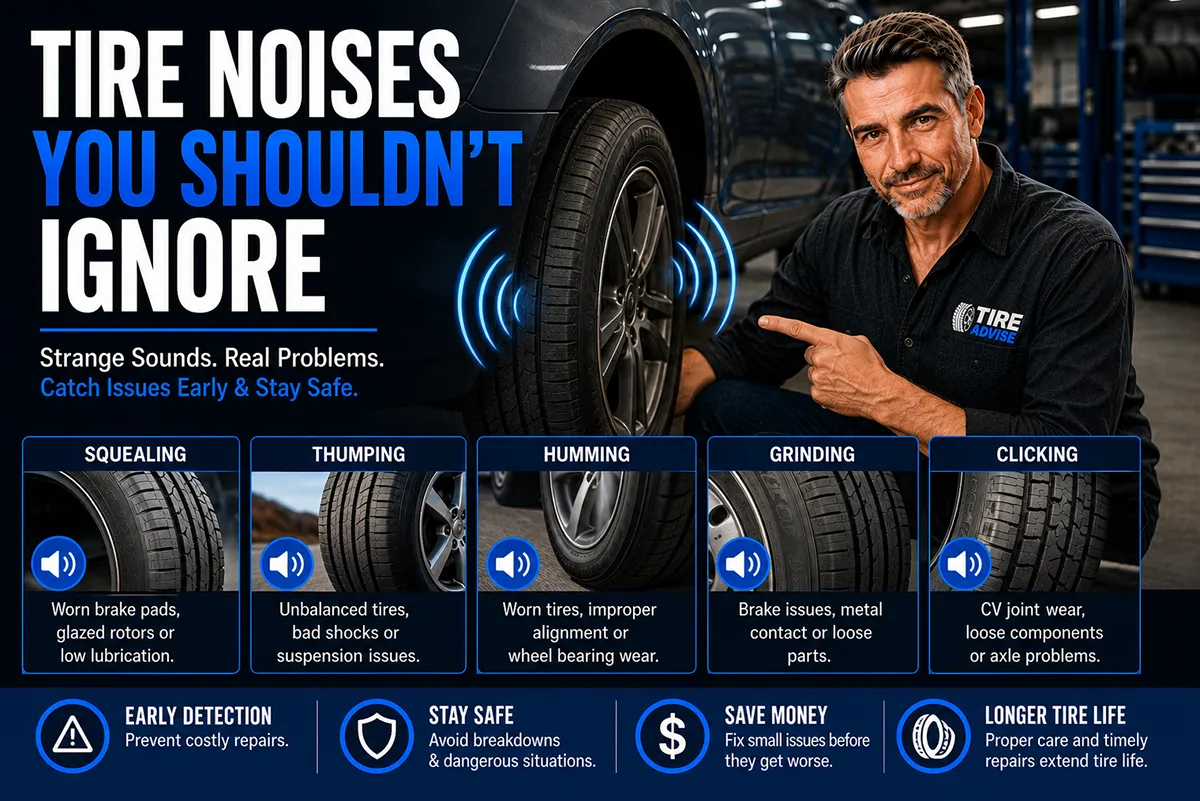
- Tire noises are your car’s way of warning you about alignment issues, uneven wear, failing bearings, or dangerous tire damage
- A humming or droning noise that changes with speed usually points to uneven tread wear or a bad wheel bearing
- Thumping or slapping sounds often mean a flat spot, separated belt, or bulge in the tire
- Squealing during turns can indicate underinflation, worn tread, or suspension problems
- Rhythmic clicking or popping may signal something lodged in the tread or a loose hubcap
- Never ignore a sudden change in tire noise — it almost always means something has changed physically with your tire or wheel assembly
- When in doubt, get your tires inspected immediately; most tire shops offer free inspections
Liked this article?
Add TireAdvise as a preferred source so you see more of our tire reviews and guides on Google.
Why Tire Noises Matter More Than You Think
Your tires are the only part of your car that actually touches the road. That’s four contact patches, each roughly the size of your hand, responsible for every bit of acceleration, braking, and steering your vehicle performs.
When those tires start making unusual sounds, they’re communicating something important. In my years of testing and reviewing tires across every category — from budget all-seasons to premium winter tires — I’ve learned that the sounds your tires make can tell you almost as much as a visual inspection.
The tricky part is knowing which noises are normal and which ones are red flags. That’s exactly what this guide is for.
Normal Tire Noises vs. Warning Signs
Before we dive into the scary stuff, let’s establish a baseline. All tires make some noise — it’s the unavoidable result of rubber meeting pavement at speed.
What’s Considered Normal
Every tire produces what’s called “pattern noise,” which comes from the tread blocks compressing and releasing as they roll across the road surface. On smooth asphalt, this might be a soft hiss. On coarse chip-seal roads (common across Texas and many southern states), it can sound louder and more aggressive.
In my experience, all-terrain tires like the BFGoodrich KO2 or Falken Wildpeak AT3W will always be louder than a touring tire like the Michelin Defender. That’s by design — the more aggressive the tread pattern, the more air gets pumped through those larger tread voids, creating more noise.
I’ve also noticed that brand-new tires can sound slightly different during the first few days of driving as the mold release compound wears off and the tread “breaks in.” This is completely normal and nothing to worry about.
When to Start Paying Attention
The warning signs are all about change. If your tires have sounded one way for weeks and then suddenly sound different, that’s your signal to investigate. Here’s my general rule: if you notice a new noise and it persists for more than a day across different road surfaces, it’s time to take a closer look.
Let me walk you through each type of concerning tire noise, what causes it, and what you should do about it.
1. Humming or Droning That Gets Louder With Speed
This is the most common tire noise complaint I hear from readers, and it’s the one that almost got me into serious trouble on I-95.
What It Sounds Like
A steady, low-pitched hum or drone that increases in volume as you go faster. It’s often described as sounding like driving on a rumble strip, but softer. You’ll notice it most at highway speeds — typically above 40-50 mph — and it may seem to come from one specific corner of the vehicle.
What’s Likely Causing It
In my experience, this noise has two primary causes:
- Uneven tire wear (cupping or scalloping): This happens when your tires develop a wavy, uneven wear pattern across the tread surface. It’s often caused by worn shocks or struts, improper alignment, or tires that haven’t been rotated on schedule. I’ve seen this on dozens of vehicles during my reviews, and it’s the number-one noise complaint tied to tire condition.
- Failing wheel bearing: A bad bearing creates a similar droning sound, but it changes pitch when you sway the car slightly left or right. If the noise gets louder when you lean into a right turn, the left-side bearing may be failing (and vice versa). This one is especially important to catch early — a seized wheel bearing can lock your wheel.
What You Should Do
First, run your hand carefully across each tire’s tread surface (make sure the car is parked and in gear). If you feel high and low spots — almost like a scalloped pattern — you’ve found your culprit. At that point, you’ll need new tires, and I’d strongly recommend getting your shocks, struts, and alignment checked before mounting them. Otherwise, the new tires will develop the same wear pattern.
If the tread feels smooth and even, have a mechanic check your wheel bearings. This is not a DIY diagnosis you want to get wrong.
2. Thumping or Rhythmic Slapping
This one usually gets people’s attention fast because it sounds — and sometimes feels — like something is physically wrong.
What It Sounds Like
A rhythmic thump-thump-thump that matches your vehicle’s speed. It slows down when you slow down and speeds up when you accelerate. Sometimes you can feel it through the floorboard or steering wheel.
What’s Likely Causing It
- Flat spot on the tire: I’ve seen this happen after a vehicle sits parked for an extended period, especially in cold weather. The tire develops a temporary flat spot where it contacted the ground. In most cases, the flat spot warms out after several minutes of driving. If it doesn’t go away, the tire’s internal structure may be permanently deformed.
- Belt separation: This is the dangerous one. When the steel belts inside a tire begin to separate from the rubber, they create a raised area — sometimes visible as a bulge — that thumps with every rotation. I cannot stress this enough: a separated belt is a tire emergency. Pull over safely and inspect the tire immediately.
- Tire bulge or bubble: Similar to belt separation, a sidewall bulge means the internal structure has been compromised, usually from hitting a pothole or curb. The bulge is a weak point that can blow out without warning.
What You Should Do
Stop the car in a safe location and visually inspect all four tires. Look at the tread and sidewalls for any bulges, bubbles, or raised areas. Run your hand along the tread to feel for any irregularities. If you find a bulge or suspect belt separation, do not drive on that tire — put on your spare or call for roadside assistance.
I reviewed a set of budget tires a while back that developed a slight bulge on the sidewall after I hit a particularly nasty pothole on a Michigan road. The thumping noise started immediately. I swapped to the spare within minutes. When the tire shop sectioned the damaged tire, the internal cords were completely compromised. That tire would have failed eventually.
3. Squealing During Turns
Tire squeal is one of those noises that people tend to dismiss — or even find amusing. But consistent squealing during normal turns at normal speeds is telling you something.
What It Sounds Like
A high-pitched screech or squeal when you turn the steering wheel, especially at lower speeds in parking lots or during moderate cornering. It may happen on every turn or only when turning in one direction.
What’s Likely Causing It
- Underinflated tires: This is the most common cause in my experience. When a tire is low on air, the tread deforms excessively during cornering, and the rubber literally scrubs against the pavement. I’ve heard this dozens of times during testing. A simple pressure check with a quality gauge (I like the Joes Racing 32307) usually reveals a tire that’s dropped well below the vehicle’s recommended PSI.
- Worn tread: Tires with shallow remaining tread depth have less grip, and the remaining rubber can squeal more easily during lateral loading. If your tread is below 4/32″ — easily checked with a quarter inserted into the tread groove — you’re in the zone where performance drops significantly in wet conditions, and tire noise changes noticeably.
- Hard, aged rubber compound: Tires more than six years old (check the DOT date code on the sidewall) can harden and lose pliability, leading to squealing even when tread depth looks acceptable. I always check the manufacture date when reviewing tires, and I’ve encountered plenty of “new” tires sitting on store shelves that were already several years old.
- Alignment or suspension issues: Excessive toe-in or toe-out can cause the tires to fight each other during turns, producing a squeal. Worn ball joints or tie rod ends can also contribute.
What You Should Do
Start with the simplest fix: check your tire pressure. I recommend doing this at least once a month and always when ambient temperatures change significantly (every 10°F shift can mean roughly 1 PSI of change). If pressure is fine, inspect your tread depth and tire age.
If the tires are worn or old, it’s time to shop for replacements. And if the tires look okay but the squealing continues, get an alignment check. Most shops charge between $80 and $120 for a four-wheel alignment, and it could solve the problem entirely.
4. Clicking, Popping, or Ticking Sounds
These lighter, sharper sounds are easier to overlook but can still indicate problems worth addressing.
What It Sounds Like
A repetitive click-click-click or tick-tick-tick that follows the rotation of the tire. Sometimes it’s faint at low speeds and disappears at highway speeds. Other times, it’s audible throughout the speed range.
What’s Likely Causing It
- Stone, nail, or debris in the tread: This is the most common and least serious cause. Small rocks or debris get lodged in the tread grooves and tap against the pavement with each rotation. I’ve picked out more pebbles from test tires than I can count, especially after driving on gravel shoulders or recently chip-sealed roads.
- Nail or screw partially embedded: This one is sneakier. A nail might be slowly leaking air while creating a ticking sound. I once had a screw lodged in a Continental CrossContact tire that took three days to produce a noticeable pressure drop. The ticking was my first clue.
- Loose hubcap or wheel cover: Aftermarket wheel covers are notorious for clicking as they flex at speed. A quick push on the cover to make sure it’s seated properly often fixes it.
- Loose lug nuts: This is rare but potentially catastrophic. If lug nuts aren’t properly torqued, the wheel can shift slightly, creating a clicking or popping sound. I always use a torque wrench (set to the manufacturer’s spec) when installing wheels during tire tests.
What You Should Do
Inspect the tread visually for any embedded objects. If you see a nail or screw, don’t pull it out — the object may be acting as a plug and preventing rapid air loss. Drive carefully to the nearest tire shop for a proper plug-patch repair (typically $20-$40 at most US tire shops).
If you don’t see debris, check that your lug nuts are tight and your wheel covers are secure. If the clicking persists, have a technician put the car on a lift for a closer look.
5. Roaring or Growling at Highway Speeds
If humming is a yellow flag, roaring is a red one. This noise is hard to ignore and usually indicates a more advanced problem.
What It Sounds Like
A loud, continuous roar that sounds like you’re driving on a rough road even when the pavement is smooth. It can vibrate through the cabin and make conversation difficult. It’s almost always speed-dependent and usually most noticeable between 45-70 mph.
What’s Likely Causing It
- Severely cupped or feathered tires: This is the advanced stage of the uneven wear I described earlier. When cupping gets bad enough, the noise transitions from a mild hum to a full roar. I’ve experienced this firsthand on a test vehicle with worn struts — the rear tires developed severe cupping after several weeks of driving and sounded like a prop plane at highway speeds.
- Worn or failing wheel bearing (advanced): A bearing that’s been deteriorating for a while will progress from a hum to a roar. At this stage, you might also notice play or looseness in the wheel if you grab the tire at the 12 and 6 o’clock positions and try to rock it.
- Mismatched tires: I’ve tested vehicles where the owner had different tire brands or models on the same axle. The different tread patterns and rubber compounds can interact with the road differently, sometimes creating a roaring harmony that neither tire would produce on its own.
What You Should Do
This noise warrants immediate professional inspection. The potential causes — severely worn tires, failing bearings, or suspension damage — all carry safety risks. Don’t put this one off.
6. Whooshing or Whistling at Speed
This is less common but worth mentioning because it often gets misdiagnosed.
What It Sounds Like
A wind-like whooshing sound that seems to come from the wheel area, different from normal wind noise around the mirrors or door seals. It may pulsate slightly.
What’s Likely Causing It
In my experience, this is almost always related to aerodynamics around the wheel and tire assembly rather than the tire itself. Oversized tires that protrude past the fender, missing mud flaps, or aftermarket wheels with unusual spoke designs can create turbulence that produces a whistling or whooshing sound.
That said, I’ve also heard this noise from tires with severely worn edges — the sharp transition between worn and unworn tread can act like a whistle at the right speed.
What You Should Do
Check the tire’s overall condition and ensure it’s the correct size for your vehicle. If you recently installed new wheels or tires, compare them to the OEM specifications. If the tire itself looks fine, the noise may be cosmetic rather than dangerous, but it’s still worth having a second opinion from a trusted tire shop.
How to Diagnose Tire Noises: My Process
After testing hundreds of tires, I’ve developed a simple diagnostic process that anyone can follow. Here’s what I do when I hear something new:
Step 1: Note when it happens. Does the noise occur at all speeds or only at certain speeds? Does it change when you turn left or right? Does it go away when you brake?
Step 2: Isolate the location. Try to determine which corner of the vehicle the noise is coming from. Sometimes having a passenger listen can help, or you can open individual windows to triangulate.
Step 3: Visual inspection. Park the car, let the tires cool, and inspect all four. Look at the tread wear, check for embedded objects, examine the sidewalls for bulges, and check tire pressure.
Step 4: The hand test. Carefully run your hand across each tire’s tread surface. Feel for cupping, feathering, or any irregularity. This simple test has caught problems for me that a visual inspection missed.
Step 5: Professional help. If you can’t identify the cause, take it to a shop. Most major tire retailers — Discount Tire, Tire Rack, America’s Tire, Les Schwab — offer free tire inspections. There’s no reason not to take advantage of this.
Tire Noise Quick-Reference Comparison Table
I put together this table to help you quickly match what you’re hearing to the most likely cause and urgency level:
| Noise Type | Most Likely Cause | Urgency Level | Typical Fix | Estimated Cost |
|---|---|---|---|---|
| Humming / Droning | Uneven wear or wheel bearing | ⚠️ Moderate | New tires + alignment, or bearing replacement | $400–$800+ (tires) / $250–$500 (bearing) |
| Rhythmic Thumping | Flat spot, belt separation, or bulge | 🔴 High | Tire replacement (immediately if bulge/separation) | $100–$250 per tire |
| Squealing in Turns | Low pressure, worn tread, or alignment | ⚠️ Moderate | Inflate tires, replace if worn, alignment check | $0 (air) / $80–$120 (alignment) |
| Clicking / Ticking | Debris in tread, nail, or loose hardware | 🟡 Low to Moderate | Remove debris, plug-patch repair, tighten hardware | $0–$40 |
| Roaring / Growling | Severe cupping, advanced bearing failure | 🔴 High | Tire and/or bearing replacement + suspension check | $500–$1,200+ |
| Whooshing / Whistling | Aerodynamic interference or edge wear | 🟡 Low | Check tire fitment, inspect tread edges | $0–$100 (inspection) |
The Connection Between Tire Quality and Noise
I want to address something I’ve observed consistently across hundreds of tire reviews: not all tires are created equal when it comes to noise, and the tire you choose at the point of purchase has a huge impact on your long-term noise experience.
Premium Tires vs. Budget Tires
In my testing, premium tires from brands like Michelin, Continental, and Bridgestone consistently produce lower road noise levels over their entire lifespan compared to budget alternatives. This isn’t just about the initial ride — it’s about how the tire wears over time.
Higher-quality tires use more advanced tread compounds and construction techniques (like variable pitch tread patterns and noise-reducing foam inserts) that keep noise levels stable as the tire wears. I’ve tested budget tires that sounded great for the first few weeks but developed noticeably louder road noise as uneven wear set in.
That said, I’ve also been impressed by some mid-range options. The General Altimax RT45, for example, has been one of the quietest tires in its price bracket during my testing. And the Cooper Endeavor Plus offered surprisingly refined road manners for its price point.
Tire Type Matters
Your tire category also plays a huge role in baseline noise levels. Here’s what I’ve experienced across categories, ranked from quietest to loudest:
- Touring tires (e.g., Michelin Defender T+H, Bridgestone Turanza QuietTrack) — Designed specifically for comfort and low noise
- Grand touring / all-season tires (e.g., Continental TrueContact Tour, Pirelli Cinturato P7) — Slightly more responsive with marginally higher noise
- Highway all-season tires (e.g., Michelin Defender LTX M/S, Yokohama Geolandar CV G058) — A bit louder, especially on trucks and SUVs
- All-terrain tires (e.g., BFGoodrich KO2, Toyo Open Country AT III) — Noticeably louder due to aggressive tread
- Mud-terrain tires (e.g., BFGoodrich KM3, Nitto Trail Grappler) — The loudest category; highway droning is expected
If noise is a primary concern for you, I always recommend starting with a touring tire from a reputable brand. The difference in cabin comfort is dramatic, and I’ve never had a reader regret prioritizing ride quality on a daily driver.
Prevention: How to Keep Your Tires Quiet for Longer
Through years of testing, I’ve identified a handful of maintenance habits that make a measurable difference in how long your tires stay quiet:
Rotate Your Tires on Schedule
I can’t say this loudly enough: regular tire rotation is the single most effective thing you can do to prevent noise-causing uneven wear. I follow a strict rotation schedule during every tire test, and the difference in tread uniformity is always visible.
Most manufacturers recommend rotating every 5,000 to 7,500 miles — roughly every other oil change for most drivers. Discount Tire and Costco both offer free lifetime rotations with tire purchases, so there’s no excuse to skip it.
Check Your Alignment Annually
I recommend getting a four-wheel alignment check at least once a year, or immediately if you hit a significant pothole or curb. I’ve seen tires that were only a few months old develop noise-causing wear from a misalignment that the driver didn’t notice.
Here in the US, pothole season (late winter through early spring) is particularly rough on alignment. If you live in states like Michigan, Pennsylvania, New York, or anywhere in the northeast, I’d suggest checking alignment after winter ends.
Maintain Proper Tire Pressure
I keep a quality tire pressure gauge in every test vehicle, and I check pressure at least twice a month. Underinflation causes the tire’s edges to wear faster than the center, while overinflation wears the center faster. Both patterns produce noise over time.
Your correct tire pressure is listed on the driver’s door jamb sticker — not on the tire’s sidewall (that’s the maximum pressure, not the recommended one). I’ve encountered more than a few drivers who were overinflating their tires based on the sidewall number.
Replace Worn Shocks and Struts
If your shocks or struts are worn out, new tires won’t fix your noise problem for long. The suspension components are what keep the tire in consistent contact with the road. When they fail, the tire bounces, and that bouncing creates cupping.
I’ve specifically tested this scenario — installing brand-new tires on a vehicle with worn struts, then monitoring the wear pattern over several weeks. The cupping started developing much sooner than I expected. Replacing the struts before the tires would have saved that set.
When Tire Noise Means It’s Time for New Tires
Sometimes the noise is simply telling you what your tread depth gauge already confirms: it’s time for replacement tires.
Here are the scenarios where I tell readers to start shopping:
- Tread depth is at or below 4/32″: While the legal minimum in most US states is 2/32″, I recommend replacing tires at 4/32″. Below that threshold, wet traction degrades significantly, and tire noise often increases as the shallow tread can’t manage water and air as effectively.
- Cupping or feathering is visible: Once uneven wear has set in to the point of producing noise, no amount of rotation will fix it. The tire is compromised.
- Tires are older than six years: Even if the tread looks good, aged rubber hardens and becomes noisier and less grippy. Check the DOT code on the sidewall — the last four digits tell you the week and year of manufacture (e.g., “2219” means the 22nd week of 2019).
- You’ve had a repair in the sidewall or shoulder area: These areas shouldn’t be patched. If damage has occurred here, the tire needs to be replaced regardless of noise.
My Top Picks for Quiet Replacement Tires
If your tire noise investigation leads you to the conclusion that it’s time for new rubber, here are the tires I’ve personally tested and recommend for drivers who prioritize a quiet ride:
- Michelin Defender T+H: The gold standard for quiet touring comfort. In my testing, this tire was nearly silent on smooth pavement and remained impressively quiet even on coarser road surfaces.
- Continental TrueContact Tour: A close second in noise performance with excellent wet traction. The EcoPlus technology helps with fuel economy too.
- Bridgestone Turanza QuietTrack: True to its name, this tire uses a noise-dampening tread design that I found genuinely effective during my test period.
- Cooper Endeavor Plus: An excellent value pick. Not as whisper-quiet as the Michelin, but remarkably refined for its price bracket. I was genuinely impressed during testing.
- Yokohama AVID Ascend LX: Another strong value option that delivered solid noise comfort and a smooth ride during my evaluation. Great for sedan and CUV owners on a budget.
For SUV and truck owners who need something more capable but still relatively quiet, the Michelin Defender LTX M/S 2 and Continental TerrainContact H/T are my top picks. I’ve tested both extensively, and they manage to balance light off-road capability with surprisingly low highway noise.
Don’t Wait — Trust What Your Ears Are Telling You
I’ve been reviewing tires professionally for years, and the one lesson I keep relearning is this: tire problems almost never get better on their own. That hum you’re noticing today will be a roar next month. That ticking might be a nail slowly bleeding air. That thumping could be a tread separation waiting to happen.
Your ears are an incredibly effective diagnostic tool — probably the best one you have without a lift and a flashlight. Use them.
If something sounds wrong, take ten minutes to do a basic inspection. Check your pressure. Look at your tread. Feel for uneven wear. And if you can’t figure it out, drive to the nearest reputable tire shop for a free inspection.
The cost of catching a problem early is almost always measured in dollars. The cost of ignoring one can be measured in something much worse.
Stay safe out there, and feel free to drop a comment below if you’re hearing a noise you can’t identify. I read every one and do my best to help.
Frequently Asked Questions
What does a humming noise from my tires mean while driving on the highway?
A humming or droning noise that gets louder at highway speeds usually indicates uneven tire wear, often caused by misalignment or worn suspension components. It can also be a sign that your tires have developed a condition called cupping or scalloping. I’d recommend having a technician inspect your tread wear pattern — if the wear is severe, you’ll likely need replacement tires, which typically run $100–$200 per tire for popular brands like Michelin, Goodyear, or Cooper.
Why do my tires make a squealing noise when turning or braking?
Squealing during turns often means your tires are losing grip, which can happen when tread depth is too low or tire pressure is incorrect for your vehicle. If the squealing occurs during braking, it could be a brake issue, but worn tires with shallow tread dramatically reduce stopping performance, especially on wet US roads during spring and fall. Check your tread depth with the penny test — if you can see all of Lincoln’s head, your tires are at or below 2/32″ and need immediate replacement.
Is a thumping or vibrating tire noise dangerous to keep driving on?
Yes, a rhythmic thumping or vibration is one of the tire noises you should never ignore because it often signals a flat spot, tire belt separation, or a bulge in the sidewall. Belt separation in particular can lead to a sudden blowout at highway speeds, which is extremely dangerous. Pull over safely and inspect the tire visually for any bulges or deformities, and have it professionally evaluated before driving further.
What causes a loud roaring noise from tires that increases with speed?
A roaring noise that scales with your speed is commonly caused by aggressive or uneven tread wear, especially on all-season or all-terrain tires that have worn irregularly due to skipped tire rotations. It can also indicate a failing wheel bearing, but if the noise changes when you swap tire positions, the tires themselves are the culprit. Regular tire rotations every 5,000–7,500 miles and proper alignment can prevent this issue when you invest in a new set.
Can low tire pressure cause unusual tire noises while driving?
Absolutely — underinflated tires flex more than they should, which can produce a flapping, slapping, or soft thumping sound, particularly at lower speeds. Driving on low tire pressure also generates excessive heat and accelerates sidewall damage, which is especially risky during hot US summers when pavement temperatures soar. I always check my tire pressure monthly using a digital gauge and keep it at the PSI listed on my driver’s side door jamb, not the number on the tire sidewall.
How do I tell if tire noise means I need new tires or just a wheel alignment?
If the noise is a steady hum or drone and you notice uneven wear on one edge of the tread, an alignment issue is likely the root cause — but the damaged tires may still need replacing depending on severity. A feathered or sawtooth wear pattern across the tread blocks points to alignment or suspension problems, while uniformly worn tread below 3/32″ means the tires have simply reached the end of their life. An alignment typically costs $75–$120 at most US shops, and getting one done when you install new tires protects your investment.
Should I replace just one noisy tire or all four tires at once?
If only one tire is making noise due to damage or a defect, you can sometimes replace just that tire — but it should match the brand, model, and tread depth of the others as closely as possible to avoid handling issues. For AWD and 4WD vehicles common in states with harsh winters, most manufacturers require all four tires be replaced together to prevent drivetrain damage. I recommend replacing tires in pairs at minimum and putting the newer tires on the rear axle for better stability, regardless of whether your vehicle is front- or rear-wheel drive.
