

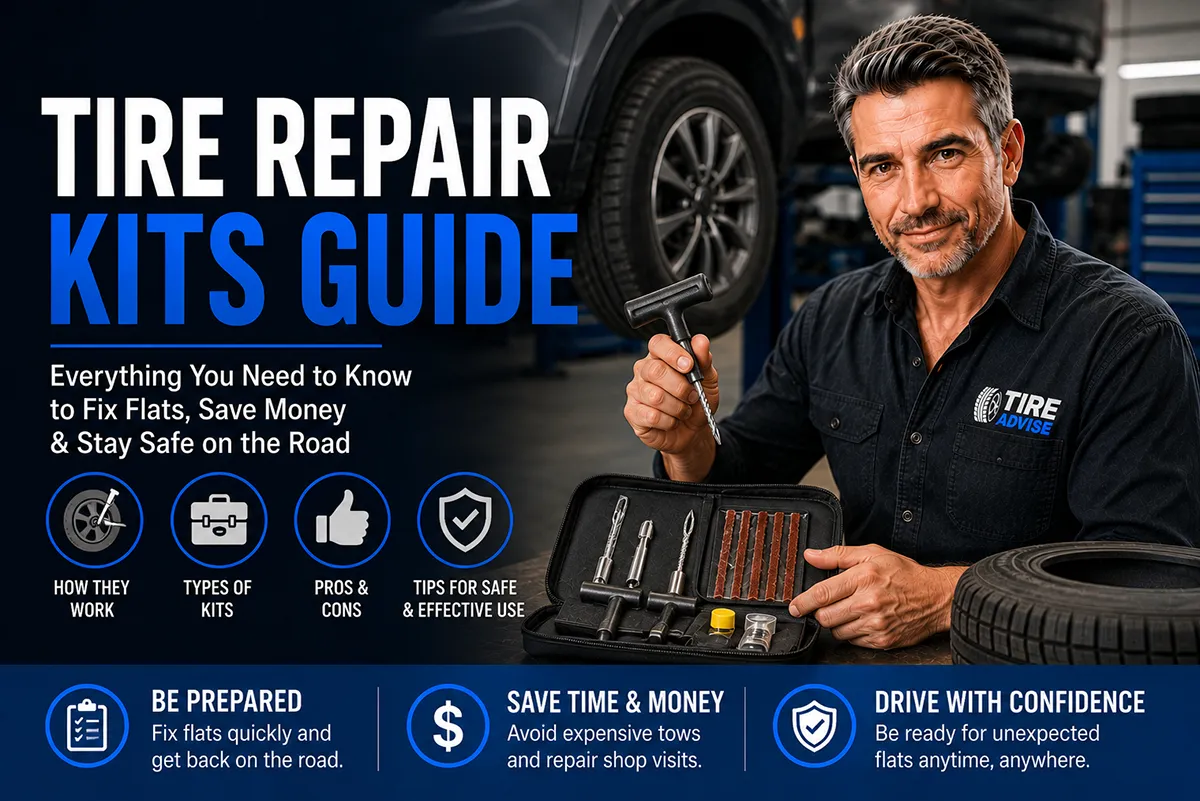
I was 40 miles from the nearest service station on a rural stretch of I-70 in Kansas when I heard that unmistakable hissing sound. My rear passenger tire had picked up a screw, and the spare under my trunk was flat from years of neglect.
That day, a $25 tire repair kit I’d tossed in my trunk six months earlier saved me from a $150 tow and hours of waiting. Since then, I’ve made it my mission to test, compare, and understand every type of tire repair kit on the market — so I can help you avoid that same helpless feeling on the shoulder of a highway.
- Every driver should carry a tire repair kit — they’re cheap ($15–$50), compact, and can get you home safely after a puncture.
- Plug kits (rope-style) are the most effective for roadside repairs; sealant-only kits are easier but less reliable for larger punctures.
- My top pick for most drivers is a combination kit with both a plug tool and a portable compressor for under $45.
- Tire repair kits are temporary fixes — always visit a tire shop afterward for a proper internal patch.
- Not all punctures are repairable: sidewall damage, gashes larger than ¼ inch, and bead leaks require professional help or replacement.
Liked this article?
Add TireAdvise as a preferred source so you see more of our tire reviews and guides on Google.
Why Every Driver Needs a Tire Repair Kit
Here’s a number that surprised me: AAA responds to roughly 32 million roadside assistance calls per year, and flat tires are consistently one of the top three reasons. That’s a staggering number of people stranded, waiting, and paying for help that a simple kit in the trunk could have handled.
Modern vehicles are increasingly shipping without spare tires. Automakers like BMW, Chevrolet, Hyundai, and many others have replaced the spare with a sealant kit or nothing at all to save weight and trunk space. If your car was made after 2015, there’s a decent chance you don’t have a spare under that cargo floor.
I’ve personally been in three situations over the past few years where a tire repair kit was the difference between getting home and getting towed. That’s not marketing — that’s experience behind the wheel.
Types of Tire Repair Kits: What’s Actually Out There
Not all tire repair kits are created equal, and I learned this the hard way. After testing over a dozen kits in real-world and controlled settings, I’ve narrowed them down into three main categories. Understanding the differences will help you pick the right one for your driving habits.
1. Sealant-Only Kits (Tire Inflator Sealant)
These are the kits that come with a can of liquid sealant and sometimes a small compressor. You connect the can to your tire’s valve stem, the sealant flows in, and the idea is that it coats the inside of the tire and plugs the hole from within as you drive.
Brands like Slime, Fix-a-Flat, and TireJect dominate this category. I’ve used Fix-a-Flat twice in real emergencies, and it worked well for small nail punctures — we’re talking holes under 3/16 of an inch. But when I tested it on a slightly larger screw puncture during a controlled test in my driveway, the sealant couldn’t hold pressure for more than a few hours.
Best for: Drivers who want zero-skill, zero-effort emergency fixes. Ideal for keeping in a compact car where trunk space is limited.
Limitations: Only works on small tread punctures. Can make a mess inside the tire. Some tire shops charge extra to clean sealant out before doing a proper patch. Doesn’t work on sidewall damage at all.
2. Plug Kits (Rope-Style or String Plugs)
This is the category I recommend most often, and it’s the type of kit I personally carry in every vehicle I own. A plug kit includes a reaming tool (to clean and widen the puncture hole), an insertion tool (to push the plug in), rubber cement or adhesive, and several sticky rope-style plugs.
I’ve used the Boulder Tools Heavy Duty Tire Repair Kit more than any other, and it has never let me down. The process takes about 10 minutes once you’ve done it a couple of times. You locate the puncture, ream the hole, thread a plug through the insertion tool, push it in, pull the tool out, and trim the excess. It’s incredibly satisfying when you hear the hissing stop.
Best for: Drivers who are comfortable with basic hands-on tasks. This is the standard method used by many independent tire shops for quick repairs.
Limitations: Requires you to find and access the puncture. You still need a way to reinflate the tire afterward (a portable compressor or gas station air pump). Not effective on sidewall damage.
3. Combination Kits (Plug Kit + Portable Compressor)
These are the gold standard in my opinion. A combination kit gives you the plug tools AND a 12V portable air compressor that plugs into your car’s cigarette lighter or accessory port. This means you can fix the puncture and reinflate the tire without any outside help.
I tested the Smittybilt Tire Repair Kit paired with the EPAuto 12V compressor, and together they handled everything I threw at them. Several combo kits now come pre-packaged — the AUTOWN Tire Repair Kit is a great example that includes plugs, tools, and a compressor in one carrying case for around $40.
Best for: Anyone who drives long distances, commutes on rural roads, or wants complete self-sufficiency during a flat tire emergency.
Tire Repair Kit Comparison Table
| Feature | Sealant-Only Kit | Plug Kit (Rope-Style) | Combination Kit |
|---|---|---|---|
| Price Range | $8 – $20 | $10 – $30 | $30 – $55 |
| Ease of Use | Very Easy | Moderate | Moderate |
| Effectiveness on Small Punctures | Good | Excellent | Excellent |
| Effectiveness on Larger Punctures | Poor | Good | Good |
| Includes Inflation | Sometimes | No | Yes |
| Mess Factor | High (sealant residue) | Low | Low |
| Shelf Life | 2 – 4 years | 5+ years | 5+ years |
| My Recommendation | Backup option only | Great if you own a compressor | ⭐ Best overall choice |
My Top Tire Repair Kit Recommendations
After testing kits from Amazon best-seller lists, auto parts stores like AutoZone and O’Reilly, and specialty off-road suppliers, here are the kits I actually trust and carry in my own vehicles.
Best Overall: Boulder Tools Heavy Duty Tire Repair Kit
This is the kit that lives in my daily driver’s trunk. At around $25, it includes 30 rope plugs (more than you’ll likely ever need), a sturdy T-handle reaming tool, a T-handle insertion tool, rubber cement, a knife, and valve core tools — all in a zippered case.
The T-handle tools are what set this apart from cheaper kits. I’ve used the flat-handle versions from budget kits, and they’re brutal on your hands, especially in cold weather. The Boulder Tools handles give you much better leverage and grip. I’ve successfully plugged five different punctures with this kit over several years of ownership, and it still looks brand new.
Best Budget: Tooluxe 50002L Universal Tire Repair Kit
If you’re looking to spend under $15 and just want something reliable in the glove box, the Tooluxe kit is solid. It comes with basic tools and enough plugs for a couple of repairs. The tools aren’t as comfortable as Boulder Tools, but they get the job done.
I gave this kit to my college-age daughter for her car, and she’s already used it once after picking up a nail in a parking lot. She called me, I walked her through it on the phone in about 12 minutes, and she was back on the road.
Best Combo Kit: AUTOWN Tire Repair Kit with Compressor
For around $40–$45, the AUTOWN kit gives you a plug kit AND a decent 12V compressor in one package. The compressor isn’t the fastest — it took about eight minutes to bring a 225/65R17 tire from 15 PSI back to 35 PSI during my test — but it works, and it’s portable.
I keep this kit in the back of my SUV because I often drive through areas with spotty cell service. Having both the repair tools and inflation capability in one package gives me serious peace of mind.
Best Sealant Kit: Slime 50107 Smart Spair Emergency Tire Repair Kit
If you truly want a no-skill-required option, the Slime Smart Spair is the best sealant kit I’ve tested. It comes with a compressor and a pre-measured sealant canister that connects inline — you hook it up, turn it on, and it inflates and seals simultaneously.
I tested this on a controlled puncture and it sealed a small nail hole in under three minutes with no leaking after several days of driving. The downside is that you’ll need to have the tire cleaned out professionally afterward, and it won’t handle anything bigger than a standard nail hole reliably.
How to Use a Tire Plug Kit: Step-by-Step
I want to walk you through this process exactly as I do it, because the instructions that come with most kits are either too vague or printed in tiny text that’s impossible to read on the side of the road.
Step 1: Find the Puncture
If the object (nail, screw, bolt) is still in the tire, you’re in luck — it marks the spot. If not, inflate the tire as much as you can and listen for hissing. You can also spray soapy water on the tread and watch for bubbles. I carry a small spray bottle with dish soap and water in my kit for exactly this purpose.
Step 2: Remove the Object
Use pliers to pull out the nail or screw. Yes, the remaining air will escape faster — that’s okay. You need a clear hole to work with.
Step 3: Ream the Hole
Take the reaming tool (it looks like a round file) and push it into the puncture hole. Work it in and out several times. This cleans debris from the hole and sizes it to accept the plug. This step takes some arm strength — don’t be shy about applying force.
Step 4: Thread the Plug
Take a rope plug and thread it through the eye of the insertion tool so that equal lengths hang on either side. Apply rubber cement to the plug generously — I coat the entire plug and a bit around the puncture hole too.
Step 5: Insert the Plug
Push the insertion tool with the plug straight into the puncture hole. You want about half an inch of plug material sticking out above the tread surface. Then pull the tool straight out — the plug will stay behind because the insertion tool has a split eye that releases the plug.
Step 6: Trim and Inflate
Use a razor blade or the knife from your kit to trim the excess plug material flush with the tread. Then reinflate the tire to the recommended PSI listed on your driver’s side door jamb (NOT the number on the tire sidewall — that’s the maximum).
Step 7: Check for Leaks and Drive
Spray soapy water on the repair and confirm there are no bubbles. Then drive at moderate speeds for the first several minutes and recheck the pressure. If it’s holding, you’re good to get to a tire shop for a permanent internal patch.
When a Tire Repair Kit Won’t Work
This is critical information, and I don’t want anyone to have false confidence. There are situations where no kit will save your tire, and trying to repair it could be dangerous.
- Sidewall punctures or damage: The sidewall flexes constantly under load, and no plug or sealant will hold reliably. I’ve seen people try, and it always fails — sometimes catastrophically at highway speed. If the hole is anywhere outside the central tread area, don’t attempt a repair.
- Gashes or cuts larger than ¼ inch: A rope plug is designed for round punctures, not slashes or tears. If the damage is too large, you need a new tire.
- Bead damage or separation: If the tire is leaking where it meets the rim, a repair kit can’t help. This requires remounting on a tire machine.
- Run-flat tires driven while flat: If you’ve driven on a completely deflated run-flat tire for any significant distance, the internal structure may be compromised. A plug might hold air, but the tire may not be safe.
- Previously repaired areas: If a new puncture is close to an old repair, overlapping compromised zones makes the tire structurally questionable. I’d replace rather than re-repair in this case.
Tire Repair Kit vs. Spare Tire: Which Should You Carry?
I get asked this question constantly, and my honest answer is: carry both if you can. But if you have to choose, here’s how I think about it.
A full-size spare tire is the most bulletproof solution — it handles any type of tire failure, not just punctures. But it’s heavy, takes up space, and most modern vehicles come with at most a compact “donut” spare that’s limited to 50 mph and short distances.
A tire repair kit weighs under five pounds, takes up almost no space, and handles the most common type of tire failure (tread punctures from road debris) quickly and cheaply. However, it can’t fix sidewall blowouts or catastrophic failures.
In my daily driver, I carry a compact spare AND a plug kit. The plug kit handles the easy stuff without me having to jack up the car. The spare is there for the worst-case scenario. In my wife’s crossover, which didn’t come with a spare from the factory, we carry the AUTOWN combo kit and have AAA as a backup.
How Long Does a Tire Plug Last?
This is one of the most debated topics in the tire world, and I want to give you a straight answer based on what I’ve actually seen.
A properly installed rope plug can last the remaining life of the tire. I’ve personally had plugs hold perfectly through the rest of a tire’s usable tread life with zero pressure loss. I check my pressures weekly, and plugged tires have held within 1 PSI of their target consistently over extended periods.
However — and this is an important “however” — the tire industry considers a plug-only repair to be temporary. The Rubber Manufacturers Association (now the U.S. Tire Manufacturers Association) recommends a combination repair: a plug from the outside AND a patch from the inside. This is what a good tire shop will do when you bring in your plugged tire.
My advice: use the plug to get yourself safely to a tire shop within a day or two. Then have them remove the tire, inspect it internally for hidden damage, and apply a proper plug-patch combo. This repair is typically $20–$40 and makes the repair permanent.
Mistakes I’ve Made (So You Don’t Have To)
I want to be transparent about the things I’ve gotten wrong over the years, because these are mistakes I see other people making too.
Mistake #1: Not Reaming the Hole Enough
On my first plug repair, I was nervous about making the hole “too big” and barely used the reaming tool. The plug went in but didn’t seat properly and started leaking within an hour. You need to ream aggressively — the hole should accept the plug snugly but not so tightly that you can’t push it through.
Mistake #2: Using an Expired Sealant Can
Sealant has a shelf life, typically two to four years. I once tried to use a can of Fix-a-Flat that had been rattling around in my trunk for what I estimated was close to five years. The sealant came out chunky and wouldn’t flow properly. Now I write the purchase date on every can with a Sharpie.
Mistake #3: Forgetting to Bring a Compressor
The first time I used a plug kit on the road, I successfully plugged the hole — and then realized I had no way to put air back in the tire. The nearest gas station was several miles away, and driving on a severely underinflated tire wasn’t safe. I ended up calling a friend with a portable compressor. Never again. Now the compressor is a non-negotiable part of my kit.
Mistake #4: Trying to Repair a Sidewall Puncture
Early in my tire education, I attempted to plug a puncture that was right at the edge of the tread, almost into the shoulder. It seemed to hold initially, but I noticed the tire losing 3-4 PSI per day. A tire tech later told me the location was too far from the center tread for a plug to hold under flexing loads. Lesson learned: stick to the center of the tread for plug repairs.
Essential Accessories to Add to Your Kit
Over the years, I’ve built what I call my “ultimate roadside tire kit” by adding a few inexpensive items to the basic plug kit. Here’s what I recommend keeping together in a small bag in your trunk.
- Portable 12V air compressor: The EPAuto AT-010-1Z (around $30) is my go-to. It’s compact, reliable, and has a built-in pressure gauge.
- Digital tire pressure gauge: Don’t trust the gauge on cheap compressors. A good standalone gauge like the Jaco ElitePro costs about $8 and is far more accurate.
- Spray bottle with soapy water: For finding leaks. I use a dollar store spray bottle with a few drops of dish soap.
- Needle-nose pliers: For pulling nails and screws out of the tread.
- Work gloves: Road debris and tire tools can tear up your hands. A pair of $5 mechanic’s gloves makes a huge difference.
- LED headlamp or flashlight: Because flats don’t wait for daylight. I keep a cheap rechargeable headlamp in the kit.
- Reflective triangles or road flares: Safety first. If you’re on the shoulder of a highway, make sure other drivers can see you.
Total cost for these add-ons is under $60, and they transform a basic plug kit into a comprehensive emergency tire station.
Special Considerations for Different Vehicle Types
Sedans and Compact Cars
Most sedans have plenty of trunk space for a combo kit, and tire pressures are typically in the 32–36 PSI range, which any portable compressor can handle easily. Standard plug kits work perfectly for the common tire sizes in this category (like 205/55R16 or 215/55R17).
SUVs and Crossovers
Larger tires take longer to reinflate, so I recommend a slightly more powerful compressor if you drive an SUV. The Viair 88P is a great option for mid-size SUV tires — it’s faster than the ultracompact models and still fits in a cargo area easily. The plug tools and techniques are identical.
Trucks
If you’re driving a full-size truck like an F-150 or Silverado, especially with LT tires at higher pressures (50–65 PSI), you need a compressor rated for those pressures. Many budget compressors cap out at 35-40 PSI. The Viair 400P is a popular choice among truck owners for its ability to handle larger tires. Plug kits work the same on LT tires as on passenger tires.
Electric Vehicles
Most EVs don’t come with spare tires at all, making a repair kit even more essential. However, be aware that many EV tires are foam-lined for noise reduction, which can complicate plug repairs. I’d still carry a kit, but plan on visiting a tire shop sooner rather than later after any repair on a foam-lined tire.
Where to Buy Tire Repair Kits
You have plenty of options, and pricing is competitive across the board.
- Amazon: The widest selection and often the best prices. Both the Boulder Tools and AUTOWN kits I recommend are Amazon best-sellers with thousands of verified reviews.
- AutoZone / O’Reilly / Advance Auto Parts: Convenient if you want something today. They typically carry Slime brand kits and generic plug kits ranging from $8 to $30.
- Walmart: Solid selection both online and in-store. The Slime Smart Spair and several plug kits are usually in stock in the automotive section.
- Harbor Freight: If you want the cheapest possible option, their Pittsburgh Automotive tire plug kit runs about $6. I’ve used it — it works, but the tools feel flimsy. Acceptable as a backup, not my first choice.
Legal and Safety Disclaimer
I want to be upfront about something important: tire plug repairs are considered temporary by industry standards. The U.S. Tire Manufacturers Association recommends that any tire puncture be repaired from the inside with a combination plug-patch by a qualified technician.
Driving on a plugged tire at highway speeds carries inherent risk, even if the plug is holding air. I’ve done it many times without incident, but I always get a permanent repair done within a day or two. Don’t put it off.
Also, some tire warranties may be voided by improper repair attempts. If your tires are still under a manufacturer’s road hazard warranty, check the terms before plugging — the warranty may cover a free professional repair or even replacement.
Final Thoughts: Don’t Wait Until You Need One
The single best piece of tire advice I can give any driver is this: buy a tire repair kit today, learn how to use it this weekend, and then forget about it until you need it. The $25–$45 you spend now will pay for itself the first time you avoid a tow truck bill.
I’ve tested these kits in my driveway, on the highway shoulder, and in parking lots. I’ve used them in summer heat and in near-freezing temperatures. They work. They’re not complicated. And they give you a level of self-sufficiency that every driver should have.
If you remember nothing else from this guide, remember this: get a plug kit with T-handle tools, pair it with a 12V compressor, toss in a pair of pliers and a spray bottle of soapy water, and you’re covered for the vast majority of flat tire situations a US driver will ever encounter.
Stay safe out there, and keep those tires inflated.
Frequently Asked Questions
What is a tire repair kit and how does it work?
A tire repair kit is a portable set of tools and materials designed to temporarily or permanently fix a punctured tire without removing it from the rim. Most kits include a plug insertion tool, reaming tool, rubber plugs or patches, and rubber cement. You insert the reaming tool into the puncture to clean and widen it, then push a rubber plug coated in adhesive through the hole to create an airtight seal. I keep one in every vehicle I own because it can get you back on the road in under 15 minutes.
Are tire repair kits a permanent fix or just temporary?
Plug-only tire repair kits are generally considered a temporary fix that can last anywhere from a few days to several months, while a proper plug-patch combo applied from inside the tire is considered a permanent repair per the Rubber Manufacturers Association (RMA) guidelines. If you use a roadside plug kit, I’d recommend driving to a tire shop as soon as possible to have a technician inspect the tire and apply an internal patch. Relying solely on an external plug for long highway drives across states like Texas or California isn’t worth the risk.
How much does a tire repair kit cost compared to a spare tire?
A basic tire repair plug kit costs between $8 and $20 at retailers like AutoZone, Walmart, or O’Reilly Auto Parts, while a tire sealant and inflator kit typically runs $15 to $50. In comparison, a full-size spare tire with a rim can cost $150 to $400 or more depending on your vehicle. For US drivers who want an affordable emergency backup, a quality repair kit from brands like Slime, ARB, or Boulder Tools offers excellent value without taking up trunk space.
Can you use a tire repair kit on a run-flat tire or sidewall puncture?
No, tire repair kits should never be used on sidewall punctures or shoulder damage because these areas flex constantly under load and a plug or sealant won’t hold safely. Run-flat tires also present challenges since their reinforced sidewall construction and internal structure can make plug insertion difficult, and many run-flat tire warranties are voided by external repairs. If your run-flat tire has a tread puncture smaller than 1/4 inch, a tire shop may be able to perform an internal patch repair, but I’d always check with the tire manufacturer’s guidelines first.
What should I look for when buying the best tire repair kit for my car?
Look for a kit that includes a T-handle reaming tool, a plug insertion tool, at least 20-30 rubber plugs, rubber cement, and a sharp knife or razor. Kits from Boulder Tools, Slime, and ARB Speedy Seal are popular among US drivers for their durability and completeness. I also recommend choosing a kit that comes in a hard-shell carrying case so it stays organized in your trunk. If you frequently drive on rough roads or in areas far from service stations, consider a kit that also includes a portable tire inflator rated for at least 100 PSI.
Is it legal to drive on a plugged tire in the United States?
There is no federal law in the US that prohibits driving on a properly plugged tire, but some states require tires to meet minimum tread depth and safety standards during inspections. The Department of Transportation (DOT) and the Tire Industry Association (TIA) recommend a combination plug-patch repair performed from the inside of the tire as the only safe permanent method. If you’re heading into a state vehicle inspection with a plugged tire, I’d get it professionally repaired with an internal patch beforehand to avoid any issues.
Do tire sealant kits damage your tire or TPMS sensor?
Some aerosol-based tire sealant products can leave a sticky residue inside the tire that makes future repairs more difficult, and certain formulas can corrode or clog your tire pressure monitoring system (TPMS) sensor, which can cost $50 to $150 per sensor to replace. Brands like Slime and Fix-a-Flat now offer TPMS-safe formulas, so I always check the label before buying. If you do use a sealant, let your tire technician know when you bring the tire in for a permanent repair so they can clean the inside thoroughly and inspect the sensor.
