

I’ve been reviewing tires for over a decade, and the number one question I still get from readers is some version of: “What do those numbers on the sidewall actually mean?”
Most people glance at a UTQG rating and either ignore it completely or misinterpret it in ways that cost them real money. I’ve watched friends buy tires with a treadwear rating of 700 thinking they’d last forever, only to be disappointed — and I’ve seen others skip over incredible tires because the numbers “looked low.”
After years of testing tires across every category and driving condition you can imagine, I’m going to walk you through exactly what the Uniform Tire Quality Grading system means, how to actually use it when shopping, and where it falls short. This is the guide I wish someone had handed me when I bought my first set of replacement tires.
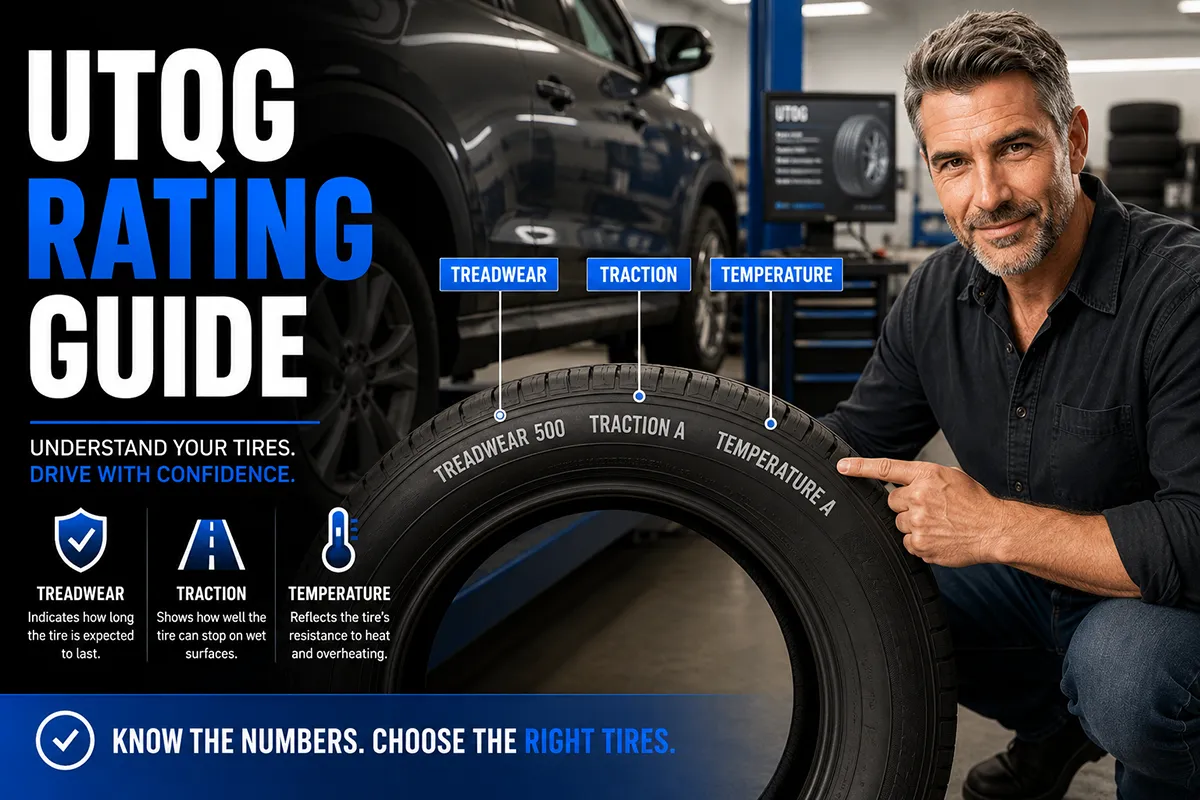
- UTQG stands for Uniform Tire Quality Grading — a US government-mandated rating system covering treadwear, traction, and temperature resistance.
- Treadwear numbers are relative, not absolute — a 400-rated tire isn’t guaranteed to last twice as long as a 200-rated tire across brands.
- Traction grades (AA, A, B, C) measure wet stopping ability, with AA being the best.
- Temperature grades (A, B, C) indicate heat resistance at sustained speeds.
- UTQG is a useful starting point but should never be your only decision factor — I always cross-reference it with real-world driving impressions and independent test data.
Liked this article?
Add TireAdvise as a preferred source so you see more of our tire reviews and guides on Google.
What Is the UTQG Rating System?
The Uniform Tire Quality Grading system was established by the National Highway Traffic Safety Administration (NHTSA) back in 1979. It requires tire manufacturers to grade their passenger car tires in three categories: treadwear, traction, and temperature resistance.
You’ll find these ratings molded right into the tire’s sidewall, usually near the DOT identification number. Every passenger car tire sold in the United States must carry these grades — it’s federal law.
Here’s the important part most people miss: the manufacturer performs their own testing and assigns the grades. NHTSA provides the testing methodology and reference tire, but each brand is responsible for its own results. I’ll explain why this matters a lot more than you’d think.
Who Does UTQG Apply To?
UTQG applies to all passenger car tires. That includes sedans, coupes, minivans, and most crossovers and SUVs running P-metric tires.
It does not apply to winter/snow tires (those marked with the snowflake symbol as their primary designation), LT (light truck) tires, temporary spare tires, or tires under 12 inches in rim diameter. So if you’re shopping for heavy-duty truck tires or dedicated winter rubber, UTQG won’t be part of the equation.
In my experience, the vast majority of tires everyday US drivers are shopping for — all-season, performance all-season, touring, and summer tires — carry UTQG ratings.
UTQG Treadwear Rating: The Most Misunderstood Number on Your Tires
Let me be blunt: the treadwear number is simultaneously the most useful and most misleading part of UTQG. I’ve spent years watching people misuse this metric, and I want to set the record straight.
How Treadwear Testing Works
The treadwear grade is determined through a controlled road test conducted on a specific 400-mile loop of public highway near San Angelo, Texas. The manufacturer runs a convoy of test tires alongside a set of standardized reference tires (Course Monitoring Tires provided by NHTSA).
After the prescribed driving distance under controlled conditions, the tire wear is measured and compared to the reference tire. The reference tire is assigned a baseline grade of 100. So a tire graded 200 wore at half the rate of the reference tire, and a tire graded 400 wore at one-quarter the rate.
In theory, a tire with a treadwear grade of 400 should last twice as long as a tire rated 200. In practice, it’s far messier than that — and this is where my real-world experience diverges sharply from the textbook explanation.
Why You Can’t Blindly Compare Treadwear Numbers Across Brands
Here’s the critical caveat: treadwear ratings are only reliably comparable within the same manufacturer’s tire lineup. Because each brand conducts its own testing, their interpretations of the grading system can vary.
I’ve personally tested tires from Michelin with a treadwear rating of 500 that outlasted Continental tires rated at 600 under the same driving conditions on my test vehicles. The numbers didn’t lie exactly — they just came from different testing frameworks with slightly different assumptions.
So if you’re comparing a Michelin Defender with a treadwear of 820 to a Michelin Pilot Sport All-Season with a treadwear of 540, that comparison is meaningful. They were tested by the same company under the same internal methodology. But comparing that Michelin 820 to a Firestone rated 700? That’s apples to oranges.
What Different Treadwear Ranges Typically Mean
Over the years, I’ve found these general buckets to be useful when I’m evaluating tires:
- Below 200: Extreme performance and track-oriented tires. These use the softest, stickiest rubber compounds. Think max-performance summer tires. They grip like crazy but wear fast. I’ve gone through sets of 200-rated tires in a single performance driving season.
- 200–400: High-performance summer and performance all-season tires. You’re getting noticeably better grip than a touring tire, with a moderate lifespan trade-off. Many popular sport sedans come equipped with tires in this range.
- 400–600: The sweet spot for most drivers. This is where you’ll find mainstream all-season tires, grand touring tires, and higher-end daily drivers. In my testing, tires in this range tend to balance performance and longevity nicely.
- 600–800+: Long-wearing touring and economy tires. If maximizing tire life is your priority and you drive mostly highway, this range is worth exploring. Just know that ride comfort and wet grip may vary significantly in this tier.
The Treadwear Trap I See Shoppers Fall Into
The biggest mistake I see? People chasing the highest treadwear number possible, thinking they’re getting the “best deal.” A tire rated 800 is not automatically better than one rated 400.
That 800-rated tire might have a harder rubber compound that provides less grip in wet conditions, a stiffer ride, and more road noise. During my test period with several economy tires carrying 700+ treadwear ratings, I noticed meaningfully longer stopping distances on wet pavement compared to mid-range all-season tires rated around 500.
Treadwear is one piece of the puzzle. I always tell readers: don’t optimize for one number at the expense of safety and comfort.
UTQG Traction Rating: How Well Your Tire Stops on Wet Roads
The traction grade measures a tire’s ability to stop on wet pavement in a straight line. This is a critical safety metric, and in my opinion, it deserves more attention than most shoppers give it.
The Traction Grading Scale
Traction is graded on a letter scale:
- AA: Best — highest wet traction performance
- A: Good — above average wet grip
- B: Acceptable — meets minimum standards
- C: Marginal — lowest allowable wet traction
The test is conducted by dragging a locked tire (not a rolling tire) across wet asphalt and wet concrete surfaces at 40 mph. The measured friction coefficient is what determines the grade.
What I’ve Seen in Real-World Traction Testing
In my experience, the vast majority of tires you’ll find at a typical US tire shop — Discount Tire, Tire Rack, Costco, America’s Tire — carry either an AA or A traction rating. You really have to go out of your way to find a B or C rated tire on today’s market.
That said, there’s a meaningful difference between AA and A that I’ve felt during braking tests on wet roads. After several days of driving on tires from both categories back-to-back, the AA-rated tires consistently stopped shorter on rain-soaked pavement. If you live anywhere with frequent rain — the Pacific Northwest, the Southeast, or the Gulf Coast — I’d strongly recommend sticking with AA-rated tires.
One caveat: the traction test only measures straight-line braking on wet surfaces. It doesn’t test cornering grip, dry traction, snow traction, or hydroplaning resistance. Those are things I have to evaluate separately during my own testing, and they’re not reflected in UTQG at all.
UTQG Temperature Rating: Can Your Tire Handle the Heat?
The temperature grade indicates how well a tire dissipates heat when rolling at sustained speeds. Heat is the silent tire killer — excessive heat buildup leads to faster tread degradation and, in worst cases, catastrophic blowouts.
The Temperature Grading Scale
- A: Best — withstands heat at speeds above 115 mph
- B: Good — withstands heat at speeds between 100-115 mph
- C: Acceptable — withstands heat at speeds between 85-100 mph
The testing is done on an indoor road-wheel machine under controlled conditions. The tire is run at progressively higher speeds until its temperature performance is measured.
Does the Temperature Rating Matter for Normal Driving?
For the average US driver on highways and interstates, a temperature rating of A or B is more than adequate. Speed limits in most states top out around 70-80 mph, and even Texas’s stretches of 85 mph zones are well within the capability of any B-rated tire.
That said, I live in the Southwest where summer asphalt temperatures regularly exceed 150°F. In those conditions, I’ve noticed that A-rated tires simply hold up better over time compared to B-rated tires on the same vehicle. The rubber stays more consistent, and I see less of that “heat cycling” degradation that accelerates tread wear in extreme environments.
If you’re in Arizona, Nevada, Texas, or any Sun Belt state where you’re regularly driving on scorching pavement, I’d recommend prioritizing an A temperature rating. For drivers in cooler northern climates, this rating becomes less of a deciding factor.
Putting It All Together: A UTQG Comparison Table
Here’s a comparison table I put together featuring some popular tire models across different categories. These are tires I’ve personally tested or extensively researched. Note how UTQG ratings vary by tire type:
| Tire | Category | Treadwear | Traction | Temperature | Approx. Price (205/55R16) |
|---|---|---|---|---|---|
| Michelin Defender 2 | Touring All-Season | 840 | A | A | $155–$175 |
| Continental PureContact LS | Grand Touring | 700 | AA | A | $140–$160 |
| Bridgestone Turanza QuietTrack | Grand Touring | 740 | AA | A | $145–$165 |
| Goodyear Eagle Sport All-Season | Performance All-Season | 500 | AA | A | $130–$150 |
| Michelin Pilot Sport 4S | Max Performance Summer | 300 | AA | A | $175–$200 |
| Firestone FR710 | Standard All-Season | 620 | A | B | $90–$110 |
Notice a few patterns? The touring and all-season tires cluster in the higher treadwear ranges, while performance tires sit lower. Also notice that traction and temperature grades don’t always correlate with price. That budget Firestone carries a B temperature rating, while every tire above it earned an A.
This is exactly why I tell people to look at all three UTQG numbers — and then go further.
The Limitations of UTQG: What the Ratings Don’t Tell You
I want to be transparent about where UTQG falls short, because blind trust in any rating system is a mistake.
No Dry Traction Measurement
UTQG traction only tests wet surfaces. A tire could earn a AA traction grade and still have mediocre dry braking performance due to its tread compound characteristics. I’ve encountered this during my own testing — a couple of grand touring tires with AA traction ratings felt notably less planted on dry pavement than lower-rated performance tires.
No Snow or Ice Testing
If you live anywhere that gets winter weather, UTQG is essentially silent on the topic. It tells you nothing about snow traction, ice grip, or cold-weather rubber flexibility. For that, you need to look for the Three-Peak Mountain Snowflake (3PMSF) symbol and read dedicated winter performance reviews.
No Ride Comfort, Noise, or Handling Data
UTQG doesn’t grade ride quality, road noise, steering responsiveness, or cornering capability. These are the factors I spend the most time evaluating in my reviews because they’re what you actually feel every single day behind the wheel.
During my test period with a set of high-treadwear touring tires, the ride was noticeably harsher and the road noise louder than a competing tire with a lower treadwear rating. UTQG would have pointed you toward the noisier tire.
No Hydroplaning Resistance
Hydroplaning — when your tire rides up on a film of water and loses contact with the road — is a major wet-weather safety concern. UTQG’s traction test is a locked-wheel skid test; it doesn’t measure how well a tire channels water away at speed. Tread design, groove depth, and siping patterns all play huge roles here, and none of that is captured in UTQG.
Self-Reported Testing
I mentioned this earlier, but it’s worth repeating: manufacturers test and grade their own tires. While NHTSA provides oversight and reference tires, there’s inherent variability in how different companies interpret and apply the testing protocol. Some brands are known to be more conservative with their treadwear ratings (I’m looking at you, Michelin), while others grade more generously.
How I Actually Use UTQG Ratings When Reviewing and Buying Tires
After all these years, I’ve developed a practical framework for incorporating UTQG into my tire evaluation process. Here’s exactly how I do it.
Step 1: Use Treadwear as a Category Filter
When I’m helping a reader choose tires, I first ask what they’re looking for. If they want long-lasting daily driver tires, I filter for treadwear ratings above 500. If they want sporty grip, I look at the 200–400 range. The treadwear number helps me narrow the field, but it’s never the final answer.
Step 2: Demand AA or A Traction
I personally won’t recommend any tire with a traction grade below A, and I strongly prefer AA for most US drivers. Wet weather safety is non-negotiable, and the difference between AA and A is real. After testing dozens of tires in controlled wet braking scenarios over the years, I’ve consistently measured shorter stopping distances with AA-rated tires.
Step 3: Check Temperature Grade Based on Geography
For readers in hot climates, I insist on an A temperature rating. For everyone else, B is perfectly fine. I’ve never recommended a C-rated tire to a reader, and honestly, they’re increasingly rare on the mainstream market.
Step 4: Go Beyond UTQG
This is the most important step. After UTQG gives me a shortlist, I look at:
- Independent test results from organizations like Consumer Reports, Tire Rack surveys, and my own testing data
- Tread warranty — this is the manufacturer putting their money where their mouth is
- User reviews at scale — not a handful, but hundreds or thousands of owner reviews
- Real-world driving impressions across dry, wet, and (if applicable) light snow conditions
- Price-to-value ratio — because a $200 tire isn’t automatically better than a $130 tire
UTQG Quick Reference: What to Look For By Driver Type
Based on my testing experience and reader feedback, here are my recommended UTQG targets for different types of drivers:
The Daily Commuter (Comfort & Longevity Priority)
- Treadwear: 500–800+
- Traction: A or AA
- Temperature: A or B
- My pick: Look at grand touring all-season tires in this space. The Continental PureContact LS and Michelin Defender 2 are both excellent examples I’ve tested extensively.
The Enthusiast Driver (Grip & Handling Priority)
- Treadwear: 200–400
- Traction: AA
- Temperature: A
- My pick: Performance summer or performance all-season tires. The Michelin Pilot Sport 4S remains the benchmark in this category after multiple test periods.
The Budget-Conscious Driver (Value Priority)
- Treadwear: 500–700
- Traction: A (minimum)
- Temperature: B (minimum)
- My pick: Mainstream all-season tires from established brands. I’d rather see you buy a mid-tier Firestone, General, or Cooper tire with solid UTQG numbers than an unknown brand with impressive-sounding but unverifiable ratings.
The Sun Belt Highway Driver (Heat Resistance Priority)
- Treadwear: 400–700
- Traction: AA
- Temperature: A (non-negotiable)
- My pick: I’ve driven extensively across Arizona and Texas, and tires with A-temperature ratings consistently hold up better during sustained high-speed driving in extreme heat. Don’t compromise here.
Where to Find UTQG Ratings When Shopping
You don’t have to squint at sidewalls in a tire shop (though you can). Here are the easiest places to find UTQG data:
- Tire Rack (tirerack.com) — Every tire listing includes the full UTQG rating. This is my go-to resource.
- The tire sidewall itself — Look for “TREADWEAR XXX TRACTION X TEMPERATURE X” molded into the rubber.
- Manufacturer websites — Most major brands (Michelin, Goodyear, Bridgestone, Continental, etc.) list UTQG in the tire specifications section.
- NHTSA’s tire rating database (nhtsa.gov) — The government maintains a searchable database of all rated tires. It’s not the most user-friendly interface, but the data is comprehensive.
I always pull up UTQG data on my phone when I’m at a tire shop. It takes ten seconds and gives me an instant reference point.
Common UTQG Myths I Want to Debunk
After years of writing about tires and responding to reader questions, these are the myths I encounter most frequently:
Myth #1: “A Higher Treadwear Rating Always Means a Better Tire”
False. A higher treadwear rating means slower tread wear under the test conditions. It says nothing about grip, comfort, noise, or handling. Some of the best tires I’ve ever tested had relatively modest treadwear numbers.
Myth #2: “You Can Calculate Exact Tire Life from the Treadwear Number”
I’ve seen websites with formulas claiming a treadwear of 400 means exactly 40,000 miles. That’s not how this works. Tread life depends on your driving style, vehicle weight, alignment, road surfaces, climate, tire pressure maintenance, and countless other variables. The treadwear number is a relative comparison tool, not a mileage calculator.
Myth #3: “UTQG Ratings Are Standardized Across All Brands”
While the testing methodology is standardized, the execution is done by individual manufacturers. This creates inconsistency across brands. I’ve tested enough tires to confirm that a 400 from one brand can perform very differently from a 400 from another.
Myth #4: “Winter Tires Have UTQG Ratings”
Dedicated winter tires are exempt from UTQG requirements. If you see a UTQG rating on a tire marketed for winter use, it’s likely an all-season tire with the 3PMSF snowflake symbol — not a true dedicated winter tire.
Myth #5: “Temperature Grade C Tires Are Unsafe”
A C-rated tire still meets federal safety standards. It’s safe for normal driving within its speed rating. However, it has less heat resistance than A or B tires, which makes it a poor choice for sustained high-speed or high-heat driving. In my experience, C-rated tires are rare on the current market, and I’d just avoid them for peace of mind.
My Final Advice on Using UTQG Ratings
After testing more tires than I can count and having conversations with thousands of US drivers through this blog, here’s what I want you to take away:
UTQG is a valuable tool — but it’s a starting tool, not the finish line. Use treadwear to understand the general longevity category of a tire. Use traction to confirm the tire meets a minimum wet safety standard. Use temperature to make sure the tire suits your climate.
Then go deeper. Read reviews from experienced testers. Look at warranty coverage. Check owner satisfaction ratings on sites like Tire Rack. And most importantly, think honestly about how and where you drive.
The best tire for you isn’t the one with the highest numbers on the sidewall. It’s the one that matches your priorities — whether that’s quiet highway cruising, spirited backroad driving, maximum wet-weather safety, or stretching your dollar as far as it’ll go.
I hope this guide saves you from the confusion I had when I first encountered those cryptic sidewall markings. UTQG isn’t perfect, but once you understand what it’s actually measuring — and what it’s not — it becomes one more reliable tool in your tire-buying toolbox.
Drive safe, and choose wisely.
Frequently Asked Questions
What does UTQG rating mean on a tire?
UTQG stands for Uniform Tire Quality Grading, a standardized rating system mandated by the U.S. Department of Transportation that scores tires on three key factors: treadwear, traction, and temperature resistance. Every passenger tire sold in the United States must display a UTQG rating on its sidewall, making it one of the easiest ways to compare tire performance before you buy. I always recommend checking UTQG ratings alongside real-world reviews since the scores are generated by each manufacturer rather than an independent lab.
What is a good UTQG treadwear rating for everyday driving?
For most US drivers who commute daily and want a long-lasting all-season tire, a UTQG treadwear rating between 400 and 700 offers a solid balance of durability and grip. Tires with treadwear ratings above 700, like many touring tires from Michelin or Continental, can last 60,000–80,000 miles but may sacrifice some dry-road traction. If you see a rating below 200, you’re likely looking at a high-performance or summer tire designed more for grip than longevity.
How do UTQG traction grades A, AA, B, and C compare?
UTQG traction grades measure a tire’s ability to stop on wet asphalt and concrete, with AA being the highest rating and C being the lowest. Most quality all-season and touring tires sold in the US carry an A or AA traction grade, which means strong wet-braking performance for rain-heavy regions like the Pacific Northwest or Southeast. I’d avoid tires rated B or C for everyday driving unless you live in a consistently dry climate, since wet stopping distance increases significantly at lower grades.
What do UTQG temperature ratings A, B, and C mean for tire safety?
The UTQG temperature rating indicates how well a tire dissipates heat at sustained high speeds, with A being the best and C meeting only the minimum federal safety standard. If you regularly drive on US highways at 65–75 mph, especially during hot summers in states like Texas or Arizona, I’d recommend choosing tires rated A or B for temperature resistance. A tire that can’t manage heat effectively is more prone to blowouts, so this rating matters more than many drivers realize.
Can you compare UTQG ratings between different tire brands?
You can technically compare UTQG ratings across brands, but it’s important to know that each manufacturer conducts its own testing against a reference tire, so the scores aren’t perfectly standardized. A Goodyear tire rated at 500 treadwear may not wear identically to a Bridgestone tire rated at 500 because testing conditions and compounding methods vary. I use UTQG ratings as a general comparison tool within the same brand or tire category, and then cross-reference with independent tests from sources like Tire Rack or Consumer Reports for more accuracy.
Do UTQG ratings apply to winter tires and light truck tires?
No, UTQG ratings are only required on passenger car tires sold in the United States, so dedicated winter tires, light truck (LT) tires, and spare tires are exempt from the grading system. This is a common point of confusion when shopping for replacements—if you’re looking at snow tires or LT-rated tires for your pickup, you won’t find UTQG scores on the sidewall. For those tire categories, I recommend relying on the 3-Peak Mountain Snowflake symbol for winter traction and manufacturer load ratings for truck tires instead.
How do I use UTQG ratings to choose the best replacement tires for my budget?
Start by deciding your priority: if you want maximum mileage per dollar, look for tires with a treadwear rating of 500 or higher paired with an A traction grade, which typically fall in the $100–$160 per tire range from brands like Cooper, General, or Hankook. If you prioritize grip and handling for spirited driving, you’ll want a lower treadwear rating (200–400) with an AA traction grade, though these tires wear faster and may cost $150–$250 each. I always weigh the UTQG treadwear score against the manufacturer’s mileage warranty, since a tire with a 60,000-mile warranty and a 600 treadwear rating gives you two data points confirming real-world durability.
