

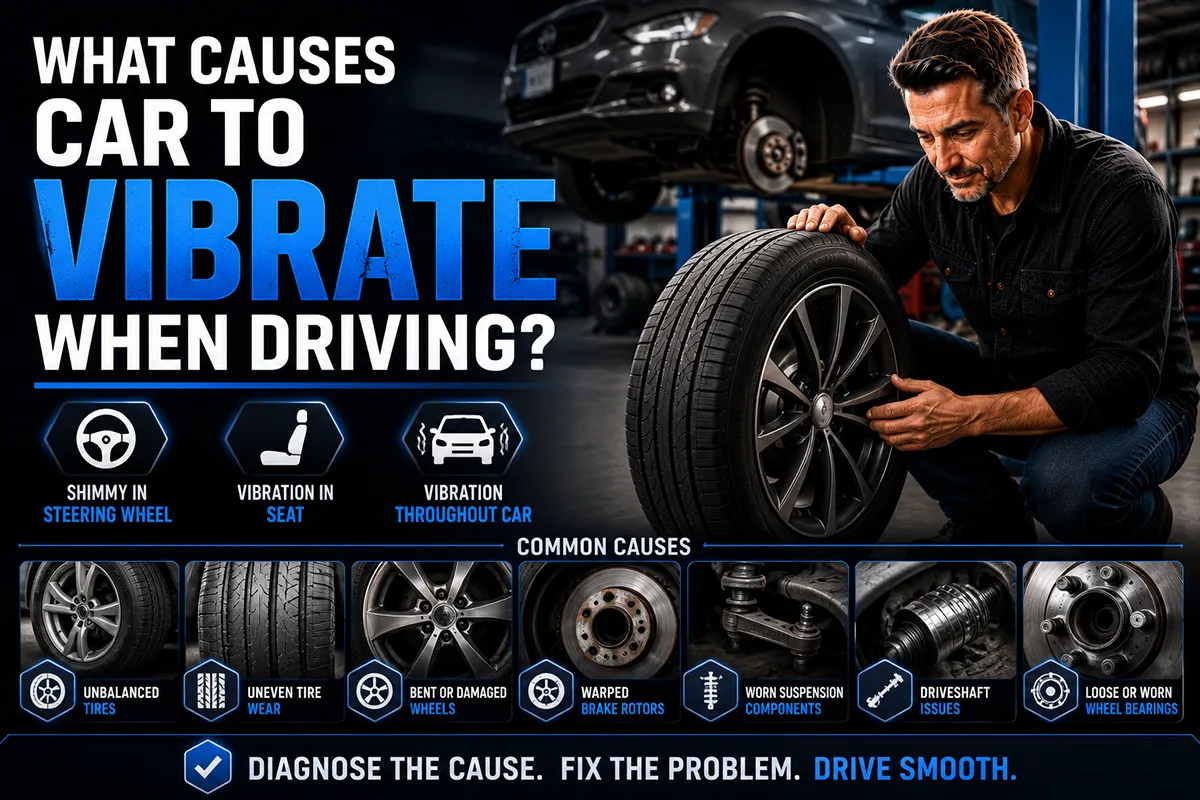
Have you ever been cruising down the highway at 65 mph and suddenly felt your steering wheel start shaking like it had a mind of its own? That unsettling vibration can turn a relaxing commute into a white-knuckle experience faster than you’d think.
I’ve spent over a decade reviewing tires, inspecting suspensions, and diagnosing vibration issues on dozens of vehicles — from compact sedans to full-size trucks. And I can tell you this: most vibration problems trace back to your tires more often than people realize.
- Unbalanced or worn tires are the #1 cause of vibration while driving
- Vibrations at specific speeds often point to wheel balance issues
- Warped brake rotors cause shaking only when braking
- Worn suspension parts like tie rods and ball joints amplify vibrations
- Misaligned wheels cause uneven tire wear, which leads to vibrations over time
- A simple tire inspection and balance can solve most vibration problems for under $80
- Don’t ignore vibrations — they worsen over time and can become a safety hazard
Liked this article?
Add TireAdvise as a preferred source so you see more of our tire reviews and guides on Google.
Why Your Car Vibrates: It’s Usually Simpler Than You Think
Before you start imagining catastrophic engine failures or transmission meltdowns, take a breath. In my experience diagnosing vibration issues across countless vehicles, the cause is almost always related to the wheels, tires, or braking system.
I’ve seen people spend hundreds of dollars at the mechanic chasing phantom engine problems when the real culprit was a $15 wheel weight that fell off on a pothole. That’s exactly why I wrote this guide — to help you pinpoint the problem before you waste money on the wrong fix.
Let me walk you through every major cause of car vibration, how to identify each one, and exactly what to do about it.
Cause #1: Unbalanced Tires — The Most Common Culprit
If I had to pick the single most common reason cars vibrate while driving, it’s unbalanced tires. I’d estimate that roughly 60-70% of the vibration complaints I’ve investigated over the years come down to this one issue.
Every tire and wheel assembly has slight weight inconsistencies. When a tire is mounted, small lead or adhesive weights are placed on the rim to compensate. Over time, these weights can fall off — especially if you hit a nasty pothole or clip a curb.
How to Identify Unbalanced Tires
The telltale sign is a vibration that starts at a specific speed — usually between 55 and 70 mph — and gets worse the faster you go. In my testing, I’ve noticed the vibration typically shows up in the steering wheel if the front tires are unbalanced, and in the seat or floorboard if it’s the rears.
During one of my review periods, I was testing a set of Continental DWS 06 Plus tires on a Camry. After several days of driving on some rough Michigan roads, I picked up a noticeable shimmy at highway speeds. A quick trip to Discount Tire confirmed that one front wheel had lost its adhesive weight. A $20 rebalance, and it was smooth as glass again.
The Fix
- Visit any tire shop (Discount Tire, Costco, Walmart, etc.) and request a wheel balance
- Typical cost: $15-$25 per tire, or free if you purchased tires there
- I recommend rebalancing every time you rotate your tires
- If the vibration returns quickly after balancing, you may have a deeper issue like a bent wheel or a tire defect
Cause #2: Uneven or Worn Tire Tread
This is the sneaky one that builds up gradually. Uneven tire wear creates an irregular contact patch with the road, and that inconsistency translates directly into vibration.
I’ve pulled tires off vehicles that looked fine from the outside, only to find severe cupping (scalloped wear patterns) on the inner edges. You’d never see it without getting down on your hands and knees — or running your hand across the tread.
Types of Uneven Wear That Cause Vibration
- Cupping (scalloped wear): Creates a rhythmic thumping or vibration. Often caused by worn shocks or struts.
- Feathering: Tread blocks are worn at an angle. Usually caused by misalignment.
- One-sided wear: Inside or outside edge is significantly more worn. Points to camber misalignment.
- Center wear: Middle of the tread is worn down. Indicates chronic over-inflation.
- Edge wear on both sides: Shoulders worn but center has tread. Indicates under-inflation.
How I Check for This
I always run my hand across the tire surface (when cool) in multiple directions. If you feel any ridges, bumps, or rough spots, that’s your problem. I also use the penny test — insert a penny into the tread groove with Lincoln’s head facing down. If you can see the top of his head, that tire is past due for replacement.
The Fix
If the wear is mild, a tire rotation and balance might buy you some time. But in my experience, once cupping has set in, the vibration rarely goes away completely without replacing the affected tires.
If you’re in the market, I’ve had excellent results with options like the Michelin Defender 2, Cooper Discoverer EnduraMax, and Bridgestone Turanza QuietTrack — all of which wear very evenly when properly maintained.
Cause #3: Tire Defects and Sidewall Bulges
This one is more serious and can be a genuine safety hazard. A tire with a manufacturing defect or internal damage can develop a bulge, flat spot, or belt separation that creates a pronounced vibration.
I encountered this during a test period with a budget tire brand I won’t name. After just a few days of driving, I noticed a wobble at low speeds that I could actually see when I watched the tire spin. Upon inspection, there was a visible sidewall bulge about the size of an egg.
What to Look For
- Visible bulges or blisters on the sidewall
- Vibration that occurs even at low speeds (under 30 mph)
- A rhythmic thumping sound that matches wheel rotation speed
- Vibration that appeared suddenly after hitting a pothole or curb
The Fix
There is no fix for a tire with a sidewall bulge or belt separation. Replace it immediately. This is a blowout waiting to happen, and I don’t say that to scare you — I say it because I’ve seen the aftermath.
If the tire is relatively new, check the manufacturer’s warranty. Many major brands like Michelin, Goodyear, and Bridgestone offer road hazard coverage or workmanship warranties that could get you a prorated replacement.
Cause #4: Misaligned Wheels
Wheel alignment doesn’t directly cause vibration the way an unbalanced tire does. But it causes uneven tire wear, and that uneven wear absolutely causes vibration over time.
Think of it as a slow-building problem. Your alignment goes off — maybe from hitting a pothole on I-94 or bumping a curb in a parking lot — and over several weeks, your tires develop irregular wear patterns that start to produce shaking.
Signs Your Alignment Is Off
- The car pulls to one side on a straight, flat road
- The steering wheel is off-center when driving straight
- Uneven wear on the inside or outside edges of your tires
- The steering wheel doesn’t return easily to center after a turn
The Fix
Get a four-wheel alignment at a reputable shop. In the US, you’re typically looking at $80-$120 for a standard alignment, though some shops like Firestone offer lifetime alignment packages for around $200 that cover unlimited adjustments.
I personally get an alignment check every time I install a new set of tires, and again at least once a year. It’s cheap insurance against premature tire wear.
Cause #5: Warped Brake Rotors
Here’s how you can quickly distinguish this from a tire issue: if the vibration only happens when you press the brake pedal, it’s almost certainly your brake rotors.
Brake rotors are large metal discs that your brake pads clamp onto to slow the car. Over time, they can warp from heat buildup — especially if you ride your brakes on long downhill stretches or do a lot of stop-and-go city driving.
What Warped Rotors Feel Like
You’ll feel a pulsation through the brake pedal, and often through the steering wheel as well, specifically when braking. The vibration usually gets worse the harder you brake, and it may be accompanied by a slight grinding or groaning noise.
I tested a set of tires on a Honda Accord last year and initially thought I had a balance issue because of steering wheel vibration. But I quickly realized it only happened when I touched the brakes coming off the highway. New rotors and pads solved it completely.
The Fix
- Mild warping: Rotors can sometimes be resurfaced (turned) on a lathe for $20-$40 per rotor. However, this only works if there’s enough material left.
- Severe warping: Replace the rotors. Budget rotors run $30-$60 each; premium options from brands like Bosch or ACDelco are $50-$100 each.
- I always recommend replacing brake pads at the same time as rotors for best results.
Cause #6: Worn Suspension Components
Your car’s suspension is a complex system of springs, shocks, struts, control arms, tie rod ends, ball joints, and bushings. When any of these components wear out, they can’t properly dampen road imperfections — and vibrations get transmitted directly into the cabin.
Key Suspension Parts That Cause Vibration
| Component | Vibration Symptom | Typical Replacement Cost (US) |
|---|---|---|
| Worn Shocks/Struts | Bouncy ride, cupped tire wear, vibration over bumps | $200–$600 per pair (installed) |
| Worn Tie Rod Ends | Steering wheel shimmy, loose steering feel | $100–$250 per side (installed) |
| Worn Ball Joints | Clunking noise, vibration over bumps, wandering steering | $150–$350 per side (installed) |
| Worn Control Arm Bushings | Vague steering, vibration during acceleration or braking | $150–$400 per side (installed) |
| Worn Wheel Bearings | Humming/growling noise that changes with speed, vibration in steering | $150–$400 per wheel (installed) |
How I Identify Suspension Issues
The “bounce test” is my go-to quick check. Push down firmly on each corner of the car and release. If the car bounces more than once or twice before settling, the shocks or struts are likely worn. For tie rods and ball joints, I jack up the front end and try to wiggle the wheel — any play usually means worn components.
That said, suspension diagnosis really benefits from professional inspection. Many shops like Midas, Pep Boys, or your local independent mechanic will do a free or low-cost suspension inspection.
Cause #7: Bent or Damaged Wheels
If you’ve hit a serious pothole — and here in the Midwest, they’re practically a way of life — there’s a real chance you’ve bent a wheel. Even a slight bend that’s invisible to the naked eye can cause a vibration that no amount of balancing will fix.
I had this exact issue during a winter test period. After navigating some truly brutal frost-heaved roads, I developed a persistent vibration that survived two rebalancing attempts. The tire shop finally mounted the wheel on the balancer by itself and confirmed it was bent.
How to Identify a Bent Wheel
- Vibration persists even after fresh balancing
- The vibration appeared suddenly after hitting a pothole or road hazard
- You can sometimes see the wobble visually if someone drives slowly past you
- A tire shop can confirm by spinning the bare wheel on a balancer
The Fix
Steel wheels can often be straightened for $75-$150 per wheel at a specialty wheel repair shop. Alloy wheels are trickier — some can be repaired, but severe bends usually require replacement. Replacement alloy wheels can range from $150-$500+ each depending on the vehicle.
Cause #8: Drivetrain Issues
Now we’re getting into the less common but more expensive territory. If you’ve ruled out tires, wheels, brakes, and suspension, the vibration could be coming from the drivetrain.
Common Drivetrain Causes
- Worn CV joints (front-wheel drive): Clicking or vibration during turns or acceleration. Common in cars with higher mileage. Replacement typically costs $200-$400 per axle.
- Worn U-joints (rear-wheel drive): Vibration during acceleration that changes with speed. Typically $200-$400 to replace.
- Unbalanced driveshaft: A constant vibration that increases with speed. Less common but can happen after driveshaft service.
- Worn engine or transmission mounts: Vibration at idle or during acceleration, sometimes accompanied by a clunk when shifting gears. $200-$600 per mount to replace.
In my experience, drivetrain vibrations feel different from tire-related ones. They tend to be more of a deep, low-frequency hum or throb rather than the higher-frequency shimmy you get from tire balance issues. They also often change with acceleration rather than with road speed alone.
How to Diagnose Your Vibration: A Step-by-Step Approach
Let me give you the exact process I use when I encounter a vibration on any test vehicle. This systematic approach saves time and money by starting with the simplest, cheapest checks first.
Step 1: Note When the Vibration Occurs
This is the single most important diagnostic clue. Ask yourself these questions:
- Does it happen at a specific speed? (Likely tire balance)
- Does it happen only when braking? (Likely brake rotors)
- Does it happen only during acceleration? (Likely drivetrain)
- Does it happen at all speeds? (Likely tire defect, severe wear, or bent wheel)
- Does it happen only on rough roads? (Likely suspension)
- Is it a new development or gradually worsening? (Helps determine wear-related vs. sudden damage)
Step 2: Visual Tire Inspection
Get down and look at every tire. Check for:
- Visible bulges or damage on sidewalls
- Uneven tread wear (run your hand across the surface)
- Foreign objects embedded in the tread
- Adequate tread depth (use the penny test)
Step 3: Check Tire Pressure
Under-inflated or over-inflated tires can absolutely cause vibrations. I always check pressure cold (before driving) with a quality digital gauge. Reference the placard on your driver’s door jamb for the correct PSI — not the number on the tire sidewall, which is the maximum, not the recommended pressure.
Step 4: Get a Balance and Rotation
If the visual inspection doesn’t reveal anything obvious, this is your next move. It’s the cheapest professional service ($40-$80 for all four) and fixes the most common vibration cause.
Step 5: Professional Inspection
If the balance doesn’t solve it, have a trusted mechanic inspect the wheels, brakes, and suspension. At this point, you need professional eyes and equipment.
When Vibration Means It’s Time for New Tires
As a tire reviewer, this is where I can add the most value. Many vibration issues are your tires telling you they’ve reached the end of their useful life.
Signs It’s Time to Replace Rather Than Repair
- Tread depth is at or below 3/32″ (at 2/32″ it’s legally bald in most US states)
- Cupping or scalloped wear that can’t be rotated away
- Sidewall cracking or dry rot (common on tires over 5-6 years old, even with good tread)
- Persistent vibration after balancing and alignment
- Multiple patches or plugs in the same tire
My Top Tire Picks for a Smooth, Vibration-Free Ride
Based on my extensive testing across multiple seasons and vehicles, here are the tires that consistently delivered the smoothest ride quality:
| Tire | Type | Best For | Price Range (per tire) | Ride Comfort Rating |
|---|---|---|---|---|
| Michelin Defender 2 | All-Season | Sedans, CUVs | $140–$200 | ★★★★★ |
| Continental TrueContact Tour | All-Season Touring | Sedans, comfort priority | $120–$170 | ★★★★★ |
| Bridgestone Turanza QuietTrack | Grand Touring | Luxury sedans, quiet ride | $150–$210 | ★★★★★ |
| Cooper Discoverer EnduraMax | All-Season | CUVs, SUVs | $130–$180 | ★★★★☆ |
| Goodyear Assurance MaxLife | All-Season | Budget-friendly longevity | $110–$160 | ★★★★☆ |
In my testing, the Michelin Defender 2 and Bridgestone Turanza QuietTrack consistently produced the least road vibration and cabin noise. If ride comfort is your top priority — and you’re tired of dealing with vibrations — those are my two strongest recommendations.
Prevention: How to Avoid Vibration Problems in the First Place
I’ll be honest — some vibration causes are unavoidable. You can’t predict every pothole, and tires do wear out eventually. But in my experience, a simple maintenance routine can prevent the vast majority of vibration issues.
My Recommended Maintenance Schedule
- Monthly: Check tire pressure when cold. Maintain the PSI listed on your door jamb.
- Every tire rotation interval: Rotate and rebalance all four tires. Most manufacturers recommend every 5,000-7,500 miles, but I set a calendar reminder rather than relying on odometer tracking.
- Annually: Get a four-wheel alignment check, especially if you notice any pulling or uneven wear.
- Seasonally: Visually inspect tires for damage, bulges, cracking, and uneven wear.
- When installing new tires: Always get an alignment and ensure proper balancing. I consider this non-negotiable.
Quick Tips That Make a Real Difference
- Avoid potholes when safely possible — they’re the enemy of wheels, tires, and suspension.
- Don’t ride your brakes on long downhill stretches. Downshift instead to prevent rotor warping.
- Replace all four tires at the same time when possible for the most balanced ride.
- If you must replace only two, put the new tires on the rear axle for stability, regardless of whether your car is front or rear-wheel drive.
- Keep your tires properly inflated — both over and under-inflation cause premature and uneven wear.
Don’t Ignore Vibrations — They’re Trying to Tell You Something
I want to be really clear about this: car vibrations don’t fix themselves. They always get worse over time. What starts as a minor annoyance at highway speed can escalate into a safety hazard if left unaddressed.
An unbalanced tire creates uneven wear, which worsens the vibration, which accelerates the wear further. A worn ball joint that causes a slight shimmy today can fail catastrophically next month. A tire with a developing belt separation can blow out at highway speed.
I’ve seen all of these scenarios play out. The common thread? The driver noticed the vibration weeks or months earlier and hoped it would go away.
The Real Cost of Ignoring Vibrations
Let me put it in financial terms. A wheel balance costs $15-$25. An alignment costs $80-$120. But if you ignore the vibration and destroy a set of tires prematurely, you’re looking at $500-$800+ to replace them. And if a failed suspension component causes an accident, the costs become immeasurable.
The bottom line is this: when your car starts vibrating, deal with it promptly. Start with the cheapest diagnosis — a tire inspection and balance — and work your way up from there. In the majority of cases, you’ll solve the problem for under $100.
Final Thoughts From a Tire Reviewer Who’s Felt Every Vibration
After years of testing tires across every road condition the US has to offer — from smooth Florida interstates to Michigan’s pothole-cratered highways to Colorado mountain passes — I’ve come to appreciate that a smooth, vibration-free ride isn’t just about comfort. It’s about safety, tire longevity, and even fuel efficiency.
Your tires are the only part of your car that touches the road. When they’re in good shape, properly balanced, and correctly aligned, everything just works. When they’re not, your car will tell you — usually through vibrations.
I hope this guide helps you identify and solve whatever vibration issue you’re dealing with. And if it turns out you need new tires, check out our in-depth reviews right here on TireAdvise.com. I’ve personally tested every tire we recommend, and I’ll steer you toward the right choice for your vehicle, budget, and driving conditions.
Drive safe out there.
Frequently Asked Questions
What causes a car to vibrate when driving at highway speeds?
The most common cause of car vibration at highway speeds (55-70 mph) is unbalanced or worn tires. When tire tread wears unevenly or wheel weights shift, it creates an imbalance that becomes more noticeable the faster you drive. I’d recommend having your tires inspected and rebalanced at a local tire shop, which typically costs $15-$25 per tire across most US service centers.
Can worn or bad tires cause your car to shake while driving?
Absolutely — worn, damaged, or defective tires are one of the top reasons your car shakes while driving. Tires with flat spots, bulges, separated belts, or uneven tread wear create vibrations that travel through the steering wheel and floorboard. If your tires have less than 2/32″ of tread depth or show visible damage, it’s time to shop for replacements from trusted US brands like Goodyear, Cooper, or General Tire.
Why does my steering wheel vibrate when driving between 40 and 60 mph?
Steering wheel vibration specifically between 40 and 60 mph usually points to out-of-balance front tires or a warped brake rotor. Tire-related vibrations tend to be constant at those speeds, while brake-related vibrations appear only when you press the pedal. Start by getting a tire balance and rotation — this simple service resolves the issue for most drivers and costs under $100 for all four tires at chains like Discount Tire or Tire Rack-affiliated installers.
Can misaligned wheels cause vibration when driving on the highway?
Yes, a wheel alignment that’s significantly off can cause your car to vibrate, pull to one side, and accelerate uneven tire wear — especially on long highway stretches common in US driving. Potholes, curb strikes, and rough road conditions across northern states during winter are major causes of misalignment. I recommend getting an alignment check ($75-$120 at most US shops) whenever you install new tires to protect your investment and eliminate vibrations.
How do I know if my car vibration is caused by tires or something else?
A quick way to diagnose tire-related vibration is to pay attention to when and where you feel it. If the vibration is constant at certain speeds and felt mainly in the steering wheel, it’s likely a front tire issue; if it’s in the seat or floorboard, it could be rear tires. However, if the shaking only happens during braking or acceleration, the cause may be brake rotors, CV joints, or drivetrain components rather than tires. A tire professional can perform a road-force balance test to confirm whether your tires are the culprit.
Should I replace my tires if my car vibrates at high speeds after balancing?
If your car still vibrates after a proper wheel balance and alignment, your tires may have internal damage like belt separation or excessive radial runout that can’t be fixed. This is especially common with budget tires or older tires that have been driven on rough US roads through multiple seasons. In that case, replacing the affected tires is the safest and most cost-effective solution — quality all-season replacement tires from brands like Michelin, Bridgestone, or Continental start around $100-$150 per tire for most passenger vehicles.
Do tire pressure problems cause car vibrations while driving?
Underinflated or unevenly inflated tires can definitely cause noticeable vibrations, especially at sustained highway speeds. When one or more tires are running low on air, they flex more than they should, creating irregular contact with the road and uneven heat buildup. I check my tire pressure at least once a month using the PSI recommended on my driver’s side door jamb — not the number on the tire sidewall — and this simple habit has helped me avoid vibrations and extend tire life significantly.
