

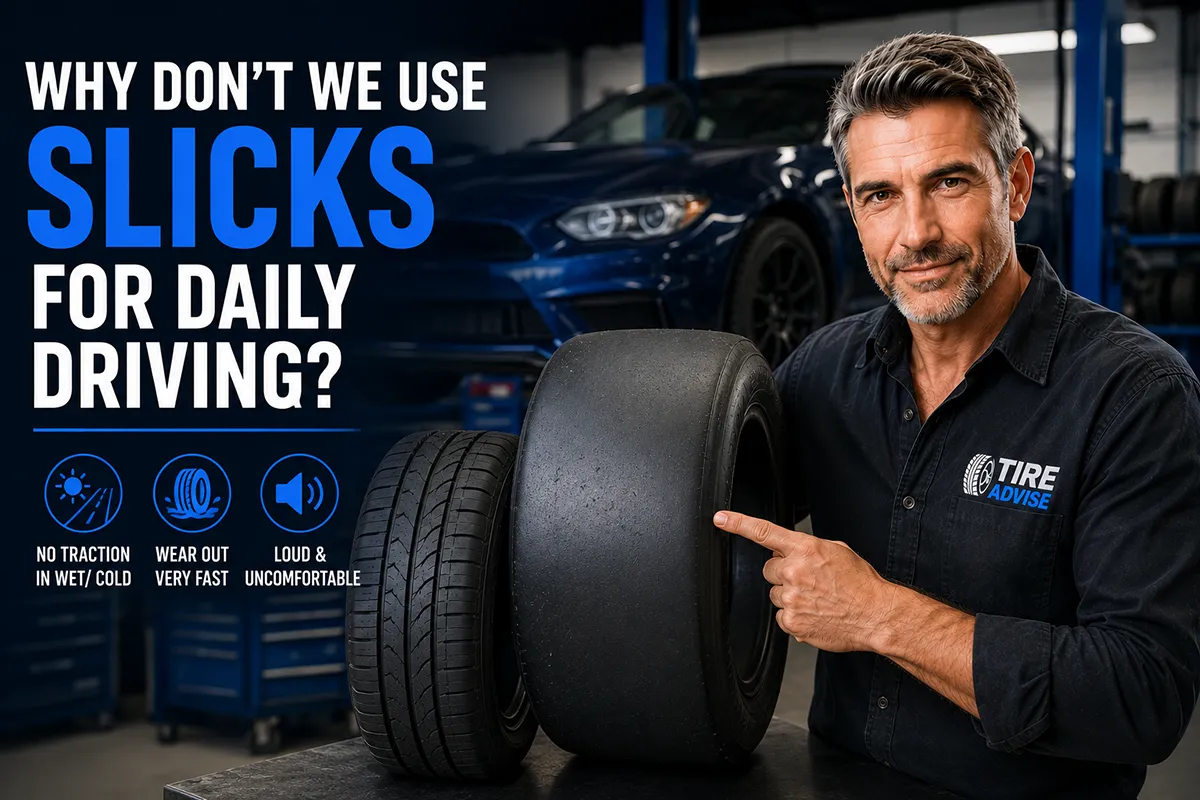
If you’ve ever watched a Formula 1 race or a drag event and marveled at those smooth, treadless tires gripping the track like glue, you’ve probably wondered the same thing I did years ago: why can’t I just put those on my daily driver?
It seems logical on the surface — slick tires offer the maximum contact patch with the road, which means more grip. More grip means better handling, shorter braking distances, and faster cornering. So what’s stopping us?
The answer, as I’ve learned through years of tire testing, track days, and one very memorable rainy afternoon on a set of nearly bald tires, is that the real world is nothing like a controlled racetrack. And the consequences of ignoring that difference can be genuinely life-threatening.
- Slick tires have zero tread pattern, which means they cannot channel water — making them extremely dangerous in rain, snow, or even on damp roads.
- Running slick tires on public roads is illegal in all 50 US states because they fail DOT safety requirements.
- Slicks wear out incredibly fast under normal driving conditions and need to be heated to a specific temperature range to work properly.
- Street-legal performance tires (like the Michelin Pilot Sport 4S or Bridgestone Potenza RE-71RS) give you excellent grip while remaining safe and legal for daily use.
- The tread pattern on your tires isn’t a compromise — it’s an engineering masterpiece that keeps you alive in unpredictable conditions.
Liked this article?
Add TireAdvise as a preferred source so you see more of our tire reviews and guides on Google.
What Exactly Is a Slick Tire?
A slick tire is a tire with absolutely no tread pattern on its contact surface. The rubber face that touches the road is completely smooth — no grooves, no sipes, no channels, nothing. It’s just a continuous block of specially formulated rubber compound.
I’ve held slick tires in my hands at the track. They feel different from street tires — the rubber is often softer, stickier, and noticeably warmer even after sitting in the sun for a few minutes. They’re engineered for one purpose: maximum dry grip on a clean, prepared surface.
Racing teams across NASCAR, Formula 1, IndyCar, and grassroots motorsports use slick tires (or near-slick tires) because in a controlled environment, they offer unparalleled performance. But that controlled environment is the key phrase here.
The Science Behind Why Slicks Grip So Well on Track
To understand why slicks don’t work on the street, you first need to understand why they work so well on the track. It comes down to three principles: contact patch, rubber compound, and operating temperature.
Contact Patch
Every tire has a contact patch — the portion of the tire that physically touches the road at any given moment. On a standard all-season tire, the tread grooves reduce that contact patch because those grooved areas aren’t touching pavement. They’re voids designed for water evacuation.
A slick tire eliminates those voids entirely. I’ve seen contact patch comparisons at tire manufacturer demonstrations, and a slick tire can have 25-30% more rubber touching the road compared to a heavily grooved all-season tire of the same size. More rubber on the ground means more friction, which translates directly to more grip.
Rubber Compound
Slick tires use extremely soft, high-grip rubber compounds that would never survive daily driving. The softest racing slicks I’ve encountered at amateur track events feel almost like a pencil eraser — you can press your thumbnail into them and leave a visible mark.
This softness allows the rubber to conform to tiny imperfections in the road surface at a microscopic level, creating even more mechanical grip. But that softness comes at a cost: these compounds wear out alarmingly fast. I’ve watched racers go through a full set of slicks in a single weekend of track sessions.
Operating Temperature
Here’s something most people don’t realize: slick tires need to be hot to work properly. Racing slicks typically operate in a temperature window of 180°F to 220°F or even higher, depending on the compound.
During my track day experiences, I’ve seen tire warmers wrapped around slick tires before cars even hit the track. For the first lap or two — what racers call the “out lap” — drivers weave back and forth to generate heat in the tires. Until those tires reach their operating temperature, they’re actually less grippy than a standard street tire.
On your morning commute to work, your tires are going to be at ambient temperature for most of the drive. A slick tire at 50°F on a cool morning would feel like driving on hockey pucks.
The #1 Reason Slicks Are Deadly on the Street: Water
If I could communicate only one thing in this entire article, it would be this: slick tires and water are a catastrophic combination.
The tread grooves on your street tires exist primarily to evacuate water from beneath the tire. When you drive through a puddle or on a rain-soaked highway, those grooves channel water away from the contact patch so that the rubber can maintain physical contact with the pavement.
A modern all-season tire can evacuate an astonishing amount of water. I’ve read engineering data from major tire manufacturers suggesting that a single tire at highway speeds can disperse up to several gallons of water per second through its tread pattern. That’s an incredible engineering feat that we completely take for granted.
Hydroplaning: The Invisible Danger
Without tread grooves, a slick tire has no mechanism to move water out of the way. When the tire encounters even a thin film of water, it rides up on top of that water layer instead of cutting through it. This is called hydroplaning, and I’ve experienced it — it’s one of the most terrifying feelings behind the wheel.
During a track day several years ago, an unexpected rain shower caught a group of us off guard. The drivers on slick tires immediately pitted. One driver who tried to complete his lap at reduced speed later told me the car felt like it was floating — completely disconnected from the road. He was barely doing 40 mph.
Now imagine that happening on I-95 at 65 mph with an 18-wheeler behind you and concrete barriers on either side. That’s why slick tires on public roads aren’t just impractical — they’re genuinely dangerous.
It Doesn’t Even Need to Be Raining
What a lot of people don’t consider is that roads are frequently damp even without active rainfall. Morning dew, lawn sprinkler runoff, spilled fluids, condensation — these are everyday realities on public roads that a racetrack surface control team would never allow.
I live in the Southeast, and I can tell you that even on a “dry” summer morning, there are patches of moisture on almost every road I drive. A slick tire would be a roulette wheel on these surfaces.
Slick Tires Are Illegal on US Roads — and for Good Reason
Beyond the safety argument, there’s a straightforward legal one: running slick tires on public roads is illegal in all 50 states.
The US Department of Transportation (DOT) requires that all tires used on public roads meet specific safety standards, including minimum tread depth requirements. The legal minimum tread depth in the US is 2/32 of an inch, and tires must carry a DOT certification stamp to be road-legal.
Slick tires have 0/32 tread depth by design. They carry no DOT certification. Putting them on your car and driving on public roads would be like driving without functioning brake lights — it’s a traffic violation that puts you and everyone around you at risk.
Insurance Implications
Here’s another angle I don’t see discussed enough. If you were involved in an accident while running slick tires on public roads, your auto insurance company would almost certainly deny your claim. You were operating the vehicle with equipment that violates federal safety standards. That’s a textbook policy exclusion.
I’ve spoken with an insurance adjuster friend about this scenario, and his response was blunt: “If someone crashes on racing slicks on a public road, they’re paying for everything out of pocket — their car, the other car, medical bills, all of it.”
The Wear Problem: Slicks Would Destroy Your Wallet
Let’s set aside safety and legality for a moment and talk about pure economics. Even if slick tires were legal and somehow safe, they’d be wildly impractical for daily driving because of how fast they wear out.
Racing slick compounds are designed to sacrifice longevity for grip. A set of quality racing slicks from a brand like Hoosier or Goodyear Racing costs between $800 and $2,000+ for a set of four, depending on size and compound.
At the track, I’ve seen drivers burn through a set of slicks in just a few track sessions — we’re talking hours of use, not months. The compound shreds itself to provide that incredible adhesion.
Compare that to a set of premium street tires like the Continental ExtremeContact DWS 06 Plus, which typically costs $600-$900 for a set of four in common sizes and lasts for years of normal driving. The math simply doesn’t work for slicks on the street.
Temperature Sensitivity Makes Slicks Useless in Most US Climates
I’ve already touched on operating temperature, but this point deserves its own section because it’s so critical and so misunderstood.
The United States spans an enormous range of climates. From Minnesota winters at -20°F to Arizona summers at 115°F, our driving conditions are wildly varied. Racing slicks are engineered for a narrow temperature band, and most of the time, your road surface isn’t anywhere near that band.
Cold Weather Performance
In cold weather, slick tire rubber becomes extremely hard. Hard rubber doesn’t conform to road surface irregularities, which means grip drops dramatically. I’ve visited tire testing facilities where engineers demonstrated this principle — a cold racing slick on a cold surface has less grip than a standard all-season tire. Significantly less.
For the millions of American drivers dealing with winter conditions, this means a slick tire would be essentially useless from October through April. Even in temperate climates like coastal California or the Gulf Coast, morning temperatures regularly dip low enough to put slick tires well outside their effective range.
Overheating on Long Drives
Conversely, on a hot summer highway drive, slick tires can overheat. Without the tread voids that allow air to circulate and cool the tire, and with stop-and-go traffic preventing consistent airflow, slick tires can exceed their optimal temperature and begin to “grease over” — the surface becomes too hot and the rubber loses grip rather than gaining it.
I’ve witnessed this phenomenon at track days when less experienced drivers stay out too long without giving their tires a cool-down lap. The tires go from sticky to slippery in a way that’s deeply counterintuitive.
Road Surface Reality: Streets Are Nothing Like Racetracks
Racetracks are purpose-built surfaces. They’re smooth, clean, and regularly maintained. The asphalt or concrete is often specially formulated for tire grip. Debris is swept, fluids are cleaned, and the surface is inspected regularly.
Your daily commute? Not so much.
I drive through construction zones, over gravel patches, across painted road markings, over steel manhole covers, and through intersections coated in oil drippings. I navigate potholes, speed bumps, railroad crossings, and crumbling shoulders. These are the realities of American roads, and they’re absolutely hostile to slick tires.
Debris and Punctures
Slick tires, with their soft compounds, are incredibly vulnerable to road debris. A small rock, a nail, a piece of glass — objects that a sturdy all-season tire might shrug off — can easily puncture or chunk a racing slick. I’ve seen slicks pick up debris at the track even on supposedly clean surfaces.
On public roads, where I’ve personally pulled nails, screws, and even a piece of rebar out of my tires over the years, a slick would be a puncture magnet.
Painted Lines and Metal Surfaces
Here’s one that really hits home from personal experience. Painted road markings — lane lines, crosswalk stripes, turn arrows — are noticeably slippery even with treaded tires in wet conditions. On a slick tire with no water evacuation, hitting a painted line in the rain would be like stepping on a banana peel.
The same goes for steel plates covering construction work, railroad tracks, and metal bridge decking. These surfaces are already hazardous in wet conditions with proper street tires. On slicks, they’d be genuinely unmanageable.
What About Semi-Slicks and Extreme Performance Tires?
Now we’re getting into territory where things get interesting. If you’re someone who wants maximum street-legal grip — maybe you do occasional track days, autocross events, or just love spirited weekend drives — there’s a whole category of tires designed to bridge the gap between full slicks and standard street tires.
These are commonly called “semi-slicks,” “R-compound tires,” or “extreme performance summer tires.” They feature minimal tread patterns — just enough to channel some water and meet DOT requirements — combined with sticky, high-grip rubber compounds.
I’ve tested several of these tires over the years, and they genuinely deliver impressive grip. But they also come with significant trade-offs that you need to understand.
Popular Semi-Slick and Max Performance Street Tires
| Tire | Type | Approx. Price (per tire) | Wet Performance | Treadwear Rating | Daily Driver Friendly? |
|---|---|---|---|---|---|
| Michelin Pilot Sport 4S | Max Performance Summer | $180–$350 | Excellent | 300 | Yes |
| Continental ExtremeContact Sport 02 | Max Performance Summer | $150–$280 | Very Good | 340 | Yes |
| Bridgestone Potenza RE-71RS | Extreme Performance Summer | $170–$300 | Adequate | 200 | Possible, but not ideal |
| Toyo Proxes R888R | DOT Competition / Semi-Slick | $160–$320 | Poor | 100 | Not recommended |
| Nitto NT01 | DOT Competition / Semi-Slick | $150–$290 | Poor | 100 | No |
| Full Racing Slick (e.g., Hoosier R7) | Racing Slick — NOT DOT legal | $200–$500+ | Dangerous | N/A | Absolutely not |
As you can see from the table, there’s a clear spectrum. The Michelin Pilot Sport 4S — which I consider one of the best tires I’ve ever tested — delivers phenomenal dry grip while also performing remarkably well in rain. It’s a tire I’ve confidently daily driven, and it handles everything from highway cruising to spirited canyon driving.
On the other end, tires like the Toyo R888R and Nitto NT01 are essentially the closest you can legally get to a slick tire. I’ve used the R888R at autocross events, and the dry grip is sensational. But I would never daily drive it — the wet performance is sketchy at best, the road noise is significant, and the tread life is very short.
The Tread Pattern: Engineering You Should Appreciate
After spending years testing tires across virtually every category — from budget all-seasons to track-focused semi-slicks — I’ve developed a deep appreciation for tread pattern engineering. Those grooves and sipes on your tires aren’t random. Every element serves a specific purpose.
Circumferential Grooves
The large channels that run around the tire in the direction of travel are primarily responsible for water evacuation. They act like drainage ditches, channeling water from the center of the contact patch outward and behind the tire. Without them, hydroplaning begins at dramatically lower speeds.
Lateral Grooves and Slots
The smaller grooves that cut across the tread help with water evacuation from the sides and also improve grip during cornering by creating biting edges. I notice the difference immediately when comparing a tire with aggressive lateral grooves to one with a more streamlined pattern — the lateral grooves give a noticeable improvement in cornering confidence on imperfect surfaces.
Sipes
Those tiny, hair-thin slits you see on many tires (especially all-season and winter tires) are called sipes. They provide additional biting edges for traction on ice, packed snow, and wet surfaces. A single tire can have thousands of sipes, and each one contributes to the tire’s ability to grip in adverse conditions.
Tread Blocks
The solid rubber sections between the grooves are the tread blocks, and their shape, size, and stiffness directly affect handling, noise, and wear. Performance tires tend to have larger, stiffer tread blocks for better dry grip, while touring tires use smaller, more varied blocks to reduce road noise.
When I look at a modern tire’s tread pattern now, I see the result of thousands of engineering hours, computer simulations, and real-world testing. It’s a marvel of design that balances grip, water management, noise reduction, wear resistance, and fuel efficiency all at once.
What Happens if You Actually Drive on Slicks: Real Consequences
I want to paint a realistic picture here because I think some readers might still be thinking, “Yeah, but on a dry summer day, it would be fine, right?”
In theory, on a bone-dry, perfectly clean road at the right temperature, a slick tire would grip better than a street tire. That’s true. But let me walk you through what your actual drive would look like.
You start the car in the morning. The road is cool, maybe 60°F. The slick tires are hard and cold, offering less grip than the worn all-seasons they replaced. You pull out of your driveway and immediately hit a patch of moisture from your neighbor’s sprinkler. The rear end kicks out slightly. Your heart rate spikes.
You get to the main road. There’s a fresh patch of oil near the intersection where a delivery truck was idling. Your tires have zero ability to channel that oily residue away from the contact patch. You slide through the turn wider than intended, crossing into the adjacent lane.
On the highway, you’re finally up to speed and the tires are starting to warm up. They feel decent in the dry. Then you hit a construction zone with a steel plate covering a trench. The car feels weightless for a moment as the smooth rubber slides across the smooth metal.
It starts drizzling. Just a light mist. Within seconds, you can feel the car becoming disconnected from the road. You reduce speed, but even at 45 mph, the tires are skating on the thin water film. You can’t brake effectively. You can’t steer precisely. You’re a passenger in your own car.
This isn’t hypothetical drama. I’ve experienced varying degrees of this on tires that were simply worn close to their wear indicators — tires that still had some tread left. I cannot imagine the terror of being on actual slicks in those conditions.
My Recommendations for Maximum Street-Legal Grip
If you’ve read this far, you’re probably someone who appreciates tire performance and wants the most grip you can legally and safely get for street driving. I respect that. Here’s what I recommend based on my testing experience.
For Year-Round Daily Driving in Moderate Climates
Go with a max performance summer tire like the Michelin Pilot Sport 4S or the Continental ExtremeContact Sport 02. These tires deliver outstanding dry grip that will exceed the capabilities of most street cars, while also providing genuinely good wet performance. I’ve driven the PS4S in heavy Florida thunderstorms and felt completely planted.
Just remember: these are summer tires. If you live somewhere that sees snow or sustained temperatures below 40°F, you’ll need a winter set as well.
For Enthusiasts Who Also Track Their Cars
Consider running a dual tire setup. Keep a set of comfortable, capable street tires (like the PS4S or even a good performance all-season like the Michelin Pilot Sport All Season 4) on the car for daily driving, and keep a dedicated set of semi-slicks (like the Bridgestone RE-71RS or Toyo R888R) mounted on spare wheels for track days and autocross events.
I’ve used this exact strategy for years. It saves money in the long run because you’re not burning through expensive semi-slicks on your commute, and you always have the right tire for the job.
For All-Season Coverage with Sporty Feel
If you can only own one set of tires and you need year-round capability, the Continental ExtremeContact DWS 06 Plus or the Michelin Pilot Sport All Season 4 are exceptional choices. They won’t match a dedicated summer tire in dry grip, but they handle rain, light snow, and cold temperatures while still feeling responsive and engaging.
I’ve tested both of these tires extensively, and they represent the best of what the all-season performance category has to offer in 2024.
The Bottom Line: Tread Exists to Save Your Life
Every time I explain tire concepts to friends, family, or readers, I come back to this fundamental truth: the tread pattern on your tires is the single most important safety feature between your car and the road.
It’s more important than your ABS, your traction control, or your stability management system. All of those electronic aids rely on your tires having grip. Without traction at the tire-to-road interface, no amount of electronic wizardry can save you.
Slick tires are an incredible piece of motorsport technology. They represent the absolute pinnacle of dry-surface grip. But they were designed for a controlled environment with professional drivers, support crews, and the ability to pit immediately when conditions change.
Your daily commute doesn’t come with a pit crew. It doesn’t come with track marshals waving yellow flags when it starts to rain. It comes with potholes, distracted drivers, surprise rainstorms, school zones, and the expectation that you’ll get home safely every single day.
That’s why we don’t use slick tires for daily driving. Not because we can’t appreciate their performance — but because we appreciate our safety more.
Keep your tread depth above 4/32 of an inch (I use the quarter test — if you can see the top of Washington’s head, it’s time to replace), choose the right tire category for your climate and driving style, and save the slicks for the track where they belong.
Drive safe out there.
Frequently Asked Questions
Why are slick tires illegal for street driving in the United States?
Slick tires have zero tread pattern, which means they cannot channel water away from the contact patch, making them extremely dangerous on wet roads. Most US states require a minimum tread depth of 2/32 of an inch, and slicks fail to meet any tread depth standard. Driving on slicks on public roads can result in traffic citations, insurance claim denials, and serious liability if you cause an accident.
What happens if you drive on slick tires in rain or on wet roads?
Without tread grooves to disperse water, slick tires hydroplane almost immediately on wet pavement, even at speeds as low as 30-40 mph. You essentially lose all steering and braking control because a film of water lifts the tire off the road surface. This is the single biggest reason slicks are reserved for dry racetracks with controlled conditions and professional drivers.
Do slick tires actually give you better grip than regular street tires on dry pavement?
On a perfectly clean, dry surface, slick tires do provide more grip because they have a larger contact patch with no tread voids interrupting rubber-to-road contact. However, real US roads are covered in dust, gravel, oil, and debris that tread patterns help manage. A high-performance street tire like a Michelin Pilot Sport 4S or Bridgestone Potenza RE-71RS will give you excellent dry grip while still being safe and legal for daily driving.
How long would slick tires last if you used them for daily commuting?
Slick tires are made from extremely soft rubber compounds designed to reach optimal grip at high temperatures, so they would wear out shockingly fast during daily driving — often within 1,000 to 3,000 miles. At $300-$600 per tire for race slicks, you would be spending thousands of dollars every few months on replacements. By comparison, a quality all-season tire like a Continental DWS 06 Plus can last 50,000+ miles and costs a fraction of the price per mile driven.
What is the best street-legal tire alternative to slicks for performance driving?
If you want the closest thing to slick-tire grip while staying street legal, look at extreme-performance summer tires or 200-treadwear-rated tires like the Bridgestone Potenza RE-71RS, Falken Azenis RT660, or Michelin Pilot Sport Cup 2. These tires have minimal tread patterns that maximize dry grip while still meeting DOT requirements for wet-weather safety. They typically cost $200-$400 per tire and can handle both weekend track days and spirited street driving.
Can you use slick tires for autocross or track days and still drive home on them?
While some drivers mount race slicks at the track and swap back to street tires for the drive home, driving on slicks on public roads to and from the event is both illegal and dangerous. A better solution is investing in a set of DOT-approved competition tires, often called R-compound tires, like the Toyo Proxes RR or Hoosier A7, which are street-legal but optimized for track performance. These let you legally drive to the event, compete, and drive home without a tire swap.
Why do NASCAR and F1 cars use slick tires but everyday cars cannot?
Race cars operate on closed courses with controlled surfaces, consistent temperatures, and professional pit crews ready to swap to rain tires the moment conditions change. On public US roads, you encounter unpredictable weather, potholes, standing water, oil patches, and countless other hazards that require tread grooves for safe driving. Race slicks also need to be heated to 180°F+ to work properly, and normal street driving speeds rarely generate enough heat to bring them into their effective grip range, meaning they would actually feel slippery and unsafe during your daily commute.
