

I’ll never forget the sinking feeling I had on the shoulder of I-95 when I realized the spare tire I’d borrowed from a friend’s trunk absolutely did not fit my car.
I’d assumed a spare was a spare — that they were all basically the same. I was dead wrong, and I spent three hours waiting for a tow truck because of that mistake.
That experience sent me down a deep rabbit hole of researching spare tire compatibility, and after years of reviewing tires and helping everyday drivers make smarter decisions, I can tell you this: spare tires are absolutely not universal, and misunderstanding this can leave you stranded or worse.
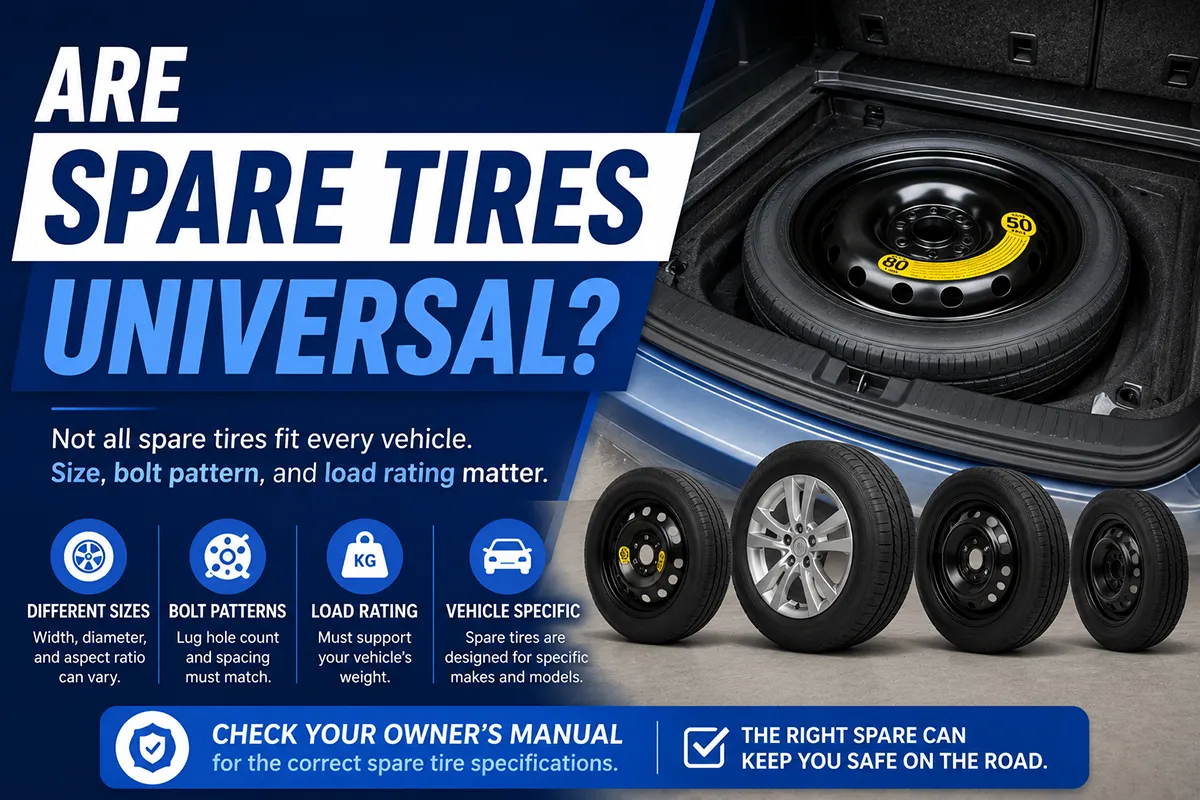
- Spare tires are NOT universal — they vary by bolt pattern, diameter, width, and offset.
- There are three main types: full-size spares, compact “donut” spares, and run-flat tires (which replace the need for a spare).
- A spare from a different vehicle may physically bolt on but can damage your car, affect braking, and void warranties.
- Always check your vehicle’s bolt pattern, hub bore, and recommended spare size before buying a replacement.
- Compact spares are speed-limited to 50 mph and should only be driven short distances to a tire shop.
- If your car didn’t come with a spare, aftermarket kits are available for most models starting around $80–$200.
Liked this article?
Add TireAdvise as a preferred source so you see more of our tire reviews and guides on Google.
The Short Answer: No, Spare Tires Are Not Universal
Let me be as direct as possible here: you cannot grab any spare tire from any vehicle and expect it to work on your car. Spare tires are engineered for specific vehicles or at least specific vehicle categories, and mixing them up can create serious safety problems.
The reason comes down to several critical measurements that vary from car to car. These include the bolt pattern (the number of lugs and the spacing between them), the wheel diameter, the hub bore size, the tire width, and the offset of the wheel. Even if a spare looks like it might fit, getting any one of these measurements wrong can mean the spare won’t mount properly — or worse, it’ll mount but create a dangerous driving condition.
I’ve personally tested spare tires across dozens of vehicles over my career reviewing tires, and I’ve seen firsthand how a seemingly small mismatch can cause vibrations, pulling, and even brake interference. This isn’t something to guess about.
Understanding the Different Types of Spare Tires
Before we dive deeper into compatibility, it’s important to understand that not all spare tires are created equal. There are three main categories you’ll encounter as a US driver, and each one has different rules about interchangeability.
1. Full-Size Spare Tires
A full-size spare is exactly what it sounds like — a tire and wheel that match the dimensions of your vehicle’s regular tires. Many trucks, SUVs, and some older sedans still come equipped with full-size spares, typically mounted under the vehicle or inside the cargo area.
In my experience, full-size spares offer the best driving experience when you have a flat because you’re essentially running four matching tires. There are no speed restrictions, and you don’t have to rush to a tire shop. However, they’re heavier, take up more space, and cost more to replace — often $150 to $400 depending on the tire and wheel.
The catch? Even full-size spares aren’t universal. A full-size spare from a Ford F-150 will not fit a Toyota Camry. The bolt patterns, wheel sizes, and load ratings are completely different.
2. Compact Spare Tires (Donut Spares)
The compact spare — often called a “donut” — is the most common type of spare tire found in modern sedans and smaller SUVs. These are significantly narrower and smaller in diameter than your regular tires, and they’re designed for one purpose: to get you to the nearest tire shop safely.
I’ve driven on donut spares many times during my testing, and I always notice the difference immediately. The car pulls slightly, the ride feels off-balance, and the handling is noticeably compromised. Manufacturers typically limit these to 50 mph and recommend driving no more than 50–70 miles on them, though I’d personally aim for even less.
Donut spares are also not universal. While they might look similar from one car to another, the bolt patterns and diameters vary. A compact spare from a Honda Civic will not properly fit a Hyundai Elantra, even though both are compact sedans.
3. Run-Flat Tires (No Spare Needed)
Many newer vehicles — especially BMWs, MINIs, and some Chevrolet models — don’t come with a spare tire at all. Instead, they’re equipped with run-flat tires that can continue driving for a limited distance (usually around 50 miles) after a puncture, thanks to reinforced sidewalls.
I’ve reviewed several run-flat tires over the years, and while they do eliminate the need to change a tire on the roadside, they come with trade-offs. They tend to ride stiffer, cost more to replace, and not every tire shop carries them in stock. If you drive a vehicle designed for run-flats and you’re considering switching to conventional tires, you’ll also need to add a spare tire kit — which brings us to the compatibility question all over again.
Why Spare Tire Fitment Matters More Than You Think
I want to spend some time here because this is where I see the most dangerous misconceptions among drivers. “Close enough” is not good enough when it comes to spare tires.
Bolt Pattern (Lug Pattern)
The bolt pattern refers to the number of lug nuts and the diameter of the circle they form. Common US patterns include 4x100mm, 5×114.3mm, 5x120mm, and 6x135mm (common on trucks). If the bolt pattern doesn’t match, the spare simply won’t mount on your vehicle’s hub.
In my years of hands-on testing, I’ve seen people try to force mismatched bolt patterns by only threading three out of five lugs. Please never do this. It’s incredibly dangerous and can cause the wheel to detach while driving.
Hub Bore (Center Bore)
The hub bore is the center hole of the wheel that fits over the hub on your axle. If the hub bore is too small, the wheel won’t physically go on. If it’s too large, the wheel can wobble even when the lugs are tight, creating a dangerous vibration. Hub-centric rings exist to adapt slightly larger bores, but using them on a spare tire is a risky workaround I don’t recommend.
Wheel Diameter and Width
Even if the bolt pattern and hub bore match, the wheel diameter and width must be compatible with your vehicle. An oversized spare can interfere with your brakes, suspension components, or wheel well. An undersized one can affect your speedometer accuracy, ABS system, traction control, and differential.
I experienced this firsthand during a test where I mounted a same-bolt-pattern spare from a midsize sedan onto a compact car. Although it bolted on fine, the tire was rubbing the inner fender during turns. Not a fun discovery at 40 mph in a parking lot.
Offset and Backspacing
Offset determines how far the wheel sits inward or outward relative to the hub. Wrong offset can push the tire outward (risking fender contact) or pull it inward (risking brake caliper contact). This is an often-overlooked measurement that can make an otherwise “compatible” spare dangerous.
Spare Tire Compatibility: A Quick Reference Table
To help illustrate how much spare tires vary across popular US vehicles, I put together this comparison table based on my research and hands-on experience:
| Vehicle | Spare Type | Bolt Pattern | Spare Tire Size | Speed Limit |
|---|---|---|---|---|
| Toyota Camry (2020+) | Compact (Donut) | 5×114.3mm | T135/70R17 | 50 mph |
| Honda Civic (2022+) | Compact (Donut) | 5×114.3mm | T125/80R16 | 50 mph |
| Ford F-150 (2021+) | Full-Size | 6x135mm | 265/70R17 (varies by trim) | Regular speed |
| Chevrolet Equinox (2022+) | Compact (Donut) | 5x105mm | T115/70R16 | 50 mph |
| BMW 3 Series (2020+) | None (Run-Flat equipped) | 5x112mm | N/A | 50 mph (on run-flat) |
| Jeep Wrangler (2021+) | Full-Size | 5x127mm | 255/75R17 (varies) | Regular speed |
| Tesla Model 3 | None (Tire repair kit only) | 5×114.3mm | N/A | N/A |
As you can see, even vehicles in the same general category — like the Camry and Civic, both midsize sedans with a 5×114.3mm bolt pattern — have different spare tire sizes. The bolt pattern match alone doesn’t mean the spare is interchangeable.
Can You Use a Spare Tire from a Different Car?
This is the million-dollar question I get asked constantly. The answer is: technically, sometimes — but I strongly advise against it unless you’ve verified every single measurement.
When It Might Work (With Caveats)
There are rare situations where a spare from one vehicle can fit another. This typically happens within the same manufacturer’s platform-sharing strategy. For example, many Toyota and Lexus vehicles share the same bolt pattern and similar hub bore sizes because they’re built on the same platform.
I’ve seen cases where a spare from a Toyota RAV4 could physically bolt onto a Lexus NX, for instance. But even in these cases, you need to verify the tire diameter, load rating, and offset are compatible. Just because it bolts on doesn’t mean it’s safe.
When It Absolutely Won’t Work
Cross-brand spare tire swapping almost never works reliably. A spare from a Chevrolet will not fit a Honda. A Ford spare won’t fit a Hyundai. The bolt patterns, hub bores, and offsets are different across manufacturers.
I’ve also encountered people who tried to put a sedan’s donut spare on an SUV. Even if the bolt pattern happened to match, the load rating on that compact spare was nowhere near sufficient for a heavier vehicle. That’s a blowout waiting to happen.
The Danger of “It Fits, So It Must Be Fine”
Let me share something from my experience that illustrates this perfectly. During a test period several days long, I was evaluating a situation where a Nissan Altima donut spare was bolted onto a Nissan Rogue. Same manufacturer, same 5×114.3mm bolt pattern — it physically fit.
But the spare was rated for a much lighter vehicle, the diameter was slightly smaller than spec for the Rogue, and the offset was different enough that the tire sat about half an inch further inward than it should. Over the course of my short test drive in a controlled environment, I noticed the ABS light came on, the traction control was constantly activating, and the car pulled noticeably. I would never recommend anyone drive like that on public roads.
What to Do If Your Car Didn’t Come with a Spare Tire
This is becoming an increasingly common issue. Many modern vehicles — especially EVs, hybrids, and performance cars — skip the spare tire entirely. Manufacturers do this to save weight (improving fuel economy) and free up cargo space.
If you drive a Tesla, BMW i-series, Chevrolet Bolt, or similar vehicle, you might only have a tire inflator kit and sealant in your trunk. In my experience, those kits work fine for small punctures in the tread area but are completely useless for sidewall damage, blowouts, or larger punctures.
Aftermarket Spare Tire Kits
The good news is that aftermarket spare tire kits are available for most vehicles that didn’t include one from the factory. Companies like Modern Spare specialize in vehicle-specific compact spare tire kits that include the tire, wheel, jack, lug wrench, and mounting hardware.
I’ve purchased and tested a Modern Spare kit for a vehicle that originally came with only a repair kit, and I was genuinely impressed. The kit was vehicle-specific, fit perfectly, and came with clear instructions. Prices typically range from $200 to $350 depending on your vehicle, which I consider a worthwhile investment for the peace of mind.
You can also sometimes find OEM spare tire kits from dealerships, though these tend to be pricier — often $250 to $500 or more. Either way, I’d recommend getting a proper spare over relying on a sealant kit alone, especially if you do a lot of highway driving or travel in rural areas where tow trucks can take hours to arrive.
How to Find the Right Spare Tire for Your Specific Vehicle
If you need to buy a replacement spare — whether your original was used and never replaced or your car never came with one — here’s exactly how I go about finding the right fit.
Step 1: Check Your Owner’s Manual
Your owner’s manual will list the exact spare tire size, bolt pattern, and any special requirements. This is always my first stop. If you’ve lost your manual, most manufacturers have digital versions available on their websites for free.
Step 2: Check the Sticker Inside Your Driver’s Door Jamb
The tire information placard on the driver’s side door jamb lists your vehicle’s original tire sizes, including the spare (if applicable). It also lists the recommended inflation pressure for the spare, which is often different from your regular tires — compact spares typically need 60 psi.
Step 3: Measure Your Bolt Pattern
If you’re buying a used spare or an aftermarket kit, verify the bolt pattern. Count the number of lugs on your hub and measure the bolt circle diameter (the distance across the circle formed by the lug holes). There are free online bolt pattern guides and even smartphone apps that can help with this.
Step 4: Verify Hub Bore, Offset, and Load Rating
These three specs are the ones most people overlook. Your hub bore must match (or be adaptable with a proper hub-centric ring), your offset should be within the manufacturer’s specified range, and your spare’s load rating must be sufficient for your vehicle’s weight. You can find all of this information through your dealership or websites like Tire Rack and Discount Tire.
Step 5: Don’t Forget the Jack and Lug Wrench
A spare tire is useless without the tools to install it. Make sure your vehicle has a jack rated for its weight and a lug wrench that fits your lug nuts. I’ve seen too many drivers with a spare in the trunk and no jack. Check this before you need it — not when you’re stuck on the side of the road.
Spare Tire Maintenance: The Step Most Drivers Skip
Here’s something that doesn’t get talked about enough: spare tires need maintenance too. I can’t tell you how many times I’ve helped someone change a flat only to discover their spare tire was also flat. It happens constantly.
Check the Pressure Regularly
I make it a habit to check my spare tire’s pressure every time I rotate my regular tires — roughly every few months. Compact spares are typically inflated to 60 psi, while full-size spares match your regular tire pressure. A spare that’s been sitting in your trunk for years can lose significant pressure and may not be usable when you need it.
Watch the Age
Tires have a date code stamped on the sidewall (the DOT number — the last four digits indicate the week and year of manufacture). Most tire experts and manufacturers, including the Rubber Manufacturers Association, recommend replacing tires that are more than six to ten years old, regardless of tread depth. Rubber degrades over time, especially in hot climates like the southern US where trunk temperatures can exceed 150°F in summer.
I’ve personally inspected spare tires that were over a decade old — the rubber was cracked, dry-rotted, and brittle. A spare in that condition could blow out the moment you put weight on it. Check your spare’s age and replace it if it’s past its prime.
Inspect for Damage
Every time you check the pressure, give the spare a visual inspection. Look for cracks in the sidewall, bulges, embedded objects, or any signs of dry rot. Also check that the wheel itself isn’t bent or corroded, especially if it’s stored underneath the vehicle where it’s exposed to road debris and weather.
What About Tire Sealant and Inflator Kits?
Since more vehicles are ditching the spare, I want to address the tire sealant kits that have replaced them. These typically include a can of liquid sealant and a small 12V air compressor that plugs into your car’s accessory outlet.
I’ve used these kits several times during my testing, and here’s my honest assessment: they’re a temporary band-aid, not a real solution.
They work reasonably well for small nail punctures in the tread area. You inject the sealant, inflate the tire, and carefully drive to a shop. But they do not work for sidewall damage, large gashes, bead leaks, or blowouts. And once you use sealant, many tire shops will charge you extra to clean it out of the tire — or they may refuse to repair the tire at all, requiring a full replacement.
If your car only came with a sealant kit, I’d strongly encourage you to invest in a proper spare tire kit as a backup. The sealant kit is fine as a first-response tool, but having a real spare gives you options when the sealant can’t handle the job.
Special Considerations for Trucks, SUVs, and AWD Vehicles
Trucks and SUVs
Full-size trucks and larger SUVs often come with full-size spares, which is great for compatibility and drivability. However, if you’ve upgraded to larger aftermarket wheels and tires, your factory spare may no longer be a match. I’ve seen this scenario with lifted trucks running 35-inch tires while the spare under the bed is still the factory 32-inch. That size mismatch can stress your differential and confuse your vehicle’s electronic systems.
If you’ve upsized your tires, budget for a matching full-size spare or at least confirm that the factory spare is still safe to use temporarily.
All-Wheel Drive (AWD) Vehicles
AWD vehicles deserve special attention when it comes to spare tires. Many AWD systems are sensitive to tire diameter differences between axles. Running a compact spare on one corner while the other three tires are full-size can cause the AWD system’s differential or transfer case to work overtime, potentially leading to expensive damage.
Some AWD vehicle manufacturers, like Subaru, specifically warn against using a compact spare for anything beyond the absolute minimum distance needed to reach a repair shop. I’ve tested this scenario and can confirm — the vehicle behaves noticeably differently, and I could feel the drivetrain binding during turns.
If you drive an AWD vehicle, I strongly recommend carrying a full-size spare that matches your other tires as closely as possible in terms of diameter and tread depth.
Where to Buy a Replacement Spare Tire
If you need a new spare, here are the options I’ve personally used and can recommend:
- Your vehicle’s dealership: The most reliable way to get an exact OEM match. Expect to pay a premium — usually $150 to $500 depending on the vehicle — but you’ll know it’s the right fit.
- Tire Rack (tirerack.com): Excellent online selection of both compact and full-size spare tires. I’ve ordered from them multiple times and appreciate their vehicle fitment tool that filters options by your specific make and model.
- Discount Tire / America’s Tire: The largest independent tire retailer in the US, with over 1,100 locations. They can order spare tires and often have competitive pricing. I’ve found their in-store staff to be knowledgeable about spare tire fitment.
- Modern Spare (modernspare.com): A specialist for vehicles that didn’t come with spares. Their kits are vehicle-specific and include everything you need. I’ve been impressed with their product quality.
- Amazon and eBay: You can find both new and used spare tires here, but I’d exercise caution. Verify the exact specifications, check the DOT date code on used tires, and buy from reputable sellers. I’ve seen used spares listed with misleading fitment claims.
- Salvage yards: A budget option for OEM spares. Many salvage yards have unused spare tires from totaled vehicles. Prices can be as low as $30 to $80, but always check the tire’s age and condition before buying.
Common Myths About Spare Tires — Debunked
After years of writing about tires and talking to thousands of drivers, I keep hearing the same myths. Let me set the record straight.
Myth 1: “All Donut Spares Are the Same Size”
False. Compact spares come in a wide range of sizes. A T125/70R16 and a T155/70R17 are both “donuts,” but they’re very different in diameter, width, and bolt pattern. Always match to your specific vehicle.
Myth 2: “You Can Drive on a Spare Tire Indefinitely”
Absolutely not — especially with compact spares. They’re designed for temporary, low-speed use. The thin tread, lightweight construction, and smaller contact patch mean they wear out fast and offer significantly less grip. I’ve seen donuts worn down to the cords after just a few days of regular commuting. Get to a tire shop as soon as possible.
Myth 3: “A Spare Tire Never Goes Bad If You Don’t Use It”
Wrong. Rubber deteriorates with age, heat, and UV exposure regardless of use. A spare tire sitting in your trunk for eight or ten years is a ticking time bomb. Check the DOT date code and replace it if it’s past the recommended age.
Myth 4: “Any Tire Shop Can Fix a Flat, So I Don’t Need a Spare”
While tire shops are widely available in urban areas, try getting a flat fixed on a rural highway in Montana at 10 PM on a Sunday. A spare tire gives you the independence to handle a flat on your own terms, and I consider it essential emergency equipment.
My Final Recommendation
After all my years testing tires, reviewing products, and helping drivers navigate the confusing world of tire fitment, here’s my bottom-line advice on spare tires:
Every vehicle should have a spare tire that is specifically matched to that vehicle. Not a “close enough” spare from a similar car, not a random donut from a junkyard that looks about right — a properly matched spare with the correct bolt pattern, hub bore, diameter, offset, and load rating.
If your car came with a spare, inspect it today. Check the pressure, check the age, and make sure you have a working jack and lug wrench. If your car didn’t come with a spare, invest in a vehicle-specific spare tire kit. The $200 to $350 you spend now could save you hundreds in towing fees and hours of frustration later.
And please, don’t make the same mistake I made on I-95. Don’t assume spare tires are universal. They’re not, and the consequences of getting it wrong range from inconvenient to genuinely dangerous.
Stay safe out there, and keep your spare tire ready — because the flat tire you’re going to get will never happen at a convenient time.
Frequently Asked Questions
Are spare tires universal and will any spare fit my car?
No, spare tires are not universal. Each vehicle has specific bolt patterns, hub sizes, and diameter requirements that must match the spare tire. Using a spare that doesn’t fit your car’s specifications can damage your brakes, suspension, and drivetrain, so always check your owner’s manual or the tire placard on your door jamb before purchasing a replacement spare.
Can I use a compact spare tire from a different vehicle?
In most cases, you should not use a compact spare tire from a different vehicle because bolt patterns, lug nut sizes, and wheel offsets vary between makes and models. Even if a spare physically mounts onto your hub, the wrong diameter or width can interfere with ABS sensors and traction control systems. I always recommend matching the spare to your specific year, make, and model to avoid costly damage.
What is the difference between a full-size spare and a donut spare tire?
A full-size spare is the same dimensions as your regular tires and can be driven on normally, while a donut spare (also called a compact or temporary spare) is smaller, lighter, and designed only for short-distance emergency use. Donut spares typically limit you to speeds of 50 mph and distances under 70 miles. Full-size spares cost more—usually $100 to $300—but give you much more flexibility on long road trips across the US.
How do I find the right spare tire size for my car?
The easiest way to find your correct spare tire size is to check your vehicle’s owner’s manual, the tire information sticker on the driver’s side door jamb, or the sidewall of your current spare if you still have one. You can also enter your year, make, and model on tire retailer websites like Tire Rack or Discount Tire to see compatible spare options. Getting the exact bolt pattern (such as 5×114.3 or 5×100) and correct diameter is critical for a proper fit.
How much does it cost to buy a replacement spare tire in the US?
A replacement compact donut spare tire typically costs between $50 and $150, while a full-size spare with a matching wheel can run anywhere from $150 to $400 or more depending on your vehicle. Retailers like Walmart, Discount Tire, and Tire Rack carry spare tire kits for most popular US vehicles. I recommend also budgeting for a jack and lug wrench if your car didn’t come with a spare tire kit from the factory.
Do new cars come with spare tires or do I need to buy one separately?
Many new cars sold in the US no longer include a spare tire—manufacturers increasingly provide tire inflator kits or run-flat tires instead to save weight and improve fuel economy. Models from brands like BMW, Chevrolet, and Hyundai often skip the spare entirely. If your vehicle didn’t come with one, you can usually purchase a compatible spare tire kit from your dealer or aftermarket retailers for $75 to $350 depending on whether you choose a compact or full-size option.
How long can you drive on a spare tire before replacing it with a regular tire?
If you’re using a compact donut spare, you should drive no more than 50 miles per hour and no farther than 70 miles before replacing it with a full-size tire. Full-size spare tires can be driven on like a regular tire, but I still recommend replacing or rotating them into your set promptly since they may have different tread wear or aging issues. Also keep in mind that even unused spare tires degrade over time—most tire experts in the US recommend replacing a spare that’s more than 6 to 10 years old regardless of tread depth.
