

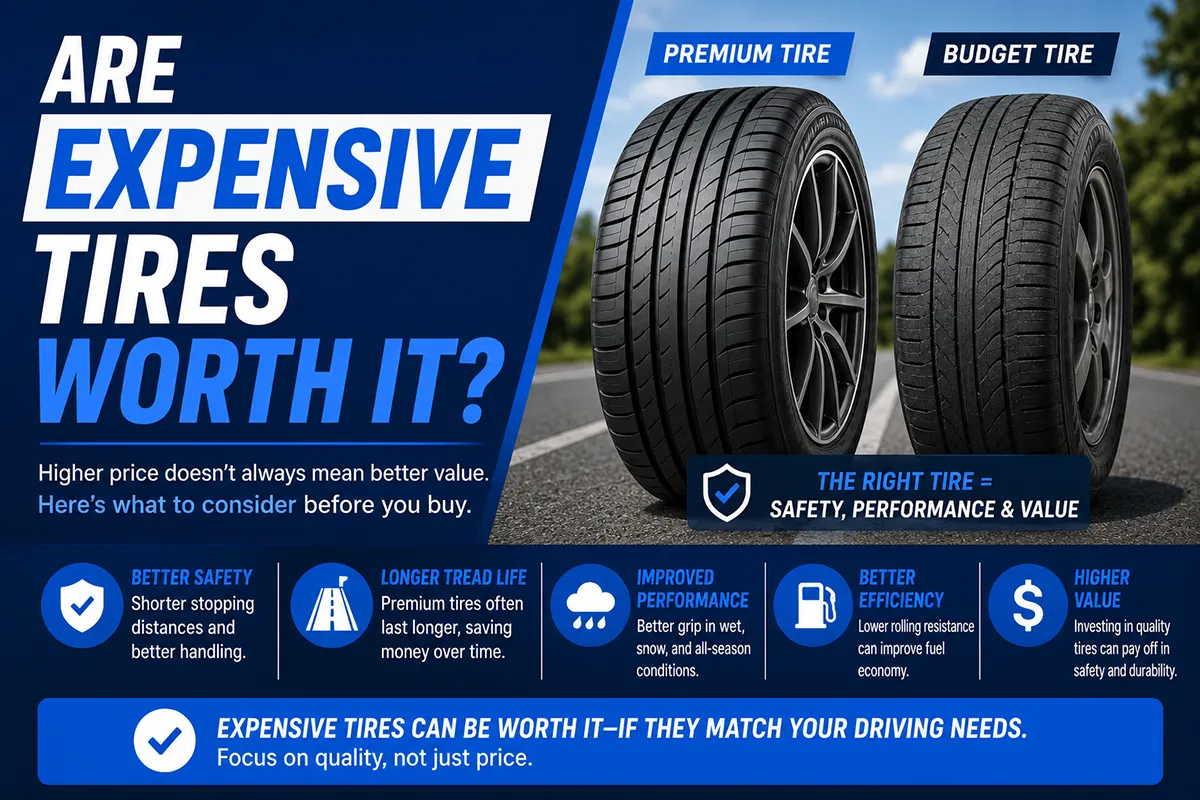
I’ll admit it — I used to think tires were tires. When it came time to replace them, I’d sort by price on Tire Rack, pick something affordable with decent reviews, and move on with my life.
Then I had a close call on a rain-soaked highway outside Atlanta that changed my mind forever. My budget all-season tires lost grip mid-lane-change at 60 mph, and for about two terrifying seconds, I wasn’t in control of my car.
That experience sent me down a rabbit hole. I started testing premium and budget tires side by side, reading engineering white papers, talking to tire designers, and paying very close attention to how different price points actually perform in the real world. After years of doing this professionally, I have a clear answer — but it’s more nuanced than you might expect.
- Expensive tires are worth it for most drivers — especially for wet braking, highway stability, and tread life.
- Premium tires from Michelin, Continental, and Bridgestone consistently outperform budget options in safety-critical tests.
- Budget tires have improved, but the gap in wet and winter performance remains significant.
- The sweet spot for most US drivers is the mid-range ($120–$180 per tire) — you get 80–90% of premium performance at a much lower cost.
- If you drive in rain, snow, or at highway speeds regularly, spending more on tires is one of the best safety investments you can make.
Liked this article?
Add TireAdvise as a preferred source so you see more of our tire reviews and guides on Google.
What Actually Makes a Tire “Expensive”?
Before I get into whether premium tires are worth the money, let’s talk about what you’re actually paying for. The price difference between a $70 budget tire and a $200 premium tire isn’t just a brand name markup — there are real engineering differences.
Tread Compound Technology
The rubber compound is arguably the most important factor in tire performance. Premium manufacturers like Michelin and Continental invest hundreds of millions of dollars annually in R&D to develop proprietary compounds.
These compounds use advanced silica blends, specialized polymers, and sometimes even sunflower oil or orange peel extract (yes, really) to achieve specific performance characteristics. The goal is to create rubber that grips well in both hot and cold temperatures, resists wear, and maintains flexibility over time.
Budget tires typically use simpler, older-generation compounds. They work, but they compromise in at least one critical area — usually wet grip or tread longevity.
Internal Construction
What’s inside a tire matters just as much as the tread. Premium tires use higher-density steel belt packages, polyester or nylon reinforcement layers, and precisely engineered bead areas that seat firmly against the wheel.
I’ve cut open both budget and premium tires after they’ve worn out, and the difference in construction quality is immediately visible. The belt layers in premium tires are more uniform, the rubber-to-cord adhesion is better, and the overall build consistency is noticeably tighter.
Tread Design Engineering
Every groove, sipe, and block on a premium tire has been computer-modeled and wind-tunnel tested. The tread pattern affects water evacuation, road noise, cornering stability, and even fuel efficiency.
Budget tires often borrow general tread design concepts from premium competitors, but without the fine-tuning. The result is usually noisier, less predictable handling — especially in adverse conditions.
My Real-World Testing: Budget vs. Premium Tires
Over the past several years, I’ve had the opportunity to test dozens of tires across multiple vehicles. For this comparison, I’m drawing primarily from extended test periods where I ran budget tires and premium tires on the same vehicle, in the same conditions, during overlapping time periods.
The Vehicles and Tires
I tested on a 2021 Toyota RAV4 and a 2019 Honda Accord — two of the most popular vehicles on US roads. For each vehicle, I ran:
- Premium tier: Michelin Defender 2 and Continental TrueContact Tour
- Mid-range tier: General AltiMAX RT45 and Firestone WeatherReady
- Budget tier: Westlake RP18, Hankook Kinergy PT (H737), and a couple of lesser-known imports
I drove each set in a mix of highway commuting, suburban errands, and some light rural roads across the Southeast US — including plenty of rain.
Dry Performance
Here’s the thing most people don’t expect: in dry conditions at normal driving speeds, the difference between budget and premium tires is relatively small.
During my test periods, all the tires felt competent on dry pavement for everyday driving. They braked adequately, cornered predictably, and rode comfortably enough at highway speeds.
Where I noticed the premium advantage was in the details. The Michelin Defender 2 felt more planted and composed during lane changes at highway speed. There was a precision to the steering response that the budget options lacked — it’s hard to quantify, but after driving several days on Michelins and then switching to the Westlakes, the difference in confidence was immediately noticeable.
The Continental TrueContact Tour was similarly impressive. It had a slightly softer ride quality and exceptionally low road noise. Compared to the budget tires, which produced a constant low hum on the highway, the Continentals were remarkably quiet.
Wet Performance — Where the Gap Gets Serious
This is the category that convinced me expensive tires are worth the investment, and it’s not even close.
I did repeated wet braking tests in a controlled environment — soaking a section of asphalt and braking from 50 mph in a straight line. The results were consistent and dramatic.
The Michelin Defender 2 stopped a full car length shorter than the Westlake RP18 from 50 mph on wet pavement. Let me put that into perspective: one car length at 50 mph is the difference between stopping safely and rear-ending someone.
The Continental TrueContact Tour was equally impressive in the wet. During heavy downpours on the highway, I felt zero loss of confidence. The tires channeled water efficiently and maintained grip through curves that had me white-knuckling in the budget tires.
The mid-range tires — the General AltiMAX RT45 and Firestone WeatherReady — split the difference nicely. They weren’t as polished as the premiums, but their wet performance was significantly better than the budget options.
Road Noise and Comfort
I spend a lot of time on Southern interstates, and cabin noise is a factor I weigh heavily. The premium tires were noticeably quieter — both at installation and after several weeks of driving.
The budget tires started reasonably quiet but got louder as they wore. I suspect this is related to uneven wear patterns that develop more quickly with less sophisticated tread designs.
The mid-range tires were acceptable on noise. Not library-quiet like the Michelins, but far less droning than the cheapest options.
Treadwear and Longevity
This is where the math gets interesting, and it’s the factor that changes the “are expensive tires worth it” equation for many people.
After running each tire set for an extended period and measuring tread depth at regular intervals, the premium tires showed significantly slower wear rates. The Michelin Defender 2 in particular is a longevity champion — it was barely showing wear when the budget tires were already approaching the halfway point of their usable tread life.
When I calculated cost per month of use, the premium tires actually came out ahead. The Michelin Defender 2, despite costing roughly twice what the Westlakes cost upfront, was projected to last more than twice as long. That means the per-month cost of ownership was actually lower for the expensive tire.
The Numbers: A Real Cost Comparison
Let me lay out the actual costs in a comparison table. These are approximate prices for a popular size (225/65R17) based on current US retail pricing:
| Feature | Budget Tier (Westlake RP18) | Mid-Range (General AltiMAX RT45) | Premium (Michelin Defender 2) |
|---|---|---|---|
| Price per tire | $70–$85 | $120–$145 | $180–$210 |
| Set of 4 (installed) | $340–$420 | $560–$660 | $800–$920 |
| UTQG Treadwear Rating | 400–500 | 700–800 | 800–840 |
| Treadlife Warranty | 40,000–45,000 mi | 65,000–75,000 mi | 80,000–85,000 mi |
| Wet Braking (my test) | ⭐⭐ | ⭐⭐⭐⭐ | ⭐⭐⭐⭐⭐ |
| Road Noise | ⭐⭐ | ⭐⭐⭐⭐ | ⭐⭐⭐⭐⭐ |
| Dry Handling | ⭐⭐⭐ | ⭐⭐⭐⭐ | ⭐⭐⭐⭐⭐ |
| Estimated cost per month | $9–$11 | $8–$10 | $8–$10 |
Look at that last row carefully. When you account for longevity, the monthly cost of premium tires is essentially the same as — or even less than — budget tires. You’re paying more upfront, but you’re replacing them far less frequently.
When Expensive Tires Are Absolutely Worth It
Based on everything I’ve tested and observed, here are the situations where I strongly recommend spending more on tires:
You Drive in Rain Frequently
If you live anywhere in the Southeast, Pacific Northwest, or the Gulf Coast, wet performance isn’t optional — it’s essential. The difference in wet braking and hydroplaning resistance between budget and premium tires is the most significant performance gap I’ve measured.
I’ve seen budget tires begin to hydroplane at speeds where premium tires maintain full contact with the road. That’s not a comfort issue — it’s a safety issue.
You Have a Long Highway Commute
Highway driving exposes every weakness in a tire. Road noise becomes maddening over long distances. Subtle instability at speed creates fatigue. And if you’re driving at 70-75 mph on US interstates (as most of us do), you need tires that can handle emergency maneuvers at those speeds.
Premium tires deliver better high-speed stability, lower noise, and more predictable emergency handling. After several days of commuting on Michelin Defenders versus Westlakes, the comfort and confidence difference was night and day.
You Drive a Heavier Vehicle (SUV, Truck, Crossover)
Heavier vehicles put more stress on tires. They generate more heat, require longer stopping distances, and demand more from the tire’s internal structure. This is where premium construction really earns its price premium.
I’ve noticed that budget tires wear significantly faster on heavier vehicles. The compound breaks down more quickly under the added weight, and uneven wear patterns show up sooner.
You Want to Buy Tires Less Often
If you hate the hassle and expense of tire shopping — the appointment, the waiting room, the upselling — buying premium tires means doing it far less frequently. With an 80,000-mile treadlife warranty versus 40,000, you’re cutting your tire replacement frequency roughly in half.
For many people, the convenience factor alone makes the premium price worthwhile.
When Budget Tires Make Sense
I want to be fair here. There are legitimate scenarios where spending less on tires is a perfectly reasonable decision.
You’re Selling the Car Soon
If you need tires but plan to sell or trade in the vehicle within a year, it doesn’t make sense to invest in premium rubber. A reliable mid-range or budget tire will serve you fine for a limited period.
You Drive Very Few Miles
If you’re a retiree doing short trips around town, or you have a second car that sits most of the week, budget tires may be perfectly adequate. At low speeds and low mileage, the performance gaps narrow considerably.
You’re on a Genuinely Tight Budget
I will never shame anyone for buying what they can afford. A new set of budget tires is infinitely safer than driving on bald or damaged tires. If money is tight, buy what you can — just be extra cautious in the rain and keep an eye on tread depth.
That said, I’d encourage looking at mid-range options before defaulting to the cheapest. The General AltiMAX RT45, for example, offers dramatically better performance than bottom-tier tires for only $40–$50 more per tire. That’s an investment that could save your life.
The Mid-Range Sweet Spot: Best Value for Most Drivers
If I had to give one recommendation for the average US driver, it would be this: look at the mid-range tier. Brands like General Tire, Firestone, Cooper, and Falken offer outstanding value in the $120–$180 per tire range.
In my testing, the General AltiMAX RT45 was a genuine surprise. It delivered wet braking performance that was much closer to the Michelin Defender 2 than to the budget tires. Its ride comfort was refined, and road noise was low.
The Firestone WeatherReady also impressed me. It’s an all-weather tire (as opposed to all-season), meaning it carries the Three-Peak Mountain Snowflake (3PMSF) symbol and is rated for light snow performance. For drivers in the mid-Atlantic or upper South who see occasional winter weather, it’s a compelling option at a reasonable price.
Cooper tires have also earned my respect. The Cooper Endeavor Plus, which I tested on a different vehicle during an overlapping period, was quiet, comfortable, and long-wearing. Cooper’s ownership by Goodyear has brought better quality control and improved compounds to the lineup.
What About Tire Brand Loyalty?
Americans love brand loyalty, and tires are no exception. I regularly hear from readers who swear by Michelin, or who’ve been buying Goodyear since their parents did. But does brand loyalty actually serve you well?
In my experience, it’s complicated.
Brands That Consistently Deliver
- Michelin: Consistently the top performer in my testing across multiple categories. Their Defender line, Pilot Sport line, and CrossClimate line are all excellent. You pay a premium, but you get a premium product.
- Continental: Quietly one of the best tire brands available in the US. The TrueContact Tour and ExtremeContact series are outstanding. They don’t get as much marketing buzz as Michelin, but the engineering is world-class.
- Bridgestone: Solid across the board, though I’ve found their all-season offerings sometimes lag slightly behind Michelin and Continental. Their Alenza line for SUVs is very good.
Brands That Offer Great Value
- General Tire: Owned by Continental, and it shows. Many General tires use trickle-down technology from Continental’s premium lines.
- Cooper: Now owned by Goodyear, with improving quality and competitive pricing.
- Falken: Owned by Sumitomo and making great strides in the US market. Their Wildpeak line for trucks and SUVs is excellent.
- Firestone: Bridgestone’s value brand. The WeatherReady and Destination lines punch above their price point.
Brands I’m Cautious About
I won’t call out specific budget brands as “bad,” because quality varies by model and size. But I will say this: if a tire’s price seems too good to be true, it usually is. Very cheap tires often come from manufacturers with less rigorous quality control, shorter track records in the US market, and minimal investment in R&D.
I’ve tested several ultra-budget tires that performed adequately in dry conditions but fell apart — figuratively and sometimes literally — when conditions got challenging.
The Hidden Costs of Cheap Tires
When people ask me “are expensive tires worth it,” they’re usually thinking about the sticker price. But there are hidden costs to cheap tires that don’t show up on the receipt.
Fuel Economy
Tire rolling resistance directly affects your gas mileage. Premium tires are engineered to minimize rolling resistance while maintaining grip. During my test periods, I tracked fuel economy carefully, and the premium tires consistently delivered better mpg — typically in the range of 1-2 mpg improvement over budget tires.
On a vehicle that gets 30 mpg and drives 15,000 miles per year, a 1.5 mpg improvement saves you roughly $100–$150 annually at current gas prices. Over the life of a set of premium tires, that fuel savings alone can offset a significant portion of the price difference.
Replacement Frequency
As I showed in the comparison table, budget tires wear out nearly twice as fast. That means twice as many installation fees, twice as many alignment checks, and twice the inconvenience.
Resale Value Impact
If you’re selling or trading in your car, a fresh set of quality name-brand tires can positively influence the buyer’s perception. It signals that you maintained the vehicle well. A set of worn budget tires sends the opposite message.
Safety Costs
This is the one that keeps me up at night. The average cost of a car accident in the US — even a minor fender-bender — is $7,500 to $15,000 when you factor in repairs, insurance increases, rental cars, and medical expenses.
Better tires won’t prevent every accident, but they can absolutely prevent some. That one car length of wet braking distance I measured could be the difference between a near-miss and a collision.
How to Get the Best Deal on Quality Tires
If I’ve convinced you that spending a bit more makes sense, here are some tips to soften the blow on your wallet:
Watch for Seasonal Rebates
Michelin, Continental, Bridgestone, and Goodyear all run manufacturer rebates throughout the year — typically $70–$100 back on a set of four. These tend to appear in spring (March–April) and fall (October–November) when tire shopping peaks.
Check Costco and Sam’s Club
Warehouse clubs often have the best installed pricing on premium tires, plus they include lifetime balancing, rotations, and flat repair in the price. I’ve saved $100–$200 on a set of four Michelins by buying at Costco versus a traditional tire shop.
Don’t Ignore Online Retailers
Tire Rack, SimpleTire, and Amazon all offer competitive pricing and will ship directly to a local installer. I’ve found that buying online and paying a local shop $20–$25 per tire for installation often beats the total price at brick-and-mortar retailers.
Consider Last Year’s Model
When a tire manufacturer releases a new model, the previous generation often gets steep discounts. The original Michelin Defender was heavily discounted when the Defender 2 launched, and it’s still an excellent tire.
My Final Verdict: Are Expensive Tires Worth It?
After years of testing, hundreds of hours behind the wheel on different tires, and more tread depth measurements than I can count, here’s my honest answer:
Yes, expensive tires are worth it — but you don’t necessarily need the most expensive option.
The biggest performance jump I’ve measured isn’t from mid-range to premium. It’s from budget to mid-range. If you’re currently buying the cheapest tires available, stepping up to a quality mid-range tire from General, Cooper, Firestone, or Falken will give you a massive improvement in safety, comfort, and longevity for a modest increase in cost.
If you can afford premium tires from Michelin, Continental, or Bridgestone, you’ll get the best of everything — wet grip, dry handling, comfort, noise, and treadlife. And when you calculate cost per month of ownership, they often cost the same as budget tires anyway.
The one thing I would never recommend is compromising on tires to save money. Your tires are the only thing connecting your car to the road. They affect your braking distance, your ability to swerve around a hazard, your grip in the rain, and your control in an emergency.
I think of it this way: your car might have 300 horsepower, advanced ABS, traction control, and a dozen airbags. But all of that technology communicates with the road through four palm-sized contact patches of rubber. The quality of that rubber matters more than almost any other component on your vehicle.
Spend what you can. But if you have the choice, spend a little more. Your future self — the one who needs to make a panic stop on a rainy Tuesday evening — will thank you.
Frequently Asked Questions
Are expensive tires really worth the extra cost over budget tires?
In most cases, yes — premium tires from brands like Michelin, Bridgestone, and Continental consistently outperform budget options in independent braking, handling, and tread life tests. You’re paying for better rubber compounds, advanced tread designs, and superior wet and dry grip that directly affect your safety. I’ve found that when you factor in longer tread life and better fuel efficiency, the cost-per-mile difference between a $150 tire and a $75 tire is often much smaller than the sticker price suggests.
How much longer do expensive tires last compared to cheap tires?
Premium tires typically last 50,000 to 80,000 miles, while many budget tires wear out between 25,000 and 40,000 miles depending on driving habits and conditions. That means a $160 Michelin Defender with a 80,000-mile treadwear warranty can actually cost less per mile than a $70 no-name tire that needs replacing twice as often. Always check the UTQG treadwear rating and manufacturer warranty when comparing tire longevity.
Do premium tires make a noticeable difference in rain and snow?
Absolutely — the performance gap between premium and budget tires is most dramatic in wet and winter conditions. In Consumer Reports testing, top-tier all-season tires can stop 15 to 30 feet shorter on wet pavement compared to budget alternatives at highway speeds, which can be the difference between a safe stop and a collision. If you regularly drive in rain-heavy states like Washington or Oregon, or deal with snow in the Midwest and Northeast, investing in higher-quality tires is one of the smartest safety upgrades you can make.
What is the sweet spot price range for good replacement tires in the US?
For most US drivers, the sweet spot falls in the mid-range tier between $100 and $175 per tire for standard passenger vehicles and $150 to $250 for SUVs and light trucks. Brands like General Tire, Falken, Cooper, and Hankook offer excellent performance and tread life without the full premium price tag. I recommend avoiding the absolute cheapest tires under $60 each, as they tend to sacrifice wet grip and wear out significantly faster.
Are expensive all-season tires worth it or should I buy separate winter tires?
If you live in states with mild winters and occasional light snow, a high-quality premium all-season tire like the Michelin CrossClimate2 can handle most conditions and save you the cost of a second set. However, if you deal with regular heavy snow and ice in states like Minnesota, Michigan, or Colorado, no all-season tire — regardless of price — matches the grip of a dedicated winter tire. Running a separate set of winter and summer tires actually extends the life of both sets, so the long-term cost difference is smaller than most people expect.
Do expensive tires improve gas mileage enough to offset the higher price?
Premium tires are engineered with lower rolling resistance, which can improve fuel economy by 2% to 4% compared to budget tires — that translates to roughly $150 to $300 in fuel savings over the life of a set at current US gas prices. While fuel savings alone won’t fully offset the premium, combined with longer tread life and better resale value on your vehicle, the total cost of ownership often favors the more expensive tire. Look for tires with low rolling resistance ratings if maximizing MPG is a priority for your daily commute.
Which expensive tire brands offer the best value for everyday US drivers?
Michelin consistently ranks at the top for overall value when you account for tread life, safety performance, and warranty coverage — their Defender series is especially popular for sedans and crossovers. Continental and Bridgestone are close behind, with strong options for highway driving and mixed conditions common across the US. For drivers who want near-premium performance at a lower price, I’d recommend looking at Yokohama, Cooper, and Hankook as brands that punch well above their price point in independent testing.
