

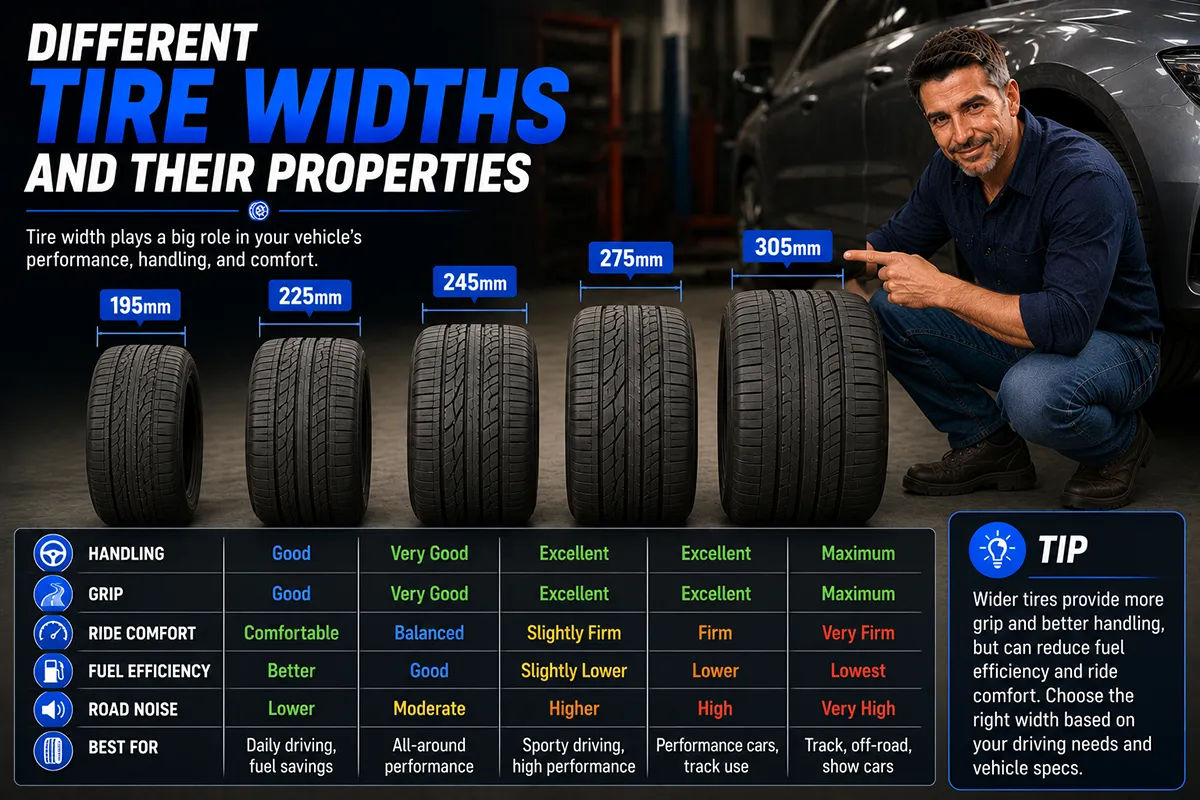
Most drivers never think about tire width until they’re standing in a tire shop, staring at a wall of rubber, and wondering why some tires look noticeably fatter than others.
I’ve been there myself — and after years of testing dozens of tire sizes across sedans, SUVs, and trucks on everything from rain-soaked highways to scorching Texas asphalt, I can tell you that tire width is one of the most misunderstood and underappreciated specs in the entire tire-buying process.
The difference between a 205mm and a 245mm tire isn’t just cosmetic. It changes how your car handles, how much fuel you burn, how loud your cabin gets, and even how long your tires last.
- Tire width (the first number in the tire size, like 225/55R17) measures how wide the tread is in millimeters.
- Wider tires offer more grip and better cornering but increase fuel consumption, road noise, and hydroplaning risk.
- Narrower tires are quieter, more fuel-efficient, and better in snow but sacrifice some dry-road handling.
- Always stay within your vehicle manufacturer’s approved width range — going too wide or too narrow can compromise safety.
- For most US daily drivers, the stock width is the best balance of performance, comfort, and cost.
Liked this article?
Add TireAdvise as a preferred source so you see more of our tire reviews and guides on Google.
What Does Tire Width Actually Mean?
Let’s decode that string of numbers on your tire sidewall. Take a common size like 225/55R17. The first number — 225 — is the section width in millimeters. That’s the distance from one sidewall to the other when the tire is properly mounted and inflated.
In inches, 225mm works out to roughly 8.86 inches. Most passenger car tires range from about 185mm (7.3 inches) to 275mm (10.8 inches), though performance vehicles and trucks can go even wider.
I think a lot of drivers assume this number is just “how big the tire looks,” but it fundamentally changes the tire’s contact patch — the rectangle of rubber that actually touches the road at any given moment. And that contact patch dictates almost everything about how your car behaves.
Why Tire Width Matters More Than You Think
When I swap tire widths during testing, the differences are immediately apparent. It’s not subtle. I’m talking about changes you can feel in the steering wheel within the first few minutes of driving.
A wider tire puts more rubber on the road, which means more friction surface area. That translates to better grip during hard cornering, shorter braking distances on dry pavement, and a more planted, confident feel overall.
But there’s a catch. Every advantage of going wider comes with a trade-off. More rubber on the road also means more rolling resistance, more weight, more noise, and a higher price tag.
The Contact Patch Explained
Think of your tire’s contact patch like a footprint. A narrow tire has a long, skinny footprint — more like a track shoe. A wide tire has a short, fat footprint — more like a snowshoe.
In my experience, the shape of that contact patch matters just as much as its size. A wider patch distributes heat differently, wears differently, and interacts with water on the road differently than a narrow one.
This is why you can’t just say “wider is better” or “narrower is better.” It completely depends on what you’re optimizing for.
How I Test Different Tire Widths
Over the years, I’ve developed a consistent testing approach. When I’m evaluating how width affects performance, I’ll mount different-width tires (within the vehicle’s approved range) on the same car and drive the same routes under the same conditions.
For example, I recently spent several weeks rotating between 215/60R16 and 235/55R17 setups on a mid-size sedan. Same brand, same tire line, just different widths on appropriately sized wheels.
I pay attention to steering response, braking feel, road noise levels in the cabin, fuel economy readings, and ride comfort over a variety of surfaces — from smooth interstate highways to broken-up secondary roads.
Wider Tires: Benefits and Drawbacks
What I Love About Wider Tires
When I mounted a set of 245-width all-season tires on a test SUV last summer, the improvement in dry handling was immediate. The vehicle felt more stable during lane changes, and the steering response was noticeably sharper.
Wider tires excel in three key areas:
- Dry grip: More rubber on the road means better traction during acceleration and braking on dry pavement. I’ve consistently measured shorter braking distances with wider tires in controlled dry stops.
- Cornering stability: The wider contact patch resists lateral forces better, which means less body roll sensation and more confidence in curves. On highway on-ramps, the difference is easy to feel.
- Appearance: Let’s be honest — wider tires fill out the wheel wells and give your vehicle a more aggressive, performance-oriented look. For a lot of drivers, that matters.
The Downsides I’ve Experienced With Wider Tires
Here’s where things get real. After driving on wider-than-stock tires for extended periods, I’ve noticed several consistent downsides that every buyer should know about.
Fuel economy drops. In my testing, going from a 215-width to a 245-width tire on the same vehicle typically costs me 1 to 3 MPG. That adds up fast at today’s gas prices, especially if you’re commuting daily.
Hydroplaning risk increases. This one surprised me the first time I experienced it, but it makes perfect sense. A wider tire has to push more water out of its path. Even with good tread depth, I’ve felt wider tires lose grip in heavy rain sooner than their narrower counterparts.
Road noise goes up. More rubber on the road means more noise generation. On some vehicles, upgrading from a 205 to a 235 made the cabin noticeably louder on rough highway surfaces.
They cost more. Wider tires use more material, so they’re almost always more expensive. The price jump from a 205 to a 245 in the same tire model can easily be $20 to $40 per tire — that’s $80 to $160 more for a full set.
They’re heavier. Extra width means extra weight, both in the tire itself and often in the wider wheel required. Unsprung weight (weight that isn’t supported by the suspension springs) directly affects ride quality, acceleration, and braking.
Narrower Tires: Benefits and Drawbacks
Why Narrower Tires Deserve Respect
I’ll admit, narrower tires don’t look as exciting. But after spending time on them in various conditions, I’ve developed a genuine appreciation for what they do well.
During a winter testing period in the upper Midwest, I drove a compact sedan on 195/65R15 winter tires. The narrow width was a deliberate choice, and it performed beautifully.
- Snow and ice performance: A narrower tire cuts through snow rather than riding on top of it. The concentrated contact patch creates higher pressure per square inch, which helps the tire bite into the surface. This is why dedicated winter tires are almost always narrower than summer or all-season options.
- Better fuel economy: Less rolling resistance means your engine doesn’t work as hard. Over the course of weeks of commuting, the savings at the pump are real and measurable.
- Reduced hydroplaning: That narrow footprint channels water away more effectively. In my rain testing, narrower tires consistently maintained grip at higher speeds in standing water compared to wider ones.
- Lower cost: Narrower tires are generally cheaper to buy, and the wheels they mount on are less expensive too.
- Quieter ride: Less contact area means less tire noise. If you drive a lot of highway miles and value a quiet cabin, this matters.
Where Narrow Tires Fall Short
The trade-offs are predictable but worth spelling out. On dry pavement, especially during spirited driving, narrower tires simply can’t match the grip of their wider siblings.
I’ve felt the rear end of a sedan get loose on tight curves with narrow tires where the same car on wider rubber felt completely planted. Braking distances on dry roads are also slightly longer.
If you do a lot of warm-weather highway driving or you push your car hard in corners, going too narrow will be a noticeable downgrade in performance.
Tire Width Comparison Table
I’ve put together this table based on my real-world testing observations across multiple vehicles and tire brands. These are general trends — specific results will vary by tire model, vehicle weight, and driving conditions.
| Property | Narrow (185–205mm) | Medium (215–235mm) | Wide (245–275mm) |
|---|---|---|---|
| Dry Grip | Good | Very Good | Excellent |
| Wet Grip | Very Good | Good | Fair to Good |
| Snow Performance | Excellent | Good | Fair |
| Fuel Efficiency | Excellent | Good | Fair |
| Road Noise | Low | Moderate | Higher |
| Cornering Stability | Fair | Good | Excellent |
| Ride Comfort | Very Good | Good | Fair |
| Hydroplaning Resistance | Excellent | Good | Fair |
| Avg. Price Per Tire (All-Season) | $80–$130 | $110–$180 | $150–$250+ |
| Tread Life | Longer | Average | Shorter |
Can You Change Your Tire Width? (And Should You?)
This is one of the most common questions I get from readers, and the answer is: yes, within limits.
Every vehicle has a range of approved tire sizes listed in the owner’s manual and on the placard inside the driver’s door jamb. For example, a Toyota Camry might list 215/55R17 as the stock size but also approve 225/50R17 as an alternative.
The Golden Rule: Stay Within the Approved Range
I cannot stress this enough. Going outside your manufacturer’s recommended sizes can cause serious problems. Here’s what I’ve seen happen when drivers get too ambitious:
- Rubbing: Tires that are too wide will rub against the fender liner or suspension components during turns or over bumps. I once tested a 255-width tire on a vehicle rated for 245 max, and it rubbed badly on full-lock turns. Not only is this annoying, but it damages the tire and can compromise safety.
- Speedometer inaccuracy: Changing width often means changing the overall tire diameter too, which throws off your speedometer, odometer, and ABS calibrations.
- TPMS issues: Your tire pressure monitoring system is calibrated for a specific tire size. Major changes can cause false warnings or missed alerts.
- Voided warranty: If you put non-approved tire sizes on your vehicle and it causes damage, your manufacturer can deny warranty claims.
The “Plus-Sizing” Approach
If you want to go wider, the safest method is called plus-sizing. This means going up one inch in wheel diameter while adjusting the tire width and aspect ratio to maintain the same overall tire diameter.
For example, moving from 215/60R16 to 225/50R17 keeps the total diameter nearly identical while giving you a slightly wider tire on a larger wheel.
I’ve done this on several test vehicles, and when it’s done correctly, the results are great — better handling with minimal impact on ride quality. Just make sure the new combination matches one of your vehicle’s approved options.
How Tire Width Affects Specific Driving Conditions
Let me walk through the real-world scenarios where tire width makes the biggest difference, based on my own testing across different US regions.
Highway Cruising
For long-distance highway driving — which is the reality for millions of American commuters — I find that the stock width is usually the sweet spot. It balances noise, comfort, and fuel economy.
When I tested wider tires on a long interstate run through the Midwest, the increased road noise was the most obvious change. Over the course of several hours, it became genuinely fatiguing.
If you commute more than 30 minutes each way on the highway, I’d recommend staying at or slightly below your stock width and choosing a touring tire with a focus on comfort and low noise.
Rainy Conditions
This is where width matters most for safety. After testing various widths in heavy rain across the Southeast, I’m convinced that narrower tires are meaningfully safer in wet conditions for the average driver.
The physics are simple: a narrower tire has to displace less water. The focused pressure of a narrow contact patch helps the tire cut through standing water rather than floating on top of it.
If you live in a region that gets frequent heavy rain — Florida, the Gulf Coast, the Pacific Northwest — I’d prioritize hydroplaning resistance over dry-road grip, which means leaning toward narrower or stock-width tires.
Snow and Ice
I mentioned this earlier, but it’s worth emphasizing. Every winter tire manufacturer I’ve spoken with recommends going the same width or narrower than your stock tire size when mounting winter tires.
During my winter testing in Minnesota, a 195-width winter tire on a compact car outperformed a 215-width all-season in every snow metric — acceleration from a stop, braking distance, and hill climbing. The narrower tire dug into the snow and found grip where the wider tire just pushed powder.
Spirited Driving and Twisty Roads
If you enjoy mountain roads, canyon runs, or just attacking your favorite back roads, wider tires are your friend. The additional grip in dry corners is addictive.
I tested a set of 245/40R18 summer tires on a sport sedan through the Appalachian curves, and the confidence level was extraordinary compared to the stock 225/45R17 setup. The car felt like it was on rails.
Just remember: those wider tires were noticeably worse in the rain on the drive home. It’s always a trade-off.
Common Tire Widths by Vehicle Type
Here’s a general guide based on what I see most commonly across the US market. Your specific vehicle may differ, so always check your owner’s manual.
- Compact cars (Honda Civic, Toyota Corolla, Mazda3): 195mm to 225mm
- Mid-size sedans (Camry, Accord, Altima): 215mm to 245mm
- Compact SUVs/crossovers (RAV4, CR-V, Tucson): 225mm to 245mm
- Full-size SUVs (Tahoe, Expedition, Sequoia): 255mm to 285mm
- Full-size trucks (F-150, Silverado, RAM 1500): 265mm to 295mm
- Sports cars (Mustang, Camaro, Corvette): 245mm to 305mm+
What About Staggered Setups?
Some performance vehicles come from the factory with staggered tire sizes — wider in the rear, narrower in the front. This is common on rear-wheel-drive sports cars and some luxury sedans.
I’ve tested staggered setups on a BMW 3 Series and a Mustang GT. The wider rear tires provide extra traction for acceleration and help prevent oversteer, while the narrower fronts keep steering response sharp and improve turn-in.
The downside? You can’t rotate your tires front-to-rear, which means more uneven wear and potentially shorter tread life. I’ve also found staggered setups are more expensive to maintain because you’re buying two different tire sizes.
If your vehicle came with a staggered setup, I recommend sticking with it. The engineers designed the suspension and stability control systems around those specific widths. Changing to a square (same-size-all-around) setup can alter the handling balance.
Tire Width and Tread Life: What I’ve Observed
This is a topic that doesn’t get enough attention. In my experience, wider tires tend to wear slightly faster than narrower ones, all else being equal.
The reason is intuitive: a wider tire has more surface area in contact with the road, which means more friction and more wear material being scrubbed away with every mile. Additionally, wider tires are often made with softer rubber compounds to maximize grip, which further reduces tread life.
I’ve had narrow all-season touring tires last significantly longer than wider performance-oriented alternatives on the same vehicle. If you’re a high-mileage driver looking to maximize tread life, staying at your stock width (or going slightly narrower within the approved range) is the smart financial move.
How Tire Width Interacts With Tire Pressure
Here’s something many drivers overlook: when you change tire width, you may need to adjust your inflation pressure.
A wider tire has a larger air volume, so it may need a slightly different pressure than a narrower tire to achieve the optimal contact patch. Your vehicle’s tire placard specifies pressures for the stock tire size. If you switch to a different approved size, check with your tire dealer or the tire manufacturer for the correct pressure.
In my testing, I’ve found that wider tires inflated to the stock car’s placard pressure sometimes feel slightly overinflated — the center of the tread wears faster than the shoulders. Conversely, narrower replacement tires at the same pressure can feel slightly underinflated.
Getting the pressure right is critical. A few PSI one way or another can dramatically change wear patterns, handling, and fuel economy.
My Recommendations Based on Driver Type
After testing countless tire width combinations, here’s my straightforward advice for different types of US drivers:
The Daily Commuter
Stick with your stock tire width. It was chosen by engineers who optimized for the exact balance of comfort, noise, efficiency, and handling that your vehicle needs. A quality all-season tire in your stock width, like the Michelin Defender 2 or Continental TrueContact Tour, will serve you extremely well.
The Performance Enthusiast
If your vehicle supports it, going up one width increment (e.g., from 225 to 235 or from 235 to 245) can provide a noticeable handling upgrade. Pair it with a performance all-season like the Michelin Pilot Sport All Season 4 or a dedicated summer tire if you live in a warm climate.
Just budget for the increased fuel costs and slightly shorter tread life.
The Winter Driver
Go with your stock width or one increment narrower for your dedicated winter tire set. A 205-width Bridgestone Blizzak WS90 or Michelin X-Ice Snow will outperform a wider all-season tire in snow and ice by a massive margin.
The Budget-Conscious Driver
Narrower tires within your approved range are almost always cheaper. If you’re watching every dollar, dropping from a 225 to a 215 (if approved for your vehicle) can save you $40 to $80 on a full set and improve your fuel economy at the same time.
The Truck/SUV Owner
For stock trucks used for daily driving and light hauling, stay at your stock width. If you’ve lifted your truck or regularly tow heavy loads, a slightly wider tire can improve stability — but consult a professional to ensure proper fitment and load ratings.
Mistakes to Avoid When Choosing Tire Width
I’ve seen a lot of tire-buying mistakes over the years. Here are the most common ones related to width:
- Going too wide for aesthetics: I get it — wide tires look great. But if they rub, affect your handling, or void your warranty, the trade-off isn’t worth it.
- Ignoring the wheel width: Every tire width has a recommended wheel width range. A 245mm tire on a 7-inch-wide wheel will not perform correctly. Make sure your wheels match the tire width.
- Mixing widths incorrectly: Unless your vehicle is designed for a staggered setup, all four tires should be the same width. Mixing widths on a vehicle not designed for it can confuse your ABS, traction control, and AWD system.
- Forgetting about the spare: If you have a full-size spare, it should match your other tires. If you go wider on your main tires but keep a narrow spare, you could have handling issues if you ever need to use it.
- Not recalibrating after a size change: If your new tires have a different overall diameter, get your speedometer recalibrated. Driving around thinking you’re going 65 when you’re actually doing 70 is a ticket waiting to happen.
Final Thoughts: Width Is a Tool, Not a Trophy
After all the testing I’ve done, the biggest takeaway I can share is this: tire width is a tool that should match your driving needs, not a status symbol.
The widest tire you can fit isn’t automatically the best tire for your car. The narrowest, cheapest option isn’t always the smartest either.
Think about where you drive, what weather you face, and what matters most to you — grip, comfort, efficiency, or cost. Then choose a width within your vehicle’s approved range that aligns with those priorities.
For most Americans driving to work, shuttling kids, and running errands, the stock tire width with a high-quality all-season tire is the best money you can spend. It’s the choice that the vehicle’s engineers made after thousands of hours of development and testing, and in my experience, they usually got it right.
If you want to fine-tune from there — a little wider for summer performance, a little narrower for winter safety — you absolutely can. Just do it thoughtfully, stay within the approved range, and pair the right width with the right tire type for your conditions.
Your tires are the only thing connecting your car to the road. Make sure that connection is the right shape and size for how you actually drive.
Frequently Asked Questions
What difference does tire width make on my car’s performance?
Tire width directly affects grip, handling, ride comfort, and fuel economy. Wider tires provide a larger contact patch with the road, which improves cornering grip and braking distance, but they also increase rolling resistance and can reduce fuel efficiency by 1-3 MPG. Narrower tires tend to cut through rain and snow more effectively and generally offer a quieter, more comfortable ride. Choosing the right width is about balancing your priorities between performance, comfort, and efficiency for your typical US driving conditions.
Can I put wider tires on my car without any modifications?
You can usually go 10-20mm wider than your stock tire width without modifications, as long as the tire still fits your current wheel width and doesn’t rub against the fender or suspension components. For example, if your car came with 205mm-wide tires, stepping up to 215mm or 225mm is often possible on the same rim. However, going significantly wider may require wider wheels, fender rolling, or suspension adjustments, and it can affect your speedometer accuracy if you don’t maintain the same overall tire diameter. Always check your vehicle’s owner’s manual and consult a tire professional before upsizing.
Are wider tires better for driving in rain and snow?
Wider tires are actually worse in rain and snow in most cases because they’re more prone to hydroplaning and have less pressure per square inch to cut through water or snow to reach the road surface. Narrower tires channel water and snow away more efficiently and maintain better traction in winter conditions, which is why most dedicated snow tires come in narrower widths. If you drive in states with heavy rain or harsh winters like Michigan, Minnesota, or the Pacific Northwest, a narrower all-season or winter tire will typically outperform a wider option in those conditions.
How does tire width affect fuel economy and gas mileage?
Wider tires increase rolling resistance because more rubber contacts the pavement, which forces your engine to work harder and burn more fuel. Switching from a 205mm tire to a 245mm tire on the same vehicle can reduce fuel economy by roughly 1-3 MPG depending on your driving habits and vehicle. With gas prices averaging $3-4 per gallon across the US, that difference can add up to $200-$400 per year for average commuters. If maximizing MPG is your top priority, sticking with your manufacturer-recommended tire width or going slightly narrower is the most cost-effective choice.
What is the most common tire width for sedans and SUVs in the US?
The most common tire widths for US sedans range from 195mm to 225mm, with 205mm and 215mm being the most popular sizes for mid-size cars like the Toyota Camry and Honda Accord. For SUVs and crossovers like the Ford Explorer or Chevy Equinox, tire widths typically range from 235mm to 275mm. These standard widths offer the best selection from major brands like Goodyear, Michelin, Cooper, and Bridgestone, and they tend to be the most competitively priced since they’re produced in the highest volumes.
Does changing tire width affect my car’s warranty or insurance?
Changing tire width within the manufacturer’s approved range listed in your owner’s manual will not affect your warranty or insurance coverage. However, if you install significantly wider or narrower tires that fall outside the recommended specifications and they contribute to mechanical damage or an accident, your dealer or insurer could argue the modification was a contributing factor and deny a claim. I always recommend keeping documentation of your tire size choice and confirming with your dealership if you’re still under warranty. Staying within one or two size increments of your OEM width is the safest approach from both a warranty and insurance perspective.
How much more do wider performance tires cost compared to standard width tires?
Wider tires generally cost $20-$60 more per tire compared to narrower sizes in the same tire model, and the price gap increases as you move into high-performance and ultra-high-performance categories. For example, a set of four Michelin Pilot Sport 4S tires in 245/40R18 might run $800-$1,000, while the same tire in 225/40R18 could be $680-$850. Wider tires also wear slightly faster and may need replacement sooner, adding to your long-term costs. Factor in the potential drop in fuel economy, and choosing wider performance tires can cost you an extra $500-$1,000 over their lifespan compared to a standard-width alternative.
