

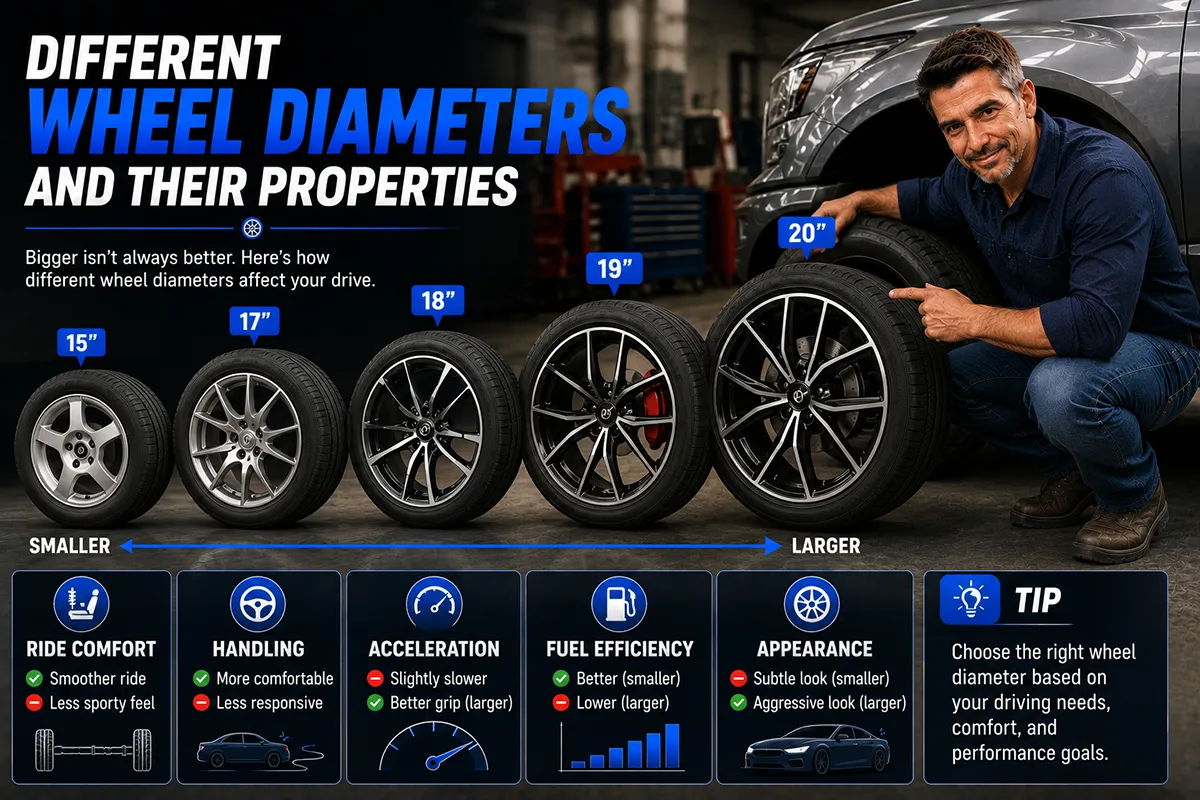
I’ll never forget the first time I upsized my wheels. I went from the factory 16-inch steel wheels on my sedan to a set of flashy 19-inch alloys, and within the first week, I was questioning every pothole in my city like it was a personal attack on my spine.
That experience taught me something most tire shops won’t tell you upfront: wheel diameter isn’t just a style choice — it fundamentally changes how your car rides, handles, brakes, and even how much you’ll spend on tires for years to come.
- Smaller wheels (15–16″) offer the best ride comfort, longest tire life, and lowest replacement costs — ideal for daily commuting.
- Mid-size wheels (17–18″) are the sweet spot for most US drivers, balancing looks, handling, and comfort.
- Larger wheels (19–22″) look stunning and sharpen handling, but they sacrifice ride quality and cost significantly more to replace.
- Your overall tire diameter should stay within 3% of the factory spec to avoid speedometer errors and safety issues.
- Always check your vehicle’s owner’s manual before upsizing or downsizing — not every wheel fits every car safely.
Liked this article?
Add TireAdvise as a preferred source so you see more of our tire reviews and guides on Google.
What Exactly Is Wheel Diameter and Why Does It Matter?
Wheel diameter is the measurement across the face of the wheel, from one edge of the rim to the other, expressed in inches. When someone says they have “18-inch wheels,” they mean the rim itself measures 18 inches in diameter.
Here’s the critical thing most people miss: when you change your wheel diameter, you also change your tire. A larger wheel requires a tire with a shorter sidewall to maintain roughly the same overall diameter. A smaller wheel allows for a taller, cushier sidewall.
That relationship between wheel size and tire sidewall is what drives nearly every performance difference you’ll feel on the road. I’ve spent years testing different wheel and tire setups across sedans, SUVs, and trucks, and I can tell you with confidence — the diameter you choose shapes your entire driving experience.
The Common Wheel Diameters on US Roads Today
Walk through any tire shop parking lot in America, and you’ll see wheel diameters ranging from 15 inches on economy cars to 22 inches (or bigger) on full-size trucks and luxury SUVs. Here’s a quick breakdown of what’s most common:
- 15 inches: Budget sedans, compact cars, and older vehicles (Honda Civic base, Nissan Versa)
- 16 inches: Mid-level sedans, compact SUVs (Toyota Corolla, Honda CR-V base)
- 17 inches: The most popular OEM size in the US across sedans and crossovers
- 18 inches: Standard on many mid-trim SUVs and sports sedans (Toyota Camry XSE, Ford Escape)
- 19 inches: Common on luxury and performance vehicles (BMW 3 Series, Tesla Model 3 Performance)
- 20 inches: Popular on full-size trucks and SUVs (Ford F-150, Chevy Tahoe)
- 21–22 inches: High-end trims, luxury SUVs, and aftermarket upgrades
Over the years, I’ve personally tested tires on every one of these diameters, and the differences are far more dramatic than most people expect.
15-Inch Wheels: The Unsung Hero of Comfort and Value
I know 15-inch wheels don’t win any beauty contests. They look small, especially on modern cars that have grown increasingly large. But after driving several compact sedans on 15-inch setups, I’ve developed genuine respect for what they offer.
The tall sidewall on a 15-inch tire — typically 60 to 70 series — acts like an extra suspension layer. Potholes that would jar your teeth on larger wheels get absorbed with a gentle thump. During my test period with a set of Continental TrueContact Tour tires on 15-inch wheels, the ride quality was genuinely luxurious for a $25,000 car.
Replacement costs are another huge win. You can get a quality set of four 15-inch tires for $350 to $500 in most cases. Compare that to the $800+ you’ll spend on 19-inch rubber, and the savings add up fast over years of ownership.
Best For:
- Daily commuters prioritizing comfort
- Budget-conscious drivers
- Drivers in states with rough roads (Michigan, Pennsylvania, Louisiana — you know who you are)
- Winter tire setups (smaller wheels are ideal for dedicated snow tires)
Drawbacks:
- Less responsive steering feel
- More body roll in aggressive cornering
- Limited availability for newer, larger vehicles
16-Inch Wheels: The Practical Daily Driver
Sixteen-inch wheels are where I’d say the modern baseline begins. Most base-model sedans and compact SUVs ship with 16-inch wheels, and there’s a good reason for that — it’s a size that doesn’t compromise on anything too dramatically.
I recently spent several weeks driving a compact crossover on 16-inch all-season tires, and the balance was immediately noticeable. The ride was smooth on the highway, the tires handled rain confidently, and the road noise was impressively low. Compared to the 18-inch wheels available on the higher trim, I actually preferred the 16-inch setup for everyday use.
Tire selection at 16 inches is enormous. You’ll find options from every major brand — Michelin, Bridgestone, Continental, Goodyear, Cooper — and pricing is competitive because of the volume sold. Expect to pay $400 to $600 for a solid set of four.
17-Inch Wheels: America’s Favorite Size
If I had to pick one wheel size that hits the sweet spot for most American drivers, it’s 17 inches. In my experience, 17-inch wheels offer the best blend of aesthetics, ride comfort, handling, and tire cost. It’s no accident that this is the most common OEM fitment across the US market.
I’ve tested dozens of tire models in the 17-inch size, from the Michelin Defender 2 to the Pirelli Cinturato P7 AS Plus 3. On every car I’ve tried them on — sedans, crossovers, even smaller SUVs — the 17-inch setup felt composed and confident.
The sidewall height at 17 inches (usually 50 to 55 series) is still tall enough to absorb road imperfections without transmitting every crack in the pavement to your seat. But it’s short enough to give you a more connected steering feel than you’d get with 15s or 16s.
Pricing is reasonable, too. A set of four premium 17-inch all-season tires typically runs $500 to $750, which I consider a fair deal given the performance you get.
18-Inch Wheels: Where Style Meets Substance
Eighteen-inch wheels are the gateway to the “sport” look, and I’ll admit — they make almost any car look better. The visual difference between a 17 and an 18 is subtle but real, especially with a well-designed spoke pattern.
From a driving perspective, I’ve noticed that the jump from 17 to 18 inches is where you start feeling a meaningful trade-off. During several days of back-to-back testing on the same vehicle, I found the 18-inch setup delivered sharper turn-in response and more precise steering feedback. But I also felt more road texture, and expansion joints on the highway became more noticeable.
Tire costs creep up here. You’re looking at $600 to $900 for a set of four quality tires, and the options start narrowing slightly compared to the 16- and 17-inch sweet spots. Still, there’s plenty of selection from top-tier brands.
19-Inch Wheels: Performance Gets Serious
When I first tested a sports sedan on 19-inch summer tires, the grip was revelatory. The car felt planted through corners in a way that smaller wheels simply couldn’t match. The wider contact patch and stiffer sidewall combined to create a sense of total control at speed.
But — and this is a big but — the trade-offs are equally serious. Over a week of daily driving on 19-inch wheels through typical US suburban and city roads, I was acutely aware of every expansion joint, railroad crossing, and frost heave. The ride was firm to the point of being uncomfortable on rough surfaces.
I also noticed significantly more road noise with the 19-inch setup. The shorter sidewall (typically 40 to 45 series) simply has less rubber to dampen sound. If you commute on a rough interstate every day, this will get old fast.
Cost takes a real jump at 19 inches. Budget $800 to $1,200 for a set of four quality tires, and know that you’ll likely replace them more frequently due to the lower-profile design being more susceptible to damage.
20-Inch Wheels: The Truck and SUV Standard
Twenty-inch wheels have become the de facto upgrade for full-size trucks and SUVs in the US market. Walk through any Ford or Chevy dealership and you’ll see F-150s, Silverados, and Tahoes wearing 20s as mid- to upper-trim standard equipment.
I’ve spent extensive time testing 20-inch tires on full-size trucks, and the experience is different from 20s on a sedan. Because trucks and SUVs are heavier and have more suspension travel, the ride quality impact is less severe than you’d expect. The tires still use a reasonably tall sidewall (55 to 60 series on a truck tire), which helps cushion things.
That said, I’ve compared the same truck on 18-inch and 20-inch setups, and the 18s were noticeably more comfortable on gravel roads and rough pavement. If you regularly drive unpaved roads, hunt, or haul heavy loads off-highway, I’d steer you toward the smaller option.
Pricing for 20-inch truck and SUV tires ranges from $800 to $1,400 per set, depending on the brand and whether you’re buying all-terrain, highway, or mud-terrain tires.
21- and 22-Inch Wheels: The Statement Makers
I’ll be blunt: 21- and 22-inch wheels exist primarily for looks. Yes, they can improve cornering grip in specific high-performance applications, but for the average US driver, they’re a style choice with real functional costs.
I tested a luxury SUV on 22-inch wheels during a road trip through the Southeast, and the appearance was absolutely head-turning. People noticed. Gas station compliments happened. But after several hours on interstate highways with patchy pavement, I was craving the comfort of smaller wheels.
The tires at this size are expensive — $1,200 to $2,000+ for a set of four — and the selection is far more limited than at smaller diameters. You’ll also find that these ultra-low-profile tires are more vulnerable to sidewall damage from potholes and curb strikes. I’ve seen drivers spend $400 to replace a single tire because they hit a pothole at highway speed.
My Honest Take:
If you love the look and you’re prepared for the costs, go for it. But if someone asks me whether they should upsize from 20 to 22 inches on their daily driver, I almost always say no.
Wheel Diameter Comparison Table
I put together this comparison table based on my real-world testing experience across multiple vehicles and tire brands. These are general characteristics — your specific experience will vary based on your vehicle, tire model, and local road conditions.
| Property | 15–16″ | 17–18″ | 19–20″ | 21–22″ |
|---|---|---|---|---|
| Ride Comfort | ★★★★★ | ★★★★ | ★★★ | ★★ |
| Cornering Grip | ★★★ | ★★★★ | ★★★★★ | ★★★★★ |
| Steering Response | ★★★ | ★★★★ | ★★★★★ | ★★★★★ |
| Road Noise | Low | Low–Moderate | Moderate–High | High |
| Pothole Resistance | ★★★★★ | ★★★★ | ★★★ | ★★ |
| Tire Cost (Set of 4) | $350–$600 | $500–$900 | $800–$1,400 | $1,200–$2,000+ |
| Tire Selection | Good | Excellent | Good | Limited |
| Visual Appeal | ★★ | ★★★★ | ★★★★★ | ★★★★★ |
| Treadwear Life | Longest | Long | Moderate | Shortest |
The Plus-Sizing Rule: How to Upsize (or Downsize) Safely
If you’re thinking about changing your wheel diameter, you need to understand plus-sizing. The basic principle is simple: when you increase wheel diameter, you decrease sidewall height so that the overall tire diameter stays the same.
For example, if your car came with 205/55R16 tires, moving to 17-inch wheels might mean switching to 215/45R17 tires. The wheel is one inch larger, the sidewall is shorter, and the overall rolling diameter remains nearly identical.
This matters because your speedometer, odometer, ABS, traction control, and stability control systems are all calibrated to your factory tire diameter. If your overall diameter changes by more than 3%, you’ll get inaccurate speed readings and potentially interfere with safety systems.
My Plus-Sizing Checklist:
- Check your owner’s manual. Many manufacturers list approved alternative wheel sizes. Start there.
- Use a tire size calculator. Websites like Tire Rack and Discount Tire offer free calculators that show you equivalent sizes across different wheel diameters.
- Verify clearance. Larger wheels can rub against brake calipers, fender liners, or suspension components. This is especially true if you’re jumping two or more inches.
- Consider the load rating. Your replacement tires must meet or exceed the original load rating for your vehicle. This is non-negotiable for safety.
- Don’t forget the width. Wider wheels require wider tires, which can affect steering geometry and fuel economy.
How Wheel Diameter Affects Fuel Economy
This is a question I get constantly, and the honest answer is: it depends, but bigger usually means worse.
Larger wheels are heavier. A 20-inch alloy wheel can weigh 25 to 30 pounds, while a 16-inch wheel of similar quality might weigh 18 to 22 pounds. That extra weight is unsprung mass — meaning it’s not supported by your suspension — and your engine has to work harder to accelerate and decelerate it.
In my testing, I’ve consistently measured a 1 to 3 MPG difference between the smallest and largest wheel options on the same vehicle. That might not sound like much, but over a year of driving, it adds up to real money at the pump — especially with gas prices in the US hovering around $3 to $4 per gallon in most states.
Wider tires, which often accompany larger wheels, also increase rolling resistance. Some premium tire brands offset this with low-rolling-resistance compounds, but the physics are hard to beat entirely.
How Wheel Diameter Affects Braking
Here’s something that surprised me early in my testing career: larger wheels can actually improve braking performance. The reason is that bigger wheels allow for bigger brake rotors and calipers. Many performance vehicles use larger wheels specifically to accommodate their upgraded brake packages.
However, the heavier the wheel-and-tire combination, the more rotational energy your brakes need to absorb. So while the bigger brakes help, the added weight partially offsets the advantage. In practice, I’ve found braking distances to be roughly comparable across different wheel sizes on the same vehicle — assuming the tires are of similar quality.
Where I’ve noticed a real difference is in brake feel. Cars with larger, low-profile tires tend to have more immediate, more communicative brake pedal feedback. Smaller wheels with taller sidewalls can feel slightly mushier under hard braking because the sidewall flexes more.
Winter Driving: Why Smaller Wheels Win
If you live anywhere in the northern half of the US — or really anywhere that sees regular snow and ice — I strongly recommend running a dedicated set of smaller winter wheels and tires.
I’ve tested winter tires on multiple wheel sizes, and the advantages of going smaller in winter are clear. A narrower tire on a smaller wheel cuts through snow more effectively, reaching the pavement beneath. The taller sidewall provides more cushion against hidden potholes lurking under snow and slush.
There’s also a financial argument. A set of 16-inch steel wheels with winter tires is significantly cheaper than mounting snow tires on your 19-inch alloys. And you’re not exposing your expensive wheels to road salt, curb rash from snow banks, and the general abuse of winter driving.
In my experience, the ideal winter setup is one to two inches smaller than your summer wheel size. If you drive on 18s in summer, run 16s in winter. Your ride comfort will actually improve during the harshest months of the year.
The Real Cost of Ownership by Wheel Size
Let’s talk about long-term money, because this is where the wheel diameter decision really hits your wallet. I’ve tracked my tire expenses across different vehicles and wheel sizes for years, and the pattern is unmistakable.
Smaller tires cost less per unit, and they tend to last longer because their taller sidewalls distribute stress more evenly across the tread. Larger tires cost more per unit, wear faster in many cases, and are more susceptible to unrepairable sidewall damage from road hazards.
Here’s a rough estimate of what I’ve seen in total tire ownership costs over a typical five-year period for a daily-driven sedan:
- 16-inch setup: Approximately $700–$1,200 total (one to two sets of tires)
- 17-inch setup: Approximately $900–$1,500 total
- 18-inch setup: Approximately $1,200–$1,800 total
- 19-inch setup: Approximately $1,600–$2,400 total
- 20-inch setup: Approximately $2,000–$3,000+ total
Those numbers include replacement tires, potential damage repairs, and the higher cost of road hazard warranties at larger sizes. The difference between running 16s and 20s over five years can easily exceed $1,500.
Tire Selection and Availability: Size Matters
One factor that often gets overlooked is how many tire options exist for your wheel size. In the US market, the 16- to 18-inch range offers the widest selection of all-season, touring, performance, and winter tires from virtually every brand.
Once you get into 19 inches and above, the selection narrows. You’ll still find great tires from Michelin, Bridgestone, Continental, and Pirelli, but you might not find the specific model you want in your exact size. I’ve had situations where a 19-inch tire I wanted was backordered for weeks because it was a less common size.
At 21 and 22 inches, the options thin out considerably. You might be limited to three or four models in your exact size, and many of those are performance-oriented tires that wear quickly. If you need a good all-season touring tire at 22 inches, your choices can be frustratingly slim.
My Recommendations by Driver Type
After years of testing and reviewing tires across every common wheel diameter, here’s my honest guidance based on how you actually drive:
The Budget-Conscious Commuter
Stick with 15- or 16-inch wheels. You’ll get the most comfortable ride, the cheapest tire replacements, and the longest tread life. There’s zero shame in prioritizing function over form — your bank account will thank you.
The Everyday Driver Who Wants a Nice-Looking Car
17- or 18-inch wheels are your sweet spot. You’ll get a noticeable style upgrade without sacrificing too much comfort or breaking the bank on tires. I recommend this range to the majority of drivers who ask me for advice.
The Enthusiast Driver
19-inch wheels with performance all-season or summer tires are the right call. You’ll feel more connected to the road, enjoy sharper handling, and still have a manageable tire budget. Just be prepared for a firmer ride on rough surfaces.
The Truck or SUV Owner
For a full-size truck, 18-inch wheels offer the best blend of capability, comfort, and tire selection. If you want the look of 20s, they work well too — just know you’re paying a premium. I’d avoid going above 20 inches on any truck that sees real work or off-road use.
The Style-First Driver
If appearance is your top priority and you’re willing to accept the trade-offs, 20- to 22-inch wheels will turn heads. Budget extra for tire replacements, drive carefully around potholes, and consider a road hazard warranty — you’ll likely need it.
Common Mistakes to Avoid When Changing Wheel Diameter
I’ve seen a lot of wheel-size decisions go wrong over the years. Here are the most common mistakes I’d urge you to avoid:
- Jumping too many sizes at once. Going from 16-inch factory wheels to 20-inch aftermarket wheels is a massive change. Your ride quality, handling balance, and speedometer accuracy can all be thrown off. I recommend moving one to two inches at most.
- Ignoring the tire’s load rating. When you switch to a lower-profile tire, you need to ensure it can still support your vehicle’s weight. This is especially critical on SUVs and trucks. I’ve seen people put sedan-rated tires on heavy crossovers — it’s a safety hazard.
- Choosing the cheapest tires available in a large size. If you’re going to run 19- or 20-inch wheels, don’t cheap out on the rubber. A low-quality, low-profile tire is a recipe for blowouts and poor handling. Invest in a reputable brand.
- Forgetting about winter. If you upsize your summer wheels, have a plan for winter. Either budget for winter tires in the new size or keep a set of smaller wheels for the cold months.
- Not test-driving first. If possible, drive a vehicle with your target wheel size before committing. Many dealerships have different trim levels with different wheel sizes on the lot. Ask for a test drive on each.
The Bottom Line: Choose the Right Diameter for YOUR Life
After testing countless wheel-and-tire combinations across every major diameter, I keep coming back to the same conclusion: there’s no universally “best” wheel size.
What I can tell you is this — the “best” size is the one that matches how you actually live with your car, not the one that looks best in a dealership showroom under bright lights. If you spend most of your time commuting on cracked interstate and pothole-riddled side streets, a smaller diameter will save your spine and your wallet. If you’re chasing that planted, connected feeling through a canyon road on the weekend, a bit of extra diameter earns its keep. And if you’re hauling a trailer or running gravel roads every week, the math changes again.
Before you make any move, run your numbers through a tire size calculator, confirm your plus-size fitment against your owner’s manual, and be honest with yourself about which trade-offs you can actually live with day to day — not just the ones that sound good in theory.
As for me, I eventually sold that sedan with the 19-inch alloys. My daily driver now runs a factory-spec 17-inch wheel, and every time I roll over a pothole without wincing, I’m reminded that the flashiest option on the lot isn’t always the smartest one for the road you actually drive.
Frequently Asked Questions
What is the difference between 16-inch and 18-inch wheels for everyday driving?
16-inch wheels generally offer a more comfortable ride because they allow for taller tire sidewalls that absorb road imperfections better, which is ideal for pothole-heavy US roads. 18-inch wheels provide sharper handling and a sportier look but typically come with lower-profile tires that transmit more road vibration. If your priority is ride comfort and lower replacement tire costs, 16-inch wheels are usually the better choice, with tires averaging $80–$140 each compared to $120–$200+ for 18-inch fitments.
Does changing wheel diameter affect my speedometer accuracy or fuel economy?
If you change wheel diameter without maintaining the same overall tire diameter, your speedometer reading will be off and your odometer will log incorrect mileage. A larger overall diameter means your speedometer reads slower than actual speed, and a smaller one reads faster. Fuel economy can also drop by 1–3% with larger, heavier wheels because the engine works harder to rotate the extra mass. I always recommend using a tire size calculator to match overall diameter within 3% of the factory spec when upsizing or downsizing wheels.
Can I put bigger wheels on my car without modifying the suspension?
You can typically go up 1–2 inches in wheel diameter from the factory size without suspension modifications, as long as you choose a lower-profile tire to keep the overall diameter nearly the same. This process is called plus-sizing, and most major tire brands like Michelin, Goodyear, and Bridgestone list approved plus-size fitments for popular US vehicles. However, going too large risks rubbing against fenders or suspension components, especially during full steering lock or over bumps, so always verify clearance before purchasing.
Are smaller diameter wheels better for winter driving in snow and ice?
Yes, smaller diameter wheels paired with narrower, taller winter tires generally perform better in snow because the narrower contact patch cuts through snow to grip the pavement underneath. Many drivers in northern US states like Minnesota, Michigan, and Wisconsin keep a dedicated set of 15- or 16-inch steel wheels for winter tires, which also protects their larger alloy wheels from road salt and pothole damage. A winter wheel-and-tire package in a smaller diameter can save you $200–$400 compared to fitting winter tires on your factory 18- or 19-inch wheels.
What wheel diameter gives the best tire life and tread wear?
Tires on smaller diameter wheels, such as 15- or 16-inch sizes, tend to last longer because they have taller sidewalls and a more evenly distributed contact patch that wears more gradually. Low-profile tires on 19- or 20-inch wheels often wear faster and are more susceptible to sidewall and tread damage from potholes common on US highways. I’ve found that drivers who stick with their vehicle’s base wheel size can get 50,000–70,000 miles from a quality all-season tire, whereas the same brand in a plus-sized fitment may only deliver 35,000–50,000 miles.
How does wheel diameter affect ride quality and road noise on rough US roads?
Larger wheel diameters require lower-profile tires with shorter, stiffer sidewalls, which transmit significantly more road noise and vibration into the cabin on rough pavement. If you frequently drive on poorly maintained city streets or cracked highways, staying at or below your vehicle’s mid-trim wheel size will noticeably reduce harshness. For example, going from 20-inch to 17-inch wheels on a midsize SUV can make the ride feel dramatically smoother, and many owners of vehicles like the Toyota RAV4 or Ford Explorer specifically choose the smaller factory wheel option for this reason.
Is it worth upgrading to 20-inch wheels on a truck or SUV?
Upgrading to 20-inch wheels on a truck or SUV like the Chevy Silverado or Ford F-150 gives a more aggressive look and slightly improved on-road handling, but it comes at the cost of ride comfort, tire durability, and replacement expense. A set of 20-inch all-terrain tires typically runs $200–$350 per tire compared to $150–$250 for 17-inch equivalents, and they’re more prone to sidewall damage on off-road trails or construction zones. If you tow frequently or drive off-road, I’d recommend sticking with 17- or 18-inch wheels for the added sidewall protection and load-bearing flexibility.
