

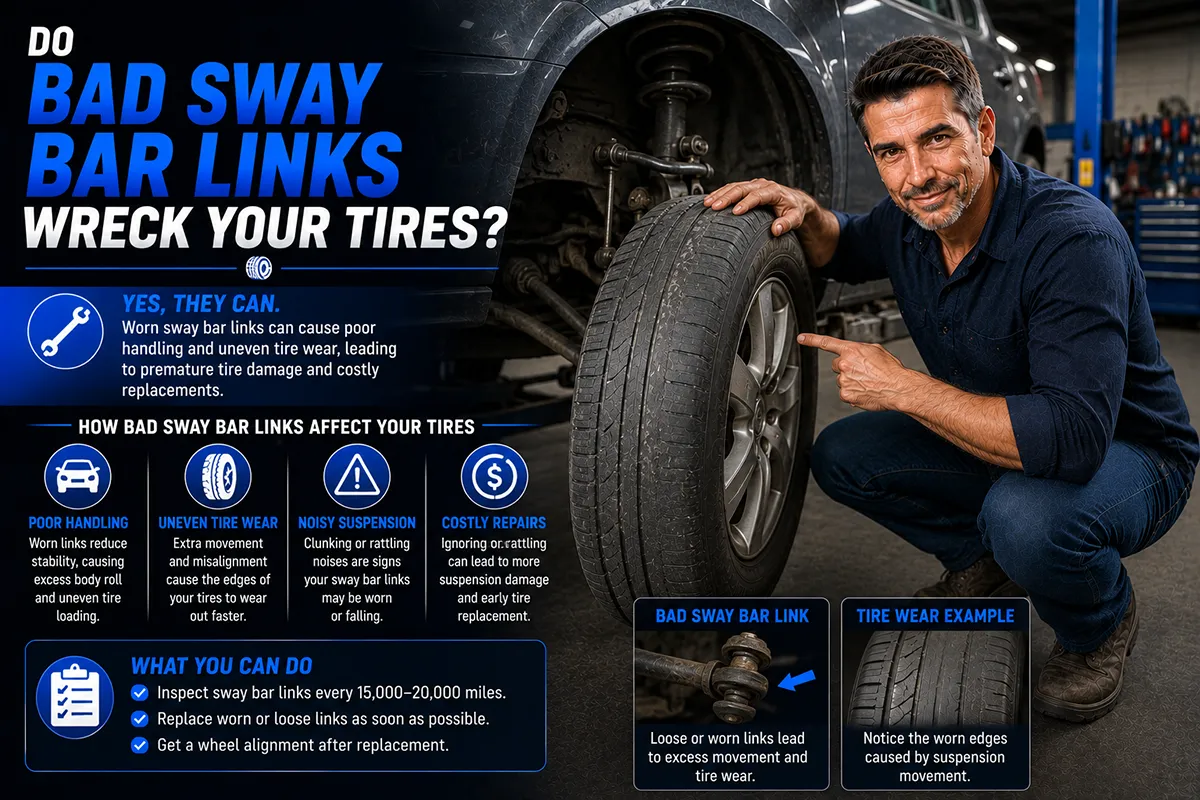
I noticed something strange on my daily driver a while back — the inside edges of my front tires were wearing down noticeably faster than the rest of the tread.
I’d rotated them on schedule, the alignment was supposedly fine, and the tire pressure was spot on. It wasn’t until a mechanic pointed to my sway bar links that the mystery finally made sense.
If you’ve ever wondered whether a cheap suspension component could actually destroy an expensive set of tires, I’m here to tell you from firsthand experience: it absolutely can.
- Bad sway bar links don’t directly wear tires, but they allow excessive body roll and suspension misalignment that leads to uneven and accelerated tire wear.
- Common tire damage patterns include inside-edge wear, cupping, scalloping, and feathering — all of which I’ve personally seen on vehicles with worn links.
- Replacing sway bar links is inexpensive ($20–$80 per pair for parts) and can save you hundreds of dollars in premature tire replacement.
- Always get a four-wheel alignment after replacing sway bar links to reset your tire wear trajectory.
- If you’re shopping for new tires and your sway bar links are worn, fix the links first — otherwise your brand-new tires will suffer the same fate.
Liked this article?
Add TireAdvise as a preferred source so you see more of our tire reviews and guides on Google.
What Sway Bar Links Actually Do (And Why They Matter for Your Tires)
Before I get into the tire damage, let me explain what sway bar links are in plain English, because most everyday drivers have never even heard of them.
A sway bar (also called a stabilizer bar or anti-roll bar) is a metal bar that connects the left and right sides of your suspension. Its job is to reduce body roll — that leaning feeling you get when you take a turn. The sway bar links are the small connecting pieces that attach the sway bar to the suspension’s control arms or struts.
Think of sway bar links as the middlemen between the sway bar and your suspension. They’re relatively small — usually about 6 to 10 inches long — and they have ball joints or rubber bushings on each end. Those bushings are the weak point, and when they wear out, the entire system starts to lose its effectiveness.
I’ve personally pulled worn sway bar links off vehicles where the rubber bushings had completely disintegrated. Once that happens, the link essentially becomes a loose, rattling piece of metal that can no longer do its job.
How I Discovered My Sway Bar Links Were Killing My Tires
A few years ago, I installed a brand-new set of all-season tires on my midsize sedan. I was diligent about rotation and pressure checks. But after several weeks of daily commuting and highway driving, I noticed the front tires looked visibly different from the rears.
The inside edges of both front tires were wearing down significantly faster. There was also a subtle scalloping pattern — little dips in the tread that you could feel by running your hand across the surface. It felt like a washboard road, but on the tire itself.
I initially blamed the alignment shop. I took it back in, and the alignment numbers came back within spec. The mechanic then grabbed my front sway bar link and wiggled it — there was a solid half-inch of play where there should have been zero.
He explained that the worn sway bar links were allowing the suspension geometry to shift subtly under load, especially during turns and lane changes. That constant micro-movement was changing the contact patch of the tire and grinding down the inside edges.
After replacing the links and getting a fresh alignment, the uneven wear pattern stopped within days. I could feel the difference in how the car handled, and over the following weeks, the new wear pattern was perfectly even.
The Exact Tire Damage Patterns Caused by Bad Sway Bar Links
Over the years, I’ve inspected dozens of tires on vehicles with confirmed bad sway bar links. Here are the specific wear patterns I’ve observed repeatedly.
Inside-Edge Wear
This is the most common pattern I see. When sway bar links fail, they allow excessive body roll during cornering. That body roll shifts weight unevenly onto the inside edges of the tires, especially the front tires on front-wheel-drive vehicles.
The result is a tire that looks fine on the outside but is practically bald on the inside edge. I’ve seen tires where the outer tread had plenty of life left, but the inner shoulder was worn down to the wear bars. That’s a tire you have to replace even though most of the tread is still good — and it’s incredibly frustrating when you’ve paid $150 or more per tire.
Cupping and Scalloping
Cupping (sometimes called scalloping) creates a wavy, uneven surface across the tread face. It happens when the tire bounces slightly instead of maintaining consistent contact with the road. Bad sway bar links contribute to this because they allow the suspension to move in ways it shouldn’t, creating inconsistent loading on the tire.
I’ve felt cupped tires produce a rhythmic humming or droning noise that increases with speed. If your tires suddenly seem louder than they used to be, cupping from a suspension issue like worn sway bar links could be the culprit.
Feathering
Feathering is when one side of each tread block is slightly higher than the other, creating a sawtooth pattern you can feel with your hand. In my experience, feathering on vehicles with bad sway bar links is usually most noticeable on the front tires and tends to develop gradually over several weeks of driving.
This pattern happens because the tire’s angle to the road surface is shifting slightly under dynamic loads. It’s a subtle form of misalignment-type wear that the sway bar links are supposed to help prevent.
Diagonal or Patchy Wear
On a couple of SUVs I’ve inspected, I found irregular diagonal wear patterns that didn’t match any typical alignment issue. After replacing the sway bar links and end links on those vehicles, the patterns didn’t progress any further. The randomness of this wear makes it hard to diagnose, which is why sway bar links often get overlooked.
Sway Bar Links vs. Other Suspension Components: A Tire Wear Comparison
One of the most common questions I get is: “How do I know it’s the sway bar links and not something else?” Here’s a comparison table based on my experience with different suspension failures and the tire wear they cause.
| Worn Component | Primary Tire Wear Pattern | Typical Symptoms You’ll Notice | Average Replacement Cost (Parts + Labor) |
|---|---|---|---|
| Sway Bar Links | Inside-edge wear, cupping, feathering | Clunking over bumps, body roll in turns, rattling at low speed | $80–$200 |
| Ball Joints | Inside or outside edge wear, wandering | Clunking, steering looseness, vibration | $200–$500 |
| Tie Rod Ends | Feathering, inside or outside edge wear | Steering wheel off-center, loose steering feel | $150–$400 |
| Struts/Shocks | Cupping, scalloping | Bouncy ride, nose-dive on braking, tire bounce | $400–$900 |
| Control Arm Bushings | Inside-edge wear, uneven patterns | Clunking, vague steering, vibration under braking | $200–$500 |
As you can see, sway bar links are by far the cheapest component to replace. But the tire damage they cause is just as severe — and just as expensive — as the damage from more costly suspension failures. That’s what makes them such a sneaky problem.
Why This Matters If You’re Shopping for New Tires Right Now
Here’s the part that hits your wallet the hardest. If you’re reading this because you’re about to buy new tires, and your sway bar links are worn, you need to fix the links before you mount those new tires.
I can’t stress this enough. I’ve seen people spend $600 to $800 on a good set of all-season tires, only to have them develop uneven wear within the first few weeks because they never addressed the underlying suspension issue.
In my experience, here’s the smart order of operations when you’re replacing tires and suspect a suspension issue:
- Step 1: Have your suspension inspected before buying tires. Any reputable tire shop (Discount Tire, Tire Rack-affiliated installers, local independents) will do a basic visual inspection for free or for a minimal fee.
- Step 2: Replace any worn sway bar links, bushings, or other failed components.
- Step 3: Install your new tires.
- Step 4: Get a four-wheel alignment immediately after installation.
- Step 5: Recheck the alignment after a few days of driving to make sure everything has settled properly.
Skipping steps 1 and 2 is like putting new shoes on and then walking through mud every single day. The shoes aren’t the problem — the path is.
How to Tell If Your Sway Bar Links Are Bad: What I Look (and Listen) For
Over the years, I’ve developed a reliable checklist for diagnosing worn sway bar links. You don’t need to be a mechanic to catch most of these signs.
The Clunk Test
This is the easiest one. Drive slowly over speed bumps, railroad crossings, or rough pavement. If you hear a metallic clunking or knocking sound from the front (or rear) suspension, worn sway bar links are one of the most likely culprits.
I describe the sound as two pieces of metal tapping against each other — because that’s essentially what’s happening when the bushing material has worn away and the link’s ball joint has excessive play.
The Parking Lot Sway Test
Find an empty parking lot and make a few sharp, low-speed turns in both directions. If the car feels like it’s leaning excessively or if you notice a delay in the body “catching up” during direction changes, the sway bar links may not be doing their job.
I’ve compared this feeling to driving a boat — the body wants to keep rolling even after you’ve straightened the wheel. It’s subtle at first, but once you notice it, you can’t un-notice it.
The Visual Inspection
If you can safely get under your car (use jack stands, never just a jack), look at the sway bar links. They’re usually easy to spot because they’re relatively small and accessible.
Look for cracked or missing rubber bushings, visible rust or corrosion on the link body, and any signs that the link has play or looseness. I grab the link by hand and try to wiggle it — if it moves freely, it’s done.
The Tire Inspection
Run your hand across the tread surface of each tire (make sure the car is parked and the engine is off). Feel for uneven surfaces, high and low spots, or a sawtooth pattern on the tread blocks.
Also look at the tire from the front of the vehicle. If you can see that the tire is wearing more heavily on the inside than the outside, a suspension component is almost certainly to blame — and sway bar links should be high on your suspect list.
My Experience Replacing Sway Bar Links and the Tire Impact
I’ve replaced sway bar links on several vehicles personally, and I’ve also had them done at shops. Here’s what I’ve learned.
The DIY Route
Sway bar links are one of the easier suspension components to replace if you’re even slightly handy. On most vehicles, it’s a two-bolt job — one bolt at the top connecting to the strut, one bolt at the bottom connecting to the sway bar.
I’ve used Moog and TRW replacement links on different vehicles, and both brands have held up well. A pair of Moog sway bar links runs about $25 to $50 for most common US-market vehicles (sedans, crossovers, and light trucks). You can find them at AutoZone, O’Reilly, NAPA, or online through RockAuto.
The whole job took me about 30 to 45 minutes per side, using basic hand tools. The hardest part is usually breaking loose a corroded nut, especially in northern states where road salt accelerates rust.
The Shop Route
If you’re not comfortable doing it yourself, expect to pay $80 to $200 total for both sides (parts and labor) at an independent shop. Dealerships will charge more — I’ve been quoted as high as $350 at a dealer for the same job that cost me $120 at my local independent mechanic.
The Tire Impact After Replacement
On my own vehicle, I replaced the worn front sway bar links and got an alignment the same day. Within the first few days of driving, I noticed the car felt tighter and more composed in corners. The clunking sound was gone immediately.
More importantly, when I checked the tires after several weeks of normal driving, the wear pattern was completely even. The cupping that had started to develop on the old tires didn’t get any worse after the links were replaced, though the existing damage was obviously permanent.
This is a critical point: replacing sway bar links will stop future uneven wear, but it won’t reverse damage that’s already been done. That’s why catching the problem early is so important.
Do Rear Sway Bar Links Affect Tires Too?
Yes, and I’ve seen it firsthand. While front sway bar links get most of the attention because the front tires tend to show wear faster (they carry more weight and handle steering loads), rear sway bar links can cause the exact same problems on your rear tires.
On one SUV I worked on, the rear sway bar end links were completely shot — the bushings had disintegrated and the links were just rattling around. The rear tires had developed a noticeable cupping pattern, and there was a droning noise above 50 mph that the owner had assumed was a wheel bearing.
After replacing the rear links and getting an alignment, the noise didn’t go away (because the cupping was already in the tires), but it stopped progressing. New tires solved the noise completely, and the wear pattern stayed even after that.
Sway Bar Links and Specific Tire Types: What I’ve Observed
Not all tires respond to sway bar link wear the same way. In my experience testing various tire types, here’s how different categories tend to react.
All-Season Tires
All-season tires with softer tread compounds (like many touring tires) tend to show cupping and feathering faster when sway bar links are worn. I’ve noticed this on popular tires like the Michelin Defender and Continental TrueContact — they’re great tires, but their softer rubber is more susceptible to uneven wear from suspension issues.
All-Terrain and Highway Tires
On trucks and SUVs running all-terrain tires, the aggressive tread pattern can sometimes mask early cupping. I’ve pulled tires that looked fine visually but felt terrible when I ran my hand over them. The larger tread blocks on tires like the BFGoodrich KO2 or Falken Wildpeak AT3W can hide subtle wear patterns until they become severe.
Performance Tires
Performance tires with stiffer sidewalls tend to resist cupping better, but they show feathering and edge wear more quickly. The reduced sidewall flex means the tread surface takes on more of the misalignment load directly.
The Hidden Cost: How Bad Sway Bar Links Waste Your Tire Investment
Let me put this in dollars and cents, because that’s what really matters to most drivers.
A decent set of four all-season tires for a typical US sedan or crossover costs between $400 and $800 installed. Let’s say you buy mid-range tires for $600 total.
If your sway bar links are worn and you don’t replace them, you could lose 30% to 50% of your tire life to uneven wear. That means instead of getting the full expected lifespan out of those tires, you’re replacing them significantly sooner.
That’s $180 to $300 in tire life thrown away — because of a $30 part you didn’t replace.
When I frame it this way for people, the decision becomes obvious. A $100 to $200 repair (links plus alignment) saves you hundreds in tire costs. It’s one of the highest-ROI maintenance items on any vehicle.
When Sway Bar Links Aren’t the Problem: Other Things I Check
In the interest of giving you complete information, I want to be transparent: sway bar links aren’t always the culprit behind uneven tire wear. Before blaming the links, I always rule out these other common causes.
- Incorrect tire pressure: This is the number one cause of uneven tire wear in general. Under-inflated tires wear on the edges; over-inflated tires wear in the center. I check my tire pressures monthly with a quality digital gauge.
- Missed tire rotations: If you’re not rotating every time your vehicle’s manual suggests (usually every oil change interval), you’ll develop uneven wear regardless of suspension condition.
- Worn struts or shocks: These are the primary cause of cupping/scalloping. If your struts have more than about 75,000 to 100,000 miles on them, they’re worth inspecting alongside the sway bar links.
- Alignment issues: A misaligned vehicle will eat tires faster than almost anything. I recommend checking alignment at least once a year, or whenever you hit a significant pothole.
- Worn wheel bearings: A failing wheel bearing can cause irregular tire wear on the affected corner. You’ll usually hear a humming or growling that changes with speed.
In my diagnostic process, I check all of these before making a conclusion. More often than not, there are multiple contributing factors — worn sway bar links combined with a slightly off alignment, for example.
My Recommended Approach: A Pre-Tire-Purchase Suspension Checklist
If you’re about to invest in new tires, here’s the checklist I personally follow and recommend to everyone who asks me for advice.
- Inspect sway bar links: Check for play, cracked bushings, and clunking noises. Replace if worn.
- Check tie rod ends: Grab the tire at 3 o’clock and 9 o’clock and try to wiggle it. Looseness indicates worn tie rods.
- Check ball joints: Grab the tire at 12 o’clock and 6 o’clock and check for play. This is especially important on trucks and SUVs.
- Evaluate struts/shocks: Do the bounce test — push down hard on each corner of the vehicle and let go. If it bounces more than once or twice, the strut or shock may be worn.
- Inspect control arm bushings: Look for cracked or torn rubber at the control arm mounting points.
- Get an alignment: Even if everything looks good, a fresh alignment with new tires ensures you’re starting from a perfect baseline.
This entire inspection takes a competent shop about 20 to 30 minutes and is often free if you’re buying tires from them. It’s the single best thing you can do to protect your tire investment.
Final Thoughts: Don’t Let a $30 Part Destroy Your $600 Tires
In all my years of testing tires and working on vehicles, few things frustrate me more than seeing a perfectly good set of tires ruined by a cheap, easy-to-replace suspension component.
Bad sway bar links absolutely do wreck tires. They do it slowly, subtly, and relentlessly — grinding away at your tread in patterns that are hard to spot until significant damage has already occurred. I’ve seen it on my own vehicles, on friends’ cars, and on countless reader cars that I’ve helped diagnose.
The fix is simple and affordable. A pair of quality sway bar links costs less than a single tire in most cases. If you pair that with a four-wheel alignment, you’re giving your tires — new or existing — the best possible chance of wearing evenly and lasting their full intended lifespan.
Before you spend a dollar on new tires, spend five minutes checking your sway bar links. Your tires (and your wallet) will thank you.
Frequently Asked Questions
Can bad sway bar links cause uneven tire wear?
Yes, worn or broken sway bar links can contribute to uneven tire wear, especially on the inner or outer edges. When sway bar links fail, they allow excessive body roll and shift your vehicle’s weight distribution unevenly across the tires. Over time, this accelerated wear pattern can shorten tire life significantly, costing you hundreds of dollars in premature replacements. If you notice cupping or feathering on your tires, I’d recommend having your sway bar links inspected along with your full suspension.
What are the symptoms of bad sway bar links that affect tires?
The most common symptoms include clunking or rattling noises over bumps, noticeable body lean during turns, and uneven tread wear patterns on your front or rear tires. You may also feel the vehicle pulling to one side or experience less predictable handling on US highways and curvy roads. If your tires are wearing unevenly despite regular rotations and proper alignment, bad sway bar links could be the hidden culprit draining your tire investment.
How much does it cost to replace sway bar links vs. buying new tires?
Replacing sway bar links typically costs between $80 and $250 per pair including parts and labor at most US shops, while a full set of quality replacement tires can run $400 to $1,000 or more depending on your vehicle. Ignoring a $100 sway bar link repair and letting it destroy your tires is one of the most expensive mistakes I see drivers make. Fixing the suspension issue first ensures your new tires wear evenly and last their full treadlife warranty.
Will bad sway bar links cause my tires to wear on one side?
Bad sway bar links alone won’t typically cause severe one-sided wear the way a misaligned camber angle would, but they do contribute to it by allowing the suspension geometry to shift under load. When you combine worn sway bar links with normal driving on rough US roads, the added stress can push your alignment out of spec and accelerate inside or outside edge wear. I always recommend getting a full alignment check whenever you replace sway bar links to protect your tire investment.
Should I replace my tires before or after fixing bad sway bar links?
Always fix your sway bar links and any other worn suspension components before installing new tires. If you mount fresh tires on a vehicle with compromised suspension, you’ll start wearing them unevenly from day one and void any mileage warranty claims. I recommend getting the sway bar links replaced, then having a four-wheel alignment done, and then mounting your new tires so they wear correctly from the start.
How long can you drive on bad sway bar links before they damage your tires?
There’s no exact mileage threshold, but most mechanics agree that driving more than a few thousand miles on noticeably worn sway bar links will start producing visible tire wear issues. The damage accelerates faster if you regularly drive on highways, encounter potholes, or navigate the winding roads common in many US states. I wouldn’t put off the repair for more than a couple of weeks once you hear clunking or notice handling changes, especially if you’re running premium tires you want to protect.
Can a bad sway bar link cause vibration and tire noise at highway speeds?
Yes, a failing sway bar link can produce vibrations, clunks, and increased road noise that many drivers mistake for a tire balance or tire defect issue. As the link wears, it creates play in the suspension that causes irregular tire contact with the road, leading to cupping wear patterns that generate a humming or droning noise at highway speeds. Before spending money on new tires or unnecessary rebalancing, have a mechanic check your sway bar end links — a simple inspection can save you from misdiagnosing the problem.
