

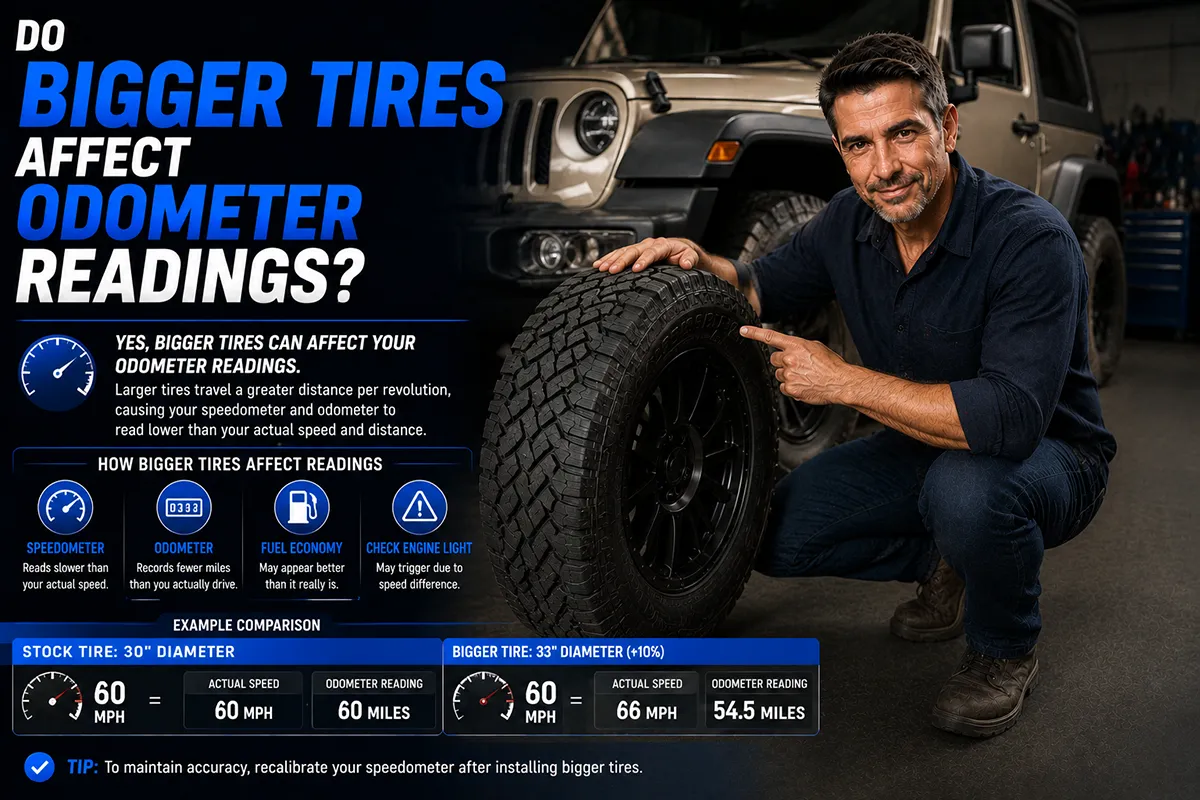
I swapped from 225/65R17 tires to 245/70R17 on my truck last year, and a few weeks later I noticed something odd — my GPS was consistently showing a higher speed than my speedometer.
That small discrepancy sent me down a rabbit hole. After researching, testing, and talking to mechanics and tire engineers, I realized that bigger tires had quietly thrown off my odometer, my speedometer, and even my fuel economy calculations.
If you’re thinking about upsizing your tires or you’ve already done it, this is something you absolutely need to understand. It affects your warranty, your resale value, and potentially even a speeding ticket.
- Bigger tires cause your odometer and speedometer to under-read because each tire revolution covers more ground than the factory calibration expects.
- A common 3% increase in tire diameter means your odometer registers roughly 3% fewer miles than you actually drove.
- This affects trip mileage, maintenance schedules, fuel economy calculations, warranty coverage, and resale value.
- You can correct the issue with a speedometer recalibration tool, a dealer reflash, or an aftermarket correction module.
- Smaller tires have the opposite effect — your odometer will over-read, showing more miles than you’ve actually driven.
Liked this article?
Add TireAdvise as a preferred source so you see more of our tire reviews and guides on Google.
How Your Odometer Actually Works
Before I explain the problem, you need to understand how your odometer measures distance in the first place. It’s simpler than most people think, and once you get it, the tire-size issue becomes immediately obvious.
In modern vehicles — basically anything built after the mid-1990s — the odometer is electronic. A sensor mounted at the wheel hub or inside the transmission counts the number of rotations your wheels make. The vehicle’s computer then multiplies those rotations by a pre-programmed tire circumference to calculate the distance traveled.
Here’s the key: that pre-programmed circumference is based on the exact tire size your vehicle came with from the factory. When you change tire sizes, the computer has no idea. It keeps using the old number.
The Simple Math Behind the Error
Let me walk you through the math I did when I first noticed the issue on my truck. My factory tires (225/65R17) had an overall diameter of about 28.5 inches, giving a circumference of roughly 89.5 inches. My new tires (245/70R17) had a diameter of about 30.5 inches, with a circumference of roughly 95.8 inches.
That’s a difference of about 7%. Every single revolution of my new tires covered 7% more ground than the computer expected. So after the computer thought I’d driven 100 miles, I’d actually driven about 107 miles.
Over weeks and months, that adds up fast. And it’s not just the odometer — every system in the car that relies on wheel speed data is affected.
What Bigger Tires Actually Change in Your Vehicle
When I first upsized, I was only thinking about the odometer. But the ripple effects go much further than that. Here’s what I’ve found gets impacted, based on my own experience and conversations with shop technicians.
1. Speedometer Accuracy
Your speedometer uses the same wheel-speed data as the odometer. With bigger tires, your speedometer will read lower than your actual speed. On my truck, when the speedometer showed 60 mph, my GPS consistently showed about 64 mph.
This might sound like a minor annoyance, but it has real consequences. You could be driving faster than you think in school zones or construction areas. And if you get pulled over, “my speedometer was off” isn’t a defense that holds up in court.
2. Odometer Under-Reading
This is the big one. With larger tires, your odometer accumulates miles more slowly than it should. You’re driving more actual miles than your dashboard shows.
I confirmed this by comparing my odometer to GPS-tracked distances on several long road trips. Over a full day of highway driving, the gap was noticeable and consistent — always in the same direction.
3. Fuel Economy Calculations
If you use your trip odometer to calculate MPG at the pump, bigger tires will make your fuel economy appear worse than it actually is. Here’s why: you’re burning fuel over a greater actual distance than the odometer records, so when you divide miles by gallons, you’re using a number that’s too small.
In my case, I thought my fuel economy had dropped after the tire swap. It took me a couple weeks to realize the math was just skewed by the odometer error. Once I corrected for the 7% difference, my actual MPG was almost unchanged.
4. Maintenance Schedules
If your maintenance reminders are mileage-based — and for most of us, they are — bigger tires mean you’ll hit those intervals later than you should. Your oil change reminder might trigger at 5,000 indicated miles, but you’ve actually driven 5,350 miles or more.
Over time, this can lead to slightly deferred maintenance without you even realizing it. I now track my service intervals by date rather than mileage to avoid this problem.
5. Transmission and ABS Behavior
Modern vehicles use wheel-speed data for transmission shift points, traction control, stability control, and ABS. A significant tire size change can confuse these systems. I haven’t experienced any dramatic issues with my 7% change, but I’ve read accounts from owners who went even larger and noticed delayed shifts or traction-control warnings on slippery roads.
How Much Error Are We Talking About? A Real Comparison Table
I put together this table to show common tire upsizing scenarios and their approximate effect on the odometer. These numbers are based on actual tire diameter measurements, not just the tire size numbers on the sidewall.
| Factory Tire Size | New Tire Size | Diameter Change | Odometer Error | Speedometer at True 70 mph |
|---|---|---|---|---|
| 215/60R16 | 225/65R16 | +3.1% | Reads ~3.1% low | Shows ~67.8 mph |
| 225/65R17 | 245/70R17 | +7.0% | Reads ~7.0% low | Shows ~65.4 mph |
| 265/70R17 | 285/70R17 | +3.0% | Reads ~3.0% low | Shows ~67.9 mph |
| 245/75R16 | 265/75R16 | +3.4% | Reads ~3.4% low | Shows ~67.6 mph |
| P255/70R18 | 275/70R18 | +3.1% | Reads ~3.1% low | Shows ~67.8 mph |
| 205/55R16 | 225/50R17 (plus-one) | -0.2% | Nearly zero error | Shows ~70.1 mph |
Notice that last row. A proper “plus-one” upgrade — where you go up one inch in wheel diameter while adjusting the tire’s aspect ratio — keeps the overall diameter nearly the same. That’s the smart way to change wheel sizes without messing up your odometer.
What About Smaller Tires? The Opposite Effect
I want to address this because it comes up a lot. If you go to a smaller tire than factory — maybe you found a great deal on a slightly narrower or shorter tire — the effect reverses completely.
Smaller tires mean each revolution covers less distance than the computer expects. Your odometer will over-read, and your speedometer will show a speed higher than you’re actually going.
In some ways this is less dangerous (you’ll always be going slower than your speedometer says), but it still throws off all the same calculations — fuel economy, maintenance schedules, and total mileage.
Does This Count as Odometer Fraud?
This is a question I see in forums constantly, and it’s worth addressing head-on. Under federal law (49 U.S.C. § 32703), odometer fraud is the intentional rollback or disconnection of an odometer to misrepresent a vehicle’s mileage for the purpose of selling it.
Simply installing bigger tires is not odometer fraud. You’re not intentionally tampering with anything. However, if you know your odometer is under-reading and you sell the vehicle without disclosure, you could end up in a gray area. I always recommend disclosing any tire-size changes when selling a vehicle, just to stay above board.
Some states require that any known odometer discrepancy be noted on the title transfer. It’s worth checking your state’s DMV guidelines.
How I Verified the Error on My Own Vehicle
I didn’t just take the math at face value. I wanted to see the actual error in the real world. Here’s the simple test I did, and you can do it too.
Method 1: GPS Comparison
I used a GPS app on my phone (any navigation app works) and drove a highway route I knew was straight and flat. After several hours of driving, I compared the GPS-reported distance to my trip odometer. The GPS consistently showed a higher number — right in line with the calculated 7% error.
I repeated this test on multiple occasions over a period of weeks to make sure it wasn’t a fluke or a GPS glitch. The results were rock-solid every time.
Method 2: Highway Mile Markers
This is even simpler. I reset my trip odometer at a highway mile marker and drove exactly 10 markers. My trip odometer showed about 9.3 miles instead of 10. That 7% error was right there on the dashboard, plain as day.
If you’ve recently changed tire sizes and want to know if your odometer is off, I highly recommend trying this test. It takes about 15 minutes and gives you a clear answer.
How to Fix the Odometer and Speedometer Error
The good news is that this problem is completely fixable. There are several approaches, and which one makes sense depends on your vehicle and budget.
Option 1: Dealer or Shop Reflash ($50–$150)
Many modern vehicles allow the dealer to reprogram the powertrain control module (PCM) with a new tire circumference value. This is the cleanest fix because it corrects the calibration at the source. I called my local dealer and they quoted me $100 for the reflash on my truck.
Not all vehicles support this, though. Some older ECUs don’t have a user-adjustable tire-size parameter. Call your dealer and ask before making the trip.
Option 2: Aftermarket Speedometer Calibrator ($200–$350)
Products like the SuperChips Flashcal, Hypertech Speedometer Calibrator, or the DiabloSport inTune are popular in the truck and Jeep communities. These plug into your OBD-II port and let you input your new tire size. The device then adjusts the signal going to the speedometer and odometer.
I used a Hypertech unit on my truck, and it took about five minutes to set up. After the correction, my speedometer matched my GPS perfectly. These devices typically run between $200 and $350 depending on the brand and your vehicle’s compatibility.
Option 3: GPS-Based Speedometer
If you don’t want to modify anything electronically, you can mount a GPS-based speedometer as a secondary reference. These cost anywhere from $30 to $100 and give you an accurate speed reading regardless of your tire size. The downside is that your odometer will still be off — this only fixes the speed display.
Option 4: Live With It (and Do the Math)
Some people simply accept the error and mentally account for it. If your tires are 3% bigger, you add 3% to whatever your odometer reads. I don’t love this approach because it requires constant mental correction, and it’s easy to forget when it comes to maintenance schedules or resale documentation.
What the Tire Industry Doesn’t Always Tell You
In my experience, tire shops rarely bring up the odometer issue when you’re buying bigger tires. I’ve purchased tires from national chains like Discount Tire, Tire Rack, and local independent shops, and not once has a salesperson mentioned that my odometer and speedometer would be affected.
This isn’t because they’re trying to hide anything — it’s just not part of the standard sales pitch. But I think it should be. When you’re spending $800 to $1,400 on a set of tires, you deserve to know about a side effect that impacts your vehicle’s instrumentation.
If you’re shopping for tires and considering a size change, ask the shop directly: “How much will this change my overall tire diameter, and will it affect my speedometer?” A good shop will know the answer immediately.
The Plus-One and Plus-Two Sizing Strategy
If you want bigger wheels and a more aggressive look without messing up your odometer, the plus-sizing strategy is the way to go. I’ve used this approach on two of my vehicles and it works perfectly.
Here’s the concept: for every inch you add to your wheel diameter, you reduce the tire’s sidewall height (aspect ratio) to keep the overall diameter the same.
Example: Plus-One Sizing
- Stock: 205/55R16 on a 16-inch wheel — overall diameter ≈ 24.9 inches
- Plus-one: 215/45R17 on a 17-inch wheel — overall diameter ≈ 24.6 inches
The difference is less than 1.5%, which is essentially negligible for the odometer. You get a bigger wheel, a lower-profile tire (which many people prefer the look of), and your instrumentation stays accurate.
The key is to always use an online tire-size calculator before buying. Tire Rack has an excellent one, and I use it every time I’m considering a size change. Aim for less than a 3% change in overall diameter to keep things within a reasonable tolerance.
Does Tire Wear Affect the Odometer Too?
Here’s something that surprised me when I first learned about it. Yes, tire wear changes the effective diameter of your tires, which technically affects your odometer — but the effect is very small.
A brand-new tire might have 10/32″ to 12/32″ of tread depth. By the time it’s worn to the legal minimum of 2/32″, you’ve lost about 0.3 to 0.5 inches of overall diameter. On a 30-inch tire, that’s roughly a 1.5% change.
So a new tire will cause your odometer to slightly under-read, and a worn tire will read slightly closer to accurate (assuming the car was calibrated for new tires). In practice, this is so small that most people never notice it. I mention it here for completeness, but it’s not something I’d worry about.
Real-World Scenarios Where This Matters Most
Let me walk through some specific situations where the odometer error from bigger tires becomes more than just a numbers game.
Leased Vehicles
If you’re leasing, this is critical. Most leases cap your annual mileage at 10,000 to 15,000 miles, and you pay a penalty (typically $0.15 to $0.25 per mile) for overages. If your bigger tires cause a 5% under-read, you might think you’re under the limit when you’re actually over it.
I’ve talked to lease return inspectors, and while they don’t typically measure your tires, the mileage discrepancy could work in your favor — or against you, depending on how you look at it. My advice: don’t change tire sizes on a leased vehicle, or get the calibration corrected immediately if you do.
Warranty Claims
Manufacturer warranties are often tied to mileage. If your odometer reads low, you could still be within your warranty period on paper but actually be past the coverage limit in real miles. This is unlikely to cause a denied claim in most situations, but it’s a theoretical risk worth knowing about.
Selling Your Vehicle
When you sell a car, the odometer reading is one of the first things a buyer looks at. If you’ve been running bigger tires for years, your odometer could be significantly lower than your actual mileage. I always disclose this when selling, and I recommend you do the same. It builds trust with the buyer and protects you legally.
Insurance and Accident Claims
Some insurance policies factor in annual mileage. If you report mileage based on an inaccurate odometer, you could inadvertently be underreporting your driving. This is unlikely to cause issues unless you’re on a pay-per-mile insurance plan, but it’s worth being aware of.
My Recommendations After Living With This Issue
After dealing with the odometer discrepancy on my own truck for over a year, here’s what I tell everyone who asks me about upsizing their tires.
If you’re going up 3% or less in diameter: You’ll barely notice the difference. The error is small enough that it’s in the same ballpark as normal tire-wear variation. I’d still consider getting a calibration correction, but it’s not urgent.
If you’re going up 3% to 5%: Get the speedometer recalibrated. The error is meaningful enough to affect your speed awareness and your long-term mileage records. An aftermarket calibrator in the $200–$350 range pays for itself in peace of mind.
If you’re going up more than 5%: Recalibration is non-negotiable. At this level, you’re looking at significant speedometer and odometer errors that affect safety, maintenance, and record-keeping. My 7% change was eye-opening, and I wouldn’t want to drive without the correction.
If you’re on a lease: Don’t change tire sizes. Period. The complications aren’t worth the aesthetic upgrade.
For everyone: Before buying any non-stock tire size, use an online tire size calculator to check the diameter difference. It takes 30 seconds and saves you from surprises later.
Tire Size Calculators I Actually Use
Here are the free online tools I’ve personally used to compare tire sizes before buying. All of them show you the percentage change in diameter, circumference, and the expected speedometer error.
- Tire Rack’s Tire Size Calculator — Clean interface, shows the comparison visually
- 1010Tires.com Size Calculator — Gives detailed speedometer correction data at various speeds
- TireSize.com — Simple side-by-side comparison with percentage differences
I recommend checking at least two of these to confirm the numbers, since they occasionally differ slightly due to rounding.
Final Thoughts: It’s a Bigger Deal Than Most People Realize
When I first started looking into this topic, I expected it to be a minor curiosity — something technically true but not worth worrying about in practice. After living with a 7% odometer error and seeing the real-world consequences, I changed my mind completely.
Bigger tires are fantastic for ground clearance, traction, and aesthetics. I love the way my truck looks and handles with the larger rubber. But going in with your eyes open about the odometer and speedometer effects is essential.
If you take one thing away from this article, let it be this: every time you change your tire size, check the overall diameter difference and decide whether you need a speedometer recalibration. It’s a small step that protects your safety, your wallet, and your vehicle’s records for as long as you own it.
And if you’re shopping for tires right now, don’t be afraid to ask your tire shop about this directly. The good shops will respect the question, and you’ll drive away with confidence that you know exactly what your dashboard is telling you — and what it isn’t.
Frequently Asked Questions
Do bigger tires make your odometer read lower than actual miles driven?
Yes, installing bigger tires causes your odometer to read fewer miles than you actually travel. This happens because your vehicle’s odometer is calibrated for the original tire size and counts wheel rotations — larger tires cover more ground per rotation, so the odometer underestimates your true mileage. For example, going from a 28-inch to a 31-inch tire can create roughly a 10% discrepancy over time.
How much does tire size affect odometer accuracy?
The odometer discrepancy is directly proportional to the change in tire diameter. A 3% increase in overall tire diameter will cause your odometer to under-read by approximately 3%, meaning for every 100 miles driven, your odometer would only register about 97 miles. Over 15,000 miles of annual driving, that could mean your odometer misses around 450 miles, which adds up significantly over the life of the vehicle.
Does changing tire size affect my speedometer reading too?
Absolutely — if bigger tires throw off your odometer, they affect your speedometer the same way since both rely on the same wheel-speed sensor data. With larger tires, your speedometer will display a speed that’s lower than your actual speed, which could lead to unintentional speeding tickets. I always recommend recalibrating your speedometer after upsizing tires, which most tire shops or dealerships can do for around $50–$100.
Can I recalibrate my odometer after installing larger tires?
On most modern vehicles, a dealership or qualified mechanic can reprogram the vehicle’s computer to account for the new tire size, correcting both the odometer and speedometer. Some trucks and SUVs popular in the US market, like the Ford F-150 and Jeep Wrangler, even allow tire-size adjustments through the infotainment settings. For older vehicles, aftermarket speedometer calibrators from brands like Dakota Digital or Yellow Box typically cost between $150 and $300 and are a reliable solution.
Do bigger tires affect my vehicle’s warranty or resale value because of odometer discrepancy?
An inaccurate odometer reading from oversized tires can complicate warranty claims if a manufacturer determines the actual mileage exceeds warranty thresholds. It can also raise concerns during resale, since the odometer will show fewer miles than the vehicle actually traveled, which could be seen as misleading. I’d recommend keeping records of your tire change and any recalibration to protect yourself during warranty service or when selling your vehicle.
How do I calculate the odometer difference when switching to bigger tires?
You can use a simple formula: divide the new tire’s overall diameter by the original tire’s diameter, then subtract 1 and multiply by 100 to get the percentage error. For instance, if your stock tires are 29 inches tall and you upgrade to 33-inch tires, that’s a 13.8% difference — meaning your odometer will under-read by nearly 14%. Free online tire size calculators from sites like Tire Rack or 1010tires.com make this even easier by comparing specific tire sizes instantly.
Will plus-sizing my wheels and tires affect the odometer if the overall diameter stays the same?
If you plus-size correctly — going to a larger wheel diameter but using a tire with a shorter sidewall so the overall tire diameter stays nearly identical — your odometer accuracy should remain virtually unchanged. This is why tire professionals recommend maintaining the same overall rolling circumference when upgrading wheel size. However, even small differences of half an inch in overall diameter can create a measurable discrepancy over thousands of miles, so it’s worth double-checking the specs before you buy.
