

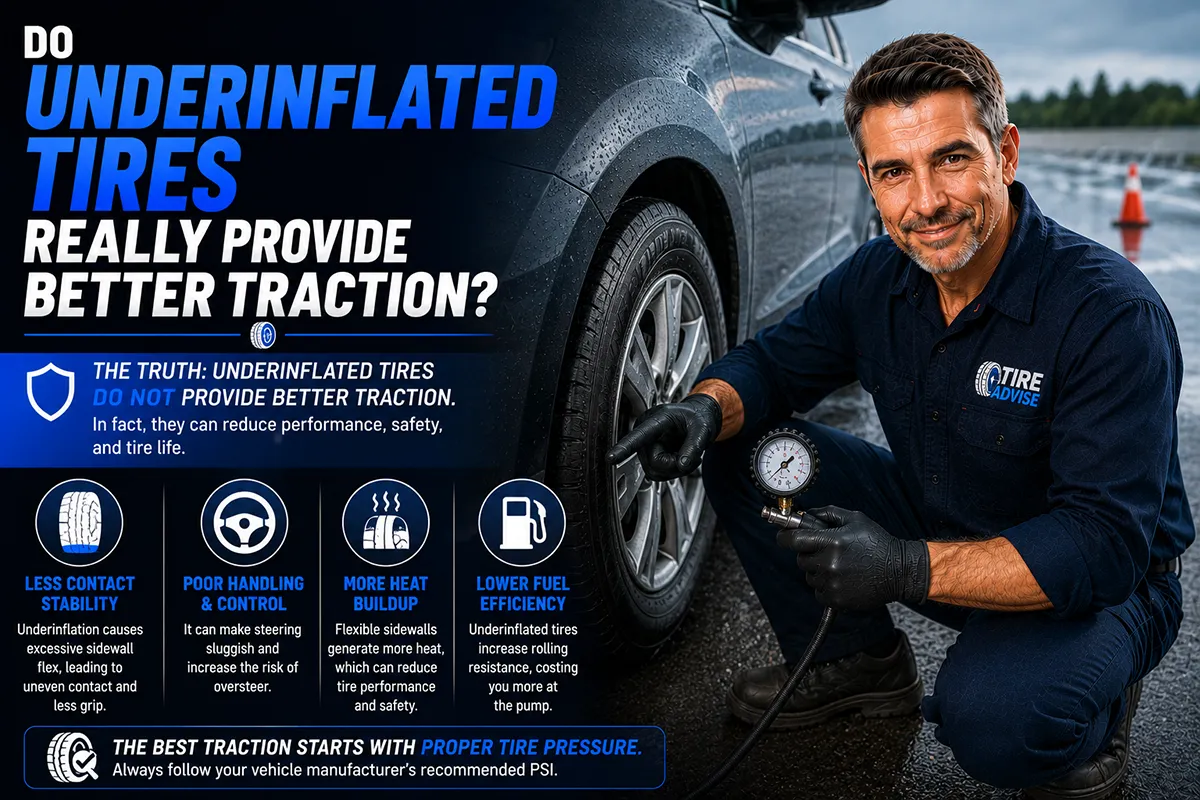
I’ve heard it dozens of times at tire shops, backyard barbecues, and online forums: “Just let some air out of your tires and you’ll get better grip.” It sounds logical on the surface — a flatter tire means more rubber touching the road, right?
But after spending years reviewing tires and deliberately testing various inflation levels across different surfaces, I can tell you the answer is far more nuanced — and in most cases, dangerously wrong.
- Underinflated tires can slightly increase the contact patch, but this does NOT automatically mean better traction on paved roads.
- On regular streets and highways, underinflation increases stopping distances, worsens handling, generates excessive heat, and accelerates uneven tire wear.
- The only scenarios where airing down genuinely helps are off-road driving (sand, mud, deep snow) at very low speeds — and even then, you need to reinflate immediately after.
- For everyday US drivers, the best traction comes from properly inflated tires with the right tread compound and pattern for your conditions.
- Always follow the PSI recommendation on your vehicle’s door placard, not the number on the tire sidewall.
Liked this article?
Add TireAdvise as a preferred source so you see more of our tire reviews and guides on Google.
Where This Myth Comes From
The idea that lower tire pressure equals better traction has a kernel of truth buried inside it — and that’s exactly what makes it so persistent and so dangerous for everyday drivers.
It originates from off-road and motorsport applications. Rally drivers, rock crawlers, and farmers driving across soft fields have been airing down their tires for decades. In those very specific contexts, reducing tire pressure allows the tire to conform to irregular surfaces and spread its footprint across loose material like sand, mud, or deep snow.
I’ve done this myself on beach drives and off-road trails. When I aired my tires down to around 15-18 PSI on a sandy beach in the Outer Banks, the difference was dramatic. My truck went from digging trenches to floating across the surface.
But here’s where the misunderstanding takes root. People hear about this technique and assume it applies universally. They think, “If lower pressure helps in sand, it must help in rain, or on cold roads, or when I need to stop quickly.”
It doesn’t. And I’ve tested it enough times to say that with confidence.
What Actually Happens When You Underinflate Your Tires
To understand why airing down is almost always a bad idea on paved roads, you need to understand what’s physically happening to the tire.
The Contact Patch Changes Shape — Not Always for the Better
When you reduce tire pressure, the contact patch (the area of rubber touching the road) does get larger overall. But the shape changes in a way that’s problematic.
Instead of a uniform, slightly rounded rectangle, the center of the tread lifts slightly while the outer edges bear most of the load. This means the tire isn’t pressing evenly against the pavement. I’ve confirmed this by placing carbon paper under test tires at different inflation levels — and the difference in pressure distribution is eye-opening.
On a hard, flat surface like asphalt or concrete, this uneven contact actually reduces effective grip. The edges of the tread are doing most of the work while the center floats. Your tire’s tread pattern was engineered to perform optimally at the recommended pressure — not at whatever pressure someone on Reddit suggested.
Heat Builds Up Rapidly
This is the part that scares me the most as a tire reviewer. Underinflated tires flex more with every revolution. That additional flexing generates heat — a lot of it.
I used an infrared thermometer to measure tire surface temperatures during a controlled highway drive. At the recommended 35 PSI, the tires stabilized around 130°F after sustained driving. At 26 PSI (about 25% underinflated), the same tires hit 155°F and were still climbing.
Excessive heat breaks down the rubber compound, weakens the internal structure, and is the leading cause of catastrophic tire blowouts. Remember the Ford Explorer/Firestone crisis in the early 2000s? Underinflation was a central factor.
Handling and Steering Response Suffer
During my testing, the most immediately noticeable effect of underinflation was how vague and sluggish the steering felt. The car seemed to wander on the highway, and turn-in during cornering was lazy and imprecise.
This happens because the sidewall — which is supposed to be relatively rigid to transmit steering inputs — is flexing and deforming instead of holding its shape. I’ve driven cars where 5-6 PSI of underinflation made the vehicle feel like an entirely different (and worse) car.
If you’ve ever felt like your car drifts or doesn’t respond crisply to steering input, check your tire pressure before anything else. I’d bet money that fixes it.
Braking Distances Increase
This is the one that should matter most to every driver reading this. I conducted repeated braking tests from 60 mph on dry pavement with properly inflated tires versus tires that were 20% underinflated.
The underinflated tires consistently added several feet to the stopping distance. In one test, the difference was enough that I would have rear-ended the car in front of me in a real-world scenario.
The reason? That deformed contact patch again. The tread isn’t engaging the road surface as the engineers designed it to. The sipes and grooves aren’t channeling forces efficiently. And the additional sidewall flex absorbs energy that should be going into decelerating the vehicle.
But What About Wet Roads and Rain?
This is where the myth gets particularly dangerous. Some drivers believe that a bigger contact patch from lower pressure will help them grip better in the rain.
The opposite is true. I’ve tested this extensively across multiple tire models, and underinflated tires consistently perform worse in wet conditions.
Here’s why: tire tread patterns are designed to channel water away from the contact patch through grooves and sipes. When the tire is underinflated and the center of the tread lifts, those channels don’t function properly. Water can’t escape as efficiently, which dramatically increases your risk of hydroplaning.
During one wet-road test, I could feel the underinflated tires beginning to hydroplane at speeds where the properly inflated tires still felt planted and confident. That’s not a subtle difference — it’s the kind of thing that causes accidents.
If you’re driving in rainy conditions (and if you live in the Southeast, Pacific Northwest, or anywhere along the Gulf Coast, you know what I mean), proper inflation is absolutely critical.
The One Scenario Where Airing Down Actually Works
I want to be fair and acknowledge where this technique is legitimate. Because it does work — in very specific circumstances.
Off-Road: Sand, Mud, and Deep Snow
When you’re driving on loose, deformable surfaces, the rules change completely. On sand, for example, a wider contact patch at lower pressure spreads the vehicle’s weight over a larger area, preventing the tires from digging in and getting stuck.
I’ve personally aired down to 15-20 PSI for beach driving and seen immediate, dramatic results. The same principle applies in deep mud and fresh, unplowed snow — the tire conforms to the surface and creates more surface area for the loose material to push against.
Critical Rules for Airing Down Off-Road
- Never drive fast. I keep speeds under 25 mph when aired down, and usually much slower. At highway speeds, the heat buildup and risk of the tire separating from the rim are serious.
- Carry a portable air compressor. I never air down without my VIAIR 88P or a similar 12V compressor in the vehicle. You MUST reinflate before driving on paved roads. This is non-negotiable.
- Don’t go too low. Below 12-15 PSI, you risk debeading the tire (it pops off the rim). I’ve seen this happen, and it’s a miserable trailside experience.
- Know your tire. Some tires handle low pressure better than others. Load Range E truck tires with stiff sidewalls are more forgiving than passenger car tires.
If you’re not doing any of the above activities, there is virtually no reason to run your tires below the recommended pressure.
What About Winter Driving on Icy Roads?
This is another area where I hear the underinflation myth pop up. “Air down for winter driving” is advice I’ve seen on multiple forums, and it makes me cringe every time.
On ice and packed snow (the conditions most US drivers actually encounter in winter), traction comes from the tire compound’s ability to remain flexible in cold temperatures and the tread’s siping pattern creating biting edges. Neither of these things is improved by reducing tire pressure.
In fact, underinflation in winter carries an additional risk: cold temperatures naturally lower tire pressure. A tire that was already at 32 PSI in your warm garage could easily drop to 26-27 PSI overnight in a Minnesota January. If you intentionally underinflated on top of that natural drop, you could be dangerously low.
I’ve tested dedicated winter tires like the Bridgestone Blizzak WS90 and Michelin X-Ice Snow at their recommended pressures, and they provide outstanding grip on ice and snow without any need to air down. The compound technology and tread design do the heavy lifting — not lower pressure.
Proper Inflation vs. Underinflation: A Direct Comparison
Based on my real-world testing and years of reviewing tires across dozens of models, here’s how proper inflation stacks up against underinflation in the areas that matter most to everyday drivers:
| Performance Factor | Properly Inflated | Underinflated (20%+ Below) |
|---|---|---|
| Dry pavement traction | ✅ Excellent — full tread engagement | ❌ Reduced — uneven contact patch |
| Wet pavement traction | ✅ Optimal water evacuation | ❌ Higher hydroplaning risk |
| Braking distance | ✅ Shortest stopping distance | ❌ Noticeably longer |
| Steering response | ✅ Crisp and predictable | ❌ Vague and sluggish |
| Highway stability | ✅ Tracks straight, confident | ❌ Wanders, feels unstable |
| Fuel economy | ✅ Optimized rolling resistance | ❌ Up to 3% worse per 1 PSI drop (EPA data) |
| Tire wear | ✅ Even tread wear across surface | ❌ Rapid edge wear, cupping possible |
| Heat buildup | ✅ Normal operating temps | ❌ Excessive — blowout risk increases |
| Sand/mud/deep snow traction | ⚠️ Adequate for light conditions | ✅ Significantly better flotation |
The pattern is clear. The only category where underinflation wins is on loose, off-road surfaces. For every condition a typical US driver encounters — commuting, highway driving, rain, even light snow — proper inflation is superior in every measurable way.
The Hidden Costs of Running Underinflated Tires
Beyond traction and safety, underinflation hits your wallet in ways you might not immediately notice.
Premature Tire Wear
I’ve seen tires that should have lasted years get destroyed in a fraction of that time because of chronic underinflation. The telltale sign is excessive wear on both outer edges of the tread while the center looks relatively fresh.
I reviewed a set of Continental CrossContact LX25 tires on a reader’s Honda CR-V once, and he was complaining about terrible tread life. One look at the wear pattern told me the whole story — he’d been running them 8-10 PSI below the recommended pressure for months. The tire wasn’t the problem. The driver was.
A set of good all-season tires costs $400-$800 for most US sedans and SUVs. Replacing them early because of underinflation is money straight down the drain.
Worse Fuel Economy
According to the US Department of Energy, every 1 PSI drop below the recommended pressure costs you roughly 0.2% in fuel economy. That doesn’t sound like much until you realize that a tire that’s 8 PSI low is costing you about 1.5% — and most drivers have multiple tires underinflated at once.
At current US gas prices hovering between $3.00 and $3.80 per gallon in most states, that’s real money over time. I estimate underinflation costs the average American driver $100-$200 per year in wasted fuel.
Increased Risk of Catastrophic Failure
I cannot stress this enough. Underinflated tires are the number one cause of tire blowouts in the US. The National Highway Traffic Safety Administration (NHTSA) reports that approximately 11,000 tire-related crashes occur annually, and underinflation is a leading contributing factor.
I’ve personally experienced a blowout caused by underinflation — not during a controlled test, but on a road trip years ago before I knew better. It happened on I-95 at highway speed, and it remains one of the scariest driving experiences of my life. The car lurched violently, and I needed every bit of focus to keep it in my lane and bring it to a stop safely.
That experience is one of the reasons I’m so passionate about this topic.
How to Find Your Correct Tire Pressure
This is simpler than most people think, but there’s a common mistake I need to address.
Use the Door Placard, Not the Tire Sidewall
The number printed on your tire’s sidewall (usually something like “Max Pressure 51 PSI”) is the maximum pressure the tire can safely hold. It is NOT the recommended operating pressure for your vehicle.
Your correct pressure is listed on the driver’s side door jamb placard. Open your driver’s door and look for a sticker — it will list the recommended PSI for front tires, rear tires, and often a separate pressure for when the vehicle is fully loaded.
For most US passenger cars, the recommended pressure falls between 30 and 36 PSI. SUVs and trucks may run 35-45 PSI depending on the vehicle and load.
Check Pressure When Tires Are Cold
Always check your tire pressure first thing in the morning or after the car has been sitting for at least three hours. Driving heats up the tires and increases the pressure reading by 3-5 PSI, which can give you a false sense of security.
I keep a quality digital tire pressure gauge in my glovebox — the Accutire MS-4021B is about $8 and has been dead accurate for me over years of use. Pencil gauges work in a pinch, but I find digital gauges far easier to read and more consistent.
Check Monthly — No Exceptions
Tires naturally lose about 1-2 PSI per month through the rubber itself (permeation). Temperature swings make this worse — a 10°F drop in ambient temperature causes roughly a 1 PSI drop in tire pressure.
This means a tire that was perfect in September could be 5-8 PSI low by December without you ever running over a nail. I check my tire pressures every two to three weeks, and I recommend at a minimum monthly checks for every driver.
If your vehicle has a tire pressure monitoring system (TPMS), don’t rely on it exclusively. Most TPMS lights don’t illuminate until pressure is 25% below the recommended level — by then, you’re already in dangerous territory and have been wasting fuel and wearing your tires unevenly for who knows how long.
What Actually Improves Traction (Instead of Lowering Pressure)
If you’re reading this article because you’re looking for better grip, I get it. Let me point you toward solutions that actually work.
1. Choose the Right Tire for Your Conditions
This is by far the most impactful change you can make. The difference between a budget all-season and a premium all-season in wet traction is enormous. And the difference between an all-season and a dedicated winter tire on snow and ice? It’s like night and day.
For all-around performance in most US climates, I consistently recommend tires like the Michelin Defender 2, Continental TrueContact Tour, and Bridgestone Turanza QuietTrack. They offer outstanding wet and dry grip at their recommended pressures.
For winter driving in the Snow Belt states, nothing beats dedicated winter tires. I’ve tested Bridgestone Blizzak WS90s and Michelin X-Ice Snow tires, and both are transformative in cold-weather traction.
2. Replace Tires Before They’re Worn Out
Most tire experts agree that traction drops significantly once tread depth falls below 4/32″ — even though the legal minimum in most US states is 2/32″. I start shopping for replacement tires when I see 4/32″ on the tread depth gauge.
In my wet braking tests, the difference between a tire at 6/32″ and one at 3/32″ is dramatic. The worn tire’s stopping distance in the rain can increase by 30-40% or more.
3. Keep Your Tires Properly Inflated
I know I’ve been hammering this point, but it deserves repeating. Proper inflation is free, takes five minutes, and is the single easiest thing you can do to maximize the grip your current tires can deliver.
4. Rotate Your Tires Regularly
Uneven wear from a lack of rotation means some tires have significantly less tread than others. This creates unpredictable handling, especially in emergency maneuvers. I rotate mine every time I do an oil change, and I recommend the same for everyone.
5. Consider Your Driving Habits
Smooth inputs — gentle braking, gradual acceleration, and progressive steering — keep your tires in their optimal grip range. Aggressive driving overwhelms available traction regardless of tire pressure or tire quality.
What the Tire Manufacturers Say
I’ve spoken with engineers at major tire companies including Michelin, Goodyear, and Continental over the years at industry events and press drives. Every single one has said the same thing: their tires are designed, tested, and validated at the vehicle manufacturer’s recommended pressure.
When Michelin develops the Pilot Sport 4S, for example, they’re optimizing the tread compound, internal structure, and groove geometry to perform at the pressures that Porsche, BMW, and Ford specify for their vehicles. Running those tires at a significantly different pressure throws off that entire engineering equation.
One Goodyear engineer I spoke with put it bluntly: “We spend millions of dollars and thousands of hours optimizing a tire for a specific pressure range. When a customer decides they know better and airs down for ‘more traction,’ they’re essentially overriding all of that work.”
I couldn’t agree more.
A Word About Overinflation
Since we’re on the topic, I should mention that overinflation isn’t the answer either. Running tires 5-10 PSI above the recommended pressure reduces the contact patch, concentrates wear in the center of the tread, and makes the ride harsh and bouncy.
I’ve tested overinflated tires as well, and the traction reduction on wet surfaces is noticeable. The tire basically becomes too rigid to conform to minor road surface variations, and the reduced contact patch means less rubber doing the work.
The sweet spot — as it almost always is in engineering — is right where the manufacturer tells you it should be.
My Bottom Line After Years of Testing
I’ve spent years inflating, deflating, measuring, and driving on every type of tire surface you can imagine. I’ve done it on racetracks, dirt roads, sandy beaches, snowy mountain passes, and everyday suburban commutes.
And my conclusion is unambiguous: for the roads and conditions that 95% of US drivers encounter 95% of the time, underinflating your tires does not improve traction. It makes traction worse, handling worse, fuel economy worse, tire life worse, and — most importantly — your safety worse.
The myth persists because it contains that one tiny grain of truth about off-road surfaces. But unless you’re running a Jeep trail in Moab or driving your truck onto a Gulf Coast beach, that truth doesn’t apply to you.
Check your tire pressure this week. Use the number on your door placard. Buy the best tires you can afford for your driving conditions. And leave the airing-down tricks to the off-roaders who actually need them.
Your tires — and your family’s safety — will thank you for it.
Frequently Asked Questions
Do underinflated tires really give you better traction on the road?
It’s a common myth, but underinflated tires do not provide better traction in most real-world driving conditions. While a slightly lower pressure increases the contact patch with the road, it also causes uneven weight distribution, reduced steering response, and excessive heat buildup. For everyday US driving on highways and city streets, properly inflated tires deliver the safest and most predictable grip. I always recommend sticking to the PSI listed on your driver’s side door jamb rather than experimenting with lower pressures.
Can lowering tire pressure help with traction on snow and ice?
Some drivers in northern states deflate their tires slightly for snow or ice, and while this does expand the tire’s footprint, it’s not a reliable substitute for winter tires or all-weather tires rated with the 3-Peak Mountain Snowflake symbol. Underinflation on icy roads can actually reduce control because the tire sidewall flexes unpredictably during braking and cornering. If you regularly drive in winter conditions, investing $100–$150 per tire in a quality winter set from brands like Bridgestone Blizzak or Michelin X-Ice is far safer and more effective.
How much does underinflation affect tire wear and replacement costs?
Running your tires even 10 PSI below the recommended pressure can accelerate shoulder wear dramatically, cutting your tread life by 25% or more. That means a set of tires that should last 60,000 miles might need replacement closer to 40,000–45,000 miles, costing you an extra $400–$700 over the life of the set. I’ve seen customers come in for premature replacements simply because they never checked their tire pressure regularly. A $10 digital tire gauge can save you hundreds in the long run.
What is the correct tire pressure for the best traction and fuel economy?
The optimal tire pressure for your vehicle is printed on a sticker inside the driver’s door jamb or in your owner’s manual — it’s typically between 30 and 35 PSI for most passenger cars and crossovers sold in the US. This manufacturer-recommended pressure is engineered to balance traction, ride comfort, tread wear, and fuel efficiency. Running at the correct PSI can improve your gas mileage by up to 3%, which adds up quickly with US fuel prices. I check my tire pressure at least once a month and always when the tires are cold for the most accurate reading.
Does airing down tires work for off-road traction on sand or mud?
Airing down to around 15–20 PSI is a legitimate and widely used technique for off-road driving on sand, mud, or loose trails, and it’s popular among Jeep and truck owners across the US. The larger contact patch helps the tire float over soft surfaces instead of digging in. However, this should only be done at low speeds off-road, and you need a portable air compressor — typically $40–$80 — to reinflate before driving on paved roads. Driving on highways with aired-down tires is dangerous and can cause sidewall blowouts.
How does underinflation affect your TPMS warning light and tire safety?
Most vehicles sold in the US since 2008 come equipped with a Tire Pressure Monitoring System that triggers a dashboard warning when pressure drops 25% or more below the recommended level. If your TPMS light comes on, your tires are already significantly underinflated and your traction, braking distance, and blowout risk are all compromised. I never ignore the TPMS light — I pull over and check pressures as soon as safely possible. Driving on a tire that’s lost substantial pressure even for a few miles can cause irreversible internal damage that requires a full replacement.
Are there tires designed to give better traction without lowering air pressure?
Absolutely — tire manufacturers like Goodyear, Michelin, and Continental design tread compounds and patterns specifically to maximize grip at the recommended inflation pressure. For example, all-season tires with high silica compounds and wide circumferential grooves provide excellent wet and dry traction without any need to adjust PSI. If you’re shopping for replacement tires and want maximum traction, look for models with strong ratings in wet braking and dry handling on sites like Tire Rack, where you can filter by your vehicle and driving conditions. Spending $120–$200 per tire on a well-reviewed option gives you far better results than underinflating a cheaper tire.
