

I still remember the look on my buddy’s face when he ordered a set of tires online for the first time and genuinely expected them to arrive mounted on shiny new rims. He’d spent hours picking the perfect all-season set, clicked “buy,” and then called me confused when four bare rubber donuts showed up on his doorstep.
It’s one of the most common questions I get from everyday drivers, and there’s no shame in asking it. The tire industry doesn’t always make things clear, and the way products are marketed can be genuinely misleading.
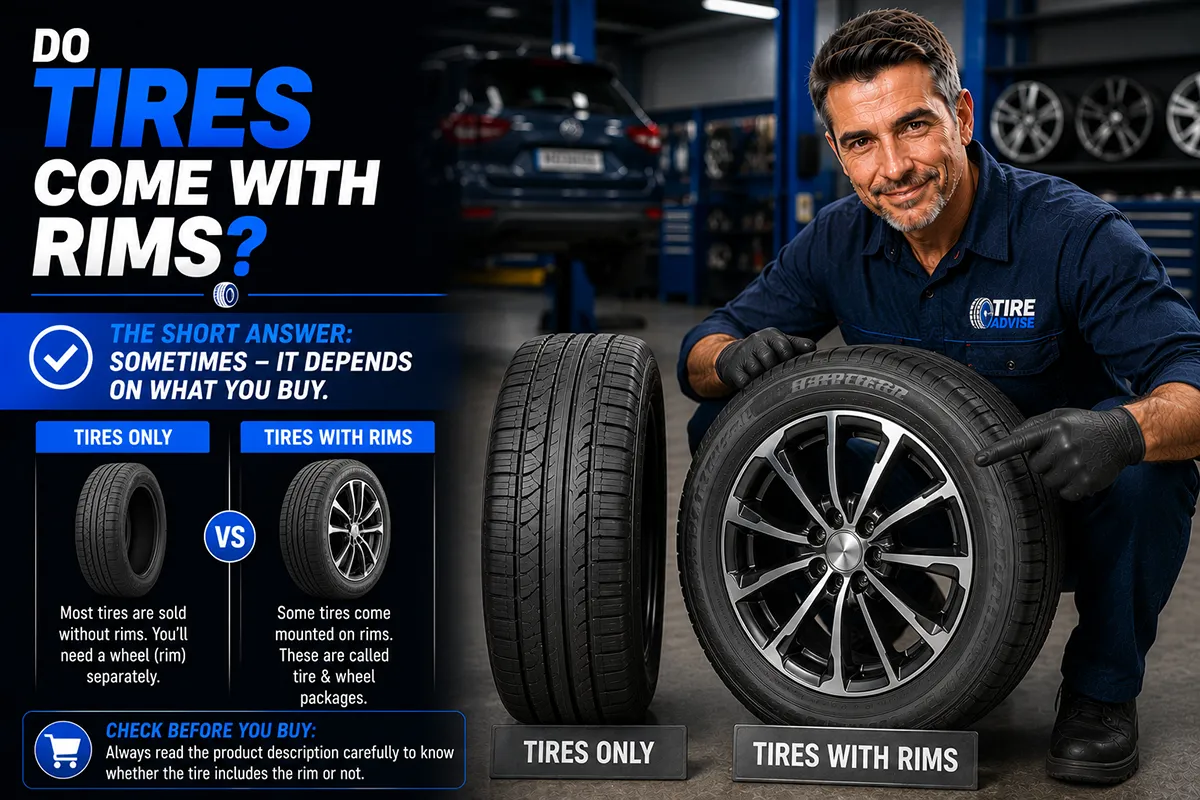
- Standard tire purchases — both online and in-store — do not include rims. You’re buying rubber only.
- If you want tires already mounted on rims, you need to specifically buy a “tire and wheel package” or “mounted assembly.”
- Your existing rims can almost always be reused when replacing tires, unless they’re damaged or you want to upgrade.
- Buying tires separately from rims is usually cheaper, but packages can save time and hassle.
- Always confirm exactly what’s included before you click “buy” — listings can be confusing.
Liked this article?
Add TireAdvise as a preferred source so you see more of our tire reviews and guides on Google.
The Short Answer: No, Tires Do Not Come With Rims
Let me clear this up right away. When you buy tires — whether online from Tire Rack, at Discount Tire, Costco, Walmart Auto Center, or any other retailer — you are buying the rubber tire only. Rims (also called wheels) are sold separately.
This is true for virtually every standard tire purchase in the US market. The tires arrive unmounted, unbalanced, and without any wheels attached.
I’ve purchased dozens of tire sets over the years for testing and personal use, and not once has a rim been included unless I specifically ordered a tire-and-wheel package. It’s just not how the industry works by default.
Why This Confusion Exists in the First Place
I totally understand why people ask this question. There are a few reasons the confusion keeps popping up.
Product Photos Can Be Misleading
Many tire retailers show product images of tires mounted on attractive alloy wheels. It makes the tire look more appealing and helps you visualize it on a car. But that wheel in the photo? It’s just a prop — a digital rendering to show the tire’s sidewall profile and tread design.
I’ve seen this trick on Amazon, Walmart’s website, and even on manufacturer pages from Michelin, Goodyear, and Bridgestone. The wheel shown is almost never included. If you look closely at the listing, there’s usually fine print that says “wheel not included” or “tire only.”
The Word “Set” Is Ambiguous
When a listing says “set of 4 tires,” some shoppers assume that means a complete set — tires plus wheels. But in the tire industry, a “set” refers to four tires only. A complete wheel-and-tire assembly would be explicitly labeled as such.
New Cars Come With Both
When you buy a new car, it rolls off the lot with tires already mounted on rims. So it’s natural to assume you’d buy them together as a package when it’s time to replace them. But the replacement market treats tires and wheels as two distinct product categories.
What Exactly Do You Get When You Buy Tires?
Here’s exactly what arrives when you order a standard set of replacement tires:
- The rubber tires themselves — unmounted, in their natural round shape
- Possible manufacturer stickers or labels — showing the DOT number, tire size, and specs
- That’s it. No rims, no valve stems, no TPMS sensors, no lug nuts
After your tires arrive (or you pick them up in-store), you’ll need to have them mounted onto your existing rims, balanced, and installed on your vehicle. Most tire shops include mounting and balancing in the purchase price or charge a modest fee — typically $15 to $30 per tire in the US.
In my experience, buying from places like Discount Tire or Costco Tire Center usually includes free mounting and balancing when you purchase tires from them. That’s one of the perks of buying from a brick-and-mortar retailer with an attached service bay.
Tires vs. Rims vs. Wheels: Let’s Clear Up the Terminology
Before we go further, let me untangle some terms that get used interchangeably but actually mean different things.
| Term | What It Actually Means | Example |
|---|---|---|
| Tire | The rubber component that contacts the road | Michelin Defender LTX M/S |
| Rim / Wheel | The metal disc the tire mounts onto | 17″ alloy wheel, steel wheel |
| Wheel Assembly | Tire + rim mounted together, ready to bolt on | Tire-and-wheel package from Tire Rack |
| TPMS Sensor | Tire pressure monitoring sensor inside the wheel | Required on all US cars since 2007 |
Technically, “rim” refers to just the outer edge of the wheel where the tire bead seats. But in everyday American English, people use “rim” and “wheel” interchangeably, and I’ll do the same here. You know what you mean, I know what you mean — let’s not be pedantic about it.
Can You Buy Tires That Come With Rims? (Yes — Here’s How)
While the default purchase is tire-only, you absolutely can buy tires pre-mounted on wheels. You just have to look for the right product listing.
Tire-and-Wheel Packages
Several major US retailers offer packages where you select both your tires and your wheels, and they ship them to you already mounted, balanced, and sometimes even with TPMS sensors installed. All you have to do is bolt them onto your car.
Here are the most popular US retailers offering these packages:
- Tire Rack — This is where I’ve had the best experience with packages. They mount, balance, and ship complete assemblies. Their package builder tool is excellent and filters by your vehicle’s year, make, and model.
- Discount Tire / America’s Tire — Offers wheel-and-tire packages both online and in-store. I’ve used their in-store service several times and it’s been seamless.
- Custom Offsets — Great for truck and SUV owners looking for lifted or off-road setups.
- Fitment Industries — Popular for aftermarket and performance wheel-tire combos.
- Costco — Primarily sells tires only, but occasionally runs wheel promotions.
When Does Buying a Package Make Sense?
I recommend tire-and-wheel packages in these specific situations:
- You want a dedicated winter tire setup. Having a second set of rims with winter tires mounted makes seasonal swaps incredibly easy. I keep a set of steel wheels with Bridgestone Blizzaks in my garage, and switching takes about 30 minutes with a floor jack.
- Your current rims are damaged. If you’ve got bent, cracked, or severely corroded wheels, it makes sense to replace everything at once.
- You want a different wheel size or style. Upgrading from 16″ steelies to 18″ alloys? You’ll need new wheels anyway.
- You don’t have a local tire shop. If you live in a rural area and the nearest installer is far away, getting pre-mounted assemblies you can bolt on at home is a game-changer.
How Much Do Rims Cost Separately?
Since tires don’t come with rims, let me give you a realistic idea of what wheels cost on their own in the US market, based on my experience shopping for them.
| Wheel Type | Price Range (Per Wheel) | Best For |
|---|---|---|
| Steel Wheels | $40 – $80 | Winter tire setups, budget builds |
| Budget Alloy Wheels | $80 – $150 | Everyday driving, OEM replacement |
| Mid-Range Alloy Wheels | $150 – $300 | Style upgrade, lighter weight |
| Premium/Forged Wheels | $300 – $800+ | Performance, show vehicles |
For most drivers doing a straightforward tire replacement, you won’t need new rims at all. Your existing wheels will work perfectly fine. Just bring your car to a tire shop, they’ll dismount the old tires, mount the new ones, balance everything, and you’re back on the road.
When You Should Reuse Your Existing Rims (Almost Always)
In my experience, about 90% of everyday tire buyers should simply reuse their current wheels. Here’s why.
Your OEM Wheels Are Designed for Your Car
The wheels that came with your vehicle are specifically engineered for its weight, bolt pattern, offset, and hub bore. They’re guaranteed to fit. When you reuse them, you eliminate any compatibility concerns.
I’ve seen people waste money buying aftermarket wheels that technically fit but create vibration issues or rub against suspension components. Unless you have a specific reason to change wheels, keeping your originals is the smart play.
Rims Last Longer Than Tires
A quality set of alloy wheels can easily outlast three or four sets of tires. I’ve got OEM wheels on one of my test vehicles that have been through multiple tire replacements and still look great after a good cleaning.
The only times I recommend replacing rims are:
- Visible cracks or bends (especially after hitting a pothole hard)
- Severe curb rash that’s broken through the surface coating, causing corrosion
- The bead seat area is corroded, causing slow air leaks
- You’re changing to a different tire size that requires a different wheel width
The Real Cost of Replacing Tires (Without Rims)
Since most people are reusing their existing wheels, here’s what a typical tire replacement actually costs in the US. These numbers reflect what I’ve seen across dozens of purchases at various retailers.
Tire Cost Only (Set of 4)
- Budget tires (Westlake, Lionhart, Hankook Kinergy): $240 – $400
- Mid-range tires (Continental TrueContact, Cooper Discoverer, General AltiMAX): $400 – $700
- Premium tires (Michelin Defender, Bridgestone Turanza, Pirelli Cinturato): $600 – $1,000+
Installation Fees
- Mounting and balancing: $15 – $30 per tire ($60 – $120 total)
- TPMS sensor service: $5 – $15 per tire (just to reset/relearn existing sensors)
- Valve stem replacement: $3 – $8 per tire (rubber stems; more for metal)
- Old tire disposal: $3 – $5 per tire
- Alignment check: $80 – $120 (recommended but not always required)
So for a typical mid-range tire replacement with installation, you’re looking at roughly $500 to $850 total. That’s without any new wheels, because you don’t need them.
What About Spare Tires — Do Those Come With Rims?
Great question, and the answer is yes — usually. When you buy a spare tire, it typically does come mounted on a small steel wheel, especially if you’re buying a compact temporary spare (the “donut” type).
I’ve replaced a spare on a Honda CR-V and a Toyota Camry, and in both cases, the spare came as a complete assembly — tire mounted on a steel rim, ready to toss in the trunk. These run about $100 to $200 for most common vehicles.
Full-size spare tires, on the other hand, are sometimes sold tire-only, expecting you to mount them on a matching wheel. Always check the listing carefully.
Buying Tires Online vs. In-Store: What You Get
I’ve bought tires both ways many times, and here’s how the experience differs regarding the “do they come with rims” question.
Buying Online (Tire Rack, Amazon, SimpleTire, Walmart.com)
When you buy online, tires ship to your door or to an installer. They arrive as unmounted rubber. You then need to either:
- Take them to a local installer for mounting (Tire Rack has a network of partner installers across the US)
- Have them shipped directly to an installer who handles everything
I’ve used Tire Rack’s ship-to-installer feature many times. You select a local shop during checkout, the tires get sent there, and you just show up with your car. It’s smooth. But the tires still don’t come with rims — they’re mounted onto your existing wheels at the shop.
Buying In-Store (Discount Tire, Costco, Les Schwab, Firestone, Pep Boys)
When you buy in-store, the shop pulls your tire selection from their inventory, mounts them on your existing rims, balances everything, and installs them on your car — usually while you wait. The whole process typically takes 45 minutes to an hour and a half.
This is the most seamless experience because you never even see the unmounted tires. But to be clear — you’re still only buying rubber. They’re just handling the mounting for you.
How to Avoid Getting Scammed or Confused When Shopping
I’ve learned a few things over the years that will save you from unpleasant surprises at checkout.
1. Always Read the Full Listing Title
Look for keywords like “tire only,” “does not include wheel,” or “sold individually.” Some listings sell one tire, not a set of four. I’ve seen people accidentally buy a single tire thinking they were getting four.
2. Check the Quantity
Is the listing for 1 tire or 4? This trips up a lot of shoppers. If the price seems surprisingly low, you might be looking at a per-tire price, not a set.
3. Look for “Tire and Wheel Package” If You Want Both
If you actually need rims, search specifically for “tire and wheel package” or “mounted wheel and tire.” On Tire Rack, there’s a dedicated section for this. Don’t assume anything based on product images.
4. Confirm TPMS Sensor Compatibility
If you’re buying new wheels, you’ll need TPMS sensors for each one (required by federal law on all vehicles model year 2008 and newer). Some wheel packages include them; others don’t. Always verify.
5. Call Before You Buy If Unsure
Seriously. Every reputable tire retailer has a customer service line. I’ve called Tire Rack and Discount Tire multiple times to confirm exactly what’s included in a listing. They’re happy to help, and it takes two minutes.
My Personal Recommendation for Most Drivers
After years of testing tires and helping friends and family with purchases, here’s my straightforward advice.
If you’re just replacing worn-out tires on your daily driver, buy tires only and reuse your existing rims. Go to a trusted local tire shop or use an online retailer that ships to a nearby installer. This is the most common, most affordable, and most practical approach for the vast majority of US drivers.
You do not need new rims unless yours are damaged or you specifically want a different look or size.
If you live in a state where winter tires are essential — Minnesota, Wisconsin, Michigan, upstate New York, Colorado — I strongly recommend buying a second set of inexpensive steel wheels with winter tires mounted on them. The upfront cost is higher, but over the long run, you save on mounting and balancing fees every time you swap, and both your tire sets last longer because they each see only half the year.
I’ve been running this dual-setup strategy for several years now, and it’s one of the best automotive investments I’ve ever made. Seasonal swaps take me about 30 minutes in the garage with a jack, a torque wrench, and a podcast.
What If You’re Buying Used Tires?
Used tires are a whole different ballgame. On marketplaces like Facebook Marketplace, Craigslist, and OfferUp, you’ll find tires sold in all configurations:
- Tire only (unmounted) — most common
- Tire mounted on a rim — sometimes sellers include the wheel, sometimes it’s a take-off from another vehicle
- Complete set of 4 with rims — usually from someone who swapped to a different wheel setup
I’d urge caution with used tires. Always check the DOT date code on the sidewall to verify the tire’s age. Tires older than six years should generally be avoided regardless of tread depth. And inspect for dry rot, sidewall damage, plugs, or patches before buying.
If the used tires come mounted on rims, make sure those rims are compatible with your vehicle’s bolt pattern, offset, and hub bore. Just because they’re the right diameter doesn’t mean they’ll fit properly.
A Quick Note About Run-Flat Tires
If your vehicle came equipped with run-flat tires (common on BMWs, MINIs, and some Mercedes models), the replacement process is the same — tires don’t come with rims. However, run-flat tires require specific mounting equipment and expertise.
Not every tire shop is equipped to handle run-flats, so call ahead. I made this mistake once and had to leave a shop and drive across town to find one with the right machine. Lesson learned.
The Bottom Line
No, tires do not come with rims. When you buy replacement tires, you’re buying rubber only. Your existing wheels will be reused in the vast majority of cases, and that’s perfectly fine — they’re built to last through multiple tire replacements.
If you want tires and wheels together, look specifically for tire-and-wheel packages from retailers like Tire Rack or Discount Tire. These are great for winter setups or wheel upgrades, but they’re not the default purchase.
The most important thing? Read the listing carefully, know what you’re buying, and don’t be afraid to ask questions. There’s no such thing as a dumb question when you’re about to spend hundreds of dollars on something your safety depends on.
I hope this guide saves you from confusion — and saves your wallet from unnecessary spending. Drive safe out there.
Frequently Asked Questions
Do new tires come with rims when you buy them?
No, when you purchase new tires they almost always come without rims. Tires and rims are sold separately because most drivers already have existing wheels on their vehicle and simply need fresh rubber mounted onto them. If you buy tires from a shop like Discount Tire, Tire Rack, or a local dealer, they’ll typically mount and balance the new tires on your current rims for $15–$45 per tire.
What is the difference between buying tires vs. buying tire and rim packages?
Buying tires alone means you’re only getting the rubber that gets mounted onto your existing wheels, while a tire and rim package includes both a new wheel and a tire pre-mounted together. Packages are popular when drivers want a different wheel size, a fresh look, or a dedicated winter tire setup. Tire and rim combos typically cost $150–$500+ per wheel depending on size and brand, compared to $80–$250 for a tire alone.
Is it cheaper to buy tires and rims separately or as a package?
In most cases, buying tires separately and reusing your current rims is significantly cheaper since you avoid the cost of new wheels entirely. However, if you actually need new rims due to damage or a size change, bundled tire and wheel packages from retailers like Tire Rack or America’s Tire can save you $50–$150 compared to purchasing each component individually. I’d recommend comparing total costs including mounting, balancing, and shipping before deciding.
Can you buy tires already mounted on rims?
Yes, you can buy tires pre-mounted on rims, and this option is commonly called a wheel-and-tire package or a tire and rim combo. Retailers like Tire Rack, Custom Offsets, and Discount Tire offer packages that ship to your door road-ready, so you or a shop just need to bolt them onto your vehicle. This is especially convenient for winter tire setups where you swap complete wheel assemblies seasonally.
Do spare tires come with a rim included?
Yes, spare tires almost always come mounted on their own rim because they need to be ready for immediate installation during a roadside emergency. Most new vehicles in the US include either a full-size or compact temporary spare already mounted on a steel wheel, stored in the trunk or under the vehicle. If you need to buy a replacement spare, expect to pay $100–$300 for a compact spare with rim or $150–$500+ for a full-size spare with a matching wheel.
How much does it cost to mount new tires on your existing rims?
Mounting and balancing new tires on your existing rims typically costs between $15 and $45 per tire at most US tire shops, with the national average around $25 per tire. Many retailers like Costco, Walmart, and Discount Tire include free or discounted mounting and balancing when you purchase tires from them. I always recommend asking about package deals that bundle mounting, balancing, valve stems, and tire disposal fees into one price.
When should you buy new rims instead of reusing your old ones with new tires?
You should consider buying new rims if your current wheels have visible cracks, significant curb rash, corrosion, or bends that cause vibrations or slow air leaks. Rims can also be damaged by potholes, which is common on US roads especially in northern states after winter. If your wheels are structurally sound and the correct size for your replacement tires, there’s no reason to replace them—a tire shop can inspect them during mounting and let you know if they’re still safe to reuse.
