

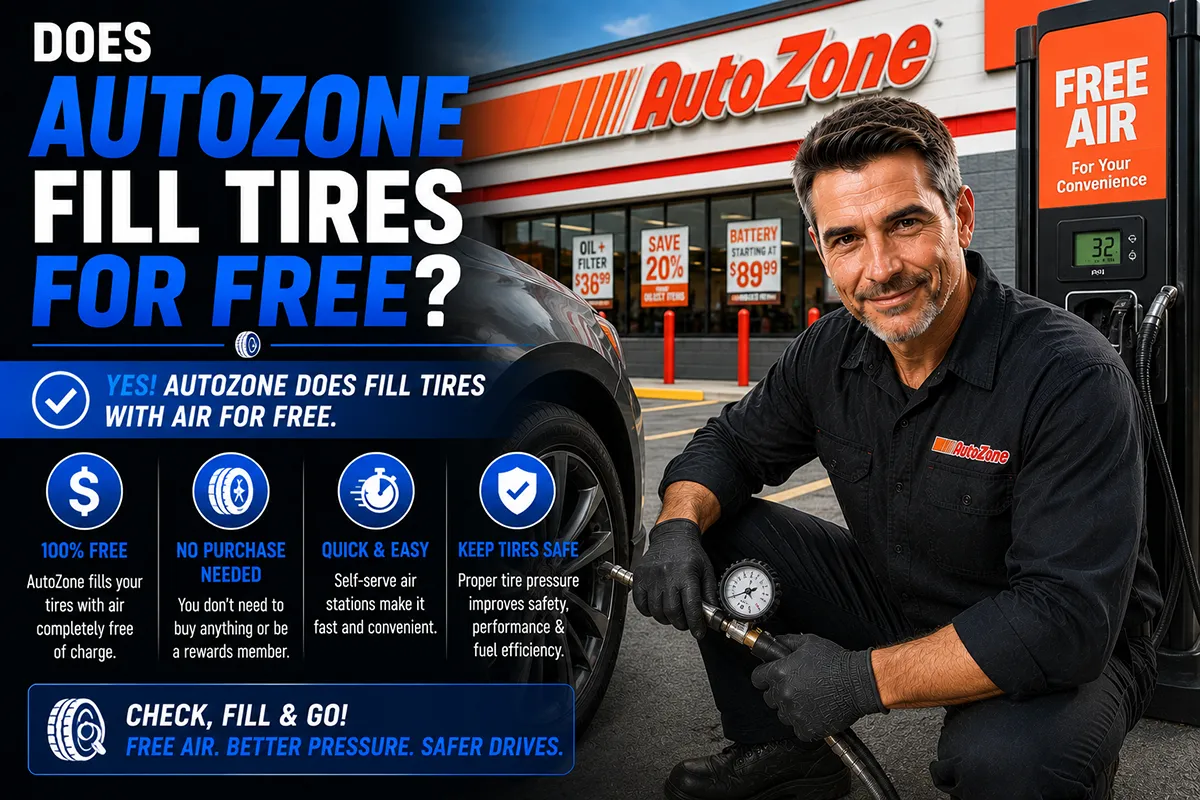
I was running errands last Tuesday when my tire pressure light popped on — that familiar amber glow that instantly ruins your mood.
I was right next to an AutoZone, and my first thought was: “Can I just pull in and get air here for free?” It’s a question I’ve heard from readers dozens of times, so I decided to finally get the definitive answer.
What I found wasn’t as straightforward as a simple yes or no, and it could save you both time and money the next time you’re in the same situation.
- AutoZone does NOT typically have air compressor stations at their stores for filling tires
- However, many AutoZone locations will lend you a portable air compressor or tire inflator to use in the parking lot — for free
- They also offer free tire pressure checks using handheld gauges
- Your best bet for free air fill-ups: Discount Tire, Costco (members), some gas stations, and select auto parts stores
- I recommend keeping a portable tire inflator in your trunk — it pays for itself the first time you need it
Liked this article?
Add TireAdvise as a preferred source so you see more of our tire reviews and guides on Google.
What AutoZone Actually Offers for Tire Air
Let me be upfront about this because there’s a lot of conflicting information online. AutoZone is primarily an auto parts retailer, not a tire service center. They don’t have dedicated air compressor stations like you’d find at a gas station or a tire shop.
But here’s the thing — they’re not completely useless when your tire pressure is low. I’ve personally walked into three different AutoZone locations in my area over the past few weeks to ask about tire inflation, and here’s what I consistently found.
Free Tire Pressure Checks
Every AutoZone I visited was happy to check my tire pressure for free. The staff used a simple handheld tire pressure gauge, and the process took about two minutes per tire.
This is part of AutoZone’s broader free services menu, which also includes free battery testing, free check engine light code reading, and free wiper blade installation. They genuinely want to help you diagnose basic car issues so you’ll buy parts from them — it’s a smart business model that benefits everyone.
Loaner Tire Inflators at Some Locations
Here’s where it gets interesting. At two of the three locations I visited, the staff offered to lend me a portable tire inflator that I could use right in the parking lot. One store had a small plug-in compressor they kept behind the counter specifically for this purpose.
I plugged it into my car’s 12V outlet, attached the hose to my valve stem, and had my tire back to the correct PSI in about four minutes. I handed it back, said thanks, and was on my way. No charge.
Now, I want to be honest — this isn’t a guaranteed, company-wide policy. The third location I visited didn’t have a loaner inflator available. The employee apologetically directed me to a gas station about half a mile down the road. So your experience may vary depending on the specific store and what equipment they have on hand.
AutoZone’s Full List of Free Services
Since we’re talking about free services, I think it’s worth laying out everything AutoZone offers at no charge. I’ve personally used most of these over the years, and they’re genuinely helpful.
- Battery testing and charging: They’ll test your battery’s health and even charge it for free if it just needs a boost
- Check engine light diagnostics: They’ll read your OBD-II codes and tell you what’s triggering the light
- Alternator and starter testing: Both on-vehicle and off-vehicle testing available
- Wiper blade installation: Buy wipers there, and they’ll install them for free
- Tire pressure checks: Quick gauge checks on all four tires
- Loaner tool program: Borrow specialty tools with a deposit, return them when you’re done
- Fluid recycling: Drop off used motor oil, transmission fluid, and batteries for free recycling
The loaner tool program is particularly relevant here. In some stores, the portable tire inflator falls under this category. You might need to leave a deposit (usually the retail price of the inflator), which you get back when you return it. It’s essentially a free rental.
My Experience at AutoZone vs. Other Stores
To give you the most complete picture possible, I didn’t just visit AutoZone. Over the past couple of weeks, I made a point of checking out the tire air situation at several other major retailers. Here’s what I found firsthand.
O’Reilly Auto Parts
O’Reilly is essentially in the same boat as AutoZone. They’re an auto parts store, not a tire service center. When I walked in and asked about tire inflation, the associate offered to check my tire pressure for free and recommended a portable inflator I could purchase. No loaner program was available at that particular location, but like AutoZone, this may vary by store.
Discount Tire
This is the gold standard for free tire air, in my experience. I pulled into my local Discount Tire, and without buying anything or even going inside, an employee came out and checked all four of my tires. He adjusted the pressure on two of them that were slightly low — all for free. The whole process took about five minutes.
Discount Tire will do this whether or not you bought your tires from them. I’ve been doing this for years, and they’ve never once tried to upsell me or made me feel like I was wasting their time.
Costco Tire Center
If you’re a Costco member, their tire centers offer free tire inflation and pressure checks. I’ve used this service several times, though the wait can be longer depending on how busy the tire center is. The catch, of course, is that you need a Costco membership ($65/year for basic).
Gas Stations
The classic option. In my area, gas station air machines cost between $1.50 and $2.00 for a few minutes of air. However, I should mention that some states — including California and Connecticut — require gas stations to provide free air to customers who purchase fuel. It’s worth checking your state’s laws.
Comparison Table: Where to Get Free Tire Air
| Location | Free Air Fill? | Free Pressure Check? | Membership Required? | Notes |
|---|---|---|---|---|
| AutoZone | Sometimes (loaner inflator) | Yes | No | Varies by store; no dedicated air station |
| Discount Tire | Yes | Yes | No | Best free option; no purchase needed |
| Costco Tire Center | Yes | Yes | Yes ($65+/yr) | Nitrogen fill available; can be busy |
| O’Reilly Auto Parts | Rarely | Yes | No | Similar to AutoZone; primarily parts store |
| Gas Stations | Usually $1.50–$2.00 | No (self-service) | No | Free in some states with fuel purchase |
| Walmart Auto Center | Sometimes | Yes | No | Depends on location; not all have auto centers |
| America’s Tire | Yes | Yes | No | Same company as Discount Tire (West Coast name) |
Why Tire Pressure Matters More Than You Think
I know checking tire pressure sounds boring. Trust me, I get it. But after years of reviewing tires and testing them across every road condition imaginable, I can tell you that proper tire pressure is one of the single most impactful things you can do for your car. And it costs nothing.
Fuel Economy
The U.S. Department of Energy estimates that for every 1 PSI drop below the recommended pressure, your gas mileage decreases by about 0.2%. That might sound small, but if all four tires are 5 PSI low — which is extremely common — you’re looking at roughly a 3-4% hit to your fuel economy.
With gas prices where they are right now, that’s real money over the course of a year. I’ve personally noticed a measurable difference in my fuel economy after correcting tire pressure on test vehicles.
Tire Longevity
Underinflated tires wear unevenly. The outer edges of the tread bear too much weight, causing them to wear down faster than the center. I’ve seen tires that should have lasted much longer get chewed up prematurely because the owner never checked their pressure.
Overinflation is bad too, by the way. It causes the center of the tread to wear faster, and it reduces your contact patch with the road. Always go with the manufacturer’s recommended pressure, not the number stamped on the tire sidewall (that’s the maximum, not the target).
Safety
This is the big one. Underinflated tires generate more heat, which increases the risk of a blowout — especially during summer highway driving. They also increase braking distances and reduce your vehicle’s handling responsiveness.
I’ve tested emergency braking and lane-change maneuvers on tires at various pressure levels, and the difference is dramatic. A tire that’s 8-10 PSI low feels noticeably sluggish in turns and takes measurably longer to stop. It’s not something you want to gamble with.
How to Check and Fill Your Tires the Right Way
Whether you end up at AutoZone, Discount Tire, a gas station, or your own driveway, here’s the process I follow every time I check tire pressure. It takes less than five minutes.
Step 1: Find Your Recommended Tire Pressure
Open your driver’s side door and look for a sticker on the door jamb. It will list the recommended tire pressure for your front and rear tires (they’re sometimes different). This is the number you want. Do NOT use the “Max PSI” number printed on the tire sidewall.
If the sticker is missing, check your owner’s manual or search your vehicle’s year, make, and model online. The information is always available.
Step 2: Check Pressure When Tires Are Cold
“Cold” means the car hasn’t been driven for at least three hours, or has been driven less than a mile. Tire pressure increases as the tire heats up from driving, so checking warm tires will give you a falsely high reading.
If you have to drive to a gas station or AutoZone to check, add about 3-4 PSI to account for the heat. But ideally, check at home in the morning before you go anywhere.
Step 3: Remove the Valve Cap and Attach the Gauge
Press the tire gauge firmly onto the valve stem. You’ll hear a brief hiss of air — that’s normal. The gauge will give you a reading within a second or two. Write down the number for each tire.
Step 4: Add or Release Air as Needed
If you’re using an air compressor (at a gas station, AutoZone loaner, or your own), add air in short bursts and recheck frequently. It’s easy to overshoot. If you accidentally add too much, press the small pin in the center of the valve stem with a fingernail or the back of the gauge to release air.
Step 5: Replace the Valve Caps
This seems minor, but valve caps keep dirt and moisture out of the valve stem. I’ve seen corroded valve stems that leaked air slowly because the caps were missing. Always put them back on.
My Recommendation: Buy a Portable Tire Inflator
I’m going to be honest with you. After years of chasing down free air at gas stations, auto parts stores, and tire shops, I finally bought my own portable tire inflator. It’s one of the best purchases I’ve ever made for my car.
I keep it in my trunk at all times. When my TPMS light comes on, I pull over, plug it into my 12V outlet (or use the battery-powered models), and I’m back on the road in minutes. No hunting for an AutoZone. No feeding quarters into a gas station machine. No waiting in line at Discount Tire.
What to Look For in a Portable Inflator
I’ve tested quite a few of these over the years, and here’s what I recommend prioritizing:
- Digital gauge with auto-shutoff: Set your target PSI, and the inflator stops automatically when it reaches that number. This is a game-changer for accuracy.
- 12V plug AND rechargeable battery: Dual power options give you the most flexibility. Battery-powered models are especially handy if your outlet is dead or hard to access.
- Built-in LED light: If you’re filling tires at night on the shoulder of a highway, you’ll be grateful for this.
- Compact size: It needs to fit in your trunk without taking up much space. Most good inflators are about the size of a lunchbox.
- Speed: Look for models that can inflate a standard passenger tire from 28 to 35 PSI in under five minutes.
You can find excellent portable tire inflators on Amazon and at AutoZone itself for between $30 and $60. Some of the models AutoZone carries from brands like Slime and EPAuto are perfectly good for everyday use.
I consider it a must-have piece of emergency equipment, right up there with jumper cables and a basic first aid kit.
What If Your Tire Keeps Losing Air?
Free air fills are great, but if you find yourself topping off the same tire every few days, that’s a red flag. You likely have a slow leak, and no amount of free air from AutoZone is going to fix it.
Common Causes of Slow Tire Leaks
- Nail or screw in the tread: This is the most common cause I encounter. A small puncture in the tread area can often be repaired with a plug or patch for $15-$30 at most tire shops. Discount Tire will often do this for free.
- Damaged valve stem: The rubber valve stem can crack or corrode over time, especially in harsh climates. Replacement is cheap — usually under $10.
- Bead leak: The bead is where the tire seats against the rim. Corrosion on the rim (common with aluminum alloy wheels) can create a gap that leaks air slowly. This requires the tire to be dismounted, the rim cleaned, and the tire reseated.
- Sidewall damage: If the puncture is in the sidewall rather than the tread, the tire cannot be safely repaired. It needs to be replaced. Don’t let anyone tell you otherwise — a sidewall repair is a ticking time bomb.
- Temperature changes: For every 10°F drop in ambient temperature, tire pressure decreases by about 1 PSI. This is why your TPMS light often comes on during the first cold snap of fall. It doesn’t necessarily mean you have a leak.
If you suspect a slow leak, here’s a quick at-home test I use: mix a few drops of dish soap with water in a spray bottle. Spray the solution around the tire’s tread, sidewall, valve stem, and bead area. Watch for bubbles — that’s where the air is escaping.
States Where Free Air Is Required by Law
This is something many drivers don’t know about. Several US states have laws requiring gas stations to provide free air to customers. Here’s a quick rundown of the ones I’m aware of:
- California: Gas stations with air machines must provide free air and water to customers who purchase fuel (California Business and Professions Code Section 13651).
- Connecticut: Free air is required at gas stations that have air pumps.
- New York: Gas stations must offer free air during operating hours (though enforcement varies).
Other states have proposed similar legislation at various times. It’s worth checking your local laws, because you might be paying for something you’re legally entitled to get for free.
Even in states without these laws, I’ve found that many gas station attendants will activate the air machine for free if you ask politely while you’re fueling up. It doesn’t always work, but it costs nothing to ask.
How Often Should You Check Your Tire Pressure?
I check mine every two weeks, and at minimum before any long road trip. The Rubber Manufacturers Association recommends checking at least once a month, which I think is a reasonable baseline for most drivers.
Your TPMS (Tire Pressure Monitoring System) is a safety net, not a substitute for regular checks. Most TPMS systems don’t trigger a warning until pressure is about 25% below the recommended level. That means your tires could be significantly underinflated for weeks before the light comes on.
I’ve made it part of my routine: every other Saturday morning, I walk around the car with a digital gauge. It takes two minutes. It’s free. And it’s caught several slow leaks and seasonal pressure drops before they became real problems.
The Bottom Line on AutoZone and Free Tire Air
So, does AutoZone fill tires for free? The honest answer is: sometimes, sort of, depending on the location. They’ll check your pressure for free at virtually any store. Some locations have loaner inflators you can borrow. But they don’t have dedicated air filling stations, and it’s not a standardized, company-wide service.
If you need reliable, free tire air on a regular basis, Discount Tire (or America’s Tire on the West Coast) is your best bet. They’ll fill your tires for free, no questions asked, no purchase necessary, every single time. I’ve relied on them for years.
But the real solution — the one I recommend to every reader and every friend who asks — is to spend $35-$50 on a portable tire inflator and keep it in your car. It eliminates the problem entirely. You’ll never need to search for free air again, and you’ll have peace of mind on every road trip, every commute, and every late-night drive.
Proper tire pressure keeps you safe, saves you money on gas, and extends the life of your tires. And whether you get that air from AutoZone, Discount Tire, or your own compressor in your trunk, the important thing is that you’re checking and maintaining it consistently.
Your tires are the only part of your car that actually touches the road. Treat them well, and they’ll return the favor.
Frequently Asked Questions
Does AutoZone fill tires for free?
Yes, most AutoZone locations offer free air tire inflation using in-store air machines or portable air compressors. You can walk in, ask an associate for help, and they’ll typically assist you at no charge. However, AutoZone does not mount, balance, or install tires, so their free tire fill service is limited to adding air pressure to your existing tires.
Will AutoZone check my tire pressure and inflate tires to the correct PSI?
AutoZone employees can help you check your tire pressure using a tire pressure gauge and inflate your tires to the manufacturer-recommended PSI. You’ll find the correct PSI listed on the driver’s side door jamb sticker or in your vehicle owner’s manual. If you’re unsure about the right pressure, just ask an associate and they’ll guide you through it.
Does AutoZone have a free air pump for tires at every location?
Not every AutoZone location has an outdoor air pump station, but most stores do have portable air compressors or air tanks available for customer use inside the store. I’d recommend calling your local AutoZone ahead of time to confirm they can fill your tires before making the trip. Availability may vary by store, especially in smaller or older locations.
What other free tire services does AutoZone offer besides air fill?
Beyond free tire inflation, AutoZone offers free tire pressure checks and sells affordable tire repair kits, tire gauges, portable air compressors, and tire sealant products like Fix-a-Flat. They also provide free TPMS sensor diagnostics at some locations using their OBD-II scan tools. However, AutoZone does not offer tire mounting, balancing, rotation, or alignment services since they are primarily an auto parts retailer, not a tire shop.
Where else can I get my tires filled for free near me?
Besides AutoZone, you can get free tire air fills at Discount Tire, Costco Tire Center, most Walmart Auto Centers, and many local gas stations with courtesy air machines. Discount Tire is especially well-known for offering free air pressure checks and tire inflation regardless of where you purchased your tires. Some newer gas stations charge $1–$2 for air, so having a backup plan like AutoZone or a portable tire inflator in your trunk is always smart.
Can AutoZone fix a flat tire or just add air?
AutoZone does not repair or patch flat tires as a service, but they do sell tire plug kits and tire patch kits ranging from $5 to $15 that you can use for a DIY flat tire repair. If you have a slow leak, an associate can inflate your tire to get you to a nearby tire shop for a professional repair. For a proper flat tire fix, I’d recommend visiting Discount Tire, Firestone, or a local tire shop that can inspect the damage and do an internal patch safely.
Is it safe to drive on underinflated tires to reach AutoZone for a free fill?
Driving a short distance on a slightly underinflated tire is generally safe, but driving on a severely low or flat tire can damage the tire sidewall, rim, and suspension components, leading to expensive repairs. If your tire pressure is below 20 PSI, I’d recommend using a portable tire inflator or a can of Fix-a-Flat before driving. Check your TPMS warning light and visually inspect the tire — if it looks completely flat or has visible damage, it’s safer to use your spare tire or call roadside assistance rather than risk a blowout on the highway.
