

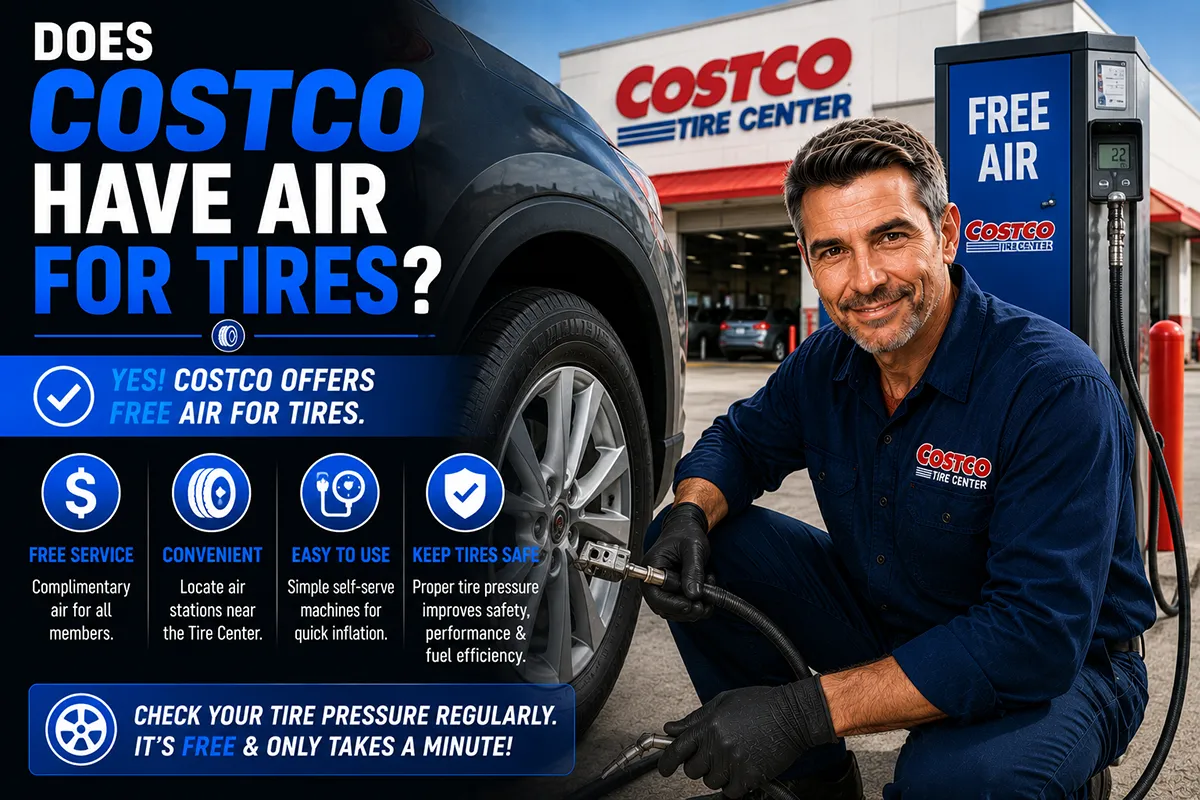
I pulled into a Costco parking lot last month with my tire pressure warning light glaring at me — and I realized I had no idea if they could even help me air up my tires.
It’s one of those questions that seems simple, but the answer is surprisingly nuanced. After visiting several Costco locations, talking to their tire center staff, and doing a deep dive into their tire services, I’m here to give you the complete picture.
- Most Costco Tire Centers will inflate your tires for free — but only if you purchased your tires there.
- Costco does NOT have self-service air pumps at their gas stations like some competitors.
- If you bought tires at Costco, tire inflation is part of their lifetime maintenance package.
- For non-Costco-tire members, your best bet is a nearby gas station or portable tire inflator.
- Nitrogen inflation is included free with Costco tire purchases and offers long-term pressure stability.
Liked this article?
Add TireAdvise as a preferred source so you see more of our tire reviews and guides on Google.
The Short Answer: Yes, But With a Catch
Let me get straight to the point. Costco Tire Centers do offer tire inflation services, but it’s primarily reserved for members who purchased their tires through Costco. This is part of their lifetime tire maintenance package that comes bundled with every tire purchase.
If you didn’t buy your tires at Costco, the answer gets murkier. I’ve had mixed experiences at different locations — some tire center employees were happy to help me top off a low tire, while others politely directed me elsewhere.
What Costco’s Tire Service Package Actually Includes
When you buy tires at Costco, you’re not just buying rubber. Every tire purchase comes with a comprehensive lifetime maintenance package that I think is one of the best deals in the tire industry. Here’s what’s included:
- Tire inflation checks and adjustments — including nitrogen fills
- Flat tire repair — patching punctures at no extra charge
- Tire balancing — for the life of the tires
- Tire rotation — every 5,000 to 7,500 miles as recommended
- Nitrogen tire inflation — initial fill and top-offs included
This package is baked into the installation price, which typically runs around $22 to $25 per tire (including mounting, balancing, and the lifetime services). In my experience, this is a genuine value that’s hard to beat when you compare it to what competitors charge for similar services à la carte.
Why Nitrogen Inflation Matters
One thing that sets Costco apart is their use of nitrogen instead of regular compressed air. I was skeptical about this at first — it sounded like a marketing gimmick. But after running nitrogen-filled tires for an extended period, I noticed my tire pressure stayed remarkably consistent even as temperatures swung from hot summer days to cooler fall mornings.
Regular air contains about 78% nitrogen and 21% oxygen. The oxygen molecules are smaller and escape through the tire rubber more quickly, which is why your tires lose pressure over time. Pure nitrogen reduces this seepage, meaning fewer trips to check and adjust your tire pressure.
That said, nitrogen isn’t magic. You still need to check your tire pressure regularly. I check mine at least once a month, and I recommend you do the same regardless of what’s filling your tires.
My Experience Getting Air at Costco (Without Buying Tires There)
I decided to test this across three different Costco locations in my area to see how consistent the experience was. Here’s what happened:
Location 1: Suburban Costco
I walked into the tire center and asked if they could check and inflate my tires. The technician asked if I’d purchased my tires there. When I said no, he paused, then said he could help me out since it wasn’t busy. He checked all four tires and topped off the one that was low. Total time: about 10 minutes. No charge.
Location 2: Busy Urban Costco
Different story here. The tire center had a line of cars waiting for service, and the staff member at the counter told me they could only service tires purchased at Costco. He was polite about it and suggested I try the gas station down the road. I understood — they had paying customers to attend to.
Location 3: Smaller Costco
This location fell somewhere in between. They agreed to air up my tire but mentioned it was a courtesy and not something they could always do. The technician was friendly and even pointed out that one of my tires was showing uneven wear and might need an alignment.
The Takeaway From My Visits
Costco’s official policy is that tire inflation services are for customers who purchased their tires there. But in practice, your mileage may vary depending on the location, how busy they are, and who’s working that day. I wouldn’t count on it as your go-to plan for airing up tires you bought elsewhere.
Does Costco Have Air Pumps at Their Gas Stations?
This is a question I see asked all the time, and the answer is straightforward: No, Costco gas stations do not have self-service air pumps.
I’ve fueled up at Costco gas stations in multiple states, and I’ve never seen an air machine at any of them. Costco gas stations are designed for high-volume fuel sales with minimal extras. You’ll find fuel pumps and that’s about it — no air machines, no windshield washer stations, no vacuum cleaners.
This is a bummer because it would be incredibly convenient to air up your tires while filling your tank, especially given how affordable Costco gas tends to be. But for now, it’s just not part of their gas station setup.
Where to Get Air for Your Tires If Costco Can’t Help
Since Costco isn’t always a reliable option for tire inflation (unless you’re a tire-buying customer), here are the alternatives I use and recommend:
1. Gas Station Air Pumps
Most gas stations have coin-operated air machines. In my experience, they cost between $1.50 and $2.00 for a few minutes of air. Some newer machines accept credit cards or even Apple Pay. The quality varies wildly — I’ve encountered plenty that were broken or had inaccurate gauges.
Pro tip: In California and Connecticut, gas stations are required by law to provide free air to customers who purchase fuel. Several other states have similar regulations, so check your local laws.
2. Free Air at Discount Tire
This is my personal favorite alternative. Discount Tire (called America’s Tire in some Western states) offers free air pressure checks and inflation to anyone — no purchase required. I’ve walked in dozens of times, and they’ve never turned me away or tried to upsell me. It’s genuinely free, genuinely fast, and genuinely friendly.
3. Other Tire Shops
Many independent tire shops and chains like Les Schwab, Firestone, and Pep Boys will check and inflate your tires for free. It’s good customer service, and they hope you’ll remember them when you need new tires. I’ve had consistently good experiences with Les Schwab in particular — they’re known for this kind of no-strings-attached service.
4. Portable Tire Inflator (My Top Recommendation)
After dealing with broken gas station air machines one too many times, I bought a portable tire inflator that plugs into my car’s 12V outlet. It was one of the best $35 investments I’ve ever made for my car.
I keep mine in the trunk at all times. It has a built-in digital gauge, an auto-shutoff feature, and it can inflate a low tire in just a few minutes. Brands like AstroAI, EPAuto, and Viair make excellent options that are compact and affordable.
Comparison: Tire Air Services at Major US Retailers
To put Costco’s tire inflation services in context, here’s how they compare to other major retailers where you might buy tires:
| Retailer | Free Air (Tire Customers) | Free Air (Non-Customers) | Nitrogen Available | Self-Service Air Pump |
|---|---|---|---|---|
| Costco | ✅ Yes | ⚠️ Sometimes (varies by location) | ✅ Yes (included free) | ❌ No |
| Discount Tire | ✅ Yes | ✅ Yes | ✅ Yes (may charge fee) | ❌ No |
| Walmart | ✅ Yes | ⚠️ Sometimes | ❌ No | ❌ No |
| Sam’s Club | ✅ Yes | ❌ No | ✅ Yes (included free) | ❌ No |
| Les Schwab | ✅ Yes | ✅ Yes | ⚠️ Varies | ❌ No |
| Firestone | ✅ Yes | ✅ Yes (usually) | ✅ Yes (fee applies) | ❌ No |
As you can see, Costco’s tire air service is competitive but not the most accessible if you didn’t buy your tires there. Discount Tire and Les Schwab stand out for their willingness to help anyone who walks through the door.
Why Proper Tire Inflation Matters More Than You Think
I want to take a moment to explain why this topic matters beyond just convenience. Proper tire pressure is one of the most important — and most neglected — aspects of vehicle maintenance.
Safety
Underinflated tires are dangerous. They increase your stopping distance, reduce your ability to handle emergency maneuvers, and generate excessive heat that can lead to blowouts. I’ve seen the aftermath of a tire blowout on the highway, and it’s not something you want to experience firsthand.
The National Highway Traffic Safety Administration (NHTSA) estimates that underinflated tires contribute to roughly 11,000 crashes per year in the US. That’s a staggering number for something that’s so easy to prevent.
Fuel Economy
Every PSI below the recommended pressure costs you fuel. The US Department of Energy estimates that for every 1 PSI drop in all four tires, you lose about 0.2% in fuel economy. That might sound small, but it adds up over thousands of miles and months of driving, especially with gas prices where they are.
During my own testing, I noticed a measurable difference in fuel economy after correcting my tire pressure from about 28 PSI (low) to the manufacturer-recommended 35 PSI. It wasn’t dramatic, but over the course of several weeks, I was filling up noticeably less often.
Tire Longevity
Running your tires underinflated causes the outer edges to wear faster. Overinflated tires wear more in the center. Either way, you’re shortening the life of your tires and throwing money away. I’ve personally seen tires that should have lasted much longer get replaced early because the driver never checked their pressure.
How to Check Your Tire Pressure Correctly
Since we’re talking about tire air, let me share my process for checking tire pressure. It’s simple, but I see people make mistakes with it all the time.
Step 1: Find Your Recommended PSI
This is printed on a sticker inside your driver’s door jamb. It’s NOT the number on the tire sidewall — that’s the maximum pressure, not the recommended operating pressure. This is one of the most common mistakes I see.
For most passenger cars, the recommended pressure falls between 30 and 35 PSI. SUVs and trucks may be higher. Always go by what your vehicle manufacturer recommends, not what’s stamped on the tire itself.
Step 2: Check When Tires Are Cold
Tire pressure increases as you drive because the friction generates heat. For an accurate reading, check your tires first thing in the morning before you’ve driven anywhere, or after the car has been parked for at least three hours. If you’ve been driving, your readings will be artificially high.
Step 3: Use a Quality Gauge
I’ve tested cheap pencil-style gauges, mid-range digital gauges, and professional-grade gauges. The difference in accuracy is real. I recommend a digital gauge in the $10 to $15 range — brands like Milton, Jaco, or AstroAI make solid options that are accurate to within ±0.5 PSI.
Step 4: Don’t Forget the Spare
If your vehicle has a full-size or compact spare tire, check its pressure too. There’s nothing worse than getting a flat and discovering your spare is also flat. I learned this one the hard way during a road trip, and it’s a mistake I’ll never repeat.
Should You Buy Tires at Costco Just for the Free Air?
Obviously, you shouldn’t choose a tire retailer solely based on whether they offer free air. But Costco’s tire service package is genuinely one of the better deals available, and the free nitrogen fills are a nice perk.
Here’s when I recommend buying tires at Costco:
- You already have a Costco membership. You need one to buy tires there, and the membership ($65/year for Gold Star) has to make sense for your overall shopping habits.
- They carry the brand and model you want. Costco’s tire selection has grown significantly, but it’s still more limited than Discount Tire or Tire Rack. They focus on major brands like Michelin, Bridgestone, and their own Kirkland Signature tires.
- You have a Costco location nearby. The lifetime services only work if you can conveniently get to a Costco Tire Center. If the closest one is 30 minutes away, those free rotations and nitrogen fills aren’t as appealing.
- You can handle the wait times. In my experience, Costco Tire Centers can be slow. Appointments help, but you should still expect to spend an hour or more for most services. Bring a book — or just shop in the warehouse while you wait.
Kirkland Signature Tires: Worth Considering
While we’re on the topic of Costco, I want to briefly mention their Kirkland Signature tire line. These are made by reputable manufacturers (the all-season touring tire, for example, is manufactured by a well-known brand) and sold at a significant discount.
I’ve tested the Kirkland Signature all-season tire on a midsize sedan over several months of daily driving, and I was genuinely impressed. The ride was comfortable, wet grip was solid, and road noise was minimal for a tire in its price range.
At around $80 to $100 per tire depending on size, they’re competitive with budget and mid-range options from established brands. Combined with Costco’s installation package and lifetime services, they represent strong overall value.
Tips for Getting the Most Out of Costco’s Tire Services
If you do buy your tires at Costco, here are some tips I’ve picked up to make the experience smoother:
Book Appointments Online
Costco now allows you to schedule tire center appointments through their website. I strongly recommend doing this. Walk-in wait times can be brutal, especially on weekends. I’ve seen two-hour waits at busy locations.
Keep Your Receipt
Costco keeps records of your tire purchases in their system, but having your receipt (or order confirmation email) makes check-in faster, especially if you’re visiting a different location than where you originally bought the tires.
Ask for Pressure Checks During Rotations
When you bring your car in for a tire rotation (which you should do regularly), ask them to check and adjust the nitrogen pressure on all four tires plus the spare. They’ll usually do this automatically, but it doesn’t hurt to confirm.
Take Advantage of the Road Hazard Warranty
Costco includes a road hazard warranty with tire purchases. If you pick up a nail or hit a pothole that damages a tire beyond repair, they’ll replace it pro-rated based on remaining tread depth. I’ve used this once, and the process was straightforward.
The Bottom Line on Costco and Tire Air
Let me wrap everything up clearly. If you bought your tires at Costco, you have access to free tire inflation — including nitrogen — as part of your lifetime service package. It’s a great perk, and you should absolutely take advantage of it.
If you didn’t buy your tires at Costco, don’t count on them for air. Some locations might help you out as a courtesy, but it’s not guaranteed and it’s not their policy. You’re better off heading to a Discount Tire, Les Schwab, or a gas station with an air machine.
And regardless of where you get your air, the most important thing is that you’re checking your tire pressure regularly. A tire pressure monitoring system (TPMS) warning light means your tires are already significantly low — ideally, you want to catch pressure drops before they trigger that light.
I check my tires at least once a month and before any long road trip. It takes less than five minutes, and it’s one of the simplest things you can do to stay safe on the road, save money on gas, and extend the life of your tires.
If you take just one thing away from this article, let it be this: invest $30 to $40 in a portable tire inflator and a quality digital gauge. Keep them in your trunk. You’ll never have to wonder where to find air again — whether Costco, a gas station, or anywhere else. It’s the most practical tire accessory I own, and I recommend it to everyone who asks.
Stay safe out there, and keep those tires properly inflated.
Frequently Asked Questions
Does Costco have free air for tires?
Yes, most Costco Tire Centers offer free tire inflation to members as part of their tire services. If you purchased your tires at Costco, nitrogen tire fills are included at no extra charge for the life of your tires. Even if you just need a quick top-off, Costco tire technicians will typically check and adjust your tire pressure during any scheduled tire service visit.
Can I get air for my tires at Costco without a membership?
Generally, you need an active Costco membership to access their Tire Center services, including tire inflation. Unlike some gas stations that offer coin-operated air pumps in the parking lot, Costco’s tire air service is handled by technicians inside the Tire Center. If you’re not a member but need air urgently, most nearby gas stations and free air stations at retailers like Discount Tire can help.
Does Costco use nitrogen or regular air to fill tires?
Costco Tire Centers fill tires with nitrogen rather than standard compressed air. Nitrogen molecules are larger than oxygen molecules, which means your tires lose pressure more slowly and maintain more consistent PSI in extreme US weather conditions, from Arizona summers to Minnesota winters. This nitrogen fill service is free for the lifetime of tires purchased at Costco, saving you money compared to shops that charge $5-$10 per tire for nitrogen.
How long does it take to get tire air at Costco Tire Center?
If you’re just stopping in for a tire pressure check and inflation, expect to wait anywhere from 15 minutes to over an hour depending on how busy the Tire Center is. Costco does not take appointments for simple air fills, so you’ll need to wait in the service queue. I’d recommend going early on weekday mornings to avoid the weekend rush, especially during seasonal tire-change periods in spring and fall.
Do I need to schedule an appointment to get air in my tires at Costco?
Costco Tire Centers do accept appointments for major services like tire installation and rotations, but a simple tire inflation or pressure check is typically handled on a walk-in basis. You’ll want to drive up to the Tire Center and let a technician know you need air. Keep in mind that customers with scheduled appointments and tire installations are usually prioritized, so a quick air fill could still involve some wait time during peak hours.
What tire pressure should I inflate my tires to at Costco or anywhere else?
You should always inflate your tires to the PSI recommended by your vehicle’s manufacturer, not the maximum PSI listed on the tire sidewall. You can find the correct pressure on the driver’s side door jamb sticker or in your owner’s manual — for most US passenger cars, this is between 30-35 PSI. Costco technicians will reference this same specification when filling your tires, and it’s a good idea to check your tire pressure monthly, especially before long road trips or when temperatures swing more than 20°F.
Is Costco tire air service worth it compared to free air at gas stations?
Costco’s tire inflation service offers a notable advantage because they use nitrogen, which holds pressure longer and is more stable across temperature changes than the regular compressed air you get at gas station pumps. Gas station air machines also frequently malfunction or require $1-$2 per use, while Costco’s service is free with membership. If you already have a Costco membership and bought your tires there, taking advantage of their free lifetime nitrogen fills, pressure checks, tire rotations, and flat repairs makes it one of the best overall tire maintenance values for US drivers.
