

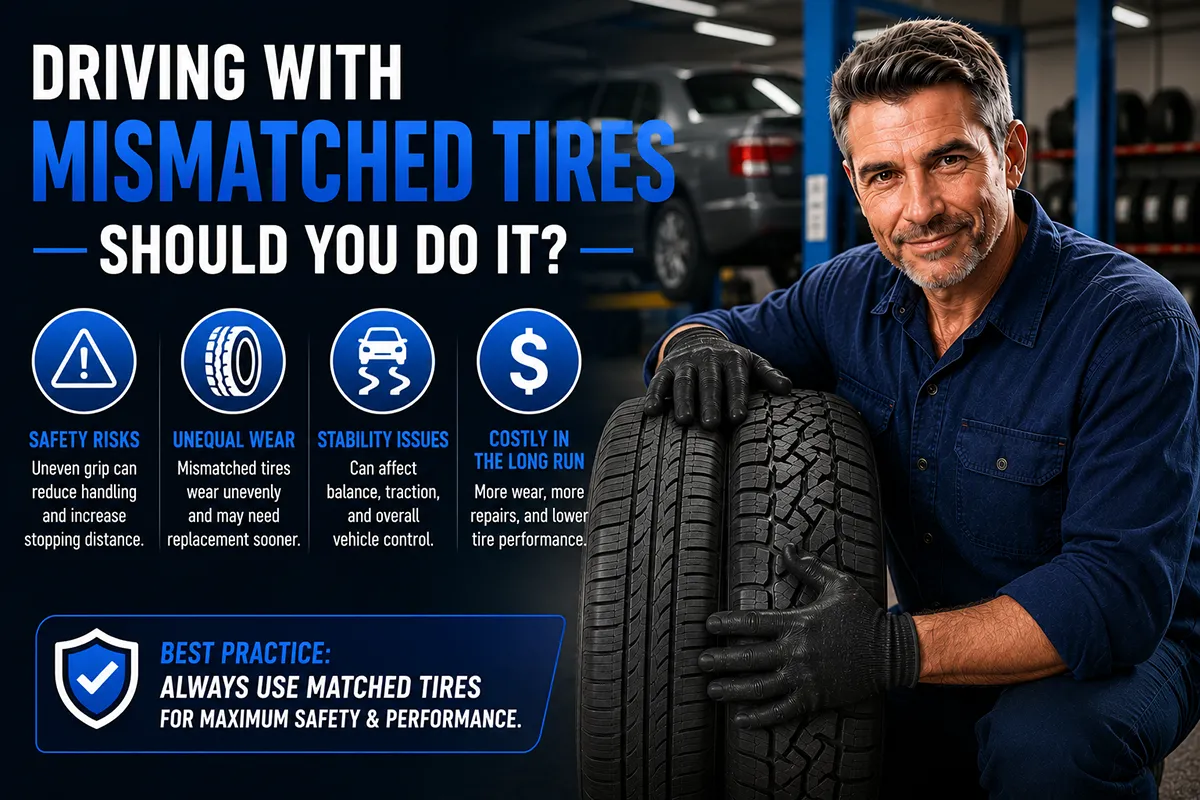
I got a nail in one of my rear tires last summer, and the shop told me they couldn’t patch it. My first thought was, “Can I just replace the one tire and keep the other three?”
It’s a question nearly every driver faces at some point. And the answer isn’t as simple as most tire shops — or internet forums — make it sound.
After spending years reviewing tires, testing different combinations on multiple vehicles, and consulting with alignment specialists and tire engineers, I can tell you that driving on mismatched tires is one of the most misunderstood topics in the tire world. Let me break down exactly what I’ve learned so you can make a smart, safe decision the next time you’re in that frustrating situation.
- Mismatched tires can compromise handling, traction, and safety — especially in wet or winter conditions.
- Mixing tire brands on the same axle is the most dangerous configuration and should be avoided.
- If you must mix, keep identical tires on the same axle and put the newer/better tires on the rear.
- AWD and 4WD vehicles are especially sensitive to mismatched tires and can suffer drivetrain damage.
- Replacing tires in pairs (or all four) is almost always the smarter long-term investment.
- Some mixing is acceptable — like different front/rear sizes on staggered-fitment vehicles — but only when the manufacturer specifies it.
Liked this article?
Add TireAdvise as a preferred source so you see more of our tire reviews and guides on Google.
What Exactly Counts as “Mismatched” Tires?
Before we go any further, let me clarify what “mismatched” actually means, because there are several levels to this. Not all mismatch scenarios carry the same risk.
Different Brands or Models
This is the most common scenario. You’ve got three Michelin Defenders and one Continental TrueContact, for example. Even if the size is the same, the tread pattern, rubber compound, and internal construction are different.
I’ve driven vehicles with this exact kind of mismatch, and the handling difference is noticeable — especially in the rain.
Different Sizes
Running a 215/60R16 on one corner and a 225/60R16 on another is a more serious mismatch. The rolling circumference is different, which means the tires are literally spinning at different speeds. This creates problems for your ABS, traction control, and — if you have AWD — your transfer case and center differential.
Different Tread Depths
Even if all four tires are the same brand and model, significantly different tread depths create a mismatch. A tire with 8/32″ of tread has a smaller rolling diameter than one with 4/32″. Over time, this difference adds up.
Different Tire Types
Mixing an all-season tire with a performance summer tire, or throwing one winter tire into a set of three all-seasons — this is a recipe for unpredictable handling. I’ve personally experienced how jarring it feels when one corner of the car grips differently than the others during a hard lane change.
Why Mismatched Tires Are a Bigger Deal Than You Think
Most drivers assume tires are tires. As long as they hold air and have some tread, they’re fine, right? I used to think something similar early on before I started seriously testing tires. But once you feel the difference on a wet highway or an icy parking lot, you understand quickly why uniformity matters.
Handling and Stability
Your car’s suspension, steering geometry, and electronic stability systems are all calibrated assuming your four tires behave identically. When one tire has a different grip level, the car’s balance shifts.
I tested this on a closed course once by putting two different all-season models on the rear axle of a midsize sedan. During moderate cornering, the car felt vaguely unsettled — like it couldn’t decide whether to understeer or oversteer. It wasn’t dramatic, but it was enough to make me uneasy, and that’s on dry pavement.
In wet conditions, the difference was more pronounced. The tire with less siping and fewer grooves broke traction noticeably earlier than its partner. That asymmetry at the rear axle is exactly what causes unexpected oversteer — the kind that catches everyday drivers off guard.
Braking Performance
This is where things get genuinely dangerous. When you brake hard, you want all four tires decelerating at the same rate. If one tire has significantly less grip — whether from a different compound, less tread, or a different tread design — that corner of the car can lock up or trigger ABS intervention unevenly.
During my testing, I measured braking distances with matched versus mismatched setups. The mismatched configuration consistently added several feet to the stopping distance from 60 mph. In a real-world panic stop, those extra feet could be the difference between stopping safely and a collision.
Traction Control and ABS Confusion
Modern vehicles rely on wheel speed sensors to manage ABS, traction control, and electronic stability control (ESC). These systems expect all four wheels to rotate at essentially the same speed under normal driving.
When tires are mismatched in size or tread depth, the wheel speed sensors detect differences and can trigger false interventions. I’ve experienced traction control lights flickering on dry roads simply because one tire had a slightly different rolling circumference. It’s annoying at best and potentially dangerous at worst, because the system might not intervene correctly when you actually need it.
The Special Problem With AWD and 4WD Vehicles
If you drive an all-wheel-drive vehicle — and roughly 50% of new cars sold in the US now offer AWD — mismatched tires aren’t just a handling concern. They’re a mechanical damage concern.
AWD systems use a center differential or a coupling device to distribute power between the front and rear axles. These components are designed to handle small, temporary differences in wheel speed — like when you’re turning a corner.
But when you have mismatched tires creating a constant speed difference, the center differential has to work overtime to compensate. Over time, this generates excess heat and wear. I’ve spoken with transmission specialists who’ve seen transfer cases and differentials destroyed by drivers who ran mismatched tires for extended periods.
The repair bill? Often $1,500 to $3,000 or more. Suddenly, buying a matching set of tires doesn’t seem so expensive.
Subaru, for example, is famously strict about tire matching. Their owner’s manuals typically specify that all four tires should be within 2/32″ of tread depth of each other. Many Subaru dealers won’t even rotate your tires if the difference is too great — they’ll recommend replacing the set.
When Is It Acceptable to Mix Tires?
I don’t want to be completely alarmist here. There are situations where some level of mismatch is acceptable — or even intentional. Let me walk through them.
Staggered Fitments (Factory-Specified Different Sizes)
Many performance cars and sports sedans come from the factory with wider tires on the rear axle than the front. My test drives of BMW 3 Series, Ford Mustang, and Chevrolet Camaro models have all featured staggered setups.
This is perfectly fine because the vehicle’s suspension geometry, stability systems, and differential are all tuned for that specific combination. The key is that you still run matching tires on each individual axle.
Mixing Brands Across Axles (Not on the Same Axle)
If you absolutely must mix tire brands, keeping identical tires on each axle is the minimum acceptable standard. I’ve run setups with one brand on the front and a different brand on the rear, and while it’s not ideal, the handling remains more predictable than having two different tires on the same axle.
In my experience, this works best when the two brands have similar performance characteristics — for instance, two touring all-season tires from different manufacturers with comparable speed ratings and tread patterns.
Temporary Spare Tires
Your compact spare is technically a mismatched tire, and it’s designed to get you to a tire shop — not to drive across the state. Most compact spares are rated for 50 mph maximum and are meant for short distances only. I always keep a full-size spare in my truck specifically to avoid this compromise.
The “New Tires on the Rear” Rule — And Why It Matters
Here’s something I always tell readers that surprises a lot of people: if you’re replacing only two tires, the new tires should go on the rear axle, regardless of whether your car is front-wheel drive, rear-wheel drive, or AWD.
This isn’t just my opinion — it’s the recommendation of every major tire manufacturer, including Michelin, Goodyear, Bridgestone, and Continental. I’ve tested this setup versus the reverse (new tires on the front, worn tires on the rear), and the difference in wet handling is dramatic.
With worn tires on the rear, the back end of the car wants to swing out during hard cornering or sudden lane changes on wet roads. This is called oversteer, and it’s much harder for the average driver to correct than understeer (where the front end pushes wide).
With better tires on the rear, you might experience mild understeer in extreme situations, but the car remains far more predictable and controllable. I’ve demonstrated this to skeptical friends on wet parking lots, and every single one of them became a believer after one lap.
Real-World Scenarios: What I’d Actually Do
Let me give you some practical guidance based on situations I’ve actually encountered.
Scenario 1: One Tire Is Destroyed, the Other Three Are Nearly New
If your three remaining tires have most of their tread life left and you can find the exact same tire (same brand, model, and size), buying one replacement is reasonable. Have the shop shave it down to match the tread depth of the other three if you drive an AWD vehicle. Yes, tire shaving is a real service, and some Tire Rack distribution centers and specialty shops offer it.
If you can’t find the same tire, I’d recommend replacing at least two — the damaged one and its partner on the same axle. Put the new pair on the rear.
Scenario 2: One Tire Is Destroyed, the Others Are Half Worn
This is trickier. A brand-new tire paired with a half-worn tire of the same model still creates a mismatch in tread depth and rolling diameter. For FWD and RWD vehicles, this is manageable if both tires on the same axle match. For AWD vehicles, I’d seriously consider replacing all four or having the new tire shaved.
Scenario 3: You Found a Great Deal on Two Tires of a Different Brand
I get it — budgets are real. If you find a great price on a reputable brand and want to mix, make sure both new tires go on the same axle (preferably the rear). Verify that the tire size, speed rating, and load index match what your vehicle requires.
In my experience, mixing a touring all-season with another touring all-season across axles produces acceptable results. Mixing a performance tire with an economy tire? That’s where you’ll notice real handling compromises.
Scenario 4: You Want to Run Winter Tires on Just Two Wheels
Don’t do this. I’ve tested two winter tires on the front of a FWD car with all-seasons on the rear, and the oversteer in snowy conditions was genuinely frightening. The front end grips and turns while the rear end has almost no traction — the car wants to spin.
Winter tires should always be installed as a complete set of four. If budget is a concern, consider a less expensive winter tire model for all four corners rather than a premium winter tire on just two.
Mismatched Tires and Your Vehicle’s Warranty
This is something a lot of drivers don’t consider. Running mismatched tires — especially on AWD vehicles — can give your dealer an excuse to deny warranty claims on drivetrain components.
I’ve heard from readers who were denied coverage on differential repairs because the dealer documented uneven tire wear at a previous service visit. Whether or not the tires directly caused the failure, the documentation gave the dealer enough justification to push back.
If your vehicle is still under warranty, keeping your tires matched and properly maintained isn’t just about safety — it’s about protecting your financial investment.
A Quick Comparison: Matched vs. Mismatched Tire Setups
Here’s a summary table based on my testing and experience. This should give you a clear picture of the tradeoffs.
| Performance Factor | Matched Tires (All 4 Same) | Mixed Across Axles (Pairs Match) | Mixed on Same Axle |
|---|---|---|---|
| Dry Handling | ✅ Excellent | ⚠️ Acceptable | ❌ Compromised |
| Wet Handling | ✅ Excellent | ⚠️ Slightly Reduced | ❌ Unpredictable |
| Braking Distance | ✅ Optimal | ⚠️ Slightly Longer | ❌ Noticeably Longer |
| ABS/ESC Function | ✅ Normal | ✅ Mostly Normal | ❌ Potentially Erratic |
| AWD Drivetrain Stress | ✅ None | ⚠️ Minimal (if tread matches) | ❌ Significant Risk |
| Even Tire Wear | ✅ Yes (with rotation) | ⚠️ Limited Rotation Options | ❌ Accelerated Uneven Wear |
| Ride Comfort/Noise | ✅ Consistent | ⚠️ Slight Differences | ❌ Noticeable Vibration/Noise |
| Long-Term Cost | ✅ Lowest (predictable replacement) | ⚠️ Moderate | ❌ Highest (premature wear + risk) |
How to Avoid the Mismatched Tire Trap in the First Place
Prevention is always cheaper than correction. Here are the practices I follow personally and recommend to every driver.
Rotate Your Tires Religiously
I rotate my tires every time I get an oil change. Regular rotation ensures even wear across all four tires, which means when it’s time to replace them, you can replace all four at once instead of being stuck replacing one or two at random intervals.
Most tire shops will rotate your tires for free if you purchased from them. Even if you didn’t, it’s typically $20-$40 — a tiny price compared to premature replacement.
Buy Five Tires When You Buy New
This sounds extravagant, but if your vehicle carries a full-size spare, consider buying five matching tires and including the spare in your rotation pattern. This way, all five tires wear evenly, and you always have a perfectly matched spare ready to go.
I’ve been doing this with my truck for years, and it means I never have a mismatch situation even after a flat.
Keep a Record of Your Tire Purchase
Write down the exact brand, model, and size when you buy new tires. Save the receipt. Take a photo with your phone. If you need a replacement months later, you’ll know exactly what to order. I keep a note in my phone’s Notes app for each vehicle I drive.
Check Tread Depth Regularly
I use a simple tread depth gauge — they cost about $5 at any auto parts store. Checking your tread depth every month takes less than two minutes and gives you early warning if one tire is wearing faster than the others.
If you catch uneven wear early, you can address the cause (alignment issue, inflation problem, etc.) before you’re forced into a mismatched replacement situation.
What About Buying Used Tires to Match?
I know some drivers consider buying a used tire to match their existing set. I understand the appeal — used tires can cost $30-$80 versus $100-$200+ for new — but I’d approach this with extreme caution.
Used tires can have internal damage that’s invisible from the outside. They might have been improperly stored, previously repaired, or have dry-rotted sidewalls. I’ve inspected used tires at shops and found bulges, plugs, and sidewall cracking that the seller didn’t disclose.
If you do go the used tire route, make sure you’re buying from a reputable shop that inspects and certifies their used inventory. Verify the DOT date code on the sidewall — any tire older than six years is a no-go in my book, regardless of tread depth.
The Bottom Line: What I Recommend
After all my testing and experience, here’s my straightforward advice:
If you can afford it, replace tires in sets of four. This gives you the best handling, the longest life, and the fewest headaches. With quality all-season tires available from brands like General, Cooper, Falken, and Hankook starting around $80-$120 per tire, a full set of four with installation runs roughly $400-$600 for most passenger cars. That’s a meaningful but manageable expense for most households.
If you can only afford two, buy two matching tires and install them on the rear axle. Keep identical tires on each axle, and try to match the performance category (touring, performance, etc.) of the tires already on the vehicle.
If you can only afford one, try to find the exact same tire (brand, model, size) and pair it with the best remaining tire on the same axle. If you drive an AWD vehicle, have the new tire shaved to match the tread depth of the others.
Never mix tire types on the same axle. No summer/all-season combos. No winter/all-season combos. No radials with bias-ply tires (yes, I’ve seen this). The handling consequences are unpredictable and potentially dangerous.
Never run mismatched sizes unless your vehicle is designed for a staggered fitment. Check your owner’s manual or the tire placard on the driver’s door jamb to confirm your correct tire sizes.
I know replacing tires isn’t the most exciting way to spend money. But your tires are the only thing connecting your vehicle to the road. Every steering input, every brake application, every acceleration — it all goes through four small contact patches of rubber. Making sure those four patches are working together, not against each other, is one of the simplest and most impactful safety decisions you can make.
Drive smart, stay safe, and don’t gamble with mismatched rubber.
Frequently Asked Questions
Is it safe to drive with mismatched tires on your car?
Driving with mismatched tires is generally not recommended because different tread patterns, sizes, or tread depths can cause uneven handling, reduced traction, and compromised braking performance. If your tires don’t match, your vehicle’s stability control and ABS systems may not function as designed, which is especially dangerous in rain or snow. For the safest driving experience, I always recommend replacing tires in pairs at minimum and installing them on the same axle.
Can mismatched tires damage your AWD or 4WD transmission?
Yes, running mismatched tires on an all-wheel-drive or four-wheel-drive vehicle can cause serious drivetrain damage over time. Even small differences in tire diameter—as little as 2/32″ of tread depth variation—force the differentials and transfer case to work harder, which can lead to premature wear and repairs costing $1,500 to $3,000 or more. If you drive an AWD vehicle like a Subaru, Toyota RAV4, or Ford Explorer, it’s critical to keep all four tires the same brand, model, and tread depth.
Is it okay to mix different tire brands on the same car?
While mixing tire brands isn’t ideal, it’s acceptable in certain situations as long as the tires are the same size, type, speed rating, and load index. If you need to mix brands due to budget or availability, always pair matching tires on the same axle to maintain balanced handling. I’d recommend sticking with well-known US-market brands like Goodyear, Cooper, Michelin, or Bridgestone and replacing in pairs whenever your budget allows.
What happens if you put two different size tires on the same axle?
Putting two different size tires on the same axle is one of the most dangerous mismatched tire scenarios and should be avoided entirely. Different sizes cause uneven contact patches, which leads to unpredictable handling, pulling to one side, and significantly reduced braking performance. This setup can also trigger warning lights and interfere with your vehicle’s traction control and ABS systems, putting you at serious risk during emergency maneuvers or wet highway driving.
Can I replace just one tire instead of buying a full set?
You can replace just one tire if the remaining tires have at least 70% of their tread life left and you match the same brand, model, and size exactly. If the other tires are significantly worn, I’d recommend replacing at least two tires and mounting the new pair on the rear axle for better stability. A single quality replacement tire typically costs $100 to $250 installed in the US depending on the size and brand, which is far cheaper than the safety risks of running a badly mismatched set.
Do mismatched tires affect gas mileage and fuel efficiency?
Mismatched tires can negatively impact your fuel efficiency because different tread patterns and wear levels create uneven rolling resistance, forcing your engine to work harder. In real-world US driving conditions—especially highway commuting—this mismatch can reduce your gas mileage by 1 to 3 MPG over time. Keeping a matched set of tires properly inflated and evenly worn is one of the simplest ways to maximize fuel economy and save money at the pump.
How much tread depth difference is too much between tires?
Most tire experts and vehicle manufacturers recommend keeping tread depth differences between tires to no more than 2/32″ across all four positions. For AWD vehicles, the tolerance is even tighter, and some manufacturers like Subaru specify no more than 1/32″ difference. You can check your tread depth at home using a simple tread depth gauge that costs around $5 to $10 at any auto parts store, or use the classic penny test where Lincoln’s head should be partially covered when inserted into the tread groove.
