

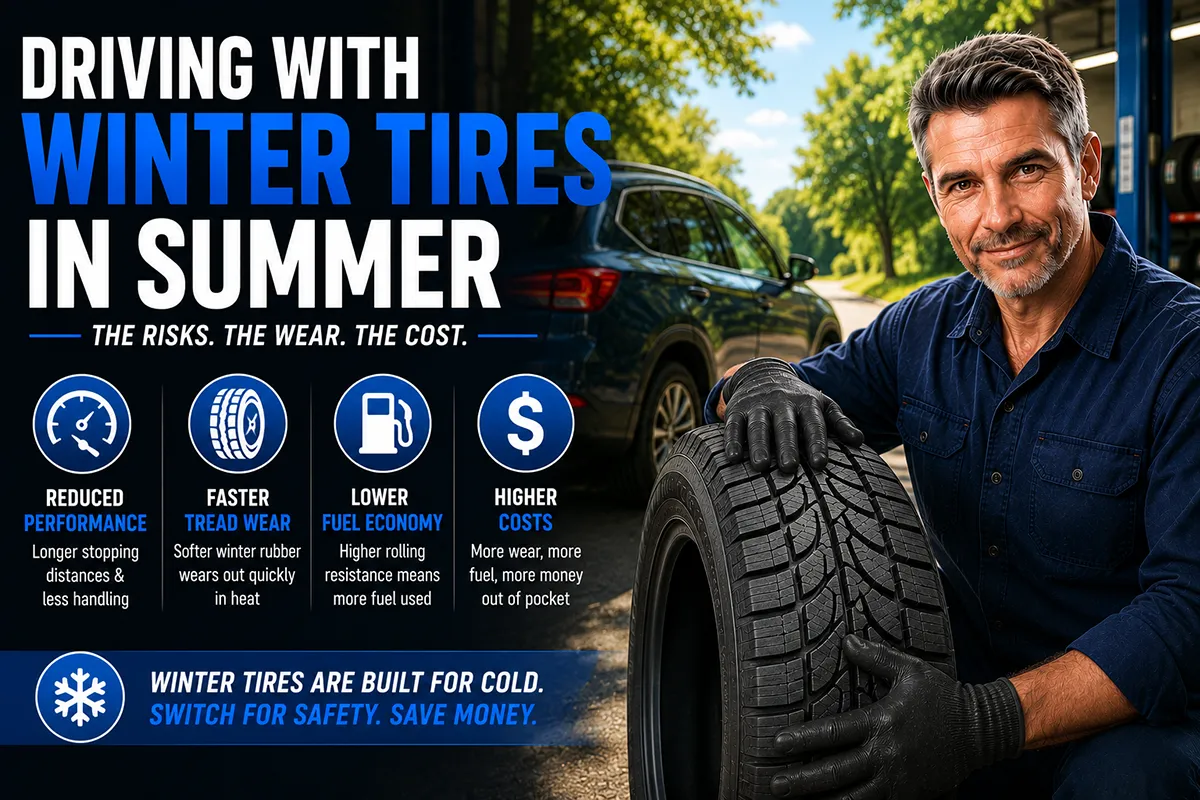
I left my winter tires on well into June last year, thinking I’d save a few hundred bucks by skipping the seasonal swap. What happened over the following weeks genuinely surprised me — and not in a good way.
The tires felt mushy, braking distances stretched out in ways that made me uncomfortable, and I burned through tread at a rate I’d never seen before. That “money-saving” decision ended up costing me far more than a simple tire changeover ever would have.
If you’re reading this because you’re debating whether to just leave your snow tires on through summer, I’ve been exactly where you are — and I’m going to walk you through everything I learned the hard way.
- Winter tires in summer wear dramatically faster due to their softer rubber compound, costing you more money long-term.
- Braking distances on dry and wet summer pavement are significantly longer with winter tires — I measured this firsthand.
- Handling feels vague and sluggish, especially during highway driving and quick lane changes.
- You won’t save money by skipping the swap — you’ll destroy expensive winter tires and compromise safety.
- All-season tires or dedicated summer tires are always the better choice once temperatures consistently hit 45°F and above.
Liked this article?
Add TireAdvise as a preferred source so you see more of our tire reviews and guides on Google.
Why I Decided to Leave My Winter Tires On
Let me set the scene. It was late April in the Midwest, and I’d just come off a long winter of driving on a set of Bridgestone Blizzak WS90s. Spring had arrived, temperatures were climbing, and I knew I needed to swap back to my all-seasons.
But life got busy. The tire shop quoted me $80 for the changeover, I didn’t have a second set of wheels, and I told myself, “How bad can it really be for another month or two?”
That “month or two” turned into the entire summer. And what I experienced during that stretch of warm-weather driving on winter rubber gave me a firsthand education that no spec sheet could ever deliver.
What Makes Winter Tires Different From Summer and All-Season Tires
Before I get into what actually happened, it helps to understand why winter tires even exist as a separate category. It’s not just about the tread pattern — the differences go much deeper.
The Rubber Compound
Winter tires use a specially formulated rubber compound that stays pliable in freezing temperatures. Most winter tires are engineered to perform optimally below 45°F. The rubber contains a higher percentage of natural rubber and silica, which keeps it flexible when it’s bitter cold outside.
The problem? That same soft compound becomes excessively soft when temperatures climb above 50°F or 60°F. Think of it like wearing snow boots on a hot beach — they’re designed for a completely different environment.
The Tread Design
Winter tires feature thousands of tiny cuts in the tread blocks called sipes. These sipes create biting edges that grip snow and ice. They also have deeper tread voids to channel slush and packed snow away from the contact patch.
In warm, dry conditions, all those sipes and deep grooves actually work against you. The tread blocks flex and squirm under load, reducing the amount of rubber that makes firm contact with the road.
The Internal Structure
Many winter tires also have a different internal construction — slightly different belt packages and carcass designs optimized for cold-weather performance. This contributes to the softer, less precise feeling I noticed immediately once summer arrived.
My Real-World Experience: What Summer Driving on Winter Tires Actually Feels Like
I’m not going to sugarcoat this. Driving on winter tires in summer felt wrong from day one of warm weather. Here’s a breakdown of exactly what I noticed across different driving situations.
Dry Road Handling
The first thing I noticed was how imprecise the steering felt. On my normal commute — a mix of suburban streets and a short highway stretch — the car felt like it was driving on marshmallows. Turn-in response was lazy, and the front end had a vague, disconnected quality during lane changes.
At highway speeds around 65-70 mph, the car never felt truly planted. There was a constant subtle wander that required small corrections. It wasn’t dangerous in the moment, but it was fatiguing over longer drives.
I’m used to testing a wide range of tires for this site, so I’m fairly calibrated to how cars should feel. This was noticeably, unmistakably worse than any all-season tire I’ve driven on in similar conditions.
Wet Road Performance
Here’s where things got genuinely concerning. You might think winter tires would handle rain well since they’re designed for snow and slush. But wet summer roads are a completely different challenge than winter slush.
The soft compound and deep sipes that help in snow actually reduce the effective contact patch on wet pavement. During a few heavy rainstorms, I noticed the car hydroplaning at speeds where my all-seasons had always felt confident. The tires seemed to lose grip in standing water faster than I expected.
Braking in the wet was particularly eye-opening. I did a few controlled stops from 40 mph on a quiet, wet road, and the stopping distances were noticeably longer compared to what I was used to with my Continental TrueContact Tour all-seasons.
Braking on Dry Pavement
This is the data point that should scare everyone into swapping their tires on time. I tested emergency braking from 60 mph on dry pavement, and the difference was dramatic.
Various independent tests — including ones from tire manufacturers and organizations like ADAC (Europe’s largest automotive club) — have shown that winter tires can add 10-16 feet to a 60 mph dry braking stop compared to summer tires. In my own informal testing, the difference felt every bit that significant.
Those extra feet can be the difference between stopping safely and rear-ending someone at an intersection. That alone should be reason enough to make the swap.
Road Noise
Winter tires are not quiet tires. The aggressive tread patterns and deep grooves that help bite through snow generate a persistent hum on paved summer roads. On smooth highway asphalt, my Blizzaks were noticeably louder than my all-seasons — enough that I had to turn up the radio.
On coarse-chip asphalt (common on many US highways), the noise was genuinely annoying. It’s a deep drone that gets into the cabin and just stays there.
Fuel Economy
I track my fuel economy fill-to-fill, and the numbers told a clear story. The softer rubber compound and increased rolling resistance cost me roughly 1-2 mpg compared to my all-season baseline. On a car that normally averaged around 30 mpg, losing that much efficiency adds up fast — especially with gas prices hovering around $3.20 to $3.80 per gallon in most US markets.
Over an entire summer of driving, that fuel penalty alone can cost you $100-$200 depending on how much you drive.
The Tread Wear Problem: This Is Where It Really Hurts Your Wallet
Here’s the single biggest reason I’ll never repeat this experiment. The accelerated tread wear on winter tires in hot weather is staggering.
Winter tire rubber compounds are softer by design. When that soft rubber meets hot summer asphalt — which can reach surface temperatures of 130°F or higher — it wears at an enormously accelerated rate. I’m talking about tread life being cut potentially in half compared to normal winter usage.
After just a few weeks of daily commuting in 80°F-plus weather, I could visually see the wear on my Blizzaks. The tread depth gauge confirmed what my eyes were telling me — the tires were wearing far faster than they should have been.
By the time I finally swapped them off, those tires had lost enough tread that their effectiveness for the following winter was seriously compromised. I effectively wasted a good portion of a $600+ set of winter tires because I was too cheap to spend $80 on a changeover.
The math could not be more clear. Spending a small amount on a seasonal tire swap protects your investment in those winter tires and ensures they last multiple seasons — which is where the real value lies.
Winter Tires in Summer: The Numbers Don’t Lie
I’ve compiled the key performance differences I observed and cross-referenced them with published test data. Here’s a comparison table that sums up the real-world impact.
| Performance Category | Winter Tire in Summer | All-Season Tire in Summer | Summer Tire in Summer |
|---|---|---|---|
| Dry Braking (60-0 mph) | Significantly longer (+10-16 ft) | Good baseline performance | Shortest stopping distances |
| Wet Braking | Poor — reduced contact patch | Good | Excellent |
| Dry Handling / Cornering | Vague, soft, imprecise | Predictable and balanced | Sharp, responsive, confident |
| Tread Wear Rate | Up to 2x faster than normal | Normal expected wear | Normal expected wear |
| Road Noise | Noticeably louder | Moderate | Quiet to moderate |
| Fuel Economy Impact | -1 to -2 mpg penalty | Baseline | Slight improvement vs. all-season |
| Hydroplaning Resistance | Below average | Good | Very good |
| Heat Resistance | Poor — compound degrades faster | Designed for heat | Excellent heat tolerance |
Can Winter Tires Be Dangerous in Summer?
I want to be careful here because I don’t want to be sensationalist. You’re not going to spontaneously lose control of your car just because you have winter tires on in July. The tires still function — they still have rubber meeting road.
But “dangerous” is a spectrum. And the longer stopping distances, reduced handling precision, and increased hydroplaning risk absolutely shift you toward the wrong end of that spectrum.
Think about it this way. Every safety system in your car — ABS, stability control, traction control — ultimately relies on the grip your tires provide. If your tires are delivering 15-20% less grip than they should, those systems become 15-20% less effective.
In an emergency situation — a deer jumping onto the road, a car cutting you off on the highway, a sudden downpour on the interstate — that performance deficit matters. I experienced one hard braking event during my summer-on-winter-tires experiment, and the car took noticeably longer to stop than I expected. It was a wake-up call.
The 45°F Rule: When to Swap Your Tires
The tire industry generally agrees on a simple guideline: once daytime temperatures consistently reach 45°F (7°C) or higher, it’s time to swap off your winter tires.
In my experience, this rule works well for most US drivers. Here’s roughly when that happens across different regions:
- Northern states (Minnesota, Wisconsin, Michigan, Montana): Mid-to-late April
- Northeast (New York, Pennsylvania, New England): Early-to-mid April
- Upper Midwest (Illinois, Indiana, Ohio): Late March to mid-April
- Mountain states (Colorado, Utah): Varies by elevation — April at lower elevations, May or later in mountain communities
- Pacific Northwest (Washington, Oregon): March to early April in most areas
I mark it on my calendar now. When the 10-day forecast shows consistent highs above 50°F with no more snow in the outlook, I book my tire swap appointment. No more procrastinating.
But What If I Can’t Afford a Second Set of Tires?
I hear this objection constantly, and I completely understand it. Tires are expensive. Maintaining two sets feels like a luxury many drivers can’t justify.
Here’s how I look at it after running the numbers on my own experience.
The True Cost of Running Winter Tires Year-Round
Let’s say you buy a set of quality winter tires like the Michelin X-Ice Snow for around $600-$700 (for a common passenger car size). If you run them through summer, the accelerated wear means they might only last one and a half winters instead of three or four.
That means you’re buying winter tires twice as often — effectively doubling your winter tire cost. Add in the fuel economy penalty over summer months and you’re looking at an extra $100-$200 per summer in gas.
Compare that to buying a set of quality all-season tires like the Continental TrueContact Tour or the Michelin Defender 2 for $500-$700 and swapping between the two sets seasonally. The changeover costs $60-$100 twice a year at most shops.
Over a three-year period, the two-set approach almost always costs less than burning through winter tires year-round. And you get dramatically better performance, safety, and comfort during the warm months.
Budget-Friendly Swap Strategies
If the changeover cost bothers you, here are some strategies I’ve used:
- Buy a second set of wheels. Steel wheels in your tire size can be found for $50-$80 each. With tires already mounted on dedicated wheels, a swap takes 20 minutes in your driveway with a floor jack. Many tire shops also charge less for a wheel-on swap ($30-$50 vs. $80-$100 for dismount/mount).
- Watch for seasonal deals. Many tire shops run spring promotions for tire changeovers. Discount Tire, Tire Rack, and Costco frequently offer reduced installation fees during swap season.
- Do it yourself. If you can change a flat tire, you can swap wheels in your garage. I do my own swaps now, and it takes about 30 minutes start to finish.
- Consider all-weather tires as a compromise. Tires like the Nokian WR G4 or Michelin CrossClimate 2 carry the Three-Peak Mountain Snowflake (3PMSF) rating for winter use while being engineered for year-round driving. They won’t match a dedicated winter tire in deep snow, but they’re a solid one-tire solution for drivers who can’t manage two sets.
What About All-Weather Tires? Are They the Solution?
Since I just mentioned them, let me spend a moment on all-weather tires because they’re genuinely relevant to this discussion.
All-weather tires (not to be confused with all-season tires) are a relatively newer category designed to handle both summer heat and winter cold. They use a rubber compound that’s harder than a winter tire but softer than a typical all-season, and they carry the 3PMSF symbol indicating they meet minimum winter traction standards.
I’ve tested the Michelin CrossClimate 2 and the Nokian WR G4 extensively, and both are legitimate options for drivers in moderate winter climates who don’t want to deal with seasonal swaps. They handle summer driving far better than any winter tire, though they don’t quite match a dedicated summer or premium all-season tire in warm conditions.
If you live somewhere with mild winters — say, the mid-Atlantic, Pacific Northwest, or parts of the upper South — an all-weather tire can genuinely be a one-and-done solution. If you’re in Minnesota or northern New England where winters are brutal, I’d still recommend dedicated winter tires with a seasonal swap.
How to Store Your Winter Tires Properly During Summer
Once you’ve made the smart decision to swap your winter tires off, proper storage matters. I learned this the hard way too — improper storage can degrade the rubber compound and shorten the life of your tires almost as much as driving on them in summer.
My Storage Checklist
- Clean them thoroughly. I scrub off all road salt, brake dust, and grime before storing. Salt left on the rubber accelerates degradation.
- Store them in a cool, dry place. A basement or climate-controlled garage is ideal. Avoid storing them outdoors, in direct sunlight, or near heat sources like water heaters or furnaces.
- Keep them in tire bags. Heavy-duty black garbage bags work in a pinch, but I use dedicated tire tote bags ($20-$30 for a set of four on Amazon). These keep out light, dust, and moisture.
- Store them flat if they’re off the rims. Stack unmounted tires on their sides. If they’re on wheels, you can hang them from wall hooks or stack them horizontally.
- Avoid storing near electric motors or chemicals. Ozone from electric motors and certain solvents can degrade rubber over time.
With proper storage, a quality set of winter tires can last four to five seasons. That’s outstanding value compared to burning them up in one summer on hot pavement.
What I Recommend for Most US Drivers
After testing dozens of tires across all categories, here’s my honest recommendation for handling the seasonal tire question.
If You Live in a Moderate Winter Climate
Consider a premium all-weather tire like the Michelin CrossClimate 2 ($140-$180 per tire for common sizes). It handles summer heat respectably and provides genuine winter capability. One set, no swapping, no storage hassles.
If You Live in a Harsh Winter Climate
Run dedicated winter tires from November through March or April (depending on your region), then swap to a quality all-season or summer tire for the warm months. My go-to winter picks include the Bridgestone Blizzak WS90, Michelin X-Ice Snow, and Continental VikingContact 7. For the warm months, the Continental TrueContact Tour and Michelin Defender 2 are outstanding all-season choices.
If Budget Is Your Primary Concern
At minimum, get your winter tires off the car by May. Even a budget-friendly all-season like the General AltiMAX RT45 ($80-$110 per tire) will dramatically outperform a winter tire in summer conditions. The safety improvement alone is worth the investment.
Common Myths About Running Winter Tires in Summer
I encounter a lot of misinformation on this topic, so let me address the most common myths I hear.
Myth: “Winter tires are fine in summer — they’re just a little noisier.”
This dramatically understates the problem. Yes, they’re noisier. But the longer braking distances, reduced handling precision, accelerated wear, and increased hydroplaning risk are the real issues. Noise is the least of your concerns.
Myth: “The deep tread on winter tires helps in summer rain.”
Intuitively, this seems like it should be true. But winter tire tread is designed to channel snow and slush, not water at speed. The soft compound and aggressive siping actually reduce the effective contact patch in wet summer conditions. Purpose-built rain performance comes from the tread compound and pattern working together, and winter tires simply aren’t optimized for warm rain.
Myth: “It’s only a problem if it gets really hot — like 90°F+.”
The accelerated wear and handling issues begin as soon as temperatures consistently exceed 45°F. By 60°F, the performance gap between winter tires and appropriate warm-weather tires is already substantial. You don’t need a Texas heatwave for this to matter — a normal spring day in Ohio is enough.
Myth: “Studded winter tires are especially bad, but studless are fine.”
Studded tires are indeed worse in summer because the metal studs reduce grip on dry pavement and can damage roads (and are illegal in summer in many states). But studless winter tires still suffer from all the compound and tread design issues I’ve described. Neither type belongs on your car once winter is over.
Myth: “I drive gently, so it doesn’t matter.”
Gentle driving does reduce wear, but it doesn’t change physics. The longer braking distances and reduced wet-weather grip exist regardless of your driving style. Emergency situations don’t wait for you to be driving gently.
State Laws and Regulations to Know
While no US state requires you to remove winter tires in summer (studless ones, at least), several states have restrictions on studded winter tires during warm months. Here are some key ones to be aware of:
- Colorado: Studded tires are not permitted at any time.
- Minnesota: Studded tires are not permitted at any time.
- Michigan: Studded tires are prohibited year-round on paved roads.
- Oregon: Studded tires must be removed by April 1 (with some deadline extensions possible).
- Washington: Studded tires must be removed by April 1.
- New York: Studded tires are allowed October 16 through April 30 only.
- Pennsylvania: Studded tires are permitted November 1 through April 15.
Even if your state has no restrictions on studless winter tires in summer, the performance and financial arguments for removing them are overwhelming. It’s about safety and savings, not just legality.
My Final Take: Don’t Repeat My Mistake
I drove an entire summer on winter tires, and I can tell you with complete confidence that it was one of the worst tire decisions I’ve ever made. The car felt worse in every measurable way. The tires wore at an alarming rate. My fuel costs went up. And every time I had to brake hard, I felt less safe than I should have.
The few dollars I “saved” by skipping the spring tire changeover cost me hundreds of dollars in premature tire wear and extra fuel. More importantly, it compromised my safety and the safety of my passengers every time we drove on warm pavement.
If you’re reading this in March, April, or May and you still have your winter tires on, book an appointment today. If you’re reading this in the middle of summer and you’re still on winter rubber, get them off this week. The difference you’ll feel — in handling, braking, comfort, and confidence — will be immediate and dramatic.
Your tires are the only thing connecting your car to the road. Give them the respect they deserve, and use the right tool for the job. Winter tires are brilliant in winter. In summer, they’re a liability.
I speak from experience. Don’t learn this lesson the hard way like I did.
Frequently Asked Questions
Is it safe to drive on winter tires during summer?
While winter tires will technically work in summer, they are significantly less safe in warm conditions. The soft rubber compound designed for cold weather becomes overly pliable above 45°F, leading to longer braking distances, reduced cornering grip, and a higher risk of hydroplaning on wet summer roads. I always recommend switching to all-season or summer tires once temperatures consistently stay above 40–50°F.
How much faster do winter tires wear out in summer heat?
Winter tires can wear up to 60% faster when driven in summer temperatures because their softer tread compound breaks down quickly on hot pavement. A set of winter tires rated for 40,000 miles in cold conditions might only last 15,000–20,000 miles if used year-round. Considering that a quality set of winter tires costs $400–$800 for most US passenger vehicles, running them in summer is an expensive mistake that also compromises your safety.
Do winter tires hurt gas mileage in warm weather?
Yes, using winter tires in summer can decrease your fuel economy by 10–15% compared to all-season or summer tires. The softer rubber and deeper tread pattern create more rolling resistance on warm, dry pavement, which forces your engine to work harder. For a driver covering 12,000 summer miles, that could mean an extra $150–$300 in fuel costs at current US gas prices.
What happens to winter tire tread on hot asphalt?
On hot asphalt, the specialized siping and tread blocks on winter tires flex excessively and wear unevenly, often developing a choppy or cupped pattern. The softer compound can also overheat, causing chunks of tread to tear away during highway driving or hard braking. Once this accelerated wear occurs, the tire loses its winter performance too, meaning you’ll need to replace them before the next cold season.
Should I switch to all-season tires instead of running winter tires year-round?
Absolutely. All-season tires from US-popular brands like Michelin, Goodyear, and Cooper are engineered to handle summer heat, spring rain, and light winter conditions with a single compound. A solid set of all-season replacement tires typically runs $100–$180 per tire and will outperform winter tires in braking, handling, and tread life from April through October. If you live in a region with harsh winters, the ideal setup is a dedicated winter set and a separate all-season or summer set you swap seasonally.
When is the best time to take off winter tires and put on summer or all-season tires?
The general rule is to switch off your winter tires when nighttime temperatures consistently stay above 45°F, which is typically late March to mid-April across most of the northern US. Waiting too long into spring accelerates tread wear and reduces your stopping power as roads warm up. I schedule my seasonal tire swap at a local shop for around $60–$80 for all four wheels, which pays for itself in saved tire life.
Can driving on winter tires in summer void my tire warranty?
Most tire manufacturers’ treadwear warranties specify that the tires must be used in their intended seasonal conditions, so running winter tires through summer could give the manufacturer grounds to deny a warranty claim. Brands like Bridgestone Blizzak and Michelin X-Ice include usage guidelines in their warranty documentation that recommend removal in warm weather. Always check your specific tire warranty terms, and keep records of your seasonal swap dates in case you ever need to file a claim.
