

Most people stare at a tire and see a round black thing filled with air. I know because I used to be one of them.
It wasn’t until I started reviewing tires professionally — mounting them, testing them across every season and road surface imaginable — that I realized how much engineering is packed into something most drivers never think twice about. Understanding what each part of a tire does has completely changed the way I shop for replacements, and I’m convinced it’ll do the same for you.
- A tire has roughly 10-12 distinct structural parts, each serving a specific purpose for safety, performance, and longevity.
- The tread is what touches the road, but the belts, plies, bead, and sidewall do the heavy lifting underneath.
- Knowing these parts helps you understand tire ratings, compare brands, and spot signs of wear or damage.
- I break down every component using plain language and real-world context from years of hands-on tire testing.
- This knowledge can save you hundreds of dollars by helping you pick the right tire the first time.
Liked this article?
Add TireAdvise as a preferred source so you see more of our tire reviews and guides on Google.
Why You Should Care About What’s Inside Your Tires
I get it — you just want new tires that are safe, quiet, and affordable. You’re not planning to become a rubber engineer.
But here’s the thing: every time you read a tire review (including mine), terms like “sidewall stiffness,” “tread compound,” and “belt package” come up. If you don’t know what those refer to, you’re essentially shopping blind.
In my experience testing dozens of tires each year across sedans, SUVs, and trucks, the buyers who understand tire anatomy make dramatically better purchasing decisions. They don’t just chase the lowest price — they match the right construction to their actual driving needs.
Think of this guide as your decoder ring. Once you finish reading, every tire spec sheet, review, and sales pitch will make perfect sense.
The Major Parts of a Tire: A Complete Breakdown
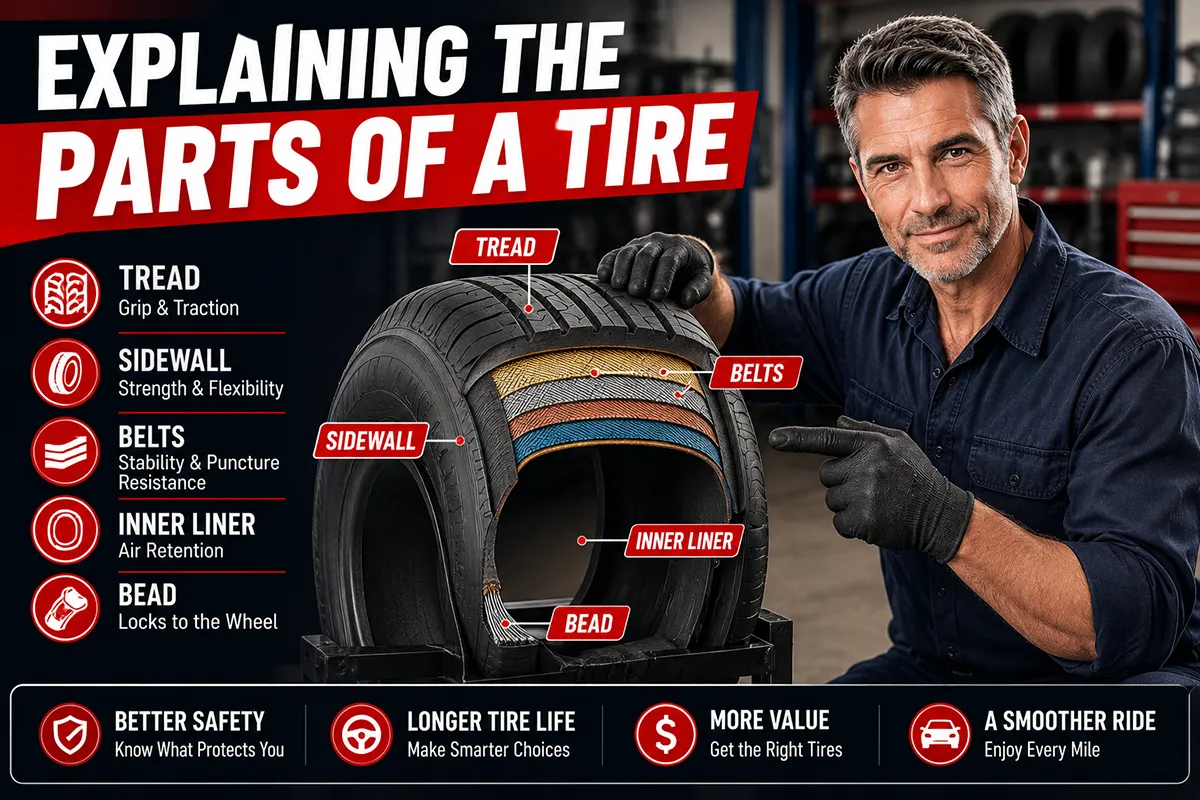
A modern radial tire — the type on virtually every passenger car and light truck sold in the US today — is made up of about a dozen distinct parts. I’m going to walk through each one from the outside in, explaining what it does, why it matters, and what to look for when you’re shopping.
1. Tread
The tread is the part of the tire that physically contacts the road surface. It’s the thick rubber layer on the outside that you can see and touch.
When I evaluate a tire, the tread is the first thing I examine — both visually and through on-road performance. The tread’s pattern (also called the tread design) and the rubber compound it’s made from determine almost everything about how a tire grips in dry, wet, and winter conditions.
There are three main types of tread patterns you’ll encounter:
- Symmetrical: The pattern is identical on both halves of the tire. This is the most common design on all-season tires. In my testing, symmetrical treads tend to offer the quietest ride and the most even wear. Think of tires like the Continental TrueContact Tour.
- Asymmetrical: The inner and outer halves of the tread have different patterns. The outer portion is usually designed for dry cornering grip, while the inner portion focuses on water evacuation. I’ve found these to be excellent on performance sedans and sporty SUVs.
- Directional (or unidirectional): The tread has V-shaped grooves pointing in one direction, optimized for channeling water forward and outward. These are the tires I consistently recommend for drivers in the Pacific Northwest or anywhere with heavy rainfall.
The tread compound matters just as much as the pattern. A softer compound gives you more grip but wears faster. A harder compound lasts longer but may sacrifice wet traction. Every tire is a balancing act, and the tread is where that compromise plays out most visibly.
What to look for when shopping: Check the treadwear rating on the UTQG (Uniform Tire Quality Grading) scale stamped on the sidewall. A higher number means longer-lasting tread, though it’s only reliable for comparisons within the same brand.
2. Tread Blocks
If you look closely at any tire’s tread, you’ll see it’s divided into individual raised segments. These are the tread blocks.
Tread block size, shape, and spacing directly affect grip, noise, and handling. In my experience, tires with larger, more rigid tread blocks — like those on the Michelin Pilot Sport 4S — deliver sharper steering response on dry pavement. Tires with smaller, more numerous blocks tend to perform better on snow and loose surfaces because they create more biting edges.
The edges of these blocks are called sipes (more on those below), and the spaces between them are the grooves. Together, they form a system that manages water, mud, gravel, and snow.
3. Grooves
Grooves are the deep channels carved into the tread surface. Their primary job is hydroplaning resistance — they channel water away from the contact patch so the rubber can maintain direct contact with the road.
I’ve tested tires in controlled wet-braking scenarios, and the difference between well-designed grooves and shallow, narrow ones is genuinely alarming. A tire with wide circumferential grooves (the ones that run around the tire’s full circumference) can evacuate a remarkable volume of water at highway speeds.
Pro tip from my testing: When your grooves wear down to 2/32 of an inch deep, the tire is legally bald in most US states. But I’ve found that wet traction drops off significantly well before that point — around 4/32 of an inch. That’s why I always recommend replacing tires earlier than the legal minimum if you regularly drive in rain.
4. Sipes
Sipes are the tiny, thin slits cut into the tread blocks. They’re easy to overlook, but they play an outsized role in wet and winter traction.
When water or ice gets between the tire and the road, sipes open up under pressure and create additional biting edges. This helps the tire grip surfaces that would otherwise be slippery. In my winter driving tests across New England roads, tires with dense siping patterns consistently outperformed those with minimal sipes on packed snow and light ice.
Some manufacturers use 3D sipes — interlocking zigzag cuts that stay rigid during dry cornering but flex open in wet or snowy conditions. I’ve been increasingly impressed by this technology in tires like the Nokian Hakkapeliitta R5 and the Bridgestone Blizzak WS90.
5. Sidewall
The sidewall is the vertical area between the tread and the bead (where the tire meets the rim). It’s one of the most important parts of a tire, and it’s the one I see drivers misunderstand most often.
The sidewall does three critical things:
- Absorbs impacts: It flexes over bumps, potholes, and rough surfaces to protect both the rim and the internal structure.
- Provides structural support: It holds the tire’s shape under load and during cornering.
- Displays critical information: Every number, letter, and symbol you see stamped on a tire is on the sidewall — size, load rating, speed rating, DOT code, manufacturing date, and more.
In my testing, sidewall stiffness is one of the most noticeable differences between tire categories. A performance tire with a short, stiff sidewall (low aspect ratio, like a 35 or 40 series) feels razor-sharp in corners but transmits every crack and expansion joint into the cabin. A touring tire with a taller, more flexible sidewall (55 or 60 series) smooths out the ride but feels less precise in aggressive turns.
What to look for when shopping: The aspect ratio — the middle number in your tire size (e.g., the “55” in 225/55R17) — tells you the sidewall height as a percentage of the tire’s width. Lower numbers mean shorter sidewalls and a sportier feel. Higher numbers mean taller sidewalls and a more comfortable ride.
6. Shoulder
The shoulder is the transition zone where the tread wraps around and meets the sidewall. It’s the rounded edge of the tire.
This area takes enormous stress during cornering. When you turn the steering wheel, the vehicle’s weight shifts to the outer shoulder of the tire. If the shoulder design is poor, you’ll feel the tire “roll over” or lose grip prematurely in turns.
I pay close attention to shoulder wear patterns during my test periods. Uneven shoulder wear is one of the first signs of misalignment or improper inflation. If you notice the inner or outer shoulder wearing faster than the center of the tread, get your alignment checked immediately.
Some tires feature reinforced shoulder blocks or continuous shoulder ribs designed specifically for stability during lane changes and highway on-ramps. I’ve noticed this design prominently in tires marketed toward crossover SUVs and minivans, like the Michelin Defender series.
7. Bead
The bead is one of the most critical — and least visible — parts of a tire. It’s the inner edge that seats against the wheel rim, creating an airtight seal.
Inside the bead, there’s a bundle of high-tensile steel wire coated in rubber. This wire bundle is incredibly strong, and it has to be — it’s the only thing keeping the tire locked onto the rim under cornering forces, highway speeds, and pothole impacts.
In all my years of working with tires, I’ve seen bead damage only a handful of times, but when it happens, the tire is done. A compromised bead cannot hold air pressure reliably and cannot be safely repaired. This is why I always stress the importance of having tires mounted by a professional with proper equipment — sloppy mounting can damage the bead area.
What to look for: When inspecting used tires or buying from a secondhand source (which I generally advise against), always check the bead area for cracks, tears, or deformation. If anything looks off, walk away.
8. Body Plies (Carcass)
Underneath the tread and inside the sidewall, you’ll find the body plies — layers of fabric cord (usually polyester in passenger tires) coated in rubber. These plies form the tire’s structural skeleton, often called the carcass.
In a radial tire — which, again, is what you’ll find on virtually every car in America — these plies run perpendicular to the direction of travel, from bead to bead across the tire. This radial arrangement is what gives the tire its name, and it’s the reason modern tires ride so much more comfortably than the old bias-ply designs.
Most passenger car tires have one or two body plies. Light truck tires often have more, which is part of why they carry higher load ratings. In my testing of LT (Light Truck) tires, I’ve noticed that extra plies add a slightly firmer ride quality but significantly improve puncture resistance and load-carrying capability.
9. Steel Belts
Directly beneath the tread, on top of the body plies, sit the steel belts. These are layers of steel cord woven at opposing angles (typically around 20-25 degrees) and coated in rubber.
Steel belts serve two primary purposes:
- They stabilize the tread: By keeping the tread flat against the road surface, steel belts maximize the contact patch and ensure even wear.
- They protect against punctures: The steel layer acts as a shield, deflecting road debris before it can reach the inner plies and cause a blowout.
Most passenger tires have two steel belts. Some premium tires add a nylon overlay (sometimes called a cap ply or nylon cap strip) on top of the steel belts for additional high-speed stability. I’ve noticed this feature in tires rated for speeds above 130 mph, such as the Continental ExtremeContact Sport 02.
The angle at which the steel cords are laid matters, too. In my conversations with tire engineers, I’ve learned that subtle changes in belt angle can shift the balance between ride comfort and high-speed stability. It’s one of those hidden design choices that separates a $90 tire from a $180 tire of the same size.
10. Inner Liner
The inner liner is the innermost layer of the tire — the part that faces the air inside. It’s made from a special rubber compound (usually butyl rubber or halobutyl rubber) that’s virtually airtight.
Before the inner liner existed, tires required inner tubes to hold air. The modern tubeless tire, which is standard on all passenger vehicles sold in the US, relies entirely on this inner liner to maintain air pressure.
In my experience, a healthy inner liner is the unsung hero of tire longevity. If it degrades — from age, heat cycling, or chemical exposure — you’ll notice slow air pressure loss that no amount of patching will fix. This is one of the key reasons I advise against running tires older than six years, regardless of remaining tread depth.
How to check: Look inside the tire (when dismounted) for cracking, flaking, or bubbling of the inner rubber surface. If you’re losing air pressure consistently and there’s no visible puncture, the inner liner may be compromised.
11. Bead Filler (Apex)
The bead filler, sometimes called the apex, is a triangular wedge of hard rubber that sits just above the bead wire bundle. It extends upward into the lower sidewall area.
This component directly influences ride quality and handling response. A taller, stiffer bead filler creates a firmer-feeling tire with sharper turn-in response. A softer, shorter bead filler allows more sidewall flex and a more cushioned ride.
I’ve noticed this difference most clearly when comparing ultra-high-performance tires to grand touring tires. Even when two tires share the same size and similar tread patterns, the bead filler can make one feel like a sports car tire and the other like a luxury sedan tire. It’s a hidden variable that doesn’t show up on any spec sheet, but you absolutely feel it on the road.
12. Chafer Strip
The chafer strip is a narrow band of reinforced rubber that wraps around the bead area where the tire contacts the wheel rim. Its job is to protect the bead and lower sidewall from abrasion and heat generated by rim contact.
This is a part most drivers will never think about, and honestly, you shouldn’t have to — as long as your tires are properly mounted and inflated. But I mention it because chafer damage is a common result of driving on underinflated tires. When a tire runs low on air, the sidewall flexes excessively, generating heat in the chafer and bead area. Over time, this can lead to structural failure.
It’s one more reason I’m a strong advocate for checking tire pressure at least once a month — and investing in a quality tire pressure gauge rather than relying on the gas station unit.
How These Parts Work Together: A System, Not Just Components
One thing I want to emphasize — and this is something that only became clear to me after years of testing — is that no single tire component works in isolation.
The tread compound delivers grip, but only if the steel belts are holding it flat against the road. The sidewall absorbs impacts, but only because the body plies give it controlled flexibility. The bead locks the tire to the rim, but only if the inner liner is maintaining proper air pressure to keep everything pressurized and in place.
When tire manufacturers like Michelin, Bridgestone, Goodyear, or Continental develop a new tire, they’re tuning all of these components simultaneously. A change in belt angle might require a different tread compound to maintain the same wear rate. A stiffer bead filler might demand a softer shoulder design to keep road noise in check.
This is why I always tell readers: don’t fixate on a single spec. A tire with the highest treadwear rating isn’t automatically the best buy if its wet grip rating is mediocre. The best tires are the ones where every component has been engineered to work in harmony for your specific driving needs.
Tire Parts Comparison Table: Passenger Car vs. Light Truck
Since many of my readers are deciding between passenger (P-metric) tires and light truck (LT) tires for their SUVs and pickups, here’s a quick comparison of how the key components differ between the two:
| Tire Component | Passenger (P-Metric) | Light Truck (LT) |
|---|---|---|
| Body Plies | 1–2 polyester plies | 2–3 polyester plies (sometimes more) |
| Steel Belts | 2 steel belts | 2–3 steel belts, often with nylon overlay |
| Sidewall Thickness | Standard — prioritizes ride comfort | Reinforced — prioritizes puncture resistance and load capacity |
| Bead Construction | Standard single-wire bead bundle | Heavier-gauge wire, sometimes dual bead bundles |
| Tread Depth (New) | Typically 10/32″ – 11/32″ | Typically 12/32″ – 16/32″ (especially all-terrain) |
| Tread Compound | Softer, optimized for comfort and fuel efficiency | Harder, optimized for durability and chip resistance |
| Inner Liner | Standard thickness | Often thicker to handle higher inflation pressures |
| Typical Price Range (Per Tire) | $80 – $220 | $150 – $350+ |
This is why LT tires cost more — they literally have more material and heavier-duty construction. If you’re driving a half-ton pickup that you use for commuting and never load beyond grocery bags, you might not need LT tires. But if you tow, haul, or drive on rough terrain regularly, the extra investment in LT construction is absolutely worth it.
Reading the Sidewall: How Tire Parts Connect to the Numbers
Now that you know what each part does, let’s connect that knowledge to the information printed on every tire’s sidewall. This is where anatomy meets practical shopping.
Let’s use a common tire size as an example: P225/55R17 97V
- P: Passenger tire (as opposed to LT for Light Truck)
- 225: Tread width in millimeters — how wide the tread face is
- 55: Aspect ratio — the sidewall height is 55% of the tread width (about 124mm, or roughly 4.9 inches)
- R: Radial construction — the body plies run radially from bead to bead
- 17: Rim diameter in inches — the bead is designed to seat on a 17-inch wheel
- 97: Load index — the maximum weight the tire can safely carry (1,609 lbs per tire at this rating)
- V: Speed rating — the maximum sustained speed the tire is engineered to handle (149 mph for V-rated)
Every single one of these numbers relates directly to a physical component of the tire we’ve discussed. The aspect ratio describes the sidewall. The R confirms the radial ply layout. The rim diameter tells you the bead size. The load index reflects the strength of the plies, belts, and bead.
When I explain this to friends and family who are shopping for tires, I can literally see the lightbulb go on. Suddenly, tire shopping isn’t intimidating — it’s logical.
Common Tire Damage and Which Parts Are Affected
Understanding tire parts also helps you diagnose problems and make smarter repair-vs-replace decisions. Here’s what I’ve encountered most frequently during my years of testing and real-world driving:
Sidewall Bulge
A bulge on the sidewall means the body plies inside have broken. This usually happens after hitting a pothole or curb at speed. The air pressure pushes out through the weakened area, creating a visible bubble.
My advice: Replace the tire immediately. There is no safe repair for a sidewall bulge. I’ve seen these fail catastrophically at highway speed, and it’s not something you want to experience.
Nail or Screw in the Tread
If a puncture is in the central tread area (not the shoulder or sidewall), and it’s smaller than 1/4 inch in diameter, it can usually be repaired with a proper plug-and-patch combination. The steel belts provide some protection here, but objects can still penetrate through.
My advice: Get a professional repair — not just an external plug from a gas station kit. A proper repair seals both the inner liner and the puncture channel.
Uneven Tread Wear
This isn’t strictly “damage,” but it indicates that the tire’s components aren’t being used as designed. Center wear means overinflation. Edge wear means underinflation. One-sided wear means misalignment.
My advice: Check your pressure monthly and get an alignment check at least once a year or whenever you notice pulling.
Cracking in the Sidewall or Tread Grooves
This is age-related degradation. The rubber compounds in every part of the tire break down over time due to UV exposure, ozone, and heat cycling — even if the tire has plenty of tread left.
My advice: Check the DOT code on the sidewall for the manufacturing date (the last four digits — e.g., 2321 means the 23rd week of 2021). I recommend replacing any tire that’s more than six years old, regardless of appearance. I’ve personally cut open old tires and seen internal cracking invisible from the outside.
How Understanding Tire Parts Makes You a Better Buyer
Let me tie this all together with a real scenario I see constantly.
A reader emails me asking: “Which tire should I buy for my 2020 Toyota RAV4? I want something that lasts long and handles well in rain.” Without understanding tire anatomy, they’d be at the mercy of whatever the tire shop pushes that day.
But with the knowledge from this guide, they can think critically:
- “I need deep grooves and good siping for rain performance.”
- “I want a tread compound that balances grip and longevity — maybe something with a treadwear rating around 600-700.”
- “I drive mostly on highways, so I’d prefer a tire with a nylon cap ply over the steel belts for high-speed stability.”
- “My RAV4 came with P-metric tires, and I don’t tow or go off-road, so I don’t need LT construction.”
That’s not just informed shopping — that’s expert-level reasoning. And it all comes from understanding what’s inside the tire.
Final Thoughts From the Test Garage
I’ve spent more time than I can count mounting, measuring, driving on, and cutting open tires. Every time I section a tire for analysis, I’m reminded of just how much thought goes into every layer, every compound, every cord angle.
The tire is the only part of your car that touches the road. It’s your braking, your steering, your traction in a sudden rainstorm on I-95. It deserves more than a glance at the price tag.
I genuinely believe that every driver who reads this guide will make better, safer, and more cost-effective tire choices going forward. You don’t need to memorize every term — just knowing that there’s real engineering behind that black rubber circle puts you ahead of 90% of shoppers walking into a tire store.
If you’re ready to start comparing tires for your specific vehicle, check out our brand-by-brand reviews and buying guides right here on TireAdvise.com. And if anything in this guide sparked a question, drop it in the comments — I read every single one.
Drive safe out there.
Frequently Asked Questions
What are the main parts of a tire and what does each part do?
A tire is made up of several key components: the tread (the rubber that contacts the road), the sidewall (the vertical area between the tread and the bead that absorbs impacts), the bead (the steel-reinforced edge that locks the tire onto the wheel), the belt system (steel or fabric layers beneath the tread for stability), and the inner liner (an airtight layer that replaces the old inner tube). Each part works together to provide grip, durability, and a safe ride whether you’re driving on US highways or navigating city streets.
What does the tread on a tire actually do and why does tread depth matter?
The tread is the patterned rubber on the outer surface of your tire that grips the road and channels water, snow, and debris away from the contact patch. Tread depth matters because once it wears below 2/32 of an inch, your tire is legally considered unsafe in most US states and loses significant traction, especially in rain. I always recommend checking tread depth with a penny test or a tread depth gauge every few months, since worn tread dramatically increases stopping distances on wet roads.
What is the sidewall of a tire and what do the numbers on it mean?
The sidewall is the rubber area between the tread and the bead that flexes to absorb road impacts and protects the internal tire structure. The markings printed on it — like P225/65R17 95H — tell you the tire type, width in millimeters, aspect ratio (sidewall height as a percentage of width), construction type, wheel diameter, load index, and speed rating. Understanding these numbers is essential when shopping for replacement tires because mounting the wrong size can affect handling, fuel economy, and even void your vehicle’s warranty.
What are tire belts and plies, and how do they affect tire performance?
Tire belts are layers of steel or synthetic cord positioned beneath the tread that reinforce the tire’s shape, improve stability at highway speeds, and resist punctures from road debris. Plies are the fabric or cord layers within the tire body that give it structural strength — most modern passenger tires sold in the US are radial construction, meaning the plies run perpendicular to the tread for a smoother ride and better fuel efficiency. More belt layers generally mean a stronger, more durable tire, which is why heavy-duty truck tires like those from Goodyear or BFGoodrich often feature additional belt reinforcement.
What is the tire bead and what happens if it gets damaged?
The tire bead is a bundle of high-strength steel wire coated in rubber that sits along the inner edge of the tire and creates an airtight seal against the wheel rim. If the bead gets damaged — from hitting a pothole, curb, or improper mounting — you can experience slow air leaks, vibrations, or even a sudden blowout while driving. Bead damage is often irreparable, meaning you’ll likely need a full tire replacement, which can cost anywhere from $100 to $300 per tire depending on size and brand.
What is the inner liner of a tire and why is it important for tubeless tires?
The inner liner is a thin layer of synthetic rubber on the inside of the tire that acts as a built-in air barrier, replacing the inner tubes that older tire designs relied on. It’s critical for maintaining proper tire pressure in modern tubeless tires, which are standard on virtually every passenger car and SUV sold in the US today. If the inner liner is compromised by a puncture or manufacturing defect, the tire will slowly lose air, reducing fuel economy and creating a potential safety hazard on long highway drives.
How do the different parts of a tire wear out and when should I replace my tires?
The tread wears down from normal road contact and is the most common reason for tire replacement — most tires last between 40,000 and 70,000 miles depending on the brand, driving habits, and US road conditions. The sidewall can develop cracks from UV exposure, age, or underinflation, while belts can separate from impact damage caused by potholes common in states with harsh winters. I recommend inspecting all visible tire components every time you rotate your tires (typically every 5,000 to 7,500 miles) and replacing any tire that shows sidewall bulges, deep cracks, exposed belts, or tread worn to 2/32 of an inch.
