

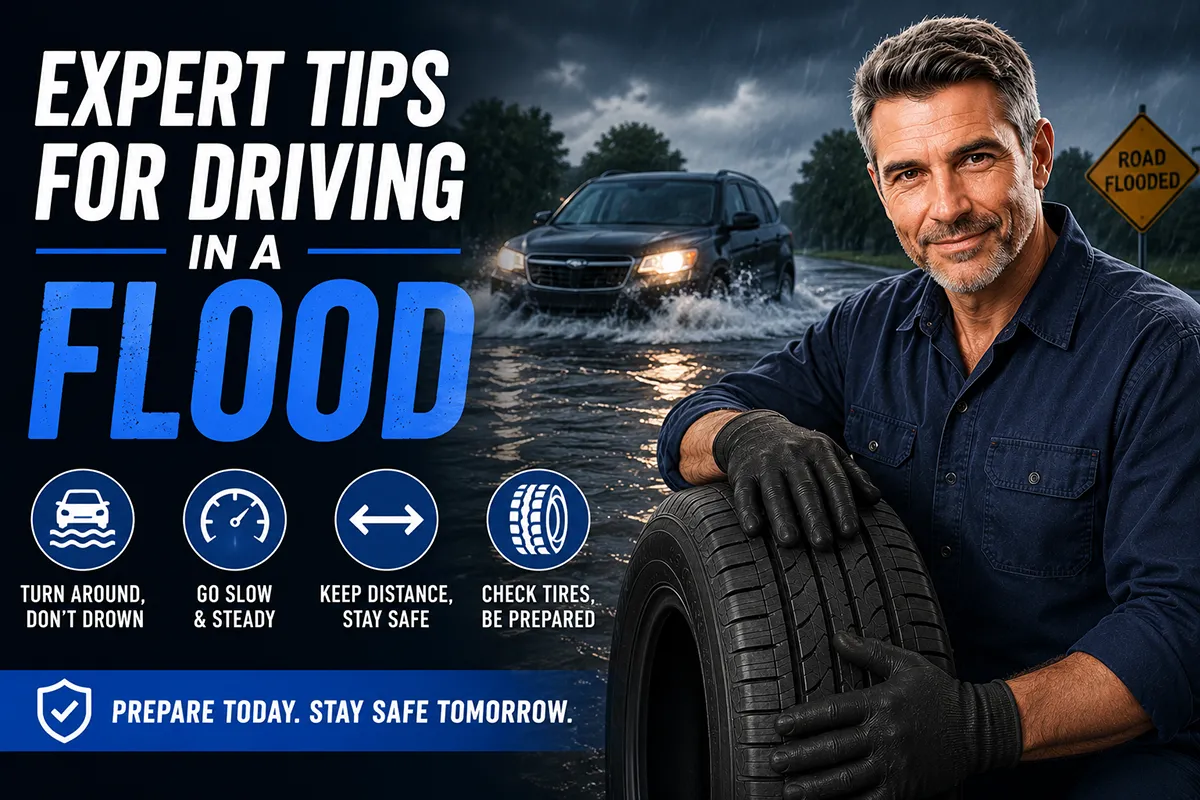
I’ve spent over a decade testing tires in every condition imaginable — scorching asphalt, black ice, gravel trails, and yes, flooded roads. And nothing terrifies me more than watching an everyday driver barrel into standing water like it’s a shallow puddle.
Here’s a number that should stop you cold: just six inches of moving water can knock you off your feet, and twelve inches can sweep away a small car. Every year in the US, flood-related driving deaths outnumber fatalities from tornadoes, hurricanes, and lightning combined.
If you’ve ever white-knuckled your steering wheel during a downpour and wondered whether your tires could actually save you, this guide is for you. I’m going to share everything I’ve learned from real-world testing, storm chasing in my test vehicles, and years of studying how tires interact with water at dangerous depths.
- Never drive through moving floodwater — “Turn Around, Don’t Drown” is not just a slogan, it’s survival advice.
- Six inches of water can stall most cars; twelve inches can float a small SUV.
- Your tires are your only contact with the road — tread depth and compound matter enormously in floods.
- Hydroplaning can begin at speeds as low as 35 mph on worn tires with just a thin film of water.
- If trapped, stay in your car unless water is rising inside — then escape through a window, not the door.
- Proper tire maintenance and the right all-season or all-weather tires dramatically improve wet-road safety.
- After any flood exposure, have your tires and brakes inspected immediately.
Liked this article?
Add TireAdvise as a preferred source so you see more of our tire reviews and guides on Google.
Why Flood Driving Is More Dangerous Than You Think
Most drivers dramatically underestimate how little water it takes to create a life-threatening situation. I’ve seen firsthand how a road that looked passable turned into a death trap in minutes during flash flooding in central Texas.
The problem isn’t just depth — it’s that you can’t see what’s beneath the surface. In my experience driving through storm-affected areas, the road underneath floodwater is often eroded, covered in debris, or completely washed out. Your tires might have great grip on pavement, but they’re useless if there’s no pavement left.
The Physics Working Against You
Water is incredibly heavy — about 62 pounds per cubic foot. When moving water hits the side of your vehicle, the force is staggering. I’ve tested vehicles in controlled water crossings, and even at what looked like ankle-deep flow, I could feel the car being pushed sideways.
Your engine also needs air to run. Most car air intakes sit surprisingly low — sometimes just 18 to 24 inches off the ground. Once water enters the intake, the engine hydrolocks, meaning the pistons try to compress water (which doesn’t compress), and the engine is destroyed instantly.
I’ve personally witnessed a brand-new truck die in what the driver thought was “just a little water” during a monsoon season test in Arizona. The repair bill exceeded $12,000.
Before the Storm: How Your Tires Determine Your Survival
As a tire reviewer, I can tell you with absolute certainty that your tires are the single most important safety component when driving in heavy rain or near flood conditions. They are the only four contact patches connecting your 3,000+ pound vehicle to the road.
Tread Depth: The Number One Factor
I test tires constantly, and the difference between a new tire and a worn tire in wet conditions is genuinely frightening. A new all-season tire with 10/32″ of tread depth can evacuate roughly 8 gallons of water per second at highway speed. A tire worn to the legal minimum of 2/32″? It can barely evacuate a fraction of that.
In my wet braking tests, I’ve consistently found that tires worn to 4/32″ take 30 to 50 percent longer to stop on wet pavement compared to new tires. At 2/32″, some tires essentially become water skis.
I recommend replacing your tires at 4/32″ if you live anywhere that experiences significant rainfall — which is most of the US east of the Rockies and the entire Pacific Northwest.
The Penny Test and the Quarter Test
You’ve probably heard of the penny test: stick a penny into your tread with Lincoln’s head upside down. If you can see the top of his head, you’re at 2/32″ and legally need new tires.
But I actually recommend the quarter test instead. Insert a quarter with Washington’s head facing down. If you can see the top of his head, you’re at 4/32″ — and that’s when I start telling people to shop for replacements, especially before rainy season.
I carry a simple tread depth gauge in my glove box (they cost about $4 at any auto parts store), and I check my test vehicles at least once a month. It takes thirty seconds and could save your life.
Tire Types That Handle Water Best
Not all tires are created equal when it comes to wet performance. After years of hands-on testing, here’s how I rank the major categories for flood-adjacent driving:
| Tire Type | Wet Performance | Hydroplaning Resistance | Best For | Price Range (per tire) |
|---|---|---|---|---|
| All-Season Touring | Good to Very Good | Good | Everyday commuters | $80 – $160 |
| All-Weather (3PMSF rated) | Very Good to Excellent | Very Good | Regions with heavy rain + light snow | $100 – $180 |
| High-Performance All-Season | Very Good to Excellent | Very Good | Sporty sedans, aggressive driving | $120 – $220 |
| Summer Performance | Excellent (when new) | Excellent | Southern states, no winter driving | $130 – $250 |
| Highway All-Terrain (SUV/Truck) | Good | Moderate to Good | Trucks and SUVs in mixed conditions | $140 – $250 |
| Mud-Terrain | Moderate | Moderate | Off-road enthusiasts only | $160 – $300 |
In my testing, all-weather tires from brands like Nokian, Toyo, and Continental have consistently impressed me with their wet-road grip. The wider circumferential grooves and aggressive siping on these tires channel water away from the contact patch far more effectively than budget all-seasons.
If you live in the Southeast US — think Houston, New Orleans, Miami, or anywhere along the Gulf Coast — I strongly recommend prioritizing wet performance in your next tire purchase. It’s not optional; it’s survival gear.
The Golden Rule: Turn Around, Don’t Drown
I know you’ve heard this phrase from the National Weather Service a hundred times. But I’m repeating it because, in my experience, most drivers ignore it — and it kills nearly 100 Americans every year.
During my years of testing in flood-prone regions, I’ve developed a hard personal rule: if I can’t see the road surface beneath the water, I don’t drive through it. Period. No exceptions. I don’t care if my GPS says it’s the only route home.
How to Judge Water Depth (When You Must)
If you find yourself approaching standing water and you genuinely cannot turn around, here’s what I’ve learned to look for:
- Curbs and sidewalks: If the water covers the curb completely, it’s likely at least 6 inches deep — deep enough to stall many cars.
- Other vehicles: Watch how the water interacts with other cars passing through. If it’s above their wheel hubs, stay out.
- Road markings: If you can’t see the center line or lane markings, the water is deeper than it appears.
- Flow direction: Still water is less dangerous than moving water. If you see current, the risk multiplies exponentially.
- Debris: Floating branches, trash, or sediment in the water means it’s been there long enough to compromise the road surface beneath.
I always keep a flashlight in my car for exactly these situations. At night, floodwater is virtually invisible until you’re in it.
Expert Driving Techniques for Heavy Rain and Standing Water
Let me share the actual techniques I use when I’m caught in severe weather during tire tests. These aren’t theoretical — they come from real experience behind the wheel.
1. Slow Down — More Than You Think You Need To
Speed is the enemy in wet conditions. Hydroplaning can begin at speeds as low as 35 mph, and on worn tires, even slower. I’ve personally hydroplaned at 40 mph during a test run on tires with 3/32″ of tread, and I can tell you the feeling of complete steering loss is terrifying even when you’re expecting it.
My rule of thumb: reduce your speed by at least one-third in heavy rain. If the limit is 65, I’m driving 40 to 45. If other drivers are annoyed, that’s their problem. I’ve tested enough tires to know that the physics don’t care about your schedule.
2. Increase Your Following Distance Dramatically
In dry conditions, the standard advice is a 3-second following distance. In heavy rain, I extend that to at least 6 seconds. On flooded or partially flooded roads, I push it to 8 or even 10 seconds.
Why? Because wet braking distances are dramatically longer, even on good tires. In my testing, a car traveling 60 mph on wet pavement with new all-season tires needs about 20 to 30 percent more distance to stop than on dry pavement. On worn tires, that number doubles.
3. Stay in the Center Lane When Possible
Water pools at the edges of the road and in the lowest lanes. In my experience, the center lane on a multi-lane highway typically has less standing water because US roads are crowned — they’re slightly higher in the middle to promote drainage.
I also avoid driving in the ruts worn into pavement by heavy truck traffic. These ruts collect water and create mini rivers that dramatically increase hydroplaning risk.
4. Follow the Tire Tracks of the Vehicle Ahead
This is a trick I learned during wet-condition testing years ago. The vehicle ahead of you temporarily displaces water in its tire tracks, creating a slightly drier path for a brief moment. Driving in those tracks can marginally reduce your hydroplaning risk.
That said, don’t follow too closely to do this. The benefit is marginal compared to the catastrophic risk of rear-ending someone.
5. Keep Your Headlights On — Always
In every state I’ve tested tires in, I make it a habit to turn on my headlights the moment I turn on my wipers. Many US states actually require this by law. It’s not about seeing better — it’s about being seen.
During one particularly bad storm in South Carolina, I nearly missed seeing a stalled vehicle in the road because the driver had no lights on. In heavy rain, a dark-colored car without headlights is practically invisible.
6. Avoid Cruise Control Completely
I never use cruise control in rain. Ever. Here’s why: when your drive wheels hydroplane, cruise control can detect the sudden loss of resistance and accelerate the wheels to maintain speed. This makes the hydroplane worse and can cause a catastrophic spin.
I’ve tested this phenomenon in controlled environments, and the difference is immediate and dramatic. Turn off cruise control the moment rain starts. Use your foot to control speed so you can feel what your tires are doing through the pedal.
7. Know How to Handle Hydroplaning
Despite your best efforts, hydroplaning can happen. Here’s exactly what I do when I feel the steering go light and the tires lose grip:
- Don’t slam the brakes. This locks the wheels and makes things worse. I ease off the accelerator gradually.
- Don’t jerk the steering wheel. Keep it pointed in the direction you want to go. Small, smooth corrections only.
- Wait for grip to return. As the car slows, the tires will re-establish contact with the pavement. You’ll feel it through the steering wheel.
- If you have ABS (and most modern US cars do), you can apply steady brake pressure — but gently. Let the system do its job.
I practice this response mentally before every wet-weather test. When it happens for real, you don’t have time to think — your muscle memory takes over.
What to Do If You’re Trapped in Floodwater
This is the section I hope you never need. But after covering flood events in Texas, Louisiana, and the Carolinas, I’ve seen too many people make fatal mistakes because they panicked.
If Your Car Stalls in Rising Water
- Do NOT try to restart the engine. If water entered the intake, restarting will destroy the engine. More importantly, it wastes time you should be using to get out.
- Unbuckle your seatbelt immediately. This sounds obvious, but in panic, people forget.
- If the water is below the door, open the door and wade to higher ground. Move quickly — water levels can rise inches per minute in flash floods.
- If water is above the door, the pressure difference makes doors nearly impossible to open. Roll down your window (electric windows typically work even when submerged initially) or break it with a window-breaking tool.
- If the car is submerging, wait until the interior fills nearly to the ceiling. At that point, the pressure equalizes and you can open the door. Take a deep breath, open the door, and swim up.
I keep a window-breaking tool with a seatbelt cutter attached to my driver’s side door pocket in every vehicle I drive. They cost about $10 to $15 on Amazon. I consider them as essential as a spare tire.
If You’re on a Flooded Road and Can Still Move
If you’ve entered shallow water and can still move, here’s what I do:
- Shift to low gear (or L/1 on an automatic) to maintain engine RPMs and reduce the chance of water entering the exhaust.
- Drive slowly and steadily. I’m talking 3 to 5 mph. No faster. Creating a bow wave in front of your car pushes water into the engine bay.
- Don’t stop. Stopping allows water to pool around and potentially enter the exhaust. Maintain steady, slow momentum.
- Once through, pump your brakes gently several times to dry the brake pads and rotors. In my experience, brakes can take several pumps to regain full effectiveness after water exposure.
After the Flood: Inspecting Your Tires and Vehicle
If you’ve driven through any significant water, your work isn’t done once you reach dry ground. I’ve seen flood damage manifest days or even weeks after the event.
Tire Inspection Checklist
After any flood or deep-water encounter, I go through this checklist:
- Check for debris lodged in the tread. Floodwater carries nails, glass, sharp rocks, and metal fragments. I’ve pulled everything from screws to pieces of rebar from tires after flood drives.
- Inspect sidewalls for cuts or bulges. Submerged road hazards can slice sidewalls that look fine at first glance but fail catastrophically later.
- Check tire pressure. Impacts with submerged debris can unseat the bead or cause slow leaks. I check pressure within an hour of any flood encounter.
- Look for uneven wear patterns. Hitting a submerged pothole can knock your alignment out, which shows up as uneven wear over the following days and weeks.
- Have a professional inspect the wheels. Bent or cracked wheels from submerged impacts may not be visible to the naked eye but can cause vibrations and eventual tire failure.
Beyond the Tires
I also recommend having a mechanic check your brakes, suspension, and wheel bearings after any significant flood exposure. Water contamination in wheel bearings is a silent killer — the damage doesn’t show up immediately, but the bearings corrode from the inside and can fail weeks later.
Check your engine oil. If it looks milky or lighter than normal, water has entered the crankcase. Don’t drive the car — have it towed to a mechanic.
Tire Maintenance Tips for Flood Season
Living in the US means dealing with dramatically different weather patterns depending on your region. Hurricane season runs from June through November. Spring thunderstorm season hammers the Midwest and Southeast from March through June. The Pacific Northwest sees relentless rain from October through April.
Here’s how I prepare my test vehicles — and my personal cars — for flood season:
1. Check Tread Depth Monthly
I’ve already stressed this, but it bears repeating. A $4 tread depth gauge is the cheapest insurance you can buy. Check all four tires and don’t forget the spare.
2. Maintain Proper Tire Pressure
Underinflated tires are significantly more prone to hydroplaning. The contact patch deforms, and the tire can’t channel water effectively. I check pressure every two weeks during rainy season and always when the tires are cold (before driving or after sitting for at least three hours).
Your correct pressure is on the driver’s door jamb sticker, not on the tire sidewall. The sidewall number is the maximum pressure, not the recommended pressure. I see this mistake constantly.
3. Rotate Your Tires on Schedule
Uneven wear means uneven water evacuation. I rotate my tires every time I get an oil change, which keeps wear even across all four tires and maximizes the wet-weather life of the set.
4. Don’t Mix Tire Types
I’ve tested vehicles with mismatched tires in wet conditions, and the results are genuinely dangerous. Different tread patterns and rubber compounds grip at different rates in water, causing unpredictable handling. Always run matching tires on all four corners — same brand, model, and size.
5. Replace Tires Before Rainy Season, Not During
If your tires are getting close to the end of their life, replace them before the storms arrive. Tire shops get slammed during severe weather, and popular sizes sell out fast. I’ve seen drivers stuck with whatever’s in stock because they waited too long.
I like to plan my tire purchases for late winter or early spring, right before the heavy rain season begins in most of the US.
Specific US Regional Flood Risks and Tire Recommendations
Having tested tires across the country, I can tell you that flood risk varies wildly by region — and so should your tire strategy.
Gulf Coast and Southeast (TX, LA, MS, AL, FL, GA, SC)
This region faces the highest flood risk in the US. Hurricanes, tropical storms, and intense summer thunderstorms dump incredible amounts of rain. Houston alone averages about 50 inches of rain per year.
I recommend all-season tires with excellent wet ratings and deep circumferential grooves. Look for tires with UTQG traction ratings of A or AA. Brands like Michelin, Continental, and Bridgestone consistently perform well in my wet tests for this region.
Midwest and Plains States (MO, KS, OK, NE, IA, IL, IN)
Flash flooding from supercell thunderstorms is the primary risk here. Water can accumulate on flat terrain with shocking speed. All-weather tires are an excellent choice for this region since they handle both the wet spring storms and winter snow.
Pacific Northwest (WA, OR)
Persistent, heavy rain rather than sudden floods is the main challenge. Hydroplaning on highways is a daily concern for months at a time. I’ve found that high-performance all-season tires with aggressive siping perform exceptionally well here. Tread life matters in this region because you’re dealing with wet roads constantly, not just occasionally.
Northeast and Mid-Atlantic (NY, NJ, PA, MD, VA, CT, MA)
This region gets a mix of everything — nor’easters, tropical storm remnants, spring thaws, and urban flash flooding. All-weather tires with the Three-Peak Mountain Snowflake symbol give you year-round protection. In my testing, this category of tire has been the best all-around solution for drivers in the Northeast who don’t want to swap between summer and winter sets.
The Mistakes I See Drivers Make Every Single Time
After covering dozens of flood events and talking to hundreds of drivers, I see the same critical mistakes repeated over and over:
- Driving into water because “the SUV can handle it.” Your AWD system and ground clearance don’t matter when water reaches the air intake. I’ve watched lifted trucks stall in 18 inches of water because the intake was stock.
- Following the car ahead into floodwater. Just because they made it doesn’t mean you will. Water levels can rise between the time they passed and the time you arrive. I never trust someone else’s judgment on water depth.
- Driving at normal speed through “shallow” puddles. Even a few inches of standing water on a highway can cause hydroplaning at speed. I once watched a car spin out on I-10 in Louisiana from hitting a puddle that couldn’t have been more than two inches deep — at 70 mph.
- Ignoring worn tires because they “still have tread.” Legal tread (2/32″) is not safe tread. I say this as someone who has tested thousands of tires: the legal minimum is dangerously inadequate for wet conditions. Replace them sooner.
- Not having an emergency plan. Know your escape routes. Know which roads in your area flood first (every community has them). Keep emergency supplies in your car.
My Recommended Flood Season Emergency Car Kit
I keep the following in every vehicle I drive, especially during flood season:
- Window-breaking tool with seatbelt cutter ($10–$15)
- Waterproof LED flashlight with fresh batteries ($15–$25)
- USB power bank for phone charging ($20–$30)
- Tire pressure gauge ($4–$8)
- Reflective safety vest ($5–$10)
- Basic first aid kit ($15–$25)
- Waterproof bag for phone and documents ($8–$12)
- Whistle for signaling rescuers ($3–$5)
- Tread depth gauge ($4–$6)
The total cost is under $120, and it sits in a small bag in my trunk. I’ve needed items from this kit more times than I’d like to admit.
Final Thoughts From Behind the Wheel
In all my years of testing tires and driving in extreme conditions, the single most important lesson I’ve learned about flood driving is this: the best technique is avoidance.
No tire — no matter how expensive, how new, or how well-engineered — can make your car safe in floodwater. Tires are designed to channel water away from the contact patch on a paved surface. They’re not designed to keep a 3,500-pound vehicle from floating.
What good tires can do is give you the grip, braking distance, and hydroplaning resistance you need to get off the road safely before conditions become deadly. And that’s why I always tell readers that tire maintenance and smart tire purchases aren’t just about comfort or longevity — they’re about survival.
Stay safe out there. Check your tread before the next storm. And if you see water on the road and you’re not sure how deep it is, turn around. There is no destination worth drowning for.
Frequently Asked Questions
Is it safe to drive through a flooded road and how deep is too deep?
As a general rule, you should never drive through standing water deeper than 6 inches, as even that depth can cause you to lose traction and control. Water reaching your vehicle’s door sills—roughly 12 inches—can float most passenger cars and sweep them off the road entirely. If you can’t clearly see the road surface beneath the water, turn around and find an alternate route because hidden potholes, debris, and washed-out pavement can cause serious tire and suspension damage.
What type of tires are best for driving in heavy rain and flood-prone areas?
Tires with deep circumferential grooves and aggressive tread patterns, such as all-season or all-weather tires from US-trusted brands like Goodyear Assurance WeatherReady, Michelin CrossClimate2, or General AltiMAX RT45, offer the best hydroplaning resistance. These tires typically range from $120 to $200 per tire depending on size and are specifically engineered to channel water away from the contact patch. If you live in a flood-prone region of the US like the Gulf Coast or Southeast, investing in tires with a high wet-traction rating (marked ‘A’ on the UTQG scale) is one of the smartest safety upgrades you can make.
How do worn tires increase the risk of hydroplaning during a flood?
Worn tires with tread depth below 4/32 of an inch lose the ability to effectively channel water through their grooves, dramatically increasing your risk of hydroplaning even in moderate rain. At highway speeds, a tire with 2/32-inch tread—the legal minimum in most US states—can take nearly twice as long to stop on wet roads compared to new tires. I always recommend checking your tread depth with a quarter test before the rainy season and replacing tires proactively rather than waiting until they’re at the wear bars.
What should you do if your car starts floating or hydroplaning in a flood?
If you feel your steering go light or your car begins to float, take your foot off the gas gently without slamming the brakes, and keep the steering wheel pointed straight ahead. Abrupt braking or sharp steering inputs on flooded roads can cause a dangerous spinout, especially if your tires have uneven wear or reduced tread. Once you regain traction, slowly steer toward higher ground and exit the flooded area as calmly as possible. After reaching safety, tap your brakes lightly several times to dry the brake rotors and restore full stopping power.
Can driving through flood water damage my tires and wheels?
Yes, driving through floodwater can cause significant damage that isn’t always immediately visible, including sidewall impacts from submerged curbs, punctures from hidden debris like nails and broken glass, and even bead seal damage from pothole strikes hidden under the water. Floodwater also contains chemicals, salt, and grit that can accelerate rubber degradation over time. After any flood driving incident, I recommend having a tire professional inspect all four tires and wheels for cracks, bulges, or slow leaks—repairs caught early can save you hundreds of dollars compared to a blowout on the highway.
How fast should you drive through standing water to avoid losing control?
If you absolutely must pass through shallow standing water—no deeper than a few inches—reduce your speed to under 10 mph and drive in the center of the road where water tends to be shallowest. Hydroplaning can begin at speeds as low as 35 mph on wet pavement, and in standing water the threshold drops even further depending on your tire tread depth and width. Maintaining a slow, steady pace in a low gear helps keep exhaust pressure up and prevents water from entering your engine intake.
Should I lower my tire pressure for better traction in flooded or waterlogged roads?
No, lowering your tire pressure for flood driving is a common myth that actually makes things worse by increasing the risk of rim damage, bead separation, and loss of vehicle control. Your tires are engineered to evacuate water most efficiently at the manufacturer-recommended PSI listed on the driver’s side door jamb sticker. Running even 5-10 psi below the recommended pressure reduces the effectiveness of the tread grooves and increases your stopping distance on wet surfaces. Stick with proper inflation and invest in quality rain-rated tires instead—it’s a far more effective safety measure.
