

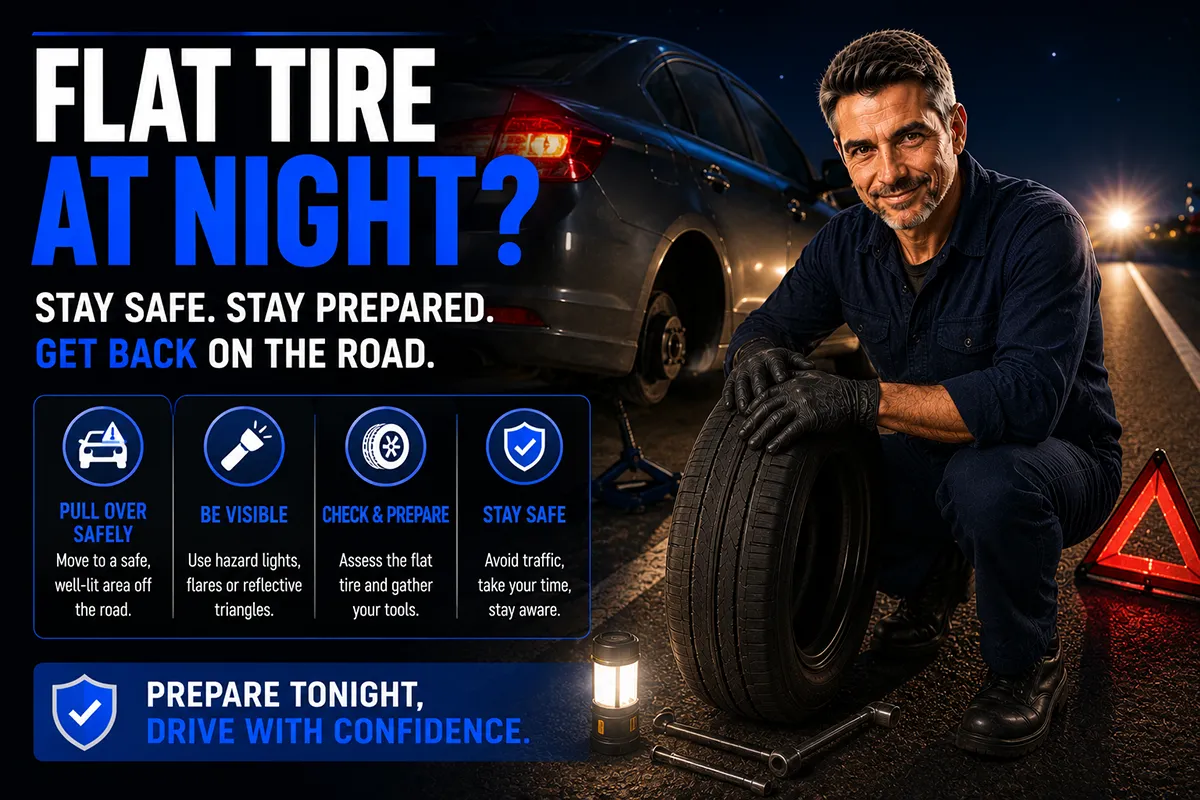
There’s a specific kind of dread that hits when you hear that telltale thump-thump-thump on a dark highway at 10 PM, miles from the nearest exit.
Your headlights illuminate nothing but empty road ahead, your dashboard warning light is glaring orange, and you realize — you’ve got a flat tire at night.
I’ve been there more than once. As someone who tests tires professionally and has spent years driving on every kind of rubber across the US, I’ve dealt with flats in parking garages, on rural backroads in Texas, and once on a rainy stretch of I-95 in the dead of winter after midnight. Each experience taught me something new about preparation, safety, and the critical decisions you need to make in those first thirty seconds.
- Pull over as far right as possible — ideally a well-lit area, gas station, or wide shoulder.
- Turn on hazard lights immediately and use reflective triangles or flares if you have them.
- Only change the tire yourself if you’re safely away from traffic; otherwise call roadside assistance.
- A quality spare tire, portable air compressor, and tire repair kit are essentials every driver should carry.
- Run-flat tires or tire pressure monitoring systems (TPMS) can prevent nighttime flat emergencies.
- After any flat, inspect or replace the affected tire — don’t just patch and forget.
Liked this article?
Add TireAdvise as a preferred source so you see more of our tire reviews and guides on Google.
Why a Flat Tire at Night Is More Dangerous Than You Think
Let me be blunt: a flat tire during the day is an inconvenience. A flat tire at night can be life-threatening.
According to the National Highway Traffic Safety Administration (NHTSA), fatal crash rates are roughly three times higher at night than during the day. When you add a disabled vehicle sitting on the shoulder of a dark highway, the risk multiplies.
Visibility is the core problem. Other drivers can’t see you as well, and many are fatigued, distracted, or potentially impaired late at night. I’ve personally watched semis blow past me at full speed with only a few feet of clearance while I was changing a tire on the shoulder of I-10 outside of Houston. The wind blast alone nearly knocked me over.
Beyond traffic dangers, there’s the issue of personal safety. Being stranded in an unfamiliar area at night raises legitimate security concerns, especially if you’re alone. This isn’t fearmongering — it’s reality, and being prepared is the best defense.
Step 1: The First 30 Seconds Matter Most
When I feel a tire go flat while driving at night, here’s exactly what I do — and what I recommend you do:
Stay Calm and Slow Down Gradually
Don’t slam the brakes. I know the instinct is to stop immediately, but sudden braking on a flat tire can cause you to lose control, especially at highway speeds. Instead, I ease off the accelerator and let the car decelerate naturally.
I grip the steering wheel firmly with both hands because a flat tire will try to pull the car in one direction. A front flat tends to pull toward the affected side. A rear flat makes the back end feel loose and sway-prone.
Turn on Your Hazard Lights Immediately
Before I even start looking for a place to pull over, I hit the hazard button. Every second of visibility matters. Those flashing lights tell every driver behind you that something is wrong.
Find the Safest Spot to Stop
This is where nighttime flats get tricky. In my experience, the ideal place to stop is a well-lit parking lot, gas station, or rest area. If you can safely limp the vehicle a short distance at low speed — even on the flat — to reach one of these spots, it’s often worth it.
I know some people worry about damaging the rim by driving on a flat. And yes, you might. But a damaged rim costs a couple hundred dollars to replace. Your life is worth infinitely more. I’d rather buy a new rim than change a tire inches from 70 mph traffic in the dark.
If you absolutely must stop on the shoulder, pull as far to the right as possible. Look for a straight, level section of road where approaching drivers have maximum visibility to see you from a distance. Avoid stopping just past a curve or over a hill crest — that’s a recipe for a rear-end collision.
Step 2: Make Yourself Visible
Once you’ve stopped, your number one job before touching a single lug nut is making sure other drivers can see you.
Use Reflective Triangles or Road Flares
I carry a set of reflective warning triangles in every vehicle I test. They’re required for commercial vehicles, and in my opinion, they should be in every passenger car too. I place them at three distances behind my vehicle: roughly 10 feet, 50 feet, and 100 feet back. On a highway, I push those distances out further.
LED road flares are another excellent option. I’ve been using the Blazer International LED road flares for a couple of years now, and they’re fantastic — bright, waterproof, and they last for hours on a single set of batteries. They cost about $20-$30 for a pack of three on Amazon.
Use Your Vehicle’s Lighting
Keep your hazard lights on. If you’re on the shoulder, keep your headlights on too — they help illuminate your workspace and make the vehicle more visible from the front. I also turn on the dome light so my car is essentially a glowing beacon from every angle.
If you have a headlamp or flashlight — which you should — use it. I always keep a rechargeable LED headlamp in my glove box. Having both hands free while working on a tire in the dark is a game changer.
Step 3: Decide — Change It Yourself or Call for Help?
Here’s where I want to be honest with you. Not every situation calls for a DIY tire change, especially at night.
When to Change It Yourself
I’ll change the tire myself if:
- I’m in a relatively safe location — a parking lot, a wide shoulder, or a rest stop.
- I’m well away from active traffic lanes.
- I have the right tools and a functional spare tire.
- The ground is level and firm (not soft dirt, mud, or a steep incline).
- I can see what I’m doing with adequate lighting.
When to Call Roadside Assistance
I’ll call for help if:
- I’m on a narrow shoulder with fast-moving traffic feet away.
- The terrain is unsafe for jacking up the car (soft, uneven, or sloped).
- I don’t have a spare, tools, or the physical ability to do the job safely.
- Weather conditions are dangerous — heavy rain, fog, ice.
- Something feels wrong about the area from a personal safety standpoint.
Most major auto insurance policies, AAA memberships (starting at about $68/year for Classic), and even some tire purchase packages include roadside assistance. Many new cars come with complimentary roadside assistance for the first few years. Check your glovebox documentation or your manufacturer’s app — you might already be covered and not even know it.
I personally keep AAA Plus, which covers tows up to 100 miles. After one incident where I needed a tow from a rural area in Arizona late at night, it paid for itself many times over.
Step 4: How to Change a Flat Tire at Night (If You Decide to Do It)
If the conditions are safe and you’re going to change the tire yourself, here’s my process. I’ve done this dozens of times during tire testing and roadside situations, so this is refined from real-world experience.
Gather Your Tools
You’ll need:
- Spare tire (full-size or compact/donut)
- Car jack (the one that came with your vehicle)
- Lug wrench
- Flashlight or headlamp
- Wheel chocks or a brick/rock to block the opposite tire
- Gloves (optional but highly recommended)
Quick note: I cannot tell you how many cars I’ve tested where the owner has never checked whether the spare tire is properly inflated. Spare tires lose air pressure over time, just like your regular tires. I make it a habit to check my spare every few months. An uninflated spare tire is essentially useless.
The Process
1. Secure the vehicle. Put it in park (or in gear if manual), engage the parking brake firmly, and place wheel chocks behind the tires on the opposite end from the flat. On a highway at night, I also make sure all passengers are out of the car and standing well away from traffic — preferably behind a guardrail.
2. Loosen the lug nuts before jacking up the car. This is the step most people get wrong. Use the lug wrench to break each lug nut loose — about a quarter turn — while the tire is still on the ground. The weight of the car keeps the wheel from spinning. Turn counterclockwise. If a lug nut is really stuck, carefully use your body weight by standing on the wrench handle. I’ve had to do this many times on over-torqued lug nuts from tire shops.
3. Position the jack and raise the vehicle. Consult your owner’s manual for the correct jack point — it’s usually a reinforced area on the pinch weld behind the front wheel or in front of the rear wheel. Placing the jack in the wrong spot can damage your car’s undercarriage. Raise the vehicle until the flat tire is about six inches off the ground.
4. Remove the lug nuts and the flat tire. Fully unscrew the lug nuts and set them somewhere safe — I usually put them in my pocket or in the hubcap if it’s the bowl type. Pull the flat tire straight toward you and set it aside.
5. Mount the spare tire. Lift the spare onto the hub bolts. This can be physically challenging, especially with a full-size spare. I’ve found that sitting on the ground and using my legs to help position the tire is easier on my back. Hand-tighten the lug nuts in a star pattern.
6. Lower the vehicle and torque the lug nuts. Lower the jack until the tire just touches the ground but isn’t bearing the full weight. Then tighten the lug nuts firmly in a star pattern. Lower the vehicle completely and give each lug nut a final tighten. Most passenger cars need lug nuts torqued to around 80-100 ft-lbs. If you don’t have a torque wrench (most people don’t carry one), just make them snug-tight and visit a tire shop within a day or two to have them properly torqued.
7. Clean up and go. Stow the flat tire, jack, and tools. Remove your warning triangles or flares. If you’re on a compact spare, remember: most donut spares have a speed limit of 50 mph and are not designed for extended driving. Get to a tire shop as soon as possible.
Essential Gear I Keep in My Trunk for Nighttime Emergencies
Over the years of testing tires and driving tens of thousands of miles across the US, I’ve built what I consider the ultimate nighttime flat tire kit. Here’s what’s in mine:
| Item | Why I Carry It | Approximate Cost |
|---|---|---|
| Reflective warning triangles (set of 3) | Visible from hundreds of feet at night; essential for highway shoulders | $15–$25 |
| LED road flares (set of 3) | More visible than triangles; don’t blow over in wind | $20–$30 |
| Rechargeable LED headlamp | Hands-free lighting for changing the tire | $15–$30 |
| Reflective safety vest | Makes you visible to approaching drivers | $5–$10 |
| Portable air compressor (12V) | Can reinflate a slow-leaking tire enough to reach a shop; also checks spare pressure | $30–$60 |
| Tire plug/repair kit | Can seal a nail puncture in the tread temporarily | $8–$15 |
| Work gloves | Protects hands; improves grip on lug wrench | $5–$10 |
| Breaker bar or cross-type lug wrench | Much easier than the flimsy wrench that came with the car | $15–$25 |
| Portable phone charger/power bank | Ensures you can always call for help | $15–$30 |
The total investment is roughly $130–$235. That’s less than the cost of a single roadside assistance call without coverage, and it could genuinely save your life.
I want to highlight the reflective safety vest specifically. I know it looks silly. I don’t care. After that experience on I-10 where a semi nearly clipped me, I now throw on a hi-vis vest every single time I’m working on a car at the roadside — day or night. They cost about five bucks. There is no excuse not to have one.
The Tire Plug vs. Tire Change Debate
If your flat is caused by a nail or screw in the tread area and the tire is losing air slowly rather than completely blown out, you may have another option: a tire plug kit.
I carry the Boulder Tools Heavy Duty Tire Repair Kit, which runs about $10-$15 on Amazon. It comes with a reamer tool, plug insertion tool, and rubber plugs. I’ve used it successfully on several occasions during my testing — once on a rear tire that picked up a roofing nail in a construction zone in Denver.
How a Tire Plug Works
You use the reamer to clean and enlarge the puncture hole, then insert a rubber plug coated in cement using the insertion tool. It takes about five minutes once you get the hang of it. Pair it with a portable air compressor to reinflate the tire, and you can often drive to a tire shop without ever touching your spare.
Important Limitations
A plug is a temporary repair. I always follow up with a proper plug-patch combo from a tire shop, which typically costs $20-$40. Also, plugs only work for punctures in the tread area. If the damage is on the sidewall, near the shoulder, or if the tire has a large gash or blowout, a plug won’t help — you need the spare or a tow.
How to Prevent Flat Tires at Night in the First Place
Prevention is always better than cure. Here’s what I do — and what I recommend to every driver — to minimize the chances of dealing with a flat in the dark.
Check Your Tire Pressure Regularly
I check tire pressure at least once a month and before any long trip. Underinflated tires are significantly more prone to flats, blowouts, and sidewall damage. Your correct pressure is on the driver’s door jamb sticker, NOT on the tire sidewall (that number is the maximum pressure, which is different).
I keep a simple digital tire pressure gauge in my center console. It takes thirty seconds to check all four tires.
Inspect Your Tires Visually
Before I get in the car each day, I do a quick visual walk-around. I’m looking for obviously low tires, embedded objects like nails or screws, cracks in the sidewall, or uneven wear patterns. This takes ten seconds and has saved me from driving on a compromised tire more times than I can count.
Don’t Ignore Your TPMS Warning
Every car sold in the US since 2007 has a tire pressure monitoring system (TPMS). That little exclamation-point-in-a-horseshoe icon on your dashboard exists for a reason. When it lights up, don’t ignore it. Check your pressures immediately.
I’ve met drivers who’ve driven for weeks with a TPMS light on. That’s a disaster waiting to happen — and it’s more likely to become a disaster at the worst possible time, like on a dark highway at night.
Replace Worn Tires Before They Fail
Bald tires or tires with cracking rubber are far more vulnerable to punctures and blowouts. The penny test is a quick way to check tread depth: insert a penny into the tread groove with Lincoln’s head facing down. If you can see the top of his head, your tread is below 2/32″, and the tire needs to be replaced.
In my experience testing dozens of tire models over the years, I’ve found that most quality all-season tires from brands like Michelin, Continental, Bridgestone, and Cooper provide excellent tread life when maintained properly. If you’re shopping for replacements, check out our tire buying guides for specific recommendations based on your vehicle type and driving needs.
Should You Consider Run-Flat Tires?
After multiple nighttime flat experiences, I started paying close attention to run-flat tires during my testing. Run-flats are designed with reinforced sidewalls that support the vehicle’s weight even after a complete loss of air pressure, allowing you to drive — typically up to 50 miles at up to 50 mph — to reach a safe location or tire shop.
The Pros
- No roadside tire changes. This is the biggest advantage for nighttime safety. If you get a flat on a dark highway, you simply keep driving at reduced speed to the next exit or service area.
- No spare tire needed. This saves trunk space and reduces vehicle weight.
- Peace of mind. For solo drivers, especially those who frequently drive at night, run-flats provide a huge sense of security.
The Cons
- Ride quality. In my testing, run-flat tires generally have a stiffer, harsher ride compared to conventional tires. The reinforced sidewalls don’t absorb bumps as well. This has improved in recent years — Bridgestone’s DriveGuard Plus and Michelin’s Pilot Sport A/S 4 (in run-flat spec) are notably more comfortable than run-flats from a decade ago — but there’s still a difference.
- Cost. Run-flats typically cost 20-40% more than comparable conventional tires. For example, a standard Bridgestone Turanza might run around $150-$180 per tire, while the run-flat version could be $200-$240.
- Limited repairability. Many tire shops won’t repair a run-flat that’s been driven on while flat, even if the puncture itself is repairable. Once the sidewall has supported the vehicle without air, its structural integrity may be compromised.
For drivers who frequently commute at night, drive in remote areas, or simply want to eliminate the scenario of a roadside tire change in the dark, I think run-flats are worth the investment. I’ve recommended them to several friends and family members for exactly this reason.
What to Do After You’ve Handled the Flat
The emergency is over. You’ve either changed the tire, plugged it, or gotten a tow. But your job isn’t done yet.
Get the Flat Tire Inspected or Replaced
If you used a plug, get a proper plug-patch repair at a tire shop within a day or two. If you changed to the spare, bring the flat tire in to see if it’s repairable. A puncture in the tread area that’s 1/4″ or smaller in diameter can usually be repaired with an internal plug-patch for $20-$40. Sidewall damage, large punctures, or blowouts mean the tire is done.
Get Your Lug Nuts Torqued Properly
As I mentioned earlier, if you changed the tire by hand, visit a tire shop to have the lug nuts torqued to spec with a calibrated torque wrench. Over-tightened lug nuts can warp brake rotors. Under-tightened ones can cause the wheel to come loose. Neither scenario is acceptable.
Check Your Spare for Next Time
If you used your spare, replace it. If you didn’t, check its pressure anyway — this is a perfect reminder to do so. Many drivers forget about the spare entirely until they need it, and there’s nothing worse than pulling out a flat spare alongside your flat tire.
Restock Your Emergency Kit
If you used flares, plugs, or any other consumables, replace them immediately. The worst time to discover you’re out of supplies is during the next emergency.
A Note on Personal Safety During Nighttime Breakdowns
I want to address this directly because it’s something I think about every time I’m stranded.
If someone pulls over and offers to help, use your judgment. Most people are genuinely kind. But it’s perfectly okay to crack your window and say, “Thank you, I’ve already called for help.” You are not obligated to accept assistance from strangers on a dark road.
Keep your doors locked while waiting for roadside assistance. Stay inside the vehicle if you’re on a busy highway — the car’s structure provides protection from both traffic and other hazards.
Share your live location with a family member or friend. Both iPhone (Find My) and Android (Google Maps location sharing) make this easy. I always text my wife my location when I’m dealing with any roadside situation at night.
If you feel genuinely unsafe — trust your instincts. Call 911. Many states also have non-emergency roadside assistance numbers (like *HP for Highway Patrol in some states, or 511 for road conditions and assistance).
Final Thoughts From the Road
I’ve changed tires in the rain, in the dark, in the blistering Texas heat, and once during a sleet storm in Pennsylvania. Each experience reinforced the same lesson: preparation is everything.
A flat tire at night doesn’t have to be a terrifying ordeal. With the right gear in your trunk, a calm approach, and a clear understanding of when to DIY and when to call for help, you can handle it safely and get back on the road.
The best investment you can make isn’t a fancy tire pressure gauge or a premium pair of work gloves — it’s five minutes of preparation before you ever need any of it. Check your spare pressure today. Throw a $5 safety vest in your trunk. Download your insurance company’s roadside assistance app. These tiny actions take almost no effort, but they pay enormous dividends when you’re standing on the shoulder of a dark highway at 11 PM.
Stay safe out there. And if you’re shopping for new tires that offer better puncture resistance or you’re considering run-flats for the first time, browse our tire reviews and buying guides — I test every tire I write about, and I write for drivers who need real answers, not marketing fluff.
Frequently Asked Questions
What should I do if I get a flat tire at night on a dark road?
First, turn on your hazard lights immediately and slowly pull over to the safest, most well-lit area you can find, such as a gas station parking lot or a wide shoulder away from traffic. Use your phone’s flashlight or a dedicated roadside emergency LED flare kit to make yourself visible. If you don’t feel safe changing the tire yourself, call roadside assistance through AAA or your auto insurance provider, which typically costs $0–$100 depending on your plan.
Is it safe to drive on a flat tire at night to reach a tire shop?
Driving on a completely flat tire is never safe, especially at night when visibility is low and other drivers may not see you in time. Continuing to drive can destroy your wheel rim, damage your suspension, and lead to a blowout that causes a serious accident. If you have a slow leak, you can use a portable tire inflator or a can of Fix-a-Flat to get enough air to reach the nearest tire shop, but keep your speed under 20 mph and drive as short a distance as possible.
What emergency tools should I keep in my car for a nighttime flat tire?
I always recommend keeping a compact LED flashlight or headlamp, reflective warning triangles, a reflective safety vest, a portable tire inflator, and a fully functional spare tire with a jack and lug wrench. A tire repair plug kit, which costs around $8–$15 at Walmart or AutoZone, can also be a lifesaver for small punctures. Having these tools ready means you won’t be stranded in the dark waiting hours for roadside assistance.
How much does it cost to get a flat tire fixed or replaced at night in the US?
A basic flat tire patch or plug repair at a shop like Discount Tire or Firestone typically costs $0–$30, but most shops close by 6–7 PM, so you may need after-hours mobile tire service, which can run $75–$150 depending on your area. If the tire is beyond repair, a replacement tire for a standard passenger vehicle averages $100–$250 per tire installed, depending on the brand and size. Budget-friendly options like General Tire or Cooper Tires offer solid performance at lower price points for US drivers.
Can I use a tire plug kit to fix a flat tire at night by myself?
Yes, a tire plug kit is one of the easiest DIY repairs you can do roadside, even at night, as long as the puncture is in the tread area and not on the sidewall. The process involves locating the puncture, reaming the hole, inserting a rubber plug, and reinflating the tire with a portable air compressor — the whole job takes about 10–15 minutes. Keep in mind that a plug is considered a temporary fix, so I’d recommend getting a proper patch-plug combo repair at a tire shop like Discount Tire or Les Schwab within a few days.
How can I prevent getting a flat tire while driving at night?
The best prevention is maintaining proper tire pressure, which you should check at least once a month using a digital gauge — underinflated tires are far more susceptible to punctures and blowouts, especially on poorly lit roads where you can’t see debris. Investing in tires with strong sidewall construction and puncture-resistant technology, like Michelin Defender or Continental TrueContact, significantly reduces your risk. I also recommend replacing tires before the tread depth drops below 3/32 of an inch, since worn tires lose their ability to resist road hazards.
Does roadside assistance cover flat tires at night, and is it worth having?
Most roadside assistance plans, including AAA (starting at $68/year), and those bundled with auto insurance from providers like GEICO or State Farm, cover flat tire changes 24/7 at no extra per-incident cost. The technician will mount your spare tire so you can safely drive to a tire shop the next day. I think it’s absolutely worth having, especially if you frequently drive at night or commute on highways — a single after-hours tow can cost $150–$300 without coverage, which more than justifies the annual membership fee.
