

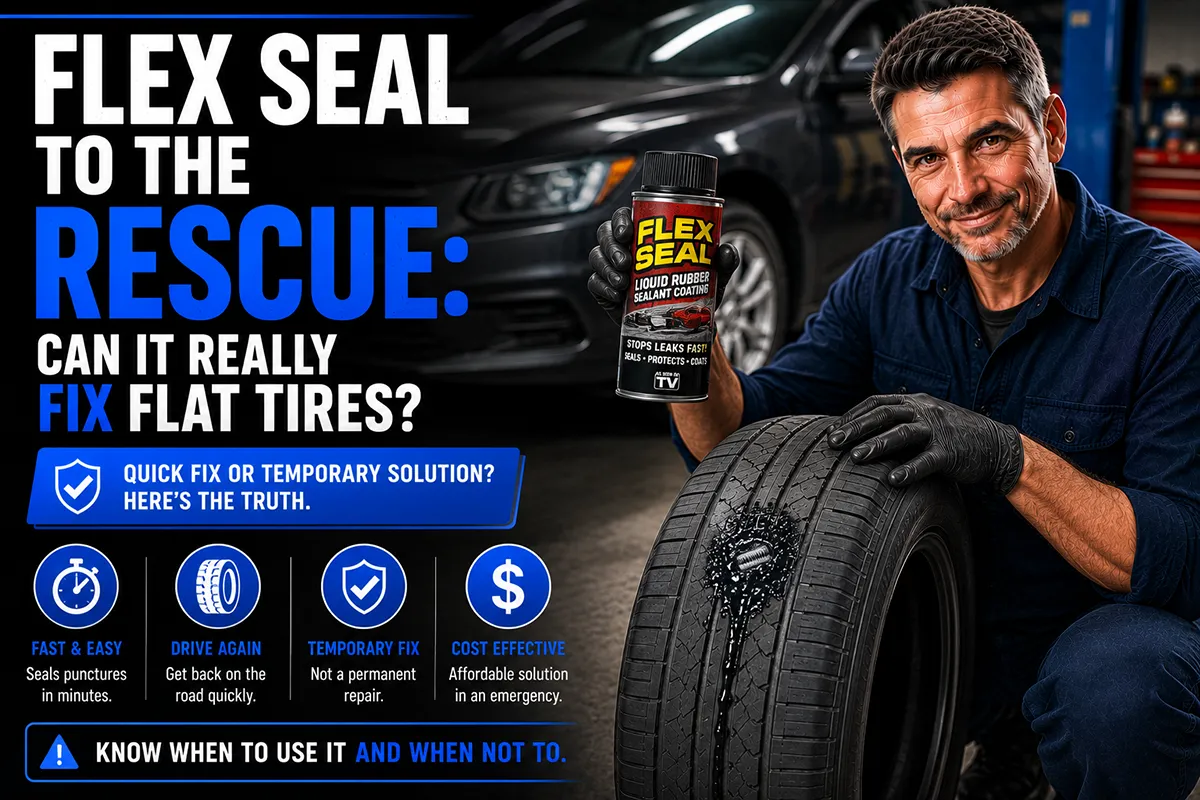
You’re standing in a parking lot staring at a flat tire, and somewhere in the back of your mind, you remember that infomercial — the one where a guy saws a boat in half and seals it back together with Flex Seal.
It stopped a boat from sinking, so surely it can fix a flat tire, right?
I had the exact same thought. So I decided to actually test it — and the results might surprise you (or confirm what you already suspected).
- Flex Seal is NOT a reliable or safe fix for a flat tire — I tested it firsthand and it failed under real driving conditions.
- It may temporarily slow a very minor leak, but it won’t hold air pressure the way a tire needs to function safely.
- Proper tire sealants like Fix-a-Flat or Slime are far better emergency solutions, though they’re still temporary.
- The only real fix is a professional plug/patch repair or a full tire replacement.
- I break down exactly what happened during my test, what alternatives actually work, and when you just need to buy new tires.
Liked this article?
Add TireAdvise as a preferred source so you see more of our tire reviews and guides on Google.
Why People Are Even Asking This Question
Let’s be real — Flex Seal has built an empire on the idea that it can fix anything. The commercials are wildly entertaining, and the product does genuinely work well for certain applications like gutters, roofing, and garden ponds.
So it’s completely natural for someone dealing with an unexpected flat to wonder if a $14 can of Flex Seal from Home Depot could save them a $200 tire replacement. I get it. I’ve been reviewing tires and tire products for years, and this question keeps coming up in forums, Reddit threads, and even in my own comment sections.
The short answer is no. But I didn’t want to just say no — I wanted to show you exactly why, based on my own hands-on testing.
What Flex Seal Actually Is (And What It’s Designed For)
Before we get into my test, let’s talk about what Flex Seal actually is. It’s a liquid rubber sealant coating that comes in spray cans, liquid pour cans, tape, and paste forms. It’s designed to coat surfaces, creating a flexible, waterproof barrier.
The key word there is waterproof — not airtight under pressure. Flex Seal is engineered to stop water leaks on static surfaces. Think of it like a thick rubber paint. It bonds to surfaces like wood, metal, concrete, glass, and yes, rubber.
But here’s the critical distinction: stopping water from dripping through a crack in your basement wall and holding 32-35 PSI of air pressure inside a rapidly spinning tire are two completely different engineering challenges. Flex Seal was never designed, tested, or marketed for tire repair, and the manufacturer doesn’t claim it works for this purpose.
The Different Flex Seal Products
- Flex Seal Spray — aerosol rubberized coating, the most common version people try on tires
- Flex Seal Liquid — thicker, paintable liquid rubber
- Flex Tape — a rubberized waterproof tape
- Flex Glue — a rubberized adhesive
I’ve seen people attempt tire repairs with all four of these. In my test, I focused on Flex Seal Spray and Flex Tape, since those are the two most commonly referenced in online “life hack” videos.
My Hands-On Test: Flex Seal on a Flat Tire
I want to walk you through exactly what I did because I think transparency matters. I didn’t just spray a tire and call it a day — I tried to give Flex Seal every possible advantage.
The Setup
I used a used tire that I pulled from my garage — a 215/60R16 all-season tire that still had decent tread life left. I intentionally created two types of damage to test against:
- A small nail puncture in the tread area (about 3mm diameter) — the kind of puncture you’d get driving over a roofing nail
- A small sidewall nick — not a full blowout, but a slow leak simulating minor sidewall damage
I mounted the tire on a spare rim, inflated it to 33 PSI, and confirmed that both punctures were actively leaking air using soapy water.
Test 1: Flex Seal Spray on the Tread Puncture
I removed the nail, dried the area thoroughly, and applied three heavy coats of Flex Seal spray to the inside and outside of the puncture area. I let each coat dry for about 30 minutes as recommended. After the final coat, I waited a full 24 hours before re-inflating.
Initial results: The tire held air for about two hours. I checked with soapy water and saw tiny bubbles forming at the puncture site. By hour four, the tire had dropped from 33 PSI to about 22 PSI.
That’s not just a slow leak — that’s a dangerous rate of air loss. If you were driving on a highway at 70 mph, you’d be riding on a significantly underinflated tire within an hour. That’s a recipe for a blowout.
Test 2: Flex Tape on the Tread Puncture
Next, I tried Flex Tape. I cleaned the area again, applied a patch of Flex Tape to the inside of the tire, pressed it firmly, and let it bond for several hours. Then I re-inflated.
Results: Slightly better than the spray. The tire held closer to its target pressure for about five to six hours. But by the next morning, it was noticeably soft. The tape simply couldn’t maintain a seal against the internal air pressure pushing outward.
I should note that the tape adhesion to the inner tire liner was mediocre at best. Tire interiors have a specific rubber compound and texture that general-purpose adhesives struggle to bond with.
Test 3: Flex Seal Spray on the Sidewall Nick
This one was the worst performer. Sidewalls flex constantly during driving — they’re literally designed to absorb impacts and deform under load. The Flex Seal coating cracked within the first simulated flex test I did by hand.
There’s no scenario where Flex Seal can maintain a seal on a tire sidewall. The rubber compound in sidewalls expands and contracts with every rotation. Even professional tire shops won’t patch a sidewall puncture because the repair simply can’t hold up to that kind of repeated stress.
My Verdict After Testing
Flex Seal failed in every test scenario. It’s not even close to a viable tire repair solution. And I want to emphasize — this was under controlled, stationary conditions. On an actual car, with the forces of acceleration, braking, cornering, and road heat, the results would be even worse.
Why Flex Seal Can’t Fix a Tire (The Engineering Explanation)
I think it helps to understand why this doesn’t work, not just that it doesn’t. Here are the core reasons:
1. Tire Pressure Is Relentless
A standard passenger tire operates at 30-35 PSI. That’s 30-35 pounds of force pushing against every square inch of the tire’s inner surface — constantly. Flex Seal creates a thin, flexible coating that simply can’t resist that kind of sustained outward pressure through a hole, no matter how small.
2. Heat Breaks Down the Seal
Tires generate significant heat during driving. Internal tire temperatures can reach 150°F or higher during highway driving on a hot summer day. Flex Seal’s rubberized coating softens and weakens at elevated temperatures, which means even if it temporarily held, heat would quickly degrade the seal.
3. Centrifugal Force Works Against You
A tire spinning at highway speed generates enormous centrifugal force on its inner surface. Any coating, sealant, or tape applied to the inside of the tire is being pulled outward. This force would rip Flex Seal away from the tire liner over time.
4. Tires Flex Constantly
This is the big one. Tires are not rigid structures. The tread area deforms with every rotation as it contacts the road surface. The sidewalls bulge and compress under load. Flex Seal is flexible, sure, but it’s not engineered for millions of flex cycles at speed. It cracks, separates, and fails.
What About Those Viral Videos?
You’ve probably seen YouTube videos or TikToks where someone sprays Flex Seal on a tire and it “works.” I’ve watched dozens of these. Here’s what they all have in common:
- They show the tire holding air for a few minutes — not hours or days
- The tire is usually stationary on a jack — never actually driven on
- They don’t show a pressure gauge reading over time
- There’s never a follow-up video showing the tire a week later
In my experience, anything can look like it works for five minutes. The real test is whether a repair holds up over days and weeks of actual driving. Flex Seal does not pass that test.
I also want to point out that these videos can be genuinely dangerous. If someone watches one and decides to Flex Seal their tire and drive on the highway, they could experience a catastrophic tire failure. That’s not a joke — it’s a real safety risk.
What Actually Works for Flat Tire Emergencies
Now that we’ve established what doesn’t work, let me share what I actually recommend based on years of testing tire repair products and dealing with flats on the road.
Option 1: Aerosol Tire Sealants (Fix-a-Flat, Slime Emergency)
These are the real “tire in a can” products. Unlike Flex Seal, these sealants are specifically formulated for tire repair. They inject a liquid sealant through the valve stem that coats the inside of the tire and fills small punctures as the tire rotates.
I keep a can of Fix-a-Flat in every vehicle I own. I’ve used it successfully on several occasions to get to a tire shop when I had a slow leak from a nail puncture. It’s not a permanent fix, but it can buy you enough time to drive at low speed to a repair facility.
Cost: Around $8-$15 per can at Walmart, AutoZone, or Amazon.
Limitations: Only works on small tread punctures. Won’t fix sidewall damage, large gashes, or bead leaks. And you’ll need to tell your tire shop you used sealant — it can complicate a proper repair if not cleaned out.
Option 2: Tire Plug Kit
This is my preferred emergency repair method, and I carry a plug kit in my trunk at all times. A basic tire plug kit costs about $8-$15 and includes a reaming tool, an insertion tool, and several rubber plug strips.
For a standard nail puncture in the tread area, I can plug a tire in about 10 minutes. I’ve done it on the side of the road multiple times. The plug expands inside the puncture, creating a surprisingly durable seal.
I’ve driven on plugged tires for extended periods without any issues. Many tire shops consider a plug-and-patch combo to be a permanent repair when done correctly on a tread puncture.
Option 3: Spare Tire (Full-Size or Donut)
This is the most reliable emergency solution, but unfortunately, many newer vehicles don’t come with a spare tire anymore. If yours does, make sure you check it periodically — I’ve seen too many people pull out their spare only to find it’s flat from sitting for years.
If you have a compact “donut” spare, remember: these are limited to 50 mph and are not designed for extended use. Get to a tire shop as soon as possible.
Option 4: Roadside Assistance
If you’re not comfortable changing a tire or using a plug kit, roadside assistance is your best bet. AAA membership starts at about $68/year and covers tire changes, towing, and more. Many auto insurance policies and credit cards also include roadside assistance.
Comparison: Flex Seal vs. Proper Tire Repair Solutions
| Feature | Flex Seal Spray | Fix-a-Flat | Tire Plug Kit | Pro Patch/Plug |
|---|---|---|---|---|
| Designed for Tires? | No | Yes | Yes | Yes |
| Holds Air Pressure? | No (fails within hours) | Temporarily (days) | Yes (weeks to months) | Yes (permanent) |
| Safe to Drive On? | No | Yes (low speed, short distance) | Yes (with caution) | Yes (fully safe) |
| Approximate Cost | $12-$16 | $8-$15 | $8-$15 | $25-$45 at a shop |
| Skill Required | Low | Very Low | Moderate | None (done by pro) |
| Repair Longevity | Minutes to hours | Days (temporary) | Weeks to permanent | Permanent |
| Works on Sidewall? | No | No | No | No |
When a Flat Tire Just Can’t Be Fixed
I want to touch on something important that doesn’t get discussed enough. Not every flat tire can be repaired — regardless of what product you use. Here are the situations where you need a brand new tire, period:
- Sidewall puncture or damage — No repair method is safe for sidewall damage. The sidewall is a structural component, and any compromise means the tire could fail catastrophically.
- Puncture larger than 1/4 inch (6mm) — Large holes can’t be reliably sealed even with professional repair methods.
- Multiple punctures close together — If you have two or more punctures within a few inches of each other, the structural integrity of that area is compromised.
- Damage to the tire bead — The bead is where the tire seals against the rim. Bead damage requires tire replacement.
- Old or worn tires — If your tread depth is already at 3/32″ or below, a flat is your signal to replace the tire rather than repair it.
- Previous repair in the same area — You can’t stack repairs. If a tire has already been plugged or patched in the same zone, it needs to be replaced.
In these situations, I always recommend heading to a tire shop and investing in a quality replacement tire. Trying to hack a fix with any product — Flex Seal, duct tape, super glue, or otherwise — is putting your safety and the safety of everyone on the road at risk.
How to Prepare for a Flat Tire (So You Never Need Flex Seal)
The best flat tire fix is being prepared before it happens. Here’s the kit I keep in every vehicle I drive:
- Tire plug kit — ARB Speedy Seal or Slime brand, about $10-$15
- Portable tire inflator — A 12V compressor that plugs into your car’s power outlet, around $30-$50
- Can of Fix-a-Flat — As a backup to the plug kit, $8-$12
- Tire pressure gauge — Digital preferred, $8-$15
- Work gloves and a flashlight — Because flats never happen at convenient times
- AAA membership card or roadside assistance info — For when you just can’t or don’t want to deal with it yourself
The total cost of this kit is about $75-$100. That’s less than the cost of a single tire, and it covers you for multiple emergencies. I’ve used every single item in this kit at some point over the years, and I can tell you from experience — having the right tools makes a flat tire an inconvenience rather than a crisis.
Check Your Tires Regularly
I also want to stress the importance of regular tire maintenance. I check my tire pressures at least once a month and do a visual inspection every time I walk to my car. Catching a slow leak early — maybe you notice a nail head embedded in the tread — means you can get it repaired on your own schedule instead of dealing with a flat on the side of I-95 at rush hour.
Look for signs of uneven wear, sidewall bulges, cracks, or embedded objects. These are all early warning signs that a flat could be in your future.
The Bottom Line: Keep Flex Seal for Your Gutters, Not Your Tires
I have nothing against Flex Seal as a product. I’ve used it on a leaky basement window, a cracked flower pot, and a garden hose connector — and it worked great for all three. It’s a genuinely useful product for the applications it’s designed for.
But tire repair isn’t one of those applications. My testing confirmed what the engineering fundamentals already tell us: Flex Seal cannot hold tire pressure, cannot withstand the heat and mechanical forces of driving, and cannot provide a safe or even marginally reliable seal on a tire puncture.
If you have a flat tire, use a product that was actually designed for the job. A $10 can of Fix-a-Flat or a $12 tire plug kit will outperform Flex Seal every single time. And if your tire is too damaged for a temporary fix, get to a tire shop and invest in a proper replacement.
Your tires are the only part of your car that actually touches the road. They’re responsible for your grip, your braking, your handling, and ultimately your safety. They deserve better than a hail-mary spray from a product designed for rain gutters.
Stay safe out there, and keep the right tools in your trunk. You’ll thank yourself the day you need them.
Frequently Asked Questions
Can Flex Seal actually fix a flat tire permanently?
No, Flex Seal is not designed to permanently fix a flat tire and should never be treated as a long-term repair. It’s a rubberized coating meant for surfaces like roofs and gutters, not for withstanding the heat, pressure, and flexing that tires endure at highway speeds. If you have a flat, I’d recommend using a proper tire plug kit or visiting a tire shop for a patch, which typically costs just $15–$30.
Is it safe to drive on a tire repaired with Flex Seal?
Driving on a tire sealed with Flex Seal is extremely risky and not recommended by any tire manufacturer or automotive safety organization. The product cannot handle the 30–35 PSI of internal pressure or the heat generated during normal driving, meaning it can fail without warning. For your safety, especially on US highways where speeds exceed 65 mph, always use a DOT-approved tire repair method or replace the tire entirely.
What is the best emergency flat tire fix if I don’t have a spare?
The best emergency option is a tire sealant specifically designed for tires, such as Fix-a-Flat or Slime, which are available at most US auto parts stores for around $8–$15. These products are formulated to withstand tire pressure and get you to the nearest repair shop safely at reduced speeds. I always keep a can in my trunk along with a portable tire inflator, which is far more reliable than trying household products like Flex Seal.
Flex Seal vs Fix-a-Flat for flat tires: what’s the difference?
Fix-a-Flat is an automotive-grade tire sealant engineered to temporarily seal small punctures and re-inflate your tire so you can drive to a shop, while Flex Seal is a general-purpose rubberized sealant meant for home repair projects. Fix-a-Flat includes a propellant that adds air pressure back into the tire, whereas Flex Seal does not inflate anything. For flat tire emergencies, Fix-a-Flat or Slime are the correct products to use—Flex Seal simply wasn’t built for this job.
How much does it cost to properly fix a flat tire vs using Flex Seal?
A professional tire patch or plug at a shop like Discount Tire, Firestone, or a local mechanic typically costs between $15 and $40, and many tire retailers like Discount Tire even offer free flat repairs. A can of Flex Seal costs around $14–$18, so you’re not even saving money by using it—and you’re risking a blowout. Investing in a proper repair or a quality replacement tire ($80–$200 per tire for most passenger vehicles) is always the smarter and safer choice.
What types of flat tire damage can actually be repaired vs needing a new tire?
Punctures in the tread area that are 1/4 inch or smaller can usually be permanently repaired with a plug-patch combo, which is the industry-standard method. However, damage to the sidewall, shoulder, or any puncture larger than 1/4 inch means the tire needs to be replaced entirely—no sealant product, including Flex Seal, can safely fix structural tire damage. If you’re unsure, any reputable US tire shop will inspect the damage for free and give you an honest recommendation.
Why do people think Flex Seal works on flat tires and what actually happens?
Viral videos and social media content have created the myth that Flex Seal can fix flat tires, but these demonstrations are heavily staged or only show very short-term, low-speed results. In reality, once you drive at normal speeds, the heat and pressure cause the Flex Seal coating to break down, bubble, and fail—often leaving a bigger mess inside the tire that can actually make a proper repair impossible. I’ve seen cases where mechanics had to scrap a tire that could have been patched because the interior was coated with rubberized sealant, so skip the experiment and use the right product from the start.
