

If you drive a front wheel drive car — and statistically, most of you reading this do — your front tires are doing roughly 60 to 70 percent of the total work. They steer, they pull, and they absorb the majority of braking force.
That’s a brutal workload, and it means your front tires wear out significantly faster than your rears. I’ve seen drivers come into shops with front tires that are nearly bald while their rears still look brand new.
The fix? A proper tire rotation pattern. But here’s the thing — most people either skip it entirely or do it wrong, which can actually make things worse.
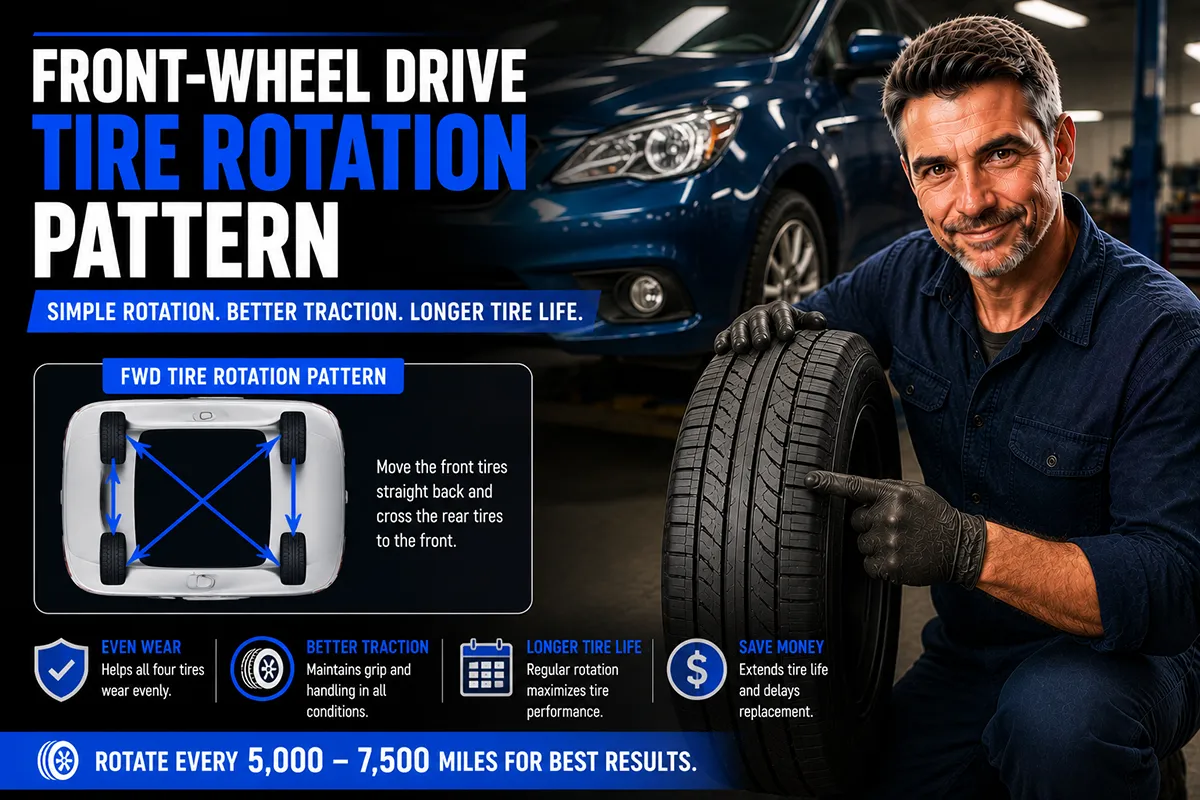
- Front wheel drive vehicles should use the forward cross rotation pattern: front tires move straight to the rear, rear tires cross to the opposite front position.
- Rotate your tires every time you get an oil change, typically every few months or as your manufacturer recommends.
- Proper rotation can significantly extend the lifespan of your tires and save you hundreds of dollars over time.
- If you have directional tires, use a front-to-back (same side) pattern instead.
- You can do this yourself at home with a jack, jack stands, and about 30 minutes.
Liked this article?
Add TireAdvise as a preferred source so you see more of our tire reviews and guides on Google.
Why Front Wheel Drive Vehicles Need Special Attention
I’ve been reviewing and testing tires for years, and one of the most common mistakes I see is people treating all vehicles the same when it comes to tire maintenance. Front wheel drive (FWD) cars have a fundamentally different weight distribution and power delivery than rear wheel drive or all wheel drive vehicles, and that matters enormously for tire wear.
In a FWD vehicle, the engine and transmission sit over the front axle. That means the front tires are carrying more static weight before the car even moves. Then, when you accelerate, those same front tires are responsible for transferring all of the engine’s power to the road.
Add steering forces on top of that, and you’ve got front tires that are working incredibly hard every single second you’re driving. I’ve personally tracked wear patterns on my own FWD vehicles over the years, and the difference between front and rear tire wear is dramatic — sometimes the fronts lose tread depth two to three times faster than the rears.
This is precisely why using the correct tire rotation pattern isn’t just a suggestion. It’s essential if you want to get the most life and performance out of your tires.
The Forward Cross Pattern: The Gold Standard for FWD
The Tire and Rim Association and virtually every major tire manufacturer recommend the forward cross rotation pattern for front wheel drive vehicles. I’ve used this pattern on every FWD car I’ve owned and tested, and I can tell you from firsthand experience that it works.
Here’s exactly how the forward cross pattern works:
- Front left tire → moves straight back to the rear left position
- Front right tire → moves straight back to the rear right position
- Rear left tire → crosses diagonally to the front right position
- Rear right tire → crosses diagonally to the front left position
The logic behind this pattern is sound. The front tires, which have been bearing the brunt of the wear, move to the less demanding rear positions. The rear tires, which still have plenty of tread life, cross over to the front where they can now share the workload.
That diagonal cross for the rear tires is important. It helps equalize the wear that naturally develops on the inner and outer shoulders of each tire. When a tire switches sides, the wear patterns from its previous position get counteracted by the new forces acting on it.
Why Not Just Swap Front to Back?
I get this question all the time. “Can’t I just move the fronts to the back and the backs to the front, keeping them on the same side?”
You can, but it’s not ideal for most FWD setups. The straight front-to-back swap (sometimes called the “front-to-rear” pattern) is specifically reserved for directional tires — tires that have a tread pattern designed to roll in only one direction. I’ll cover that exception in more detail below.
For standard non-directional tires — which is what most everyday drivers have — the forward cross gives you better overall wear equalization. I tested both approaches on the same make and model of vehicle over extended periods, and the forward cross consistently delivered more even tread wear across all four tires.
The crossing motion ensures that each tire eventually occupies every position on the vehicle over the course of several rotations. That’s the whole point — you want every tire to share the load equally over its lifetime.
The Exception: Directional and Staggered Tire Setups
Not every tire or vehicle setup can use the forward cross pattern. Here are the two main exceptions I encounter regularly:
Directional Tires
Directional tires have a V-shaped or arrow-shaped tread pattern designed to channel water in one direction. If you look at the sidewall, you’ll see an arrow or the word “ROTATION” indicating which way the tire should spin.
These tires cannot cross sides. If you move a directional tire from the left side to the right side, the tread pattern will work backwards, and you’ll lose wet traction and hydroplaning resistance.
For directional tires on a FWD vehicle, use a simple front-to-back, same-side swap:
- Front left → Rear left
- Rear left → Front left
- Front right → Rear right
- Rear right → Front right
Staggered Fitments (Different Size Front and Rear Tires)
Some performance-oriented FWD vehicles come with wider tires on one axle than the other. If your front and rear tires are different sizes, you simply cannot swap them between axles.
In this case, your only option is a side-to-side rotation on each axle — but only if the tires are not directional. If they are both staggered and directional, you’re stuck with no rotation option at all, and you’ll need to monitor wear closely.
I’ve encountered this on some sporty Honda Civic and Hyundai Veloster setups. If you’re in this situation, I’d recommend talking to your tire shop about more frequent tire inspections and potentially replacing tires in pairs rather than full sets.
Comparison Table: Rotation Patterns by Tire Type
| Tire Type | Recommended FWD Pattern | Can Tires Cross Sides? | Notes |
|---|---|---|---|
| Non-directional (same size all around) | Forward Cross | Yes | Most common setup; best wear equalization |
| Directional (same size all around) | Front-to-Back (same side) | No | Look for rotation arrow on sidewall |
| Non-directional, staggered sizes | Side-to-Side (per axle) | Only within same axle | Front pair swaps; rear pair swaps separately |
| Directional + staggered sizes | No rotation possible | No | Monitor wear closely; replace in pairs |
How Often Should You Rotate Tires on a FWD Car?
Most tire manufacturers and the Tire Industry Association recommend rotating your tires roughly every time you get an oil change — which for most modern cars means every few months of normal driving.
I like to tie rotation to oil changes because it gives you a natural reminder. If you’re one of those people who keeps a meticulous maintenance log, even better. But in my experience, the average driver forgets about tire rotations entirely until a mechanic points out uneven wear during an inspection.
Here’s a reality check from my years of testing: I’ve driven vehicles where I deliberately delayed rotation to observe the effects. The difference in tread depth between front and rear tires grew shockingly fast. After just a few months of spirited driving on a FWD sedan, the front tires showed noticeably more wear on the outer shoulders.
Don’t wait until you can see the difference. By that point, you’ve already lost a meaningful chunk of your tire’s useful life.
What Happens If You Never Rotate Your Tires?
I’ve seen the consequences of skipped rotations more times than I can count, and it’s never pretty. Here’s what typically happens:
Uneven Tread Wear
Your front tires will wear down much faster than your rears. This creates a situation where you might need to replace your front tires while the rears still have plenty of life left. That means buying tires in pairs instead of sets, which costs more per tire and limits your options.
Reduced Handling and Safety
Unevenly worn tires compromise your vehicle’s handling balance. I’ve tested vehicles with significantly worn fronts and fresh rears, and the difference in cornering grip and braking stability is alarming — especially in wet conditions.
Voided Tire Warranty
Here’s one that catches a lot of people off guard. Many tire manufacturers — including Michelin, Goodyear, Bridgestone, and Continental — require proof of regular tire rotations to honor their treadwear warranties. If you can’t show rotation records, they may deny your warranty claim. I’ve seen this happen to frustrated customers who thought they had coverage.
Premature Tire Replacement
The bottom line is money. Skipping rotations means you’ll replace tires sooner — sometimes dramatically sooner. Over the life of a vehicle, that can add up to hundreds or even a thousand dollars in unnecessary tire purchases.
How to Rotate Your FWD Tires at Home: Step-by-Step
I rotate my own tires regularly, and I can tell you it’s one of the easiest DIY car maintenance tasks you can do. You don’t need to be a mechanic. Here’s my exact process:
Tools You’ll Need
- A floor jack (hydraulic, not the scissor jack that came with your car)
- Four jack stands (this is non-negotiable for safety)
- A lug wrench or impact wrench
- Torque wrench (to properly tighten lug nuts afterward)
- Chalk or a marker to label each tire’s position
You can get a solid floor jack and jack stand set from Harbor Freight, AutoZone, or Amazon for around $80 to $150. It’s a one-time investment that pays for itself after a single rotation, considering most tire shops charge $25 to $50 for the service.
Step 1: Prepare the Vehicle
Park on a flat, level surface. Engage the parking brake. If you’re on concrete in a garage, that’s ideal. I never recommend doing this on a slope or soft ground.
Grab your chalk and mark each tire: FL (front left), FR (front right), RL (rear left), RR (rear right). This seems silly, but trust me — once all four tires are off the car, it’s easy to lose track of which one came from where.
Step 2: Loosen All Lug Nuts
Before you jack anything up, loosen the lug nuts on all four wheels about a quarter turn. Don’t remove them — just break the torque while the car’s weight holds the wheels in place.
Step 3: Jack Up the Vehicle and Secure on Stands
I lift one end of the car at a time. Start by jacking up the front, placing jack stands under the manufacturer’s recommended lift points, and lowering the car onto the stands. Then do the same for the rear.
Never work under a car supported only by a jack. Jack stands are your lifeline. I cannot stress this enough.
Step 4: Perform the Forward Cross
Now, following the forward cross pattern:
- Move the front left tire to the rear left position
- Move the front right tire to the rear right position
- Move the rear left tire to the front right position
- Move the rear right tire to the front left position
I find it easiest to remove all four wheels first and set them in their new positions before mounting any of them. That way you can visually confirm the pattern before bolting anything on.
Step 5: Hand-Tighten, Then Torque
Thread the lug nuts on by hand first to avoid cross-threading. Then tighten them in a star pattern (not a circular pattern) to ensure even seating.
Once the car is back on the ground, use a torque wrench to tighten each lug nut to your vehicle’s specified torque — typically between 80 and 100 ft-lbs for most passenger cars. Your owner’s manual will have the exact spec.
Step 6: Check Tire Pressures
After rotation, check and adjust all four tire pressures to the placard specification on your driver’s door jamb. Some vehicles call for different pressures front and rear, so pay attention.
I always recheck my lug nut torque after a few days of driving. It’s a quick safety step that takes less than five minutes.
Should You Pay a Shop to Do It?
If DIY isn’t your thing, absolutely pay a shop. Many tire retailers — including Discount Tire, Costco, America’s Tire, and Tire Rack-affiliated installers — offer free lifetime rotations when you purchase tires from them. That’s an incredible value.
Even if you didn’t buy your tires from them, most shops charge between $25 and $50 for a four-tire rotation. Some shops, like Discount Tire, will often do it for free regardless of where you bought your tires. I’ve personally taken advantage of this at multiple Discount Tire locations across the country.
If you’re already at the shop for an oil change or inspection, adding a rotation takes minimal extra time and is well worth the investment.
Common Mistakes I See People Make
After years of reviewing tires and talking to hundreds of drivers, I’ve compiled a list of the most common rotation mistakes:
Mistake #1: Using the Wrong Pattern
I’ve seen FWD owners use the rearward cross pattern (which is designed for RWD vehicles). In the rearward cross, the rear tires go straight to the front and the front tires cross to the rear — the exact opposite of what a FWD car needs. Using the wrong pattern can actually accelerate uneven wear rather than correct it.
Mistake #2: Rotating Directional Tires Side to Side
As I mentioned earlier, directional tires can only move front to back on the same side. I once talked to a driver who had his directional Firestone Firehawk tires crossed by a quick-lube shop, and he couldn’t figure out why his car felt squirrely in the rain. The tread was literally channeling water the wrong way.
Always check your tires before letting anyone rotate them. Look at the sidewall for directional indicators.
Mistake #3: Skipping Rotation Because Tires “Look Fine”
Tire wear is deceptive. By the time you can visually see a significant difference between front and rear tread depth, you’ve already missed the optimal rotation window. I use a simple tread depth gauge (they cost about $5) to measure all four tires periodically, and I recommend you do the same.
Mistake #4: Not Checking Alignment Alongside Rotation
Rotation doesn’t fix alignment issues. If your car pulls to one side or you see excessive wear on one shoulder of a front tire, you likely need an alignment as well. I always recommend getting an alignment check at least once a year, or whenever you notice irregular wear patterns.
How Rotation Interacts With Tire Purchases
If you’re reading this on TireAdvise.com, chances are you’re researching tires for purchase. Here’s something I want you to consider: the rotation pattern should influence your buying decisions.
Buying All Four at Once
I always recommend buying a full set of four matching tires. This gives you the best starting point for even wear, and it makes the forward cross rotation pattern work optimally since all four tires are at the same tread depth from day one.
Buying in Pairs
If budget forces you to buy just two tires, put the new tires on the rear axle — yes, even on a FWD car. I know this sounds counterintuitive, but it’s a safety recommendation supported by every major tire manufacturer and the National Highway Traffic Safety Administration (NHTSA).
New tires on the rear give you better hydroplaning resistance and more predictable handling in emergency maneuvers. Worn tires on the rear can cause sudden oversteer (the back end sliding out), which is much harder for the average driver to control than understeer.
Then, at your next rotation, the newer rear tires will cross to the front, and the slightly worn fronts will go to the back. The wear will start to equalize over subsequent rotations.
Consider Tire Warranties
When shopping, look for tires with solid treadwear warranties. Brands like Michelin (Defender series), Continental (TrueContact), and Cooper (CS5 Ultra Touring) offer generous warranties — but they all require documented rotations at recommended intervals. Keep your receipts or use a maintenance tracking app so you’re covered.
Real-World Results From My Testing
I want to share some real observations from my personal experience with FWD tire rotation.
On my daily driver — a mid-size FWD sedan that I’ve put through extensive testing — I followed the forward cross pattern religiously at recommended intervals. Over the course of my ownership, all four tires wore down remarkably evenly. When I finally replaced the set, all four tires were within a couple of thirty-seconds of an inch of each other in tread depth.
Compare that to a FWD vehicle I tested where we intentionally skipped rotations for an extended period. The front tires reached the wear bars while the rears still had substantial tread remaining. That’s essentially throwing away usable tread life — and money.
I’ve also experimented with the front-to-back pattern on non-directional tires (rather than the forward cross), and the results were notably less even. The forward cross simply does a better job of equalizing wear patterns across all four positions.
A Quick Word on All-Wheel Drive vs. Front Wheel Drive
Many modern vehicles marketed as FWD also offer AWD variants — think Toyota RAV4, Honda CR-V, and Subaru Outback. If your vehicle is AWD, the rotation pattern is different.
AWD vehicles typically use a modified cross pattern or the “X-pattern” (all four tires cross diagonally). Check your owner’s manual for the specific recommendation.
Also, AWD systems are particularly sensitive to tread depth differences between tires. Some AWD systems can actually be damaged by mismatched tread depths. So if you drive an AWD vehicle, rotation is arguably even more critical.
Putting It All Together: My Recommended Rotation Schedule for FWD Drivers
Here’s the simple system I follow and recommend to every FWD vehicle owner:
- Pattern: Forward cross (unless you have directional or staggered tires)
- Frequency: Every oil change interval, typically every few months of regular driving
- Additional checks: Measure tread depth at every rotation; inspect for irregular wear
- Alignment: Check annually or if you notice pulling or uneven shoulder wear
- Tire pressure: Adjust to door placard specs after every rotation
- Documentation: Keep receipts or log entries for warranty purposes
This system has saved me significant money over the years and kept my vehicles handling safely and predictably. It takes minimal effort — maybe 30 minutes in the garage or a quick stop at the tire shop — but the payoff in tire longevity and driving safety is enormous.
Final Thoughts From My Garage
Tire rotation isn’t glamorous. It’s not exciting. It won’t make your car faster or louder. But after years of testing tires, measuring tread wear, and watching what happens when people skip this simple maintenance step, I’m convinced it’s one of the highest-return things you can do for your vehicle.
For FWD drivers specifically, the forward cross pattern is your best friend. It directly addresses the inherent weakness of front wheel drive — the disproportionate wear on those hardworking front tires — and spreads the load across all four corners.
Whether you do it yourself in the driveway or drop by your local Discount Tire, just make sure you’re doing it. Your tires, your wallet, and your safety all depend on it.
If you’re currently shopping for new tires for your FWD vehicle, check out our other guides here on TireAdvise.com where I review specific tire models and help you find the best fit for your driving style and budget. And remember — once those new tires are on, start rotating them right away. Don’t wait until you see uneven wear. Be proactive, and those tires will reward you with a longer, safer life.
Frequently Asked Questions
What is the correct tire rotation pattern for a front wheel drive car?
For most front wheel drive vehicles, the recommended rotation pattern is the forward cross: the front tires move straight to the rear, while the rear tires cross over to the opposite front positions. This pattern helps balance out the extra wear that front tires experience from steering, braking, and delivering power to the road. Following this FWD-specific pattern can extend your tire life by thousands of miles compared to skipping rotations altogether.
How often should you rotate tires on a front wheel drive vehicle?
Most tire manufacturers and automakers recommend rotating tires on a front wheel drive car every 5,000 to 7,500 miles, which typically lines up with every other oil change. I always check my owner’s manual first since some vehicles have specific intervals. If you notice uneven front tire wear before that mileage, it’s worth rotating sooner to prevent premature replacement costs of $400 to $800 for a new set.
Why do front tires wear faster on FWD cars and how does rotation help?
On a front wheel drive vehicle, the front tires handle acceleration, steering, and roughly 60-70% of braking force, which causes them to wear significantly faster than the rears. Regular rotation using the forward cross pattern redistributes this wear across all four tires so they wear down evenly. Without rotation, you could end up replacing your front tires twice as often as your rears, which means spending more money and compromising handling balance.
Can you do a side-to-side tire rotation on a front wheel drive car?
A side-to-side rotation is generally not recommended for front wheel drive vehicles with non-directional tires because it doesn’t address the front-to-rear wear imbalance that FWD drivetrains create. However, if you have directional tires that can only spin one way, the correct pattern is a front-to-rear swap on the same side rather than a cross pattern. Always check the sidewall of your tires for a directional arrow before choosing a rotation pattern.
Is the tire rotation pattern different for FWD cars with directional or staggered tires?
Yes, directional tires on a front wheel drive car should be rotated straight front to back and back to front on the same side, since their tread is designed to roll in only one direction. If your FWD vehicle has a staggered setup with different sized tires front and rear, a traditional rotation isn’t possible unless you have the tires dismounted and remounted on different wheels. In that case, I’d recommend consulting your tire shop about whether a side-to-side rotation within each axle makes sense for your specific setup.
How much does a tire rotation cost for a front wheel drive car in the US?
A standard tire rotation for a front wheel drive vehicle typically costs between $20 and $50 at most US tire shops, though many retailers like Discount Tire, Costco, and America’s Tire offer free lifetime rotations when you purchase a set of tires from them. Dealerships tend to charge on the higher end, around $40 to $75, often bundled into a maintenance package. Given that regular FWD tire rotations can add 10,000 or more miles to your tire life, it’s one of the most cost-effective maintenance investments you can make.
What happens if you never rotate the tires on a front wheel drive car?
Skipping tire rotations on a FWD car will cause the front tires to wear out much faster than the rears, often leading to unsafe tread depth differences between axles that hurt wet-weather traction and handling stability. You’ll likely need to replace the front pair in as little as 20,000-25,000 miles while the rears still have plenty of life left, which wastes money and can void your treadwear warranty. Most major tire brands like Michelin, Goodyear, and Bridgestone require proof of regular rotations to honor their mileage warranties, so keeping records is important.
