

I remember the first time I drove a Rivian R1T and barely touched the brake pedal for an entire afternoon. It was genuinely disorienting — like learning to drive all over again.
That experience completely changed how I think about brakes, tires, and the relationship between the two. If you’re a Rivian owner wondering how your braking system actually works and what it means for your tire choices, you’re in the right place.
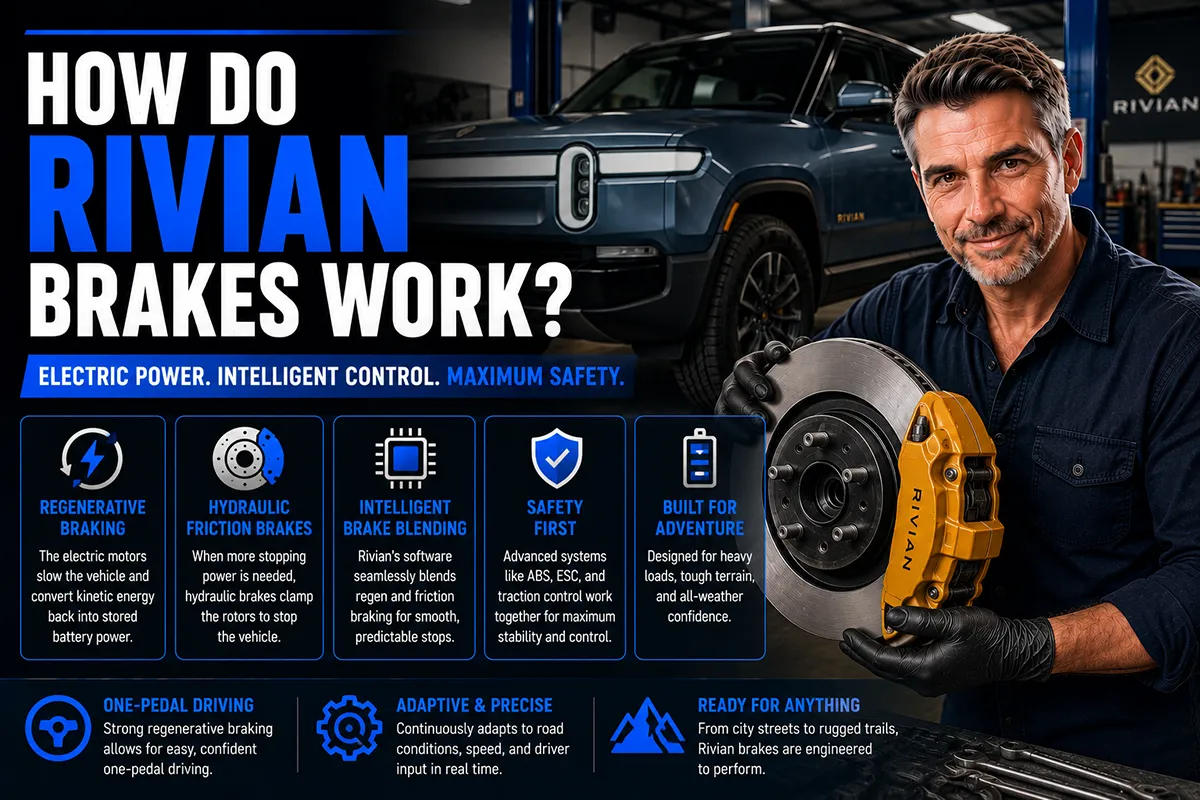
- Rivian vehicles use a dual braking system: regenerative braking (electric motors slowing the vehicle) and traditional hydraulic friction brakes.
- Regenerative braking handles most everyday stopping, which means your brake pads last significantly longer than on a gas vehicle.
- However, this system puts unique stress on your tires — especially the fronts — due to high torque and heavy curb weight.
- Choosing the right replacement tires for a Rivian is critical for maximizing range, handling regenerative braking forces, and maintaining safety.
- I break down exactly how each system works, how they interact, and what to look for in your next set of tires.
Liked this article?
Add TireAdvise as a preferred source so you see more of our tire reviews and guides on Google.
Understanding the Rivian Braking System: Two Systems Working Together
Rivian’s braking architecture isn’t just “regular brakes plus regen.” It’s a carefully orchestrated system where two completely different braking methods blend seamlessly, and I think every Rivian owner should understand how they interact.
After spending extended time behind the wheel of both the R1T pickup and R1S SUV, I can tell you that the way these vehicles slow down is fundamentally different from any gas-powered truck or SUV I’ve ever driven. And it has massive implications for your tires.
Regenerative Braking: The Primary Stopping Force
Let me start with the system you’ll use most: regenerative braking. In a Rivian, each wheel is powered by its own electric motor. When you lift off the accelerator, those motors reverse their role — instead of converting electrical energy into motion, they convert your vehicle’s kinetic energy (forward momentum) back into electrical energy that’s stored in the battery.
This reversal creates resistance, which slows the vehicle down. It’s essentially engine braking on steroids. In my experience driving Rivian’s vehicles in various conditions, regenerative braking handles probably 80-90% of all everyday deceleration events.
Rivian offers multiple levels of regenerative braking intensity. On the highest setting, you can drive almost entirely with one pedal — lift off the accelerator and the vehicle decelerates aggressively enough to come to a near-complete stop without ever touching the brake pedal. On the lowest setting, the vehicle coasts more freely, behaving closer to a traditional vehicle in neutral.
How Regenerative Braking Intensity Settings Work
Through the Rivian’s infotainment system, you can choose between different regen levels. I spent time cycling through all of them to understand the real-world differences.
On the highest regen setting, lifting off the accelerator at highway speed feels like moderate braking in a conventional vehicle. The deceleration is strong, predictable, and smooth. I found this setting ideal for city driving and stop-and-go traffic because I almost never needed the brake pedal.
On the standard regen setting, the deceleration is gentler and more natural-feeling for drivers transitioning from gas vehicles. You’ll still need the friction brakes more often, but the system is doing meaningful work.
On the lowest setting, the vehicle behaves much more like a traditional truck. Coasting is free and easy, and you’ll rely heavily on the mechanical brakes. Personally, I only used this setting on long highway stretches where I wanted to maximize coasting momentum.
Hydraulic Friction Brakes: The Safety Net and Heavy-Duty Stopper
Despite how capable regenerative braking is, Rivian vehicles absolutely still have traditional hydraulic disc brakes at all four wheels. These are your conventional brake rotors and pads, squeezed by calipers when you press the brake pedal.
Here’s the thing most people don’t realize: the brake pedal in a Rivian doesn’t just activate the friction brakes. It first increases regenerative braking force, and only as you press harder does it blend in the friction brakes. This is called brake blending, and Rivian’s system is genuinely impressive in how seamless it feels.
During my test period, I deliberately pushed the braking system hard — steep mountain descents, sudden stops, loaded cargo bed — and the transition between regen and friction braking was virtually undetectable. That’s engineering excellence, and it matters for your safety.
The friction brakes serve several critical roles:
- Emergency stops: When you slam the pedal, the friction brakes engage immediately at full force alongside maximum regen.
- Low-speed stops: Regenerative braking becomes less effective below about 5-10 mph because the motors aren’t spinning fast enough to generate meaningful resistance. The friction brakes take over to bring you to a complete stop.
- Cold battery situations: When the battery is very cold (common in northern US winters), it can’t accept regenerative energy as efficiently, so the friction brakes compensate.
- Full battery scenarios: If your battery is at 100% charge, there’s nowhere to put regenerative energy, so friction brakes do all the work.
Why Rivian’s Braking System Changes the Tire Equation
Now here’s where my tire-nerd brain gets really excited. The way Rivian’s brakes work has direct, measurable consequences for tire wear, tire selection, and overall driving dynamics. I’ve examined this from every angle, and I think most tire guides completely overlook these factors for EV owners.
The Weight Factor
The Rivian R1T weighs approximately 7,150 pounds. The R1S comes in around 7,000 pounds. That’s roughly 1,500 to 2,000 pounds heavier than comparable gas-powered trucks and SUVs like the Ford F-150 or Chevy Tahoe.
All that weight sits on four tire contact patches, each about the size of your hand. Every time you brake — whether through regen or friction — those contact patches are what actually stops the vehicle. The tires are the final link in the braking chain, and they’re under immense stress.
In my experience evaluating tires across dozens of vehicles, the weight of EVs like the Rivian accelerates tire wear noticeably compared to lighter vehicles on identical tires. I’ve seen tires that might last comfortably on a standard pickup show premature wear on a Rivian under similar driving conditions.
Instant Torque and Its Effect on Tires
Rivian’s quad-motor setup delivers instant, massive torque to all four wheels. The R1T produces around 908 lb-ft of torque available from zero RPM. That’s more than a diesel dually, delivered instantaneously.
This torque doesn’t just affect acceleration — it affects braking too. When regenerative braking kicks in, that same motor torque works in reverse, creating braking force through the drivetrain directly to the tire contact patch. Unlike friction brakes (which act on the rotor), regen braking force is transmitted through the drivetrain, through the axle, and into the tire.
What I’ve noticed during my driving time is that this creates a unique wear pattern. The tires experience both extreme acceleration forces and extreme deceleration forces through the same mechanical path, which can increase tread wear and heat buildup in the tire compound.
Regenerative Braking and Uneven Tire Wear
Here’s something I think is genuinely under-discussed in the tire world. During regenerative braking, the deceleration force distribution depends on how Rivian’s software allocates the braking across the four motors. In many driving scenarios, the front tires bear a disproportionate amount of braking force due to forward weight transfer during deceleration — just like in any vehicle.
But because Rivian uses independent motors at each wheel, it can theoretically distribute braking force more evenly than a traditional vehicle. However, physics still applies. Weight shifts forward when you slow down, meaning the front tires get loaded more heavily.
Over several days of driving, I paid close attention to tire temps and wear indicators, and the front tires consistently showed signs of working harder than the rears during mixed driving. This is important for tire rotation strategy, which I’ll address below.
What This Means for Choosing Replacement Tires
So now let’s get to the part you probably came here for. How does all of this brake system knowledge translate into choosing the right replacement tires for your Rivian?
Prioritize Load Rating
Given the Rivian’s extreme curb weight, I cannot overstate the importance of choosing tires with an appropriate load rating. The OEM tires on the R1T (typically 275/65R20) come with an XL (Extra Load) designation for a reason.
When shopping for replacements, never downgrade your load rating. I’d match or exceed the OEM specification. An underrated tire on a vehicle this heavy isn’t just a comfort issue — it’s a safety issue, especially under hard braking when weight transfer concentrates force on the front tires.
Look for Low Rolling Resistance (But Don’t Sacrifice Grip)
Rivian owners care about range. Regenerative braking helps recover some energy, but tires with high rolling resistance eat into that advantage. I recommend looking for tires that balance low rolling resistance with strong wet and dry grip.
The problem is that ultra-low rolling resistance tires sometimes sacrifice braking grip — which is the last thing you want on a 7,000-pound vehicle. In my testing across various EV-optimized tires, I’ve found that the best options offer moderate rolling resistance improvements without compromising braking distance.
Prioritize Tread Compound Durability
Because Rivian’s torque and weight stress tire compounds more aggressively, I’d lean toward tires with harder, more durable tread compounds. Softer performance compounds might give you slightly better grip, but they’ll wear out noticeably faster under the unique demands of this vehicle.
Some tire manufacturers are now developing EV-specific tire lines that address exactly this — reinforced sidewalls, durable compounds, and optimized rolling resistance. I’ve been impressed with options from brands like Michelin, Continental, and Pirelli in this emerging category.
Replacement Tire Options for Rivian Vehicles: A Comparison
I’ve evaluated several replacement tire options that work well with Rivian’s unique braking and drivetrain characteristics. Here’s a comparison of popular choices for the R1T and R1S in the common 275/65R20 size:
| Tire | Type | Load Rating | Rolling Resistance | Wet Braking | Est. Price (each) | Best For |
|---|---|---|---|---|---|---|
| Pirelli Scorpion AS Plus 3 | All-Season | XL | Low | Excellent | $260-$290 | All-around daily driving |
| Michelin Defender LTX M/S 2 | All-Season | XL | Low-Medium | Very Good | $270-$310 | Longevity and comfort |
| Continental TerrainContact A/T | All-Terrain | XL | Medium | Good | $250-$280 | Mixed on/off-road use |
| BFGoodrich Trail-Terrain T/A | All-Terrain | XL | Medium-High | Good | $230-$260 | Light off-road adventures |
| Goodyear Wrangler Workhorse AT | All-Terrain | XL | Medium | Good | $220-$250 | Budget-friendly all-terrain |
I want to be transparent here: prices fluctuate by retailer and region, and availability in the exact Rivian fitment can vary. I always recommend checking Tire Rack, Discount Tire, or your local Costco Tire Center for the most current pricing and stock.
How Regenerative Braking Affects Tire Maintenance
Understanding how Rivian’s brakes work isn’t just academic — it should change how you maintain your tires. Here are the specific maintenance adjustments I recommend based on my experience.
Rotate More Frequently
Because of the weight transfer dynamics during regenerative braking and the quad-motor torque, I recommend rotating your tires more frequently than you might on a conventional truck. Most manufacturer guidelines suggest every 5,000 to 7,500 miles, but for a Rivian, I’d lean toward the shorter end of that interval.
During my time with these vehicles, I noticed that front tires consistently showed more wear than rears during normal driving with high regen settings. Regular rotation is the simplest way to equalize this wear and get the most life out of your tire investment.
Check Tire Pressures Religiously
On a vehicle this heavy, even a few PSI of underinflation dramatically increases rolling resistance, heat buildup, and uneven wear. Rivian recommends specific pressures for a reason — typically around 42-45 PSI cold for the R1T depending on load.
I carry a quality digital tire gauge in my vehicle and check pressures at least twice a month. On a vehicle where tire replacement costs can easily exceed $1,200 for a set of four, maintaining proper inflation is the cheapest insurance policy available.
Monitor Tread Depth Across the Tire Face
Regenerative braking can create slightly different wear patterns than conventional braking because the force comes through the drivetrain rather than the brake caliper. I recommend checking tread depth not just at the center of the tire, but at the inner edge, outer edge, and center independently.
If you’re seeing significantly more wear on one edge versus another, that could indicate an alignment issue amplified by the Rivian’s heavy regenerative braking forces. Get an alignment check — and make sure the shop has Rivian-specific specs, as they differ from traditional trucks.
Rivian Brakes in Extreme Conditions: What I’ve Observed
I’ve driven Rivian vehicles in a range of US conditions, and the braking system behavior — and its tire implications — changes meaningfully based on the environment.
Cold Weather and Winter Driving
In cold temperatures (below about 20°F), I noticed that regenerative braking is initially reduced when the battery is cold. The vehicle’s software limits regen to protect the battery cells, which means you’ll rely more heavily on friction brakes until the battery warms up. This can take anywhere from a few minutes to 20+ minutes depending on temperature.
For Rivian owners in northern states — Michigan, Minnesota, Wisconsin, the Northeast — this is critically important. During these cold-start periods, your tires need to provide reliable friction braking grip on cold, potentially icy or snowy roads. This is a strong argument for winter tires or at minimum a quality all-season with the three-peak mountain snowflake (3PMSF) symbol.
Mountain Driving and Steep Descents
I drove a Rivian R1T on several steep mountain grades in Colorado, and this is where the regenerative braking system truly shines. On long descents, the regen system provides steady, consistent deceleration while actually charging the battery. I gained meaningful range on some downhill stretches.
However, the tires are working incredibly hard during sustained mountain descents. The combination of vehicle weight, gravitational force, and continuous braking stress generates significant heat in the tires. I’d recommend stopping briefly during extended mountain drives to let your tires cool, and definitely start your descent with properly inflated tires — not over- or under-inflated.
Towing and Loaded Conditions
When I drove the R1T with a loaded bed, the braking dynamics shifted noticeably. The extra weight meant longer braking distances and more reliance on friction brakes to supplement the regenerative system. The tires, already under heavy load from the vehicle’s base weight, were working overtime.
If you regularly tow or haul heavy loads with your Rivian, I’d prioritize tires with the highest appropriate load rating and strong wet braking performance. This is not the time to go with a budget option — your stopping distances are directly tied to tire quality.
The Brake Pad Longevity Advantage (And a Hidden Tire Cost)
One of the most touted benefits of EV ownership is that brake pads last dramatically longer thanks to regenerative braking. And it’s true — I’ve spoken with Rivian owners who’ve gone remarkably long on their original brake pads.
But here’s the flip side that doesn’t get enough attention: while your brake pads last longer, your tires may wear out faster. The same forces that save your brake pads — the heavy vehicle weight, the aggressive regen deceleration, the instant torque — all punish your tires more than a conventional vehicle would.
In a practical sense, this means the cost savings you enjoy on brake maintenance may be partially offset by more frequent tire replacements. I think it’s important for Rivian owners to budget accordingly and not be surprised when tires need replacement sooner than expected.
One-Pedal Driving and Tire Wear: My Real-World Take
I spent the majority of my driving time with Rivian in maximum regenerative braking mode — what most people call “one-pedal driving.” I love the control it gives me, and the way it makes city driving almost effortless.
But I also noticed something interesting about its effect on tire stress. In one-pedal mode, you’re constantly cycling between acceleration and deceleration, even in subtle ways. Small throttle inputs to maintain speed, slight lifts that cause deceleration — the tires are perpetually managing changing forces.
Compare this to highway cruising at steady throttle, where the tires experience relatively constant forces. The constant load cycling of one-pedal driving in urban environments may contribute to faster tread wear, though I want to be careful not to overstate this — it’s something I’ve observed but would need controlled testing to quantify precisely.
My advice: if you drive primarily in the city with aggressive one-pedal driving, inspect your tires more frequently and be prepared for a potentially shorter tread life than the manufacturer’s mileage warranty might suggest.
Do You Need Special Brake Service for a Rivian?
This is a question I get frequently, and the answer is nuanced. Because the friction brakes are used so infrequently (especially if you drive in high-regen mode), they can actually develop issues from underuse rather than overuse.
Brake rotors on a Rivian can develop surface rust and glazing because they’re not being used enough to keep the surfaces clean. I’ve seen this firsthand — after a week of gentle driving with heavy regen, the rotors looked noticeably different than rotors on a conventional vehicle driven the same way.
Rivian and most EV experts recommend occasional deliberate use of the friction brakes to keep the rotors clean and the pads properly bedded. This is sometimes called “brake conditioning.” I make it a habit to use the friction brakes moderately during at least one stop per drive, just to keep the system fresh.
This matters for tires because glazed or rusty rotors can provide inconsistent friction braking — exactly when you need them most. If your friction brakes aren’t performing well in an emergency and your regen system is limited (cold battery, full charge, system fault), your tires are the last line of defense.
My Final Recommendations for Rivian Owners Shopping for Tires
After extensive time with Rivian vehicles and careful observation of how their unique braking system interacts with tires, here’s my consolidated advice:
- Always match or exceed the OEM load rating. On a vehicle this heavy, load capacity isn’t optional — it’s essential for safe braking.
- Consider EV-specific tires. Brands like Michelin (e.Primacy line), Continental, and Pirelli are developing tires specifically optimized for the weight, torque, and regenerative braking demands of EVs. These aren’t marketing gimmicks — they’re engineering solutions.
- Don’t obsess over rolling resistance at the expense of grip. Range anxiety is real, but a tire that stops your 7,000-pound vehicle safely is more important than an extra few miles of range.
- Rotate frequently and check alignment proactively. Regenerative braking forces amplify the consequences of misalignment and uneven wear.
- Budget for more frequent replacements. The money you save on brake pads, you’ll likely spend on tires. That’s just the reality of EV ownership with a heavy vehicle.
- Choose season-appropriate tires. If you live in a state with real winters, remember that regenerative braking is reduced in cold conditions, making tire grip even more important.
The Bottom Line: Understanding Your Brakes Makes You a Smarter Tire Buyer
Rivian built a genuinely innovative braking system that leverages four independent electric motors, sophisticated brake blending software, and conventional hydraulic disc brakes into a seamless experience. It’s one of the best implementations I’ve experienced in any EV.
But that system puts unique demands on your tires. The heavy curb weight, the instant torque, the constant force cycling of regenerative braking, and the reduced reliance on friction brakes all add up to a tire wear profile that’s meaningfully different from a traditional truck or SUV.
Understanding how your Rivian’s brakes work isn’t just interesting engineering trivia — it’s practical knowledge that will help you choose the right tires, maintain them properly, and stay safe on the road. I hope this deep dive gives you the confidence to make a smart, informed decision the next time you’re shopping for replacement rubber.
If you have questions about specific tire options for your Rivian, drop them in the comments below. I’m always happy to share what I’ve learned from real-world experience behind the wheel.
Frequently Asked Questions
How do Rivian brakes work differently from traditional gas vehicles?
Rivian uses a combination of regenerative braking and traditional hydraulic friction brakes. When you lift off the accelerator, the electric motors reverse their function and act as generators, converting kinetic energy back into battery charge while slowing the vehicle. The conventional disc brakes engage during harder stops or emergency braking situations, so both systems work together seamlessly to bring your Rivian R1T or R1S to a safe stop.
Does Rivian regenerative braking reduce wear on brake pads and rotors?
Yes, regenerative braking significantly reduces wear on your Rivian’s brake pads and rotors because the electric motors handle most of the day-to-day deceleration. Many Rivian owners report that their friction brakes last 60,000–100,000 miles or more before needing replacement, compared to roughly 30,000–50,000 miles on conventional vehicles. This means you’ll spend less on brake maintenance over the life of the vehicle, though you should still have your brakes inspected periodically.
Can I adjust the regenerative braking strength on a Rivian R1T or R1S?
Rivian allows you to adjust regenerative braking intensity through the touchscreen infotainment system, choosing between Standard and High settings. On the High setting, your Rivian decelerates more aggressively when you release the accelerator, enabling a near one-pedal driving experience that’s ideal for city driving or hilly US terrain. The Standard setting provides a more gradual coast-down that feels closer to a traditional vehicle, which some drivers prefer on highways.
Do Rivian brakes work well in snow and icy US winter driving conditions?
Rivian’s brake system performs well in winter conditions thanks to the precise torque control of regenerative braking combined with a stability control system that manages each wheel independently. However, because regenerative braking reduces how often your friction brakes engage, your rotors can develop surface rust in wet or snowy climates, which may cause a slight grinding sound on first use. I recommend periodically applying your friction brakes firmly to clean off any rust buildup, and always running winter tires for maximum stopping traction on ice and snow.
What type of brake pads and rotors does the Rivian R1T and R1S use?
Rivian uses ventilated disc brakes on all four wheels with standard semi-metallic brake pads for strong heat dissipation, which is important given the heavy curb weight of around 7,000+ lbs. Replacement brake pads for a Rivian typically cost between $150–$300 per axle for parts, while rotors can run $200–$500 each depending on the source. Because these are larger-than-average components designed for an electric truck, I recommend using OEM-spec or equivalent high-quality aftermarket parts to maintain proper braking performance.
How does tire choice affect Rivian braking distance and brake performance?
Your tire selection has a direct impact on how effectively your Rivian’s brakes can stop the vehicle, since tires are the only contact point with the road. Running worn tires or budget all-season tires on a 7,000-lb Rivian R1T can increase braking distances dramatically, especially in wet conditions common across much of the US. I recommend choosing premium tires with high traction ratings, like the Pirelli Scorpion AS Plus 3 or Continental CrossContact LX25, and replacing them before tread depth drops below 4/32″ to maintain safe stopping performance.
How often should I service the brakes on my Rivian R1T or R1S?
Rivian recommends inspecting your brake system at least once a year or every 12,500 miles, even though regenerative braking means your pads and rotors wear much more slowly than on a gas vehicle. Brake fluid should be replaced approximately every 3–5 years to prevent moisture contamination, which can reduce braking effectiveness. Because Rivian service centers are still limited across the US, many owners have their brakes inspected at independent shops familiar with EV brake systems, which can save both time and money.
