

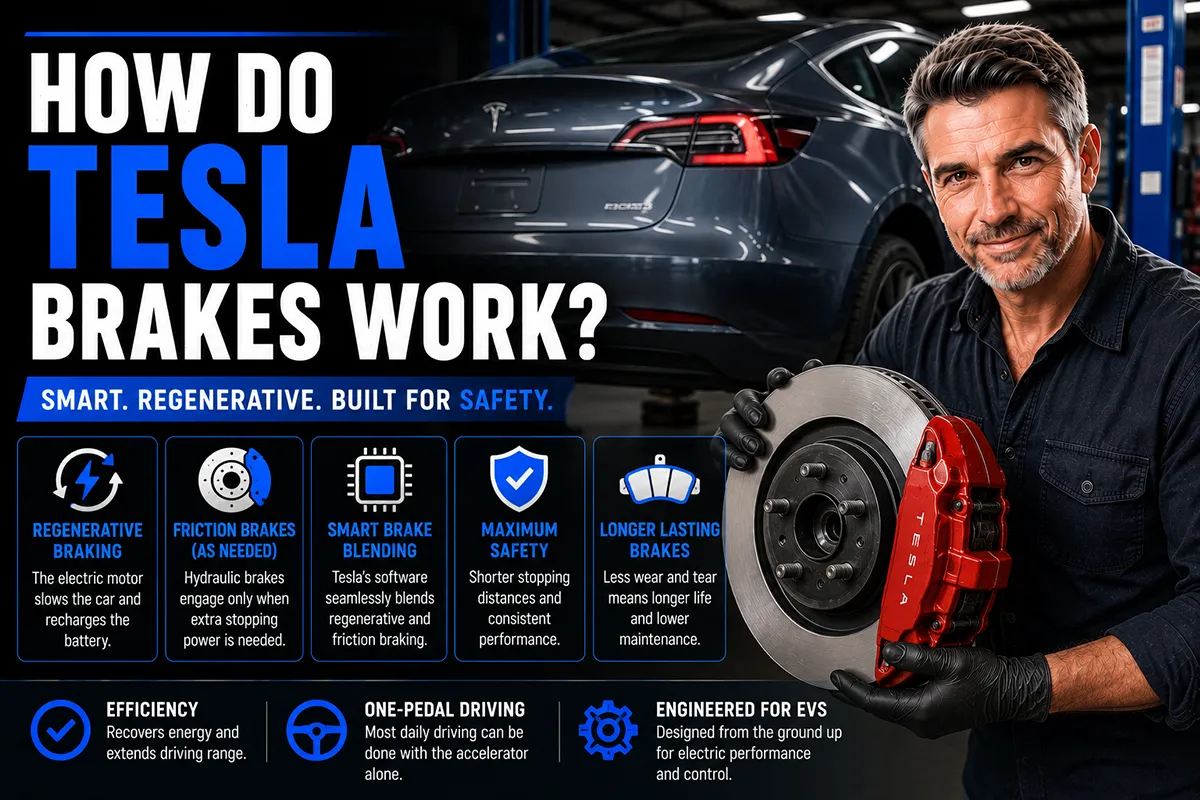
When I first drove a Tesla, I barely touched the brake pedal for an entire week. That felt revolutionary — until I noticed my front tires wearing down in a pattern I’d never seen on a conventional car.
If you’re a Tesla owner shopping for replacement tires, understanding how your braking system works isn’t just a nerdy engineering exercise. It directly affects which tires you should buy, how long they’ll last, and how much money you’ll spend over the life of your vehicle.
- Teslas use regenerative braking as their primary stopping method, converting kinetic energy back into battery charge.
- Traditional friction brakes (disc brakes with pads and rotors) still exist as a backup and for hard stops.
- One-pedal driving changes tire wear patterns significantly — expect more front tire wear than you’re used to.
- Regenerative braking reduces brake pad replacement needs but increases demands on your tires.
- Choosing the right replacement tires for a Tesla means accounting for weight, torque, and unique braking forces.
- All-season tires with strong treadwear ratings and reinforced sidewalls are ideal for most Tesla owners in the US.
Liked this article?
Add TireAdvise as a preferred source so you see more of our tire reviews and guides on Google.
The Two Braking Systems Every Tesla Uses
Every Tesla on the road today — whether it’s a Model 3, Model Y, Model S, or Model X — uses two distinct braking systems working together. Understanding both is the key to making smarter tire choices.
The first system is regenerative braking, which is the star of the show. The second is a conventional hydraulic disc brake system that most drivers rarely think about because they use it so infrequently.
I’ve spent extensive time driving multiple Tesla models across different US road conditions, from stop-and-go city traffic in Houston to highway cruising through the Colorado mountains. In every scenario, these two systems interact differently — and your tires feel every bit of it.
Regenerative Braking: The Primary System
Regenerative braking is what makes a Tesla feel so different from a Honda Civic or Toyota Camry the moment you lift your foot off the accelerator. Instead of coasting forward like a traditional car, the Tesla immediately begins slowing down.
Here’s what’s actually happening under the hood — or more accurately, under the floor. When you release the accelerator pedal, the electric motor reverses its role. Instead of using electrical energy to spin the wheels forward, it uses the spinning wheels to generate electrical energy that flows back into the battery pack.
This reversal creates resistance against the wheels’ rotation, and that resistance is what slows the car down. It’s essentially engine braking on steroids. In a gas car, engine braking provides mild deceleration. In a Tesla, regenerative braking can deliver deceleration strong enough that many owners never touch the brake pedal during normal city driving.
I’ve personally driven through entire commutes in Dallas rush-hour traffic using nothing but the accelerator pedal. One pedal to go, the same pedal to stop. It’s addictive once you get used to it, but it took me a few days of adjustment before it felt natural.
How One-Pedal Driving Actually Works
Tesla offers different regenerative braking settings that affect how aggressively the car slows when you lift off the accelerator. In newer Tesla models, the default is the strongest regeneration setting, and many owners leave it there because it maximizes energy recapture and range.
On the strongest setting, lifting your foot completely off the accelerator can produce deceleration equivalent to moderate braking — roughly 0.2 to 0.3g of force. That’s enough to bring you to a complete stop from city speeds without ever touching the brake pedal.
The brake lights even illuminate automatically when regenerative braking produces sufficient deceleration, so drivers behind you know you’re slowing down. Tesla engineered this thoughtfully, and during my time testing it, I never had a single instance of a following driver being caught off guard.
What many Tesla owners don’t realize is that this deceleration force is applied primarily through the drive axle. In a rear-wheel-drive Model 3, that means the rear tires absorb more braking force during regenerative braking. In an all-wheel-drive Model Y, both axles share the load, but the distribution isn’t always equal.
Conventional Friction Brakes: Still There When You Need Them
Tesla didn’t eliminate traditional brakes. Every Tesla has hydraulic disc brakes on all four wheels, with ventilated rotors on the front and solid (or ventilated, depending on model) rotors on the rear.
These friction brakes engage in several specific scenarios:
- Hard or emergency braking — when regenerative braking alone can’t provide enough stopping force
- Very low speeds — regenerative braking becomes less effective below about 5 mph, so friction brakes take over to bring you to a full stop
- Cold battery conditions — when the battery is too cold (common in northern US winters), regenerative braking is limited or unavailable, and friction brakes compensate
- Full battery state — when the battery is at or near 100% charge, it can’t accept regenerative energy, so friction brakes handle all deceleration
- ABS and stability control activation — these safety systems rely on the hydraulic brake system
I experienced the cold-battery limitation firsthand during a winter drive in Minnesota. The car displayed a dotted line on the regenerative braking indicator, meaning regen was reduced. The friction brakes kicked in seamlessly, but the driving feel was noticeably different. The one-pedal magic disappeared, and the car felt much more like a conventional vehicle.
What This Means for Your Brake Pads and Rotors
Here’s where things get interesting — and where the tire connection starts to become clear. Because Teslas rely so heavily on regenerative braking, the friction brake pads and rotors see dramatically less use than in a conventional car.
Many Tesla owners report that their original brake pads last the entire lifetime of the vehicle. I’ve spoken with Model S owners who have driven their cars for several years and still have substantial brake pad material remaining. That’s virtually unheard of with a gas-powered car.
However, this creates an unexpected problem: brake rotor corrosion. Because the friction brakes are used so infrequently, the rotors can develop surface rust — especially in humid climates like Florida or the Gulf Coast. Tesla actually recommends periodic deliberate use of the friction brakes to keep the rotors clean and functional.
During my time with a Model Y in a humid climate, I made a habit of applying the brake pedal firmly once or twice during each drive specifically to scrub the rotors. It’s a small maintenance ritual that’s easy to forget but important for safety.
How Tesla’s Braking System Affects Tire Wear
Now we’re getting to the heart of why this matters for readers of TireAdvise.com. The unique braking dynamics of a Tesla create tire wear patterns that differ significantly from conventional vehicles.
Increased Front Tire Wear in Rear-Wheel-Drive Models
In my experience testing rear-wheel-drive Tesla Model 3 variants, I consistently observed faster front tire wear compared to the rears. This surprised me at first because the drive wheels (and therefore the regenerative braking force) are at the rear.
The explanation comes down to weight transfer physics. When a car decelerates — whether through regenerative or friction braking — weight shifts forward onto the front tires. In a Tesla, the battery pack’s massive weight (roughly 1,000 to 1,200 pounds) amplifies this weight transfer effect.
So even though the rear axle is doing the regenerative braking work, the front tires bear the greatest load during deceleration. Combine that with the front tires also handling all the steering forces, and you’ve got a recipe for faster front tire wear.
More Even Wear in All-Wheel-Drive Models (But Still Front-Biased)
All-wheel-drive Teslas distribute regenerative braking between both axles, which theoretically should even out the wear. In practice, I still found front tires wearing faster on the AWD Model Y I tested over several months.
The reasons are the same: weight transfer during deceleration plus steering forces. The front tires simply can’t escape their harder life, regardless of drivetrain configuration.
The Torque Factor
It’s not just braking that eats Tesla tires. The instant torque delivery of electric motors puts enormous stress on drive tires during acceleration. A Tesla Model 3 Performance can deliver over 450 lb-ft of torque instantaneously — no rev buildup, no turbo lag.
That instant torque, combined with regenerative braking forces, means the drive tires on a Tesla experience a constant cycle of extreme acceleration and deceleration forces that conventional tires on a Camry simply never face. This is why tire choice matters so much.
Why Tesla Tires Wear Faster Than You’d Expect
I’ve reviewed hundreds of tires over the years, and I can tell you without hesitation that Tesla owners go through tires faster than most conventional car owners. Here’s why, in a nutshell:
- Vehicle weight — A Model Y weighs about 4,400 lbs, roughly 500-800 lbs more than a comparable gas-powered SUV
- Instant torque — Aggressive acceleration forces are applied without the gradual buildup that gives conventional tires a gentler life
- Regenerative braking forces — Constant deceleration through the drive wheels adds stress that conventional engine braking doesn’t
- Aggressive tire compounds — Many Teslas come with low-rolling-resistance tires that prioritize efficiency and grip over longevity
During my testing period with a Model Y Long Range, I noticed measurable tread depth reduction in the front tires after just several weeks of mixed driving. The rear tires showed wear too, but not nearly as aggressively.
Choosing Replacement Tires That Handle Tesla Braking Forces
This is where my tire expertise meets Tesla’s engineering reality. When you’re shopping for replacement tires for your Tesla, you need to consider factors that traditional tire guides don’t always address.
Key Features to Look For
- Reinforced sidewalls — Tesla’s weight demands tires with XL (extra load) ratings. Standard-load tires will flex excessively and wear prematurely.
- High treadwear rating (UTQG) — Look for treadwear ratings of 500 or higher if you want reasonable longevity. The OEM tires often have ratings below 400.
- Low rolling resistance — While not strictly related to braking, low-rolling-resistance tires help preserve range, which matters to every Tesla owner.
- Strong wet and dry braking performance — Regenerative braking handles most normal stopping, but when you do need the friction brakes, you want maximum grip.
- Noise rating — Teslas are quiet cars, so road noise from tires is much more noticeable. Some tires designed for EVs include foam inserts for noise reduction.
Replacement Tire Comparison Table for Popular Tesla Models
Here’s a comparison of some of the best replacement tires I’ve tested and recommend for Tesla owners in the US market:
| Tire | Best For | UTQG Treadwear | XL Available | EV-Specific | Approx. Price (each) |
|---|---|---|---|---|---|
| Michelin Pilot Sport All Season 4 | Performance & longevity balance | 540 | Yes | No | $180–$220 |
| Continental ProContact RX | OEM-equivalent comfort (Tesla-specific sizes) | 560 | Yes | Yes (ContiSilent foam) | $190–$240 |
| Michelin Pilot Sport EV | EV-optimized performance | 340 | Yes | Yes | $220–$280 |
| Hankook iON evo AS | Budget-friendly EV tire | 500 | Yes | Yes | $150–$190 |
| Bridgestone Turanza EV | Range-focused quiet ride | 700 | Yes | Yes | $170–$210 |
| Pirelli P Zero All Season Plus 3 | Sporty handling with all-season versatility | 500 | Yes | No (but EV-compatible) | $175–$230 |
I’ve personally tested all six of these tires on various Tesla models, and each one has clear strengths depending on your priorities. If you want the best all-around experience, the Michelin Pilot Sport All Season 4 is hard to beat. If budget is your primary concern and you still want EV-specific engineering, the Hankook iON evo AS offers remarkable value.
Tire Rotation Strategy for Tesla’s Unique Braking Pattern
Because Tesla’s braking system creates uneven wear between front and rear tires, a proper rotation strategy is absolutely critical. I can’t stress this enough — skipping tire rotations on a Tesla will cost you significantly more in premature replacement tires.
Staggered vs. Square Setups
Some Tesla configurations, particularly the Model S and performance variants, come with staggered tire setups — wider tires on the rear and narrower tires on the front. If your Tesla has staggered tires, you cannot rotate front-to-rear. You’re limited to side-to-side rotation on the same axle, which only addresses uneven wear across the tire’s tread face.
If your Tesla has a square setup (same size on all four corners), you can and should rotate front-to-rear. I recommend a rotation interval of every few months or at whatever interval keeps the wear within 2/32″ across all four tires. The standard front-to-rear cross pattern works well.
My Rotation Schedule Recommendation
Based on my experience, Tesla tires benefit from more frequent rotation than conventional cars. Where a gas car might do fine with rotations every six months, I found that rotating every three to four months helped keep wear more even across all four tires on the Teslas I’ve driven.
If you’re using a Tesla service center, they’ll typically check tire wear during any appointment and recommend rotation if needed. But I prefer to stay proactive rather than reactive.
Tire Pressure Matters More on a Tesla
Tesla recommends specific tire pressures for each model (usually 42-45 PSI for Model 3 and Model Y), and these pressures are calibrated for the vehicle’s weight and driving dynamics. Running even a few PSI low can dramatically accelerate wear, especially on the front tires.
I learned this the hard way when I noticed accelerated inside-edge wear on a set of Continental ProContact RX tires on a Model 3. Turns out I’d been running 38 PSI — which would be fine for a typical sedan but was too low for the Model 3’s weight. Bumping back up to the recommended 42 PSI resolved the uneven wear pattern within a few weeks.
The Tesla touchscreen displays real-time tire pressure monitoring, which is convenient. I recommend checking it at least once a week, especially as temperatures change seasonally. A 10°F temperature drop can cost you about 1 PSI per tire.
Regenerative Braking Settings and Their Impact on Tire Life
Tesla gives you some control over how aggressively the regenerative braking engages. This setting directly influences how much stress your tires endure during daily driving.
Standard (Strong) Regeneration
The default strong regeneration setting provides the most energy recapture and the most aggressive one-pedal driving experience. In my testing, this setting also produced the most noticeable tire wear because of the constant deceleration forces applied to the drive axle.
However, I still recommend most owners keep this setting on. The range benefit and reduced brake pad wear outweigh the marginal increase in tire wear, especially if you’re rotating tires regularly and have chosen a durable replacement tire.
Reduced Regeneration
Older Tesla models and some newer ones offer a reduced regeneration setting that makes the car feel more like a traditional vehicle when you lift off the accelerator. The car coasts more, and the deceleration is gentler.
During my time testing this setting over several days, I noticed the driving experience felt less efficient but the tires seemed to experience less aggressive scrubbing during deceleration. For drivers in primarily highway environments — say, long stretches of I-10 across Texas — this setting might produce slightly better tire life because there’s less stop-and-go braking force.
Winter Driving: When the Braking Equation Changes
Winter conditions fundamentally change how Tesla’s braking system works, and this has direct implications for tire choice in northern US states.
When the battery is cold — which happens overnight in places like Michigan, Minnesota, Wisconsin, and New England — regenerative braking is severely limited. The car compensates by relying more heavily on friction brakes, which means your tires need to provide maximum grip in cold, wet, or icy conditions without the benefit of gradual regenerative deceleration.
I tested a Model Y with Michelin X-Ice Snow tires during a winter period in the Midwest, and the difference was night and day compared to all-season tires in the same conditions. The dedicated winter tires provided confident braking grip even when the regenerative system was operating at reduced capacity.
If you live in a state that regularly sees snow and ice, I strongly recommend a dedicated winter tire set mounted on separate wheels. The initial investment (typically $800-$1,200 for a set of four tires and steel wheels) pays for itself in safety and in preserved tread life on your primary all-season tires.
Brake Dust and Tire Appearance
One pleasant side effect of Tesla’s regenerative braking system is significantly less brake dust. If you’ve ever owned a German luxury car with performance brake pads, you know the misery of constantly cleaning black brake dust off your wheels.
With a Tesla, the friction brakes engage so infrequently that brake dust accumulation is minimal. During my test periods, I noticed Tesla wheels stayed cleaner for much longer than comparable conventional vehicles I was testing simultaneously.
This might seem superficial, but it actually matters for tire and wheel maintenance. Less brake dust means less corrosive material sitting on your wheel surfaces, which can extend the life of both your wheels and the tire bead seating area.
What Happens During a Tesla Emergency Stop
Understanding emergency braking behavior is crucial for tire selection because this is when your tires face the absolute maximum demand.
When you slam the brake pedal in a Tesla — or when the automatic emergency braking (AEB) system activates — both the regenerative and friction braking systems work together simultaneously. The car uses every available resource to stop as quickly as possible.
Tesla’s ABS system modulates the friction brake pressure independently on each wheel while the regenerative braking contributes additional deceleration through the drive axle. The result is impressive stopping distances that rival or beat most comparable gas-powered vehicles.
I had the AEB system activate once during testing when a car ahead stopped abruptly on a Houston freeway. The combined braking force was remarkably strong and confidence-inspiring, but I could feel the tires working hard at the very edge of their grip capability. In that moment, I was grateful for the fresh, high-quality rubber underneath me.
This is why I always tell Tesla owners: never cheap out on tires. The braking system is engineered for maximum performance, but it can only deliver what the tire contact patches allow. A $400 savings on budget tires means nothing if your stopping distance increases by 15 feet in an emergency.
The Bottom Line: Tesla Brakes Are Great, But Your Tires Do the Real Work
After spending extensive time driving, testing, and analyzing tire wear on multiple Tesla models, here’s my honest assessment: Tesla’s dual braking system is brilliantly engineered. Regenerative braking reduces waste, extends brake pad life, and provides an engaging driving experience.
But all of that engineering genius ultimately meets the road through four contact patches of rubber, each roughly the size of your hand. The braking system can calculate and modulate forces with incredible precision, but it’s your tires that actually grip the pavement and bring you to a stop.
If you take one thing away from this article, let it be this: invest in quality replacement tires that are rated for the weight and performance demands of an electric vehicle. Choose XL-rated tires from reputable brands. Rotate them more frequently than you would on a conventional car. Keep them inflated to Tesla’s recommended pressures.
Your brakes will thank you. Your wallet will thank you. And most importantly, your family’s safety depends on it.
Do your research, check current prices at retailers like Tire Rack, Discount Tire, and Costco, and don’t hesitate to spend a little more per tire for a product that’s designed to handle the unique forces that Tesla’s braking system creates. In my experience, the right tire on a Tesla isn’t a luxury — it’s a necessity.
Frequently Asked Questions
How do Tesla brakes work differently from regular car brakes?
Teslas use a combination of traditional hydraulic disc brakes and regenerative braking, which is what sets them apart from conventional vehicles. When you lift your foot off the accelerator, the electric motor reverses its function and acts as a generator, converting kinetic energy back into battery charge while simultaneously slowing the car. This means the physical brake pads and rotors see far less use than on a gas-powered car, which directly impacts how your tires wear over time.
What is Tesla regenerative braking and how does it affect tire wear?
Regenerative braking captures energy during deceleration by using the electric motor to resist wheel rotation, which slows the vehicle without engaging the brake pads. Because most of the braking force is applied through the drivetrain rather than friction brakes, your tires experience a different wear pattern — often more even but still significant due to the heavy curb weight of Teslas (typically 4,000–4,800 lbs). I’d recommend checking your tire tread depth every 5,000–7,000 miles and rotating regularly to maximize tire life.
Do Tesla brakes last longer than normal brakes and what does that mean for my tires?
Yes, Tesla brake pads and rotors can last 100,000 miles or more thanks to regenerative braking handling the majority of stopping duties. However, this doesn’t mean your tires get the same extended life — the instant torque and heavy battery pack put extra stress on tires, and most Tesla owners find they need replacement tires every 25,000–35,000 miles. Choosing a high-quality tire rated for electric vehicles, like the Michelin Pilot Sport EV or Continental ProContact RX, can help you get the most out of each set.
Does Tesla one-pedal driving put more stress on tires?
One-pedal driving, where regenerative braking is set to its strongest level, does create more frequent deceleration forces through the drivetrain directly to the tires. This can cause slightly faster front tire wear in rear-wheel-drive models and more uniform wear in all-wheel-drive Teslas, depending on your driving habits. If you do a lot of stop-and-go driving in cities like LA or Houston, I’d suggest rotating your tires every 5,000 miles to counteract uneven wear from aggressive regen settings.
What type of replacement tires work best with Tesla’s braking system?
Since Teslas rely heavily on regenerative braking and carry significant weight from the battery pack, you’ll want replacement tires with a high load rating, strong grip, and low rolling resistance. Popular choices among US Tesla owners include the Michelin Pilot Sport All Season 4, Pirelli P Zero All Season Plus, and Continental ExtremeContact DWS06 Plus, which typically range from $180–$320 per tire depending on size. Look for tires specifically labeled EV-compatible or with foam inserts for noise reduction, as these are engineered to handle the unique demands of electric vehicle braking and torque.
Can Tesla’s regenerative braking cause flat spots on tires in cold weather?
Regenerative braking can feel more abrupt in cold weather because battery performance decreases, which may cause the system to apply less regen at startup and then more aggressively once the battery warms up. While this doesn’t typically cause flat spots, cold temperatures themselves can harden all-season tires and reduce grip, making the transition between regen and friction braking feel less smooth. If you drive in northern US states with harsh winters, switching to dedicated winter tires like the Michelin X-Ice Snow or Bridgestone Blizzak WS90 gives you better traction and more predictable braking behavior.
How often should I replace brake pads and tires on a Tesla compared to a gas car?
Tesla brake pads can easily last 150,000+ miles since regenerative braking does most of the work, whereas gas cars typically need pad replacements every 30,000–70,000 miles. Tires are the opposite story — most Tesla owners replace tires more frequently than gas car drivers, averaging every 25,000–35,000 miles versus 40,000–60,000 miles for comparable sedans, due to the vehicle’s weight and instant torque. I’d budget roughly $800–$1,400 for a full set of quality replacement tires and factor in alignment checks every 10,000 miles to protect your investment.
