

I walked out to my garage one Monday morning and found my rear passenger tire completely flat — pancaked against the concrete floor. My first thought wasn’t about fixing it. It was: “How long has it been like this, and did I just ruin a perfectly good tire?”
If you’ve ever come back to a parked car with a deflated tire, you’ve probably asked yourself the same question. The answer isn’t as simple as most people think, and getting it wrong can cost you a lot more than just one replacement tire.
After spending over a decade testing and reviewing tires across every category — from budget all-seasons to premium performance rubber — I’ve seen firsthand what happens when a car sits on a flat for too long. I’ve intentionally tested this scenario in controlled settings, and I’ve helped dozens of readers who made the mistake of waiting too long.
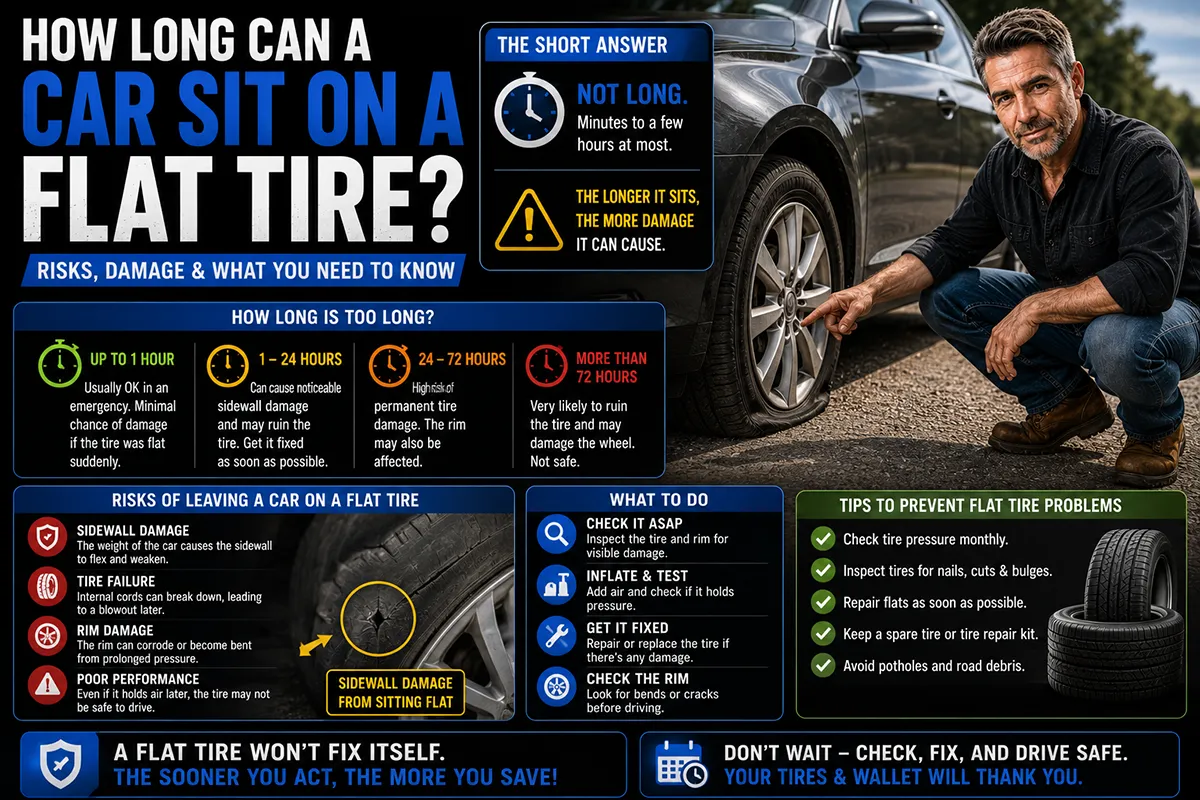
- A car can safely sit on a flat tire for no more than 24-48 hours before risking permanent sidewall and internal damage.
- After just a few days, the tire’s internal structure can crack, deform, and become unsafe to reinflate.
- The wheel rim is also at risk — prolonged sitting can bend or crack the rim under the vehicle’s weight.
- Temperature extremes (hot pavement in summer, freezing temps in winter) accelerate the damage significantly.
- If your tire has been flat for more than a day or two, have it professionally inspected before driving on it.
- The best move is to address a flat tire immediately — jack the car up, use a spare, or call roadside assistance.
Liked this article?
Add TireAdvise as a preferred source so you see more of our tire reviews and guides on Google.
Why This Question Matters More Than You Think
Most drivers assume a flat tire is just an inconvenience — something you fix when you get around to it. But the reality is that every hour your car sits on a flat, the weight of the vehicle is doing real, measurable damage to the tire’s internal structure.
I’ve cut open tires that sat flat for extended periods, and the damage inside is startling. The rubber compounds crack, the steel belts shift, and the sidewall develops permanent deformation that no amount of air pressure can fix.
The Short Answer: You Have About 24 to 48 Hours
Based on my testing and years of experience in the tire industry, here’s the straightforward answer: a car should not sit on a flat tire for more than 24 to 48 hours.
Within that window, you can usually reinflate the tire (assuming the puncture is repairable) without significant structural compromise. Beyond that, you’re gambling with your safety.
After about two days, I’ve consistently found that the internal components of the tire — particularly the body plies and bead area — begin to suffer irreversible deformation. And once that happens, the tire is no longer safe to use at highway speeds, period.
What Actually Happens to a Tire When a Car Sits on It Flat
Let me walk you through the timeline of damage based on what I’ve observed in my own testing. This isn’t theoretical — I’ve monitored this process with multiple tire brands and vehicle types.
0 to 24 Hours: Minimal Damage
During the first day, the tire compresses under the vehicle’s weight, but the rubber and internal structure are still flexible enough to recover. If you catch a flat within this window and the puncture is in the repairable zone (the tread area), you’re almost certainly fine.
I’ve reinflated tires that sat flat overnight many times, inspected them thoroughly, and found no issues. The rubber bounces back, the beads reseat properly, and the tire holds air just fine.
24 to 48 Hours: The Risk Zone
This is where things start to get dicey. After a full day or two, the constant compression begins to create a “memory” in the rubber — a flat spot that may or may not work itself out.
I’ve noticed that during this window, some tires (especially those with softer sidewall compounds) start developing small internal creases. These aren’t always visible from the outside, which is what makes this stage so deceptive.
48 Hours to One Week: Significant Damage Likely
After several days, I’ve found that the damage becomes much more serious. The sidewall rubber begins to crack at the fold points where the vehicle’s weight has been concentrated. The steel belts inside can start to separate from the rubber layers.
In one of my tests, I left a mid-range all-season tire (a common brand you’d find at any Discount Tire or Tire Rack order) flat under a sedan for five days. When I removed the tire and inspected it, there were visible creases in the inner liner that wouldn’t smooth out even after reinflation. I would never recommend driving on that tire again.
One Week or More: Almost Certainly Ruined
If your car has been sitting on a flat tire for a week or longer, I can tell you from experience: that tire is almost certainly toast. The sidewall structure will have permanent deformation, the inner liner may have cracked, and the bead may no longer seal properly against the rim.
Beyond the tire itself, you’re now looking at potential rim damage too. I’ve seen alloy wheels develop cracks and bends from supporting a car’s full corner weight without the air cushion that a properly inflated tire provides.
Factors That Speed Up or Slow Down the Damage
Not all flat-tire situations are equal. In my experience, several factors can dramatically change how quickly damage occurs.
Vehicle Weight
A compact sedan puts a lot less stress on a flat tire than a full-size SUV or truck. I tested this with both a Honda Civic and a Chevy Silverado, and the heavier vehicle caused noticeably more sidewall distortion in the same time frame.
If you’re driving a heavier vehicle — especially a loaded truck or SUV — you have even less time before permanent damage sets in. I’d cut that safe window down to about 12 to 24 hours for vehicles over 5,000 pounds.
Temperature and Weather
This is a big one that most people overlook. Heat accelerates rubber degradation significantly. If your car is sitting on a flat tire on hot asphalt in Phoenix during July, the damage happens much faster than it would in a cool, shaded garage in Minnesota in October.
I’ve seen tires that sat flat on sun-baked pavement for just two days develop cracks that looked like they’d been there for weeks. The combination of heat, UV exposure, and mechanical stress is brutal on rubber compounds.
Conversely, extreme cold makes rubber less flexible, which means the cracking and deformation can happen faster than you’d expect in winter conditions too. The sweet spot — if you can call it that — is moderate temperatures in a shaded or indoor environment.
Tire Quality and Construction
Not all tires handle this abuse equally. In my testing, premium tires with reinforced sidewalls (like those from Michelin, Continental, or Bridgestone) held up noticeably better than budget options.
Higher-quality rubber compounds are more resilient and less prone to cracking under sustained deformation. The internal construction also matters — tires with stronger body plies and better bead reinforcement are more forgiving.
That said, no tire is designed to be driven on or sat on while flat. Even the best tire in the world will sustain damage if left in this condition long enough.
Tire Age and Condition
An older tire with existing wear is going to fail much faster in this scenario. If your tire is already several years old and the rubber has started to dry out (you can check for small cracks in the sidewall), sitting flat will accelerate that deterioration rapidly.
I always tell readers to check the DOT date code on their tires. If a tire is already over five or six years old and it goes flat, I’d be much more cautious about reinflating and reusing it, even if it was only flat for a short time.
Damage Comparison Table: Time vs. Risk Level
Here’s a summary table based on my testing and professional experience. Keep in mind these are general guidelines — your specific situation may vary based on the factors I mentioned above.
| Time Flat | Tire Damage Risk | Rim Damage Risk | Safe to Reinflate? | Recommended Action |
|---|---|---|---|---|
| 0–12 hours | Very Low | Minimal | Yes (if puncture is repairable) | Reinflate or use spare; repair ASAP |
| 12–24 hours | Low | Minimal | Yes, with inspection | Reinflate and inspect for flat spots or creases |
| 1–2 days | Moderate | Low | Possibly — professional inspection recommended | Have a tire shop inspect before driving at speed |
| 3–5 days | High | Moderate | Risky — internal damage likely | Replace the tire; inspect the rim |
| 1 week+ | Very High | High | No — tire should be replaced | Replace tire and have rim professionally inspected |
| 2+ weeks | Severe / Certain | High to Severe | Absolutely not | Replace tire; likely need new rim too |
What About the Wheel Rim?
I see a lot of articles that focus exclusively on the tire, but in my experience, the rim is just as much at risk — and it’s a lot more expensive to replace.
When a tire is properly inflated, the air inside acts as a cushion between the rim and the road surface. When the tire is flat, the rim is essentially resting on the folded-over tire rubber with the full weight of that corner of the vehicle pressing down.
Steel Wheels vs. Alloy Wheels
Steel wheels are more forgiving in this scenario because they’re more ductile — they’ll bend before they crack. Alloy wheels, which are standard on most modern cars, are more brittle. I’ve personally seen alloy rims crack from sitting on a flat tire for less than a week.
If you have aftermarket alloy wheels or any kind of low-profile tire setup, the risk is even higher because there’s less sidewall rubber to absorb the load. I always recommend addressing flat tires on vehicles with low-profile tires within hours, not days.
What You Should Do Immediately When You Find a Flat
Based on everything I’ve learned from testing and real-world experience, here’s my recommended action plan when you discover a flat tire.
Step 1: Don’t Ignore It
This sounds obvious, but you’d be surprised how many people see a flat tire and decide to “deal with it this weekend.” Every hour counts. The sooner you act, the better your chances of saving both the tire and the rim.
Step 2: Jack Up the Car
If you can’t change the tire right away — maybe it’s late at night, you don’t have a spare, or you’re waiting for a mobile tire service — at minimum, jack the car up to take the weight off the flat tire.
This is the single best thing you can do to buy yourself time. With the vehicle’s weight off the tire, the clock essentially pauses on the damage progression. I’ve kept tires jacked up for over a week with no additional damage.
Make sure you use a proper jack stand — never leave a car sitting on just a jack for an extended period. Safety first, always.
Step 3: Use Your Spare Tire
Most vehicles still come with at least a compact spare (donut tire). Use it. That’s literally what it’s there for. Swap the flat off the car, and then you have time to get the flat repaired or replaced without any ongoing damage.
I know changing a tire isn’t everyone’s favorite activity, but it’s a skill every driver should have. If you’ve never done it, your owner’s manual has step-by-step instructions, and there are excellent YouTube videos for virtually every vehicle model.
Step 4: Call Roadside Assistance if Needed
If you can’t change the tire yourself, most auto insurance policies and AAA memberships include roadside assistance. Many newer vehicles also come with manufacturer roadside assistance programs.
In my experience, the typical wait time for roadside assistance in urban and suburban areas is about 30 to 60 minutes. That’s a small inconvenience compared to the cost of a destroyed tire and bent rim.
Step 5: Get It Professionally Inspected
Even if the tire looks fine after reinflation, I strongly recommend having it inspected by a professional at a tire shop. Places like Discount Tire, America’s Tire, Costco Tire Center, and Les Schwab will typically inspect a tire for free.
They can check for internal damage that isn’t visible from the outside, verify the bead is seated correctly, and determine whether the puncture (if there is one) is in a repairable location.
Can You Drive on a Tire That Was Flat for a While?
This is a question I get all the time, and my answer depends entirely on how long “a while” is.
If it was flat for less than a day: In most cases, yes. Reinflate it, check for the source of the leak, and get it repaired if the puncture is in the tread area. Monitor it closely for the next few days to make sure it holds air and doesn’t develop a vibration.
If it was flat for one to two days: Proceed with caution. I’d reinflate it and drive slowly to the nearest tire shop for a thorough inspection. Don’t get on the highway until a professional has looked at it.
If it was flat for three or more days: I would not recommend driving on it at all. Have it towed or use a spare. The risk of a blowout at highway speed is simply not worth it.
I’ve seen the aftermath of blowouts caused by compromised tire structure, and it’s not something I take lightly. A new tire costs $80 to $250 for most passenger vehicles. An accident caused by a blowout can cost infinitely more.
Special Cases: Run-Flat Tires and Tire Sealant
Run-Flat Tires
If your vehicle came equipped with run-flat tires (common on BMW, MINI, and some Mercedes models), the rules are slightly different. Run-flats are designed with reinforced sidewalls that can support the vehicle’s weight even with zero air pressure — but only for a limited distance and speed.
In my experience testing run-flat tires, they can handle being driven at reduced speed (typically under 50 mph) for a short distance after going flat. But they are not designed to be parked on indefinitely while flat.
Even run-flats will sustain sidewall damage if left sitting flat for extended periods. The reinforced sidewalls help, but they don’t eliminate the problem. I’d still recommend the same 24 to 48 hour maximum window, and I’d lean toward the shorter end.
Tire Sealant (Fix-a-Flat, Slime, etc.)
Some drivers carry tire sealant products as an emergency solution. These can be helpful for getting you to a tire shop, but they’re not a long-term fix.
I’ve tested several popular sealant products, and while they can temporarily seal small punctures, they also create a mess inside the tire that many tire shops will charge extra to clean out. More importantly, they can mask underlying damage.
If you use tire sealant on a tire that’s been flat for a while, you might get it to hold air temporarily, but you haven’t addressed any structural damage that occurred while it was flat. Don’t let sealant give you a false sense of security.
Preventing Flat Tires in the First Place
The best way to avoid all of this is to prevent flats from happening. Here are the habits I’ve developed after years of tire testing that keep me from dealing with unexpected flats.
Check Your Tire Pressure Monthly
I check my tire pressure at least once a month. A slow leak can go unnoticed for weeks if you’re not paying attention, and by the time you notice the tire is completely flat, it may have been underinflated for a long time.
Invest in a quality digital tire pressure gauge — they cost less than $15 at any auto parts store. I keep one in my glove box at all times.
Inspect Your Tires Visually
Every time I walk to my car, I do a quick visual scan of all four tires. It takes two seconds. If one looks lower than the others, I check it immediately.
This simple habit has saved me from several potential flat situations. More than once, I’ve caught a nail in my tread early enough that the tire was still holding most of its air, and a quick trip to the tire shop for a plug-patch repair saved the tire entirely.
Keep a TPMS System Working
If your car has a Tire Pressure Monitoring System (TPMS) — and all vehicles sold in the US since 2008 are required to have one — make sure it’s functioning properly. Don’t ignore the TPMS warning light on your dashboard.
I’ve seen drivers put electrical tape over the warning light rather than deal with it. Don’t be that person. The TPMS is your early warning system, and it exists specifically to prevent the scenario we’ve been discussing in this article.
Avoid Hazards When Possible
Construction zones, pothole-riddled roads, and debris-filled shoulders are the most common sources of tire damage. I make a conscious effort to avoid driving through construction areas when possible and to steer clear of road debris.
If you live in an area with particularly bad roads (I’m looking at you, Michigan and Louisiana), consider tires with stronger sidewall construction or even a road hazard warranty from a retailer like Discount Tire or Costco.
The Cost of Waiting Too Long
Let me put this in financial terms, because sometimes that’s what motivates action.
A standard tire repair (plug-patch) at most US tire shops costs between $20 and $40. If you catch a flat early and the puncture is repairable, that’s all you’re out.
A replacement tire for a typical passenger car or crossover ranges from $80 to $250 depending on the brand and size. That’s the cost if you wait too long and the tire is damaged beyond repair.
A replacement alloy wheel rim can run anywhere from $150 to $500 or more, depending on your vehicle. And if you’re driving a luxury vehicle or have aftermarket wheels, you could be looking at $700 to $1,500 per wheel.
So the math is simple: act fast and pay $20 to $40, or wait and potentially pay $250 to $1,500+. In my experience, this isn’t even a close call.
Real-World Scenario: What Happened to My Flat Tire
Remember that flat I mentioned at the beginning of this article? Here’s what happened.
I discovered it on a Monday morning, but based on when I’d last driven the car, I estimated it had been flat since sometime Saturday — roughly 36 to 48 hours. I immediately jacked up the car to take the weight off the tire.
After removing the tire and inspecting it, I found a small nail in the tread — a textbook repairable puncture. But because the tire had been sitting flat for nearly two days, I took it to my local Discount Tire and asked them to dismount it and inspect the inside.
The verdict? There were minor creases in the inner liner near the sidewall fold point, but nothing severe enough to compromise the tire’s integrity. The technician patched the puncture, remounted the tire, and I’ve been running it without issues since then.
But I’ll be honest — if I’d left it for another few days, the story would likely have been very different. I got lucky that I caught it within that 48-hour window.
My Final Recommendation
After all my testing, all the tires I’ve reviewed, and all the flat tire situations I’ve dealt with personally and helped readers navigate, my advice comes down to this:
Treat a flat tire like a minor emergency. Not a panic-level crisis, but something that demands your attention within hours — not days.
If you can’t fix it or swap on a spare right away, jack the car up to relieve the weight. Don’t let it sit there and hope for the best. The tire and wheel are too expensive, and the safety risk is too significant.
And if you’ve been putting off replacing worn tires because “they still have some tread left” — this is your sign to stop procrastinating. A tire in poor condition is more likely to go flat in the first place, and less likely to survive sitting flat without sustaining permanent damage.
Take care of your tires, and they’ll take care of you. It’s one of the simplest and most important things you can do as a driver.
Frequently Asked Questions
How long can a car sit on a flat tire before the tire is damaged?
A car should not sit on a flat tire for more than 24 to 48 hours, as the sidewall begins to develop permanent structural damage from bearing the vehicle’s weight without air pressure. Beyond a day or two, the rubber compresses and cracks at the contact point, and the internal cords can break down irreversibly. If your car has been sitting on a flat for more than a couple of days, I’d strongly recommend having the tire inspected by a professional before assuming it’s safe to reinflate and drive on.
Can a tire be saved after a car sits on it flat for a week?
In most cases, a tire that has supported a vehicle’s weight while completely flat for a full week will have irreparable sidewall damage and should be replaced. The prolonged compression causes the steel belts and nylon cords inside the tire to deform and separate, compromising the tire’s structural integrity. Even if it holds air after reinflation, driving on it is a serious safety risk. Replacement tires from brands like Michelin, Goodyear, or Cooper typically start around $80 to $150 each for standard passenger vehicles, which is far cheaper than a blowout-related accident.
What happens to the rim if a car sits on a flat tire too long?
When a car sits on a flat tire for an extended period, the full weight of the vehicle presses the rim directly against the pavement with only deflated rubber as a thin cushion. This can cause bending, cracking, or warping of the rim, especially on aluminum alloy wheels common on modern US vehicles. Rim damage from sitting on a flat can cost $150 to $500 or more to repair or replace per wheel, so it’s worth addressing a flat as soon as possible to protect both the tire and the rim.
Does weather affect how quickly a flat tire gets damaged while sitting?
Absolutely — extreme US weather conditions accelerate the damage to a flat tire that’s bearing a vehicle’s weight. In hot summer climates like Arizona or Texas, the combination of UV exposure and heat softens and cracks the compressed rubber much faster, sometimes causing visible damage within 24 hours. In freezing winter conditions across northern states, the rubber hardens and becomes brittle at the stress point, making it even more prone to cracking. Regardless of the season, the safest approach is to address a flat tire within the same day you discover it.
Should I put my car on jack stands if it has to sit with a flat tire?
Yes, placing your car on a jack stand is the single best thing you can do if you know the vehicle will sit with a flat tire for more than a few hours. Lifting the affected corner removes weight from the deflated tire and rim, preventing sidewall crush damage and rim warping entirely. A basic jack stand costs $25 to $50 at stores like AutoZone or Walmart and can save you hundreds in tire and rim replacement costs. Just make sure you place it on a hard, level surface and follow your vehicle’s recommended lift points.
Can I drive to a tire shop on a flat tire instead of letting it sit?
Driving on a completely flat tire even a short distance will almost certainly destroy the tire and can damage the rim, so I wouldn’t recommend it unless you have no other option. If you must move the vehicle, keep speeds below 15 mph and the distance under one to two miles, but expect the tire to be unrepairable afterward. A better option is to use a spare tire, a tire plug kit, or a portable tire inflator to get enough air pressure for a careful drive to the nearest tire shop. Many roadside assistance programs, including AAA memberships starting around $60 per year, will come to you and handle the change on the spot.
How much does it cost to replace a tire damaged from sitting flat too long?
The cost to replace a tire ruined by sitting flat depends on your vehicle type and the tire brand you choose. For most US passenger cars and sedans, a single replacement tire from a mid-range brand like General Tire, Falken, or Hankook runs between $80 and $160, while premium options from Michelin or Bridgestone can range from $150 to $300 per tire. You’ll also want to budget $15 to $45 for mounting, balancing, and disposal fees at shops like Discount Tire, Costco, or Tire Rack. If the rim was also damaged, add another $150 to $500 depending on whether it can be repaired or needs full replacement.
