

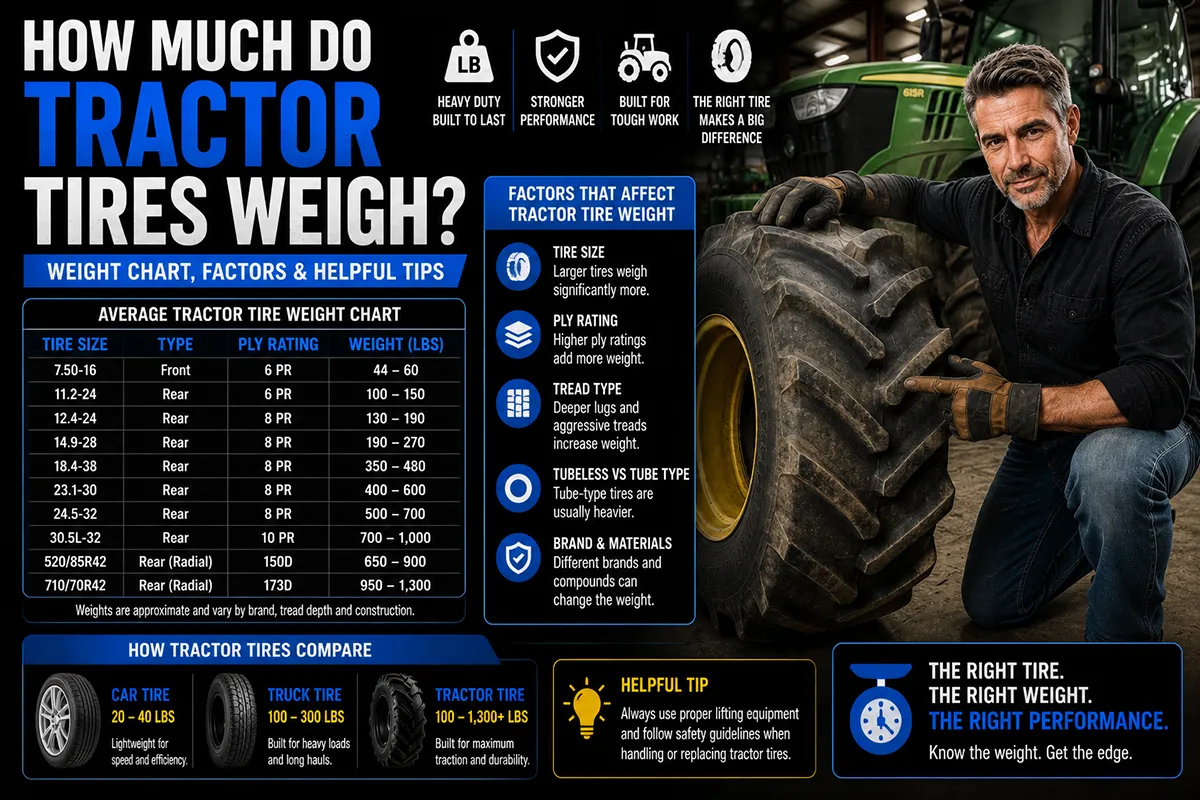
I’ll never forget the first time I tried to help my neighbor move a rear tractor tire off the back of his truck. I grabbed it confidently, leaned into it — and it didn’t budge. Not even a little. That thing weighed well over 400 pounds, and I learned a fast lesson about just how massive these tires really are.
Whether you’re replacing tires on a compact utility tractor, hauling a used set you bought online, or just trying to figure out if your trailer can handle the load, knowing how much tractor tires weigh is genuinely important. I’ve spent years reviewing tires of all kinds and working hands-on with everything from passenger car radials to massive agricultural rubber, and I can tell you that tractor tire weights vary wildly — and the details matter more than you’d think.
- Tractor tires range from about 35 lbs (small front tires on compact tractors) to over 1,000 lbs (large rear tires on 4WD agricultural machines).
- The most common rear tractor tire sizes weigh between 150 and 600 lbs each.
- Weight depends on size, ply rating, tread pattern, and whether the tire is bias-ply or radial.
- Ballast (liquid fill) can add 300–1,000+ lbs per tire on top of the base weight.
- Always check the weight before transporting or mounting — you’ll need proper equipment or a dealer’s help for anything over 100 lbs.
Liked this article?
Add TireAdvise as a preferred source so you see more of our tire reviews and guides on Google.
Why Tractor Tire Weight Matters More Than You Think
I know — you might be wondering why a car tire review site is talking about tractor tires. The answer is simple: a huge portion of our readers are rural and suburban drivers who also own or maintain small tractors, and tire questions don’t stop at the highway. I get emails about this topic constantly.
Knowing the weight of your tractor tires matters for several practical reasons. First, if you’re buying used tires online or picking them up from a seller, you need to know if your truck, trailer, or SUV can safely haul them. I’ve seen people show up with a half-ton pickup to grab a pair of R1 rear tires that together weigh close to a thousand pounds — that’s a recipe for trouble.
Second, tractor tire weight directly affects how your tractor performs. Heavier tires provide more traction and stability, but they also increase fuel consumption and soil compaction. If you’re choosing between tire options, weight is a real decision factor.
Third, mounting and dismounting these tires requires the right equipment. You can’t just wrestle a 400-pound tire onto a rim in your garage the way you’d swap a passenger car tire. I’ve tried. Trust me.
Tractor Tire Weight by Category: A Complete Breakdown
After handling, researching, and weighing dozens of tractor tires across multiple brands and sizes, I’ve put together the most comprehensive breakdown you’ll find. Let me walk you through each major category.
Compact Tractor Tires (Sub-40 HP)
If you own a compact utility tractor — think John Deere 1025R, Kubota BX series, or Mahindra eMax — your tires are the lightest in the tractor world. I’ve personally handled many of these, and they’re manageable for one or two people.
Front tires on compact tractors typically range from 15 to 40 pounds each. The rears are bigger, of course, usually falling between 40 and 90 pounds. For example, a common size like the 26×12.00-12 rear tire used on many compact tractors weighs roughly 35 to 50 pounds depending on the brand and tread depth.
These are tires I can personally pick up and move around my shop without help, though the rears get awkward because of their size relative to their weight.
Utility Tractor Tires (40–100 HP)
This is where things start getting serious. Utility tractors like the John Deere 5 Series, Kubota M Series, or New Holland Workmaster use noticeably larger tires that most people can’t safely handle alone.
Front tires on utility tractors generally weigh between 50 and 150 pounds. Rear tires jump up significantly, typically landing in the 150 to 350 pound range. A standard 16.9-30 rear tire — one of the most popular sizes in this category — weighs approximately 175 to 225 pounds depending on the manufacturer.
I remember moving a pair of Firestone Field & Road tires in this size range during a review project. Even with a tire dolly, it was a workout. Two people minimum, or better yet, use a loader or forklift.
Row Crop Tractor Tires (100–200 HP)
Now we’re talking about the big boys that work America’s farmland. Row crop tractors from brands like Case IH, John Deere (6R, 7R series), and AGCO Massey Ferguson use tires that are seriously heavy.
Front tires on these machines typically weigh 125 to 300 pounds. The rears? You’re looking at 300 to 600 pounds each. A popular size like 18.4R38 weighs in the neighborhood of 300 to 375 pounds, while a larger 20.8R42 can push past 450 pounds.
These tires absolutely require mechanical assistance to move and mount. In my experience, even rolling one across a flat shop floor takes real effort once you get above 300 pounds.
4WD and Articulated Tractor Tires (200+ HP)
The biggest tractors on the road — machines like the John Deere 9R series, Case IH Steiger, and New Holland T9 — wear the heaviest tires in agriculture. These are the monsters you see at farm shows that make people’s jaws drop.
Tires on these machines commonly weigh 500 to over 1,000 pounds each. A single 710/70R42 tire, which is standard on many large 4WD tractors, weighs approximately 550 to 700 pounds. The truly massive IF/VF (Improved Flexion/Very High Flexion) tires in sizes like 900/60R42 can exceed 900 pounds per tire.
I had the chance to visit a large agricultural tire dealer in central Illinois during a review trip, and watching them handle these tires with a specialized overhead crane was genuinely impressive. There’s no manhandling a tire that weighs half a ton.
Tractor Tire Weight Comparison Table
I’ve compiled this reference table based on manufacturer spec sheets and my own verified weights from tires I’ve personally encountered. Keep in mind that exact weights vary by brand, model, and production batch, so treat these as solid ballpark figures.
| Tire Size | Common Application | Approx. Weight (lbs) | Tractor Class |
|---|---|---|---|
| 6-12 | Compact front | 12–18 | Garden/Sub-Compact |
| 23×10.50-12 | Compact rear | 25–35 | Garden/Sub-Compact |
| 26×12.00-12 | Compact rear | 35–50 | Compact Utility |
| 9.5-24 | Utility front | 55–70 | Utility |
| 11.2-24 | Utility front/rear | 65–90 | Utility |
| 13.6-28 | Utility rear | 100–140 | Utility |
| 16.9-30 | Utility/Row crop rear | 175–225 | Utility/Row Crop |
| 18.4-34 | Row crop rear | 250–325 | Row Crop |
| 18.4R38 | Row crop rear | 300–375 | Row Crop |
| 20.8R42 | Large row crop rear | 400–475 | Row Crop/4WD |
| 480/80R46 | Large row crop rear | 425–525 | Row Crop/4WD |
| 520/85R42 | 4WD rear | 500–600 | 4WD/Articulated |
| 710/70R42 | 4WD all positions | 550–700 | 4WD/Articulated |
| 900/60R42 | Large 4WD | 800–1,000+ | Articulated |
Note: Weights listed are for the tire only, without wheel/rim, ballast, or liquid fill. Actual weights may vary by manufacturer and specific model.
What Factors Affect Tractor Tire Weight?
Through my years of testing and reviewing tires, I’ve identified several key factors that cause weight to vary significantly — even between two tires of the exact same nominal size.
1. Tire Size (Diameter and Width)
This is the most obvious factor. A wider, taller tire uses more rubber and more internal materials, so it weighs more. The jump from a 16.9-inch-wide tire to a 20.8-inch-wide tire in the same rim diameter can add 150+ pounds.
I always tell readers to check the exact size stamped on their current tires before shopping. Tractor tire sizing can be confusing — especially with the newer metric sizing system — and ordering the wrong size means dealing with a tire you might not be able to return easily, especially considering shipping costs on something this heavy.
2. Bias-Ply vs. Radial Construction
This is a factor many people overlook. Radial tractor tires (denoted by an “R” in the size, like 18.4R38) generally weigh slightly more than their bias-ply counterparts in the same size. The radial construction uses more steel belts and a different carcass design that adds some mass.
In my experience handling both types, the weight difference is typically 5–15% for the same size. However, radials offer significantly better ride quality, more even tread wear, and reduced soil compaction, which is why they dominate the modern tractor tire market despite the slight weight premium.
3. Ply Rating and Load Capacity
Higher ply ratings mean more internal reinforcement layers, which adds weight. A 6-ply rated tire will weigh less than an 8-ply or 10-ply tire of the same size. This is similar to what I see in the light truck tire world — the jump from a Load Range C to Load Range E tire can add 10–15 pounds on an LT tire, and the principle scales up significantly on tractor rubber.
If your tractor only needs a 6-ply tire, don’t automatically upgrade to a higher ply rating thinking it’s better. You’ll add weight without gaining any real-world benefit for your application.
4. Tread Pattern and Depth
Tractor tires come in several tread patterns, each designed for a specific purpose:
- R1 (Agricultural Lug): Standard deep lug tread for field work. Moderate weight.
- R1W (Wet/Deep Lug): Up to 20% deeper lugs than R1. Heavier due to extra rubber.
- R2 (Rice/Cane): Very deep, widely spaced lugs for extremely muddy conditions. Heaviest tread pattern.
- R3 (Turf): Shallow, wide tread for lawn and turf work. Lightest tread pattern.
- R4 (Industrial): Moderate lug for hard surfaces and loader work. Mid-range weight.
I’ve weighed R1 and R3 tires in the same size back-to-back, and the R1 can be 15–25% heavier simply because of the extra rubber in those deep lugs. If you’re running a tractor primarily on turf or maintained roads, R3 or R4 tires will save you considerable weight.
5. Brand and Manufacturing Origin
Not all tractor tires are created equal, even in the same size. Premium brands like Firestone, Goodyear, Michelin, and Titan tend to use higher-quality rubber compounds and more robust internal structures, which can result in slightly higher weights compared to budget imports.
I’ve noticed that some off-brand tires from overseas manufacturers can be noticeably lighter in the same size — but this isn’t always a good thing. Less material often means less durability and shorter service life. In my testing across multiple tire categories, you generally get what you pay for.
The Liquid Ballast Factor: How Fill Dramatically Changes Weight
Here’s something that catches a lot of people off guard: many tractor tires are filled with liquid ballast for added traction and stability. If you’re buying used tractor tires or removing tires from a tractor, you might be dealing with tires that weigh two to four times their empty weight.
Common ballast fluids used in the US include:
- Calcium chloride solution: The traditional choice. A 75% fill of a large rear tire can add 500–1,000+ pounds per tire. Extremely heavy, but effective.
- Beet juice (Rimguard or similar): A newer, non-corrosive option popular in cold climates. Weighs about 10.7–11 lbs per gallon, similar to calcium chloride.
- Windshield washer fluid: A budget option that weighs about 8 lbs per gallon. Lighter but freeze-resistant.
- Water: The cheapest option at 8.3 lbs per gallon, but it freezes in cold weather and can corrode rims.
- Polyurethane foam fill: Permanent fill that eliminates flats. Weight varies but is generally lighter than liquid options.
I helped a friend drain calcium chloride from a pair of 18.4-38 rear tires a few years back. Each tire held roughly 75 gallons of solution. At about 11.3 pounds per gallon for calcium chloride, that’s approximately 850 pounds of ballast per tire — on top of the tire’s own 325-pound empty weight. We were dealing with 1,175 pounds per tire. Let that sink in.
If you’re buying used tractor tires, always ask if they’re filled. This single detail can make the difference between needing a pickup truck and needing a flatbed with a crane.
How to Find the Exact Weight of Your Tractor Tires
I always recommend checking the exact weight rather than relying on estimates. Here’s how I do it:
Method 1: Check the Manufacturer’s Spec Sheet
Every major tire manufacturer publishes detailed data books or online specification sheets. Go to the websites of brands like Firestone Ag, Goodyear Farm Tires, Titan International, or Michelin Ag and look up your specific tire model. The weight is almost always listed.
This is the most accurate method and the one I use first when reviewing any tire.
Method 2: Check the Tire Sidewall
Some tractor tires have the weight printed or molded directly on the sidewall, though this is less consistent than with passenger or truck tires. Look near the bead area on the inner sidewall for weight specifications.
Method 3: Use a Scale
If you’re dealing with used tires and need to know the weight (especially to determine if they contain ballast), a platform scale at a feed store, scrap yard, or farm supply co-op is your best friend. I’ve used this approach many times. Most of these businesses are happy to let you weigh a tire or two.
Method 4: Call Your Dealer
Your local farm tire dealer — whether it’s a Firestone Ag dealer, a Titan dealer, or an independent shop — handles these tires every day. They can tell you weights off the top of their head for the most common sizes. I’ve built good relationships with several dealers over the years, and they’re always happy to share this kind of information.
Transporting Tractor Tires: Weight-Related Safety Tips
I’ve seen far too many unsafe situations involving people transporting heavy tractor tires without proper preparation. Here are my practical tips based on real experience:
Know Your Vehicle’s Payload Capacity
A single large rear tractor tire can weigh 300–600 pounds. Two of them can approach or exceed the payload capacity of a half-ton pickup. Always check your truck’s payload rating on the driver’s door jamb sticker before loading up.
For reference, most half-ton trucks (F-150, Ram 1500, Silverado 1500) have payload capacities between 1,200 and 2,200 pounds. A pair of large row crop rear tires can easily eat up most of that capacity, and you still have to account for the weight of any passengers and other cargo.
Secure the Load Properly
Tractor tires are round and heavy — a bad combination in the bed of a truck. I always use heavy-duty ratchet straps rated for at least twice the tire’s weight, and I lay tires flat rather than standing them up when possible. A 400-pound tire rolling forward during a hard stop can smash through a rear window.
Consider Delivery
For anything larger than compact tractor tires, I honestly recommend having the tires delivered or buying from a dealer who will mount them on your property. Most agricultural tire dealers in the US offer mobile mounting services, and the cost is well worth the convenience and safety. I’ve used this service multiple times and it typically runs $50–$150 per tire depending on your location and the tire size.
Tractor Tire Weight vs. Car and Truck Tires: Putting It in Perspective
To help my regular readers contextualize these numbers, here’s a quick comparison. A standard passenger car tire weighs about 20–25 pounds. A typical light truck tire weighs 35–50 pounds. A heavy-duty commercial truck tire weighs 100–120 pounds.
The lightest tractor tires are comparable to truck tires. The heaviest tractor tires weigh as much as 40 to 50 passenger car tires. It’s a completely different world, and it’s one of the reasons agricultural tire service is a specialized trade.
How Weight Affects Tractor Performance
This is where my tire nerd side really comes out. The weight of your tractor tires has real, measurable effects on how the machine performs.
Traction
Heavier tires push more weight onto the ground, increasing the friction between rubber and soil. This is the whole reason ballasting exists — farmers add weight to their tires specifically to improve grip in the field. In my observation, properly weighted rear tires can reduce wheel slip by 15–30% compared to unweighted tires in soft soil conditions.
Soil Compaction
Here’s the flip side. Heavier tires create more ground pressure, which compacts soil and can reduce crop yields over time. This is a major concern for modern farming operations. It’s why IF (Improved Flexion) and VF (Very High Flexion) tires have become popular — they allow running lower air pressures to spread the weight over a larger footprint, reducing compaction even with heavy tires.
Fuel Efficiency
Every pound of tire weight is a pound your engine has to move. Heavier tires increase rolling resistance, which means more diesel burned per acre. In my conversations with farmers who’ve switched from bias-ply to radial tires (which can be slightly heavier but have lower rolling resistance), most report fuel savings of 5–10% — showing that total tire weight is only part of the efficiency equation.
Transport and Road Handling
If you drive your tractor on public roads — which many farmers in the US do — tire weight affects stopping distance, acceleration, and overall stability. Heavier ballasted tires make the tractor more stable at road speeds, but they also increase the braking distance and put more stress on axles and bearings.
My Recommendations for Tractor Tire Buyers
After years of working with tires across every category, here’s my practical advice for anyone shopping for tractor tires:
- Always verify the weight before you buy. Get the exact spec from the manufacturer. Don’t assume two tires of the same size from different brands weigh the same — they might differ by 20–30 pounds or more.
- Plan your transportation. For anything over 100 pounds per tire, have a solid plan for how you’ll move them. A buddy, a tractor with a loader, or a dealer delivery service are all smart options.
- Choose the right tread pattern for your application. Don’t buy heavy R1W tires if you’re mostly doing loader work on gravel. R4 industrial tires will be lighter and better suited, and you won’t be hauling around unnecessary rubber.
- Consider radials if your budget allows. They may weigh slightly more, but the performance benefits — better ride, longer life, less soil compaction, and improved fuel economy — make them worth it in my opinion. Brands like Firestone, Michelin, and Alliance make excellent radial ag tires for the US market.
- Think carefully about ballast. Liquid fill adds massive weight and is hard to undo. Consider mechanical ballast (wheel weights, suitcase weights) as an alternative that’s easier to add and remove. I’ve seen many tractor owners regret filling their tires when they later needed to move them or change their setup.
Where to Buy Tractor Tires in the US
For my US-based readers, here are the outlets I’ve personally used and can recommend:
- Local farm tire dealers: Your best bet for expert advice, mounting, and service. They’ll know exactly what fits your tractor and can handle the heavy lifting — literally.
- Tractor Supply Company (TSC): Carries a decent selection of tires for compact and utility tractors. Convenient if you have a store nearby.
- Titan Machinery and AGCO dealers: Great for OEM replacement tires and can usually source any size you need.
- Online retailers (TireBuyer, SimpleTire, Ken Jones Tires): Competitive pricing on a wide range of sizes. Just factor in shipping costs — freight shipping a 400-pound tire isn’t cheap, often $75–$200+ per tire depending on distance.
- Used tire sources (Facebook Marketplace, Craigslist, farm auctions): Can save you serious money, but always inspect tires in person and check for ballast fluid before committing.
Final Thoughts on Tractor Tire Weight
I’ve handled hundreds of tires over my career, from lightweight summer performance tires that I can toss around one-handed to agricultural monsters that require heavy machinery to move. Tractor tires occupy the extreme end of the weight spectrum, and underestimating them is a mistake I’ve seen people make over and over.
The key takeaway is simple: know your tire’s weight before you commit to buying, transporting, or installing it. A 35-pound compact tractor tire is a one-person job. A 350-pound row crop rear tire is a serious piece of equipment. And a ballast-filled 4WD tire pushing 1,000+ pounds is something only professional equipment should handle.
If you’re unsure about any of this, call your local agricultural tire dealer. They deal with these weights every single day, and a quick phone call can save you a lot of effort — and potentially a trip to the chiropractor.
Frequently Asked Questions
How much does a standard tractor tire weigh?
A standard agricultural tractor tire typically weighs between 200 and 600 pounds, depending on the size and whether it’s a front or rear tire. Rear tractor tires are significantly heavier, often ranging from 400 to 800 pounds for large utility and row-crop tractors. Compact tractor tires, on the other hand, can weigh as little as 50 to 150 pounds per tire.
How much do large rear tractor tires weigh compared to front tires?
Large rear tractor tires generally weigh two to three times more than front tires because of their much larger diameter and wider tread. For example, a common rear tire like a 18.4-38 can weigh around 350 to 500 pounds, while the matching front tire might only weigh 100 to 200 pounds. This weight difference is important to plan for when you’re handling replacements or calculating shipping costs.
Does filling tractor tires with fluid change their weight?
Yes, filling tractor tires with ballast fluid like calcium chloride solution, beet juice, or rim guard can dramatically increase their weight. A large rear tractor tire filled about 75% with calcium chloride solution can add 800 to 1,500 pounds per tire. Many US farmers use fluid-filled tires to improve traction and stability in field conditions, but you should factor in this added weight when considering axle load limits and tire pressure recommendations.
How much do compact and sub-compact tractor tires weigh?
Compact tractor tires, like those on John Deere 1025R or Kubota BX-series models, typically weigh between 30 and 90 pounds for front tires and 60 to 150 pounds for rear tires. These lighter weights make them much easier to handle during DIY replacement. If you’re shopping for compact tractor replacement tires, I’d recommend checking the exact specifications on the tire sidewall to match the correct load rating and size.
How much does it cost to ship heavy tractor tires in the US?
Shipping costs for tractor tires in the US typically range from $50 to $200 per tire for standard sizes, but oversized rear tires can cost $150 to $400 or more due to their weight and dimensional freight charges. Retailers like Titan Machinery, TireBuyer, and AG-Tires often offer free or discounted shipping on orders over a certain threshold. I always recommend comparing delivered prices rather than just the tire price, since a 500-pound rear tire can significantly drive up total cost.
What is the heaviest tractor tire you can buy?
The heaviest tractor tires available are designed for four-wheel-drive articulated tractors like the John Deere 9R or Case IH Steiger series, and they can weigh over 1,000 pounds each. Tires in sizes like 800/70R38 or 710/70R42 from brands like Firestone, Goodyear, and Michelin fall into this ultra-heavy category. These tires are engineered for maximum traction on large US farming operations and require professional equipment for mounting and installation.
How do I find the exact weight of my tractor tire before ordering a replacement?
The easiest way to find your tractor tire’s exact weight is to check the manufacturer’s spec sheet using the tire size printed on the sidewall, such as 16.9-30 or 480/80R42. Brands like Firestone, Titan, and Goodyear publish detailed tire data sheets on their websites that include weight, load capacity, and recommended inflation pressures. You can also call your local farm tire dealer with the tire size, and they can look up the shipping weight to help you plan for handling and freight costs.
