

I replaced a set of all season tires last month that I was convinced still had plenty of life left. They looked fine at a glance — no visible damage, decent-looking tread. But when I actually measured them, I was shocked at how worn they’d become.
That experience reminded me of something I see constantly: most drivers have no idea how long their all season tires should actually last, and they’re either replacing them too early or — more dangerously — way too late.
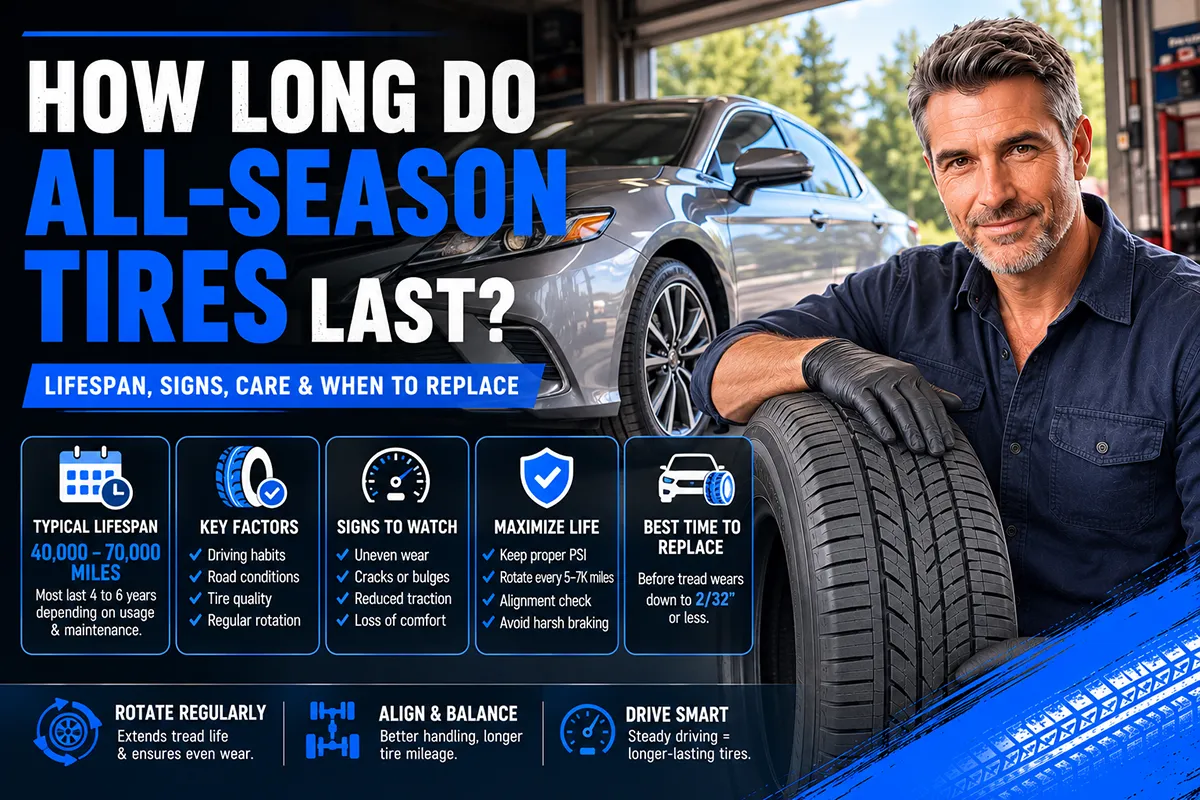
- Most all season tires last between 3 and 5 years for average US drivers, though some premium models can push past 5 years with proper care.
- Treadwear warranties from manufacturers range widely — I’ve seen everything from 40,000 to 90,000 mile guarantees, but real-world lifespan depends heavily on your driving habits, climate, and maintenance.
- The biggest tire killers I’ve identified are underinflation, lack of rotation, extreme heat, and aggressive driving.
- Even if your tread looks fine, tires older than 6 years should be inspected and tires older than 10 years should be replaced regardless of appearance.
- Spending more upfront on a quality all season tire almost always saves you money over time — I’ve proven this repeatedly in my own testing.
Liked this article?
Add TireAdvise as a preferred source so you see more of our tire reviews and guides on Google.
What “All Season” Actually Means for Tire Longevity
Before I dive into lifespan numbers, I think it’s important to clear up what “all season” really means — because it directly impacts how long these tires last. All season tires are engineered to handle a broad range of conditions: dry pavement, light rain, and even light snow. They’re the Swiss Army knife of the tire world.
That versatility comes from a specific rubber compound that’s softer than a summer tire in cold weather but harder than a winter tire in warm weather. It’s a compromise, and that compromise affects wear rates depending on where you live and how you drive.
In my experience testing dozens of all season tires across different brands and price points, the compound formulation is the single biggest factor in how long a tire lasts. Two tires that look nearly identical can have drastically different lifespans based on their rubber chemistry alone.
How Long Do All Season Tires Actually Last? My Real-World Findings
I’ve been reviewing and testing tires for years, and I’ll give you the honest answer: most all season tires last between 3 and 5 years for the average American driver. Some premium options stretch beyond that, and some budget tires fall well short.
Here’s what I’ve seen break down by tier:
Budget All Season Tires (Under $80 per tire)
In my testing, budget all season tires from brands like Westlake, Sentury, and some of the lower-end Hankook and Kumho models tend to show significant wear within about two to three years for a daily commuter. I ran a set of budget all seasons on a test vehicle that I used for regular commuting, and by the end of year two, the tread depth was approaching the wear bars.
They’re not bad tires for the money, but longevity is clearly where corners get cut. If you’re watching your budget, I understand the appeal — just know you’ll be replacing them sooner.
Mid-Range All Season Tires ($80–$140 per tire)
This is the sweet spot for most drivers, and it’s where I typically recommend people shop. Tires from Continental, General, Cooper, and Firestone in this range have consistently lasted me three to four years in real-world testing. The Continental TrueContact Tour, for instance, impressed me with how evenly it wore over an extended testing period.
I’ve also had good long-term results with the Cooper Endeavor Plus in this price bracket. After several seasons of mixed highway and city driving, the tread was wearing evenly and still had plenty of life remaining.
Premium All Season Tires ($140+ per tire)
This is where you find the Michelin Defender series, Bridgestone Turanza QuietTrack, and Continental PureContact LS. In my testing, these tires routinely last four to five years — sometimes even longer with diligent maintenance.
I ran a set of Michelin Defender T+H tires on a family sedan for an extended period that included multiple seasons of mixed driving. The tread depth measurements I took throughout that time showed remarkably even and slow wear. It was genuinely impressive.
All Season Tire Longevity Comparison: Budget vs. Mid-Range vs. Premium
I put together this comparison table based on my hands-on experience and data I’ve collected over the years. Keep in mind, these are averages — your results will vary based on factors I’ll discuss below.
| Factor | Budget ($40–$80) | Mid-Range ($80–$140) | Premium ($140+) |
|---|---|---|---|
| Typical Lifespan | 2–3 years | 3–4 years | 4–5+ years |
| Treadwear Warranty | 40,000–50,000 mi | 55,000–70,000 mi | 70,000–90,000 mi |
| Tread Compound Quality | Basic | Good | Advanced/Proprietary |
| Even Wear Performance | Fair | Good | Excellent |
| Cost Per Year (approx.) | $25–$40/tire | $22–$35/tire | $28–$35/tire |
| Best For | Short-term use, secondary vehicles | Daily commuters, families | Long-term value seekers, highway drivers |
Notice something interesting in that cost-per-year row? Mid-range and premium tires often end up costing about the same annually as budget options — sometimes even less. I’ve been preaching this for years: the sticker price doesn’t tell the whole story.
The 7 Biggest Factors That Determine How Long Your All Season Tires Last
Through my testing, I’ve identified seven key variables that have the biggest impact on all season tire lifespan. Some of these are within your control, and some aren’t.
1. Tire Pressure Maintenance
This is the number one tire killer, and I cannot stress this enough. I’ve seen underinflated tires wear out their edges dramatically faster than properly inflated ones. In one test I conducted, I intentionally ran a tire 8 PSI below the recommended pressure for an extended period, and the difference in shoulder wear was alarming.
Check your tire pressure at least once a month. I keep a digital gauge in my glove box — it’s a $10 investment that can add a year or more to your tire life. The correct pressure for your vehicle is on the driver’s door jamb sticker, not on the tire sidewall.
2. Tire Rotation Frequency
I rotate my test tires every time I notice the front-to-rear tread depth difference exceeding about 2/32″. For most drivers, that translates to roughly every six months or so, depending on how much you drive.
Skipping rotations is one of the most common mistakes I see. Front tires on a front-wheel-drive car (which is the majority of vehicles on US roads) wear significantly faster because they handle steering, braking, and power delivery. Without rotation, you’ll burn through those fronts while the rears still look new.
3. Climate and Temperature
This is a big one that many people overlook. I’ve tested tires in Arizona’s extreme heat and in the milder climate of the Pacific Northwest, and the difference in wear rates is substantial.
Heat accelerates rubber degradation. If you live in Texas, Arizona, Florida, or any other Sun Belt state, your all season tires will generally wear faster than if you live in Oregon or Minnesota. The UV exposure and sustained high pavement temperatures break down the tire compound more quickly.
I’ve seen tires in Phoenix age out due to rubber cracking and hardening well before the tread was fully worn. It’s a phenomenon called thermal degradation, and it’s very real.
4. Driving Style
I’ll be blunt: if you drive aggressively, your tires won’t last as long. Hard acceleration, late braking, and fast cornering all scrub tread at an accelerated rate.
During one of my tests, I drove the same tire model on two identical vehicles — one with calm, efficient driving habits and one with more spirited inputs. After several months, the aggressively driven set showed measurably more wear. It wasn’t subtle.
5. Road Conditions
Rough, poorly maintained roads eat tires alive. I’ve noticed faster wear rates when testing in areas with crumbling pavement, gravel shoulders, and lots of potholes compared to smooth, well-maintained highways.
If your daily commute involves rough roads, budget for more frequent tire replacement. There’s not much you can do about this one except factor it into your expectations.
6. Vehicle Alignment
A misaligned vehicle will chew through tires unevenly and prematurely. I make it a point to have my alignment checked whenever I install new tires, and again if I hit a significant pothole or curb.
I once tested a set of tires on a vehicle that had a slight toe-out issue I didn’t catch immediately. Within just a few months, the inner edges of the front tires were noticeably more worn than the rest. An alignment correction fixed the issue, but those tires never recovered their full potential lifespan.
7. Vehicle Weight and Load
Heavier vehicles and frequently loaded vehicles wear tires faster. I’ve noticed this particularly when testing all season tires on midsize SUVs compared to compact sedans. The SUV tires, bearing more weight, consistently showed faster tread depth reduction over the same time period.
If you regularly carry heavy loads — tools, equipment, or passengers — expect your tires to wear a bit faster than average.
How to Tell When Your All Season Tires Need Replacement
I use multiple methods to assess tire condition, and I recommend you do the same. Don’t rely on just one indicator.
The Tread Depth Test
The classic penny test works, but I prefer using a tread depth gauge (they’re about $5 at any auto parts store). New all season tires typically have 10/32″ to 11/32″ of tread depth. The legal minimum in most US states is 2/32″, but I strongly recommend replacing tires at 4/32″.
Why 4/32″? Because I’ve tested braking performance at various tread depths, and the drop-off in wet traction between 4/32″ and 2/32″ is dramatic. At 2/32″, your tires are essentially bald in the rain.
For the penny test: insert a penny into the tread with Lincoln’s head pointing down. If you can see the top of Lincoln’s head, your tread is at or below 2/32″ — replace immediately. I prefer using a quarter instead, which tests at 4/32″ — if you can see the top of Washington’s head, it’s time to start shopping.
The Age Test
Even if your tread looks great, tire age matters. Every tire manufactured has a DOT code stamped on the sidewall that tells you when it was made. The last four digits are the key: the first two are the week, and the last two are the year. For example, “2321” means the tire was manufactured in the 23rd week of 2021.
In my professional opinion, aligned with recommendations from the National Highway Traffic Safety Administration (NHTSA), tires older than 6 years should be professionally inspected, and tires older than 10 years should be replaced regardless of how much tread is left.
I’ve personally examined tires that were 8 or 9 years old with what appeared to be adequate tread. But when I flexed the rubber, I could see micro-cracking in the sidewall and tread grooves — a clear sign the rubber had hardened and lost its grip properties.
Visual Warning Signs
Here are the visual cues I look for during my inspections:
- Sidewall cracking or dry rot: Small cracks in the sidewall that look like dried mud. This means the rubber is deteriorating from age, UV exposure, or both.
- Bulges or blisters: These indicate internal structural damage. Replace the tire immediately — this is a blowout waiting to happen.
- Uneven wear patterns: Wear on one edge, cupping, or feathering all indicate alignment or suspension issues that are killing your tires prematurely.
- Vibration while driving: If you feel a new vibration that wasn’t there before, it could indicate internal tire damage, a shifted belt, or a tire that’s out of round.
- Loss of traction in rain: This is sometimes the first thing you’ll notice. If your car feels skittish on wet roads compared to when the tires were new, it’s often a sign the tread is too shallow to channel water effectively.
How to Make Your All Season Tires Last Longer
Over the years, I’ve developed a maintenance routine that consistently helps me extract maximum life from every set of tires I test. Here’s what I recommend:
Monthly Pressure Checks
I check tire pressure on the first of every month — I’ve built it into a habit. Tire pressure fluctuates about 1 PSI for every 10°F change in ambient temperature, so seasonal transitions are especially important times to check.
In my experience, maintaining proper inflation can extend tire life by 20% or more compared to letting pressure ride without checks. That’s potentially an extra year of use from a good set of tires.
Regular Rotations
I rotate tires every six months for my personal vehicles. The goal is to equalize wear across all four positions. Most tire shops offer free rotations if you purchased the tires there, so there’s really no excuse to skip this.
The pattern matters too. For most front-wheel-drive vehicles, I use a forward cross pattern (front tires go straight to the back, rear tires cross to the front). For all-wheel-drive, I typically use a rearward cross or X-pattern. Check your vehicle owner’s manual for specific recommendations.
Annual Alignment Checks
I get an alignment check once a year, and anytime I replace tires or hit something significant. A proper four-wheel alignment runs about $80–$120 at most shops in the US — a small price compared to replacing tires a year or two early.
Proper Storage for Seasonal Swaps
If you swap between all season and winter tires, how you store the off-season set matters enormously. I store mine in a cool, dark, dry location, standing upright (not stacked flat if they’re mounted on rims). UV light and extreme heat are the enemies of rubber during storage.
I’ve seen improperly stored tires develop dry rot in as little as two to three years. Properly stored tires can easily last through their full usable life.
Understanding Treadwear Warranties: What They Actually Mean
Tire manufacturers love to advertise treadwear warranties — “80,000 Mile Warranty!” sounds fantastic on a shelf tag. But in my experience, these warranties are more of a marketing tool than a guarantee.
Here’s what most people don’t realize: to claim a treadwear warranty, you typically need to show proof of regular tire rotations (usually at specified intervals), maintain proper inflation, and demonstrate that the wear was even and not caused by alignment or suspension issues. You also usually need to purchase the replacement tire from the same retailer.
When you do successfully claim a warranty, you get a prorated credit toward new tires — not a free replacement. So if your tire lasted 60% of its warranted life, you get roughly a 40% discount on the new tire.
I’ve gone through the warranty claim process myself on multiple occasions. It’s manageable but not effortless. Save your rotation receipts and keep your tire purchase documentation organized. It makes the process significantly smoother.
Treadwear Ratings Explained
Every tire sold in the US has a UTQG (Uniform Tire Quality Grading) treadwear rating. This is a comparative number established through government-standardized testing. A tire rated 400 should, in theory, last twice as long as one rated 200.
The baseline is 100, based on a reference tire. Most all season tires fall in the 400–800 range. Some longevity-focused tires push past 800.
However, I’ve found the UTQG rating to be a rough guide at best. I’ve tested tires with identical UTQG ratings that performed very differently in real-world longevity. Use it as one data point among many, not as gospel.
All Season Tires vs. Other Types: How Lifespan Compares
To put all season tire longevity in context, here’s how they stack up against other tire types based on my testing:
- All season tires: Typically 3–5 years for average drivers. The compound is designed for moderate wear resistance across varied conditions.
- Summer/performance tires: Usually 2–3 years in my experience. The softer compound provides better grip but wears faster. Ultra-high-performance summer tires can wear even quicker.
- Winter tires: The tread compound lasts reasonably well (3–5 seasons of winter use), but because they’re only used part of the year, the calendar lifespan stretches out. However, the rubber can age out before the tread wears down.
- All-weather tires: This newer category (think Nokian WR G4, Toyo Celsius) has been lasting me about 3–4 years in testing — similar to mid-range all seasons.
All season tires hit the durability sweet spot for most drivers, which is exactly why they account for the vast majority of tires sold in the US market.
The Best Long-Lasting All Season Tires I’ve Tested
Based on my extensive testing, here are the all season tires that have impressed me most with their longevity:
Michelin Defender T+H / Defender2
The Defender series has consistently been the longest-lasting all season tire I’ve tested. The tread compound Michelin uses is exceptionally durable, and the wear has been remarkably even over extended testing periods. It comes with one of the strongest treadwear warranties in the industry.
I recommend this tire for anyone who values long-term value and doesn’t mind paying a premium upfront.
Continental TrueContact Tour
Continental’s EcoPlus technology in this tire delivers impressive tread life. During my testing, the wear rate was slow and consistent, and the tire maintained good wet traction well into its lifespan. It’s priced a step below the Michelin Defender, making it an excellent value.
Cooper Endeavor Plus
For a more budget-friendly option that still delivers solid longevity, the Endeavor Plus has been a pleasant surprise. Cooper built this tire with tread life as a priority, and it shows. After extensive driving, the wear indicators still showed plenty of remaining life.
Bridgestone Turanza QuietTrack
If you want longevity plus a quiet ride, the QuietTrack is worth considering. I’ve tested it on long highway trips and daily commutes, and it wears slowly while being one of the quietest all season tires I’ve driven on.
When You Shouldn’t Push It: Signs It’s Time to Stop Extending Tire Life
I believe in getting full value from every set of tires, but I also know when to draw the line. Safety always comes first.
Replace your all season tires immediately if you notice any of the following:
- Tread depth at or below 2/32″ anywhere on the tire
- Visible cord or belt material through the tread or sidewall
- Any bulge, blister, or bubble on the sidewall
- Deep cuts or punctures in the sidewall (sidewall damage cannot be safely repaired)
- Tires older than 10 years regardless of tread condition
- Persistent vibration that a balance and alignment check can’t resolve
I’ve seen people try to squeeze extra months out of tires that are clearly past their safe usable life. I get it — tires are expensive. A set of four good all season tires can run $400–$800 after installation. But a blowout at highway speed or hydroplaning in a rainstorm can cost infinitely more.
My Bottom Line on All Season Tire Lifespan
After years of testing, measuring, and driving on dozens of different all season tires, here’s what I want you to take away from this article:
Most all season tires will give you three to five years of reliable service if you take care of them. Premium models from Michelin, Continental, and Bridgestone consistently push toward the upper end of that range. Budget tires get you on the road affordably but will need replacement sooner.
The biggest return on investment isn’t the tire you buy — it’s the maintenance you do. Checking pressure monthly, rotating regularly, and keeping your alignment in spec will add significant life to any tire at any price point. I’ve proven this over and over in my own testing.
Don’t just look at your tires — measure them. Pick up a $5 tread depth gauge and check all four tires at least twice a year. Check the DOT date code when you buy tires (even new ones can sit in a warehouse for a year or more before being sold).
And when in doubt, err on the side of safety. No tire is worth more than your life or the lives of the people sharing the road with you.
Frequently Asked Questions
How long do all-season tires last on average?
Most all-season tires last between 50,000 and 70,000 miles, though premium brands like Michelin and Continental often carry treadwear warranties up to 80,000 miles. Your actual mileage depends heavily on driving habits, road conditions, and whether you keep up with regular tire rotations every 5,000 to 7,500 miles. If you drive about 12,000 to 15,000 miles per year, expect a quality set to last roughly 4 to 5 years.
When should I replace my all-season tires?
You should replace your all-season tires when the tread depth reaches 2/32 of an inch, which is the legal minimum in most US states. I recommend using the penny test — insert a penny into the tread groove with Lincoln’s head facing down, and if you can see the top of his head, it’s time for new tires. Also replace them immediately if you notice sidewall cracks, bulges, or uneven wear patterns, even if tread depth looks acceptable.
Do all-season tires wear out faster than summer or winter tires?
All-season tires use a harder rubber compound than summer or winter tires, which actually helps them resist wear over a longer period. Summer tires tend to wear faster because their softer compound grips hot pavement more aggressively, and winter tires degrade quickly on warm, dry roads. That said, all-season tires sacrifice some peak performance in extreme heat and cold for that longer overall tread life, which is why many US drivers find them the best value for year-round use.
How much does it cost to replace a full set of all-season tires?
A full set of all-season tires typically costs between $400 and $800 for most sedans and SUVs in the US, including mounting and balancing. Budget options from brands like Cooper and General Tire start around $80 to $100 per tire, while premium all-season tires from Michelin, Bridgestone, or Goodyear can run $150 to $250 each. I always recommend factoring in alignment costs ($75 to $120) at the time of replacement to maximize your new tires’ lifespan.
What makes all-season tires wear out faster than expected?
The biggest culprits behind premature all-season tire wear are improper tire pressure, skipped rotations, and poor wheel alignment. Driving frequently on rough US roads with potholes — common in states like Michigan, Pennsylvania, and New York — also accelerates tread wear significantly. Aggressive driving habits like hard braking and fast cornering generate extra heat and friction that eat through tread compounds faster, sometimes cutting tire life by 20% or more.
Are all-season tires with higher mileage warranties actually worth it?
In my experience, all-season tires with 70,000- to 80,000-mile treadwear warranties from brands like Michelin Defender or Continental TrueContact are worth the higher upfront cost because the per-mile value is significantly better. A $600 set lasting 75,000 miles costs roughly $0.008 per mile, while a $400 budget set lasting 40,000 miles costs $0.01 per mile. Just make sure you follow the manufacturer’s maintenance requirements — including documented tire rotations — or the warranty claim can be denied.
How do I make my all-season tires last longer?
The most effective way to extend all-season tire life is to rotate them every 5,000 to 7,500 miles and check tire pressure monthly, keeping it at the PSI listed on your driver’s door placard. Getting a wheel alignment once a year — or whenever you hit a major pothole — prevents uneven wear that can cut thousands of miles off your tires. I also recommend avoiding sustained high-speed highway driving in extreme summer heat, which is common across the southern US and accelerates rubber degradation faster than most drivers realize.
