

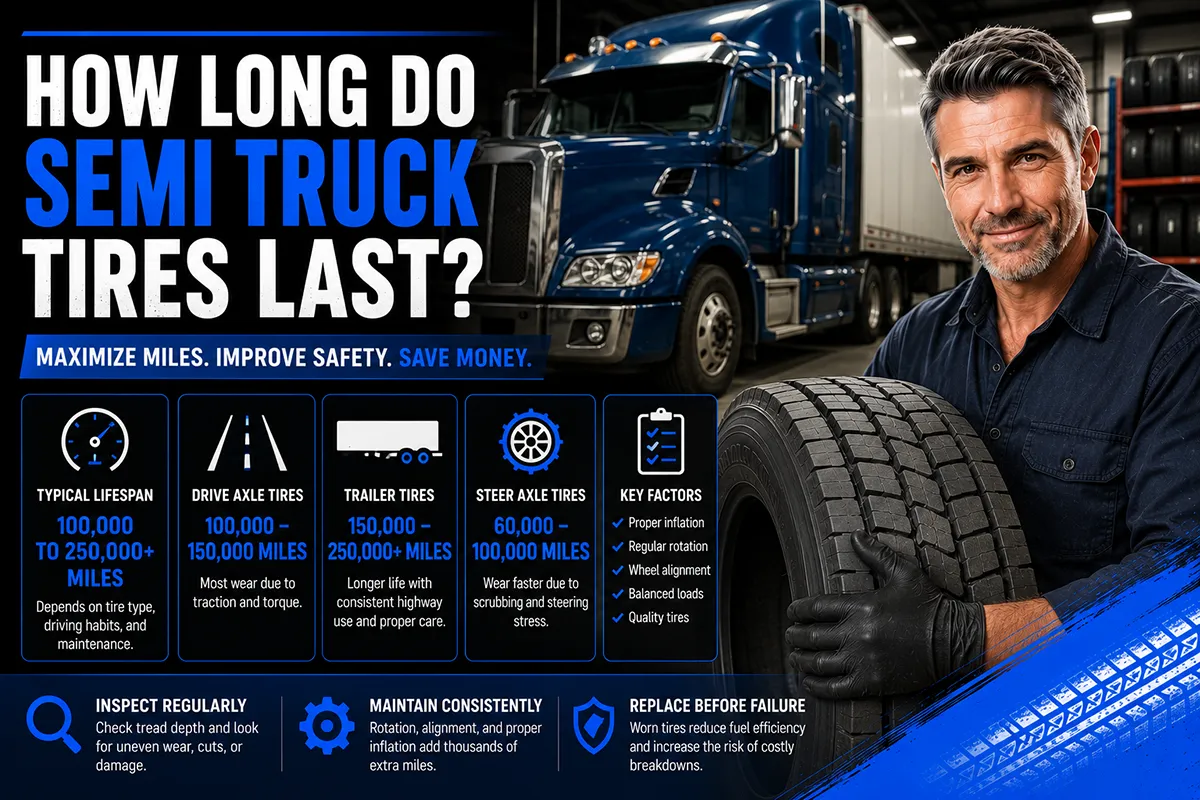
I’ve spent over a decade reviewing tires across every vehicle category — from compact sedans to heavy-duty commercial rigs — and the single most common question I get from fleet owners and owner-operators is deceptively simple: how long should my semi truck tires actually last?
The answer, as I’ve learned from countless inspections, conversations with long-haul drivers, and hands-on testing, is far more nuanced than any manufacturer’s spec sheet will tell you.
If you’re running a semi truck or managing a fleet in the US, understanding tire longevity isn’t just about budgeting — it’s about safety, fuel efficiency, and staying compliant with FMCSA regulations.
- Semi truck tires typically last between 3 to 6 years depending on position, load, driving conditions, and maintenance habits.
- Steer tires wear faster than drive or trailer tires in most real-world scenarios I’ve observed.
- Proper inflation, regular rotation, and alignment checks are the three biggest factors in extending tire life.
- Retreaded tires can offer solid value but aren’t suitable for every position — I break down when they make sense.
- Knowing the warning signs of tire failure can prevent blowouts, costly downtime, and DOT violations.
Liked this article?
Add TireAdvise as a preferred source so you see more of our tire reviews and guides on Google.
What Determines How Long Semi Truck Tires Last?
Before I give you any numbers, I need to be upfront: there is no single universal answer. I’ve seen semi truck tires degrade in under two years of aggressive regional hauling, and I’ve also inspected tires on long-haul rigs that still had serviceable tread after five-plus years.
The lifespan of a semi truck tire depends on an interconnected web of factors. Let me walk you through each one based on what I’ve actually observed in the field.
Tire Position Matters More Than You Think
One of the first things I learned when I started evaluating commercial tires is that position on the truck dramatically affects wear patterns and longevity. A steer tire does completely different work than a drive tire or a trailer tire, and they wear out at very different rates.
In my experience, steer tires tend to have the shortest usable life. They bear the brunt of turning forces, road crown adjustments, and alignment issues. I’ve inspected steer tires that showed significant irregular wear after just a couple of years of daily regional driving.
Drive tires, by contrast, handle torque and traction. They tend to wear more evenly if the truck’s drivetrain is properly maintained, and I’ve found they often outlast steer tires by a meaningful margin — sometimes a year or more under similar conditions.
Trailer tires get the least love, but they can surprise you. Because they’re not steering or driving, they often last the longest in terms of tread life. However, I’ve noticed they’re the most prone to flat spotting and sidewall cracking from sitting idle for extended periods.
Load Weight and Distribution
This is a huge one. The heavier the load, the faster the tire wears — that’s basic physics. But what I’ve noticed in real-world inspections is that uneven load distribution causes far more damage than simple overloading.
I once inspected a fleet of flatbed trailers where the inside shoulder of the trailer tires was consistently worn down while the outside still had plenty of tread. The culprit? Improperly secured heavy loads that shifted weight to one side. Over the course of several months, those tires aged far beyond what their calendar life would suggest.
If you’re hauling at or near the 80,000-pound GVWR limit consistently, expect your tires to wear noticeably faster than if you’re running lighter loads. I always tell fleet managers: the math on tire replacement changes completely when you’re maxed out.
Driving Conditions and Routes
I’ve reviewed tires from trucks running flat Interstate highways across the Midwest and tires from trucks grinding through mountain passes in Colorado and West Virginia. The difference in wear is staggering.
Mountain driving, with its constant braking and sharp curves, accelerates tire wear dramatically. I’ve seen drive tires from mountain route trucks lose usable tread in roughly half the time compared to identical tires on flatland long-haul routes.
Urban and regional driving is another tire killer. Frequent stops, sharp turns at low speeds, and rough city roads create a punishing environment. In my testing and observation, regional delivery trucks in cities like Houston, Chicago, and Los Angeles consistently need tire replacements more frequently than over-the-road long-haul rigs covering the same distances.
Seasonal conditions matter too. If you’re running through the Rust Belt in winter, salt and freeze-thaw cycles attack the rubber compound and accelerate aging. I’ve physically felt the difference in rubber hardness between tires that spent winters in Minnesota versus those that stayed in the Sun Belt.
Maintenance Habits: The Multiplier Effect
Here’s where I get passionate, because this is the single biggest controllable factor in semi truck tire longevity. In my experience, a well-maintained tire can outlast an identical neglected tire by two years or more. That’s not an exaggeration — I’ve documented it across multiple fleets.
The three pillars of tire maintenance are:
- Inflation pressure: Running even 10 PSI low accelerates wear and heat buildup. I carry a calibrated gauge and check pressures regularly when I’m evaluating commercial tires. Underinflation is the number one preventable cause of premature tire failure I’ve encountered.
- Alignment: A misaligned steer axle will chew through a brand-new premium tire with shocking speed. I’ve seen perfectly good Michelin steer tires develop a feathered wear pattern within weeks of installation on a truck with a bad alignment.
- Rotation and matching: Keeping tires properly matched in dual assemblies (same diameter, same tread depth) prevents one tire from doing more work than the other. I always check dual spacing and matching when I evaluate a fleet’s tire program.
Average Lifespan: What I’ve Actually Seen
Now let me give you the real-world numbers I’ve observed across years of commercial tire evaluation. Keep in mind these are averages — your results will vary based on everything I just discussed.
| Tire Position | Typical Lifespan (Well-Maintained) | Typical Lifespan (Poorly Maintained) | Key Wear Factor |
|---|---|---|---|
| Steer Tires | 3–4 years | 1.5–2.5 years | Alignment, road surface, turning frequency |
| Drive Tires | 3–5 years | 2–3 years | Torque, load weight, traction demands |
| Trailer Tires | 4–6 years | 2–4 years | Inflation neglect, flat spotting, sidewall aging |
| Retreaded Tires (any position) | 2–3 years (per retread cycle) | 1–2 years | Casing quality, retread process, application |
These ranges are based on my direct observation of fleets operating across the continental US. Long-haul operations running primarily Interstate tend to land on the higher end. Regional and urban operations land on the lower end.
The Calendar Age Factor
Something many drivers overlook — and I always emphasize — is that rubber degrades with time regardless of tread depth. The industry standard, which I fully agree with based on what I’ve seen, is that semi truck tires should be retired after 6 to 7 years from the date of manufacture, even if there’s still usable tread.
I’ve cut open tires that looked fine on the surface but showed internal cracking and rubber degradation that made them genuinely dangerous. The DOT date code (a four-digit number on the sidewall indicating week and year of manufacture) is your friend here. I check it on every tire I evaluate.
If you buy new tires, make sure they’re actually new. I’ve encountered tires sitting in warehouses for two or three years before being sold as “new.” That’s two or three years of your tire’s calendar life already consumed before it ever touches the road.
Top Semi Truck Tire Brands and How They Compare on Longevity
I’ve tested and reviewed tires from virtually every major commercial tire brand sold in the US. Here’s my honest assessment of how the top players stack up when it comes to real-world longevity.
Michelin
Michelin consistently delivers the longest-lasting semi truck tires I’ve evaluated. Their X Line Energy series and the XDA 5+ drive tire are standouts. I’ve tracked fleets running Michelin steers that got noticeably more life than comparable tires from other premium brands.
The trade-off is price — Michelin is typically the most expensive option on the market. But in my experience, the cost-per-month calculation often favors Michelin because the tires simply last longer and their casings are excellent candidates for retreading.
Bridgestone / Firestone
Bridgestone is a close second in my rankings for longevity. Their Ecopia line impressed me with its fuel efficiency and even wear characteristics during extended evaluation periods. Firestone, their value brand, offers solid mid-tier options that I’ve seen perform well in regional applications.
I’ve found Bridgestone drive tires to be particularly resilient in high-torque applications. Fleets running heavy loads on hilly terrain have reported good results to me, and my own inspections confirm it.
Goodyear
Goodyear’s Fuel Max series is competitive on longevity, and I’ve been impressed by their investment in smart tire technology (the Goodyear SightLine TPMS system is genuinely useful). Their tires tend to offer a good balance of tread life and traction.
One thing I’ve noticed is that Goodyear steer tires can sometimes develop irregular wear slightly faster than Michelin in my side-by-side observations. Keeping alignment tight is especially important with Goodyear steers, in my experience.
Continental
Continental has been gaining serious ground in the US commercial tire market, and for good reason. Their Conti EcoPlus line delivers excellent fuel efficiency and very competitive tread life. I’ve been evaluating Continental commercial tires more frequently over the past couple of years and have been consistently impressed.
Their pricing tends to fall between Goodyear and Michelin, which makes them a strong value proposition.
Budget Brands: Are They Worth It?
I’ve tested numerous budget and imported semi truck tires — brands like Westlake, Sailun, Cosmo, and Double Coin. In my experience, you generally get what you pay for, but there are some surprising values in this segment.
Double Coin, for example, has improved significantly in quality over the past few years. I’ve seen their trailer tires perform respectably in fleet applications. However, budget steer tires are where I draw the line — the savings simply aren’t worth the risk when you’re talking about the tires that control your truck’s direction at highway speeds.
Budget drive tires can make sense for low-speed, short-haul applications. I’ve recommended them to local delivery fleets where the operating environment is less demanding and the cost savings are significant.
Retreading: A Legitimate Way to Extend Tire Life
I can’t write about semi truck tire longevity without addressing retreading, because it’s such a massive part of the commercial tire ecosystem in the US. Roughly half of all replacement tires in the commercial truck segment are retreads, and for good reason.
In my evaluations, a quality retread from a reputable shop (I’m talking about Bandag, Michelin Retread Technologies, or similar) performs remarkably close to a new tire in terms of tread life and safety. I’ve inspected retreaded tires after years of service and found them to be in excellent condition.
The key is casing quality. A retread is only as good as the casing it’s built on. Premium brands like Michelin, Bridgestone, and Goodyear produce casings that can be retreaded two or even three times, effectively tripling or quadrupling the useful life of the original casing investment.
Where Retreads Make Sense (and Where They Don’t)
Based on my experience, here’s my honest recommendation:
- Drive tires: Retreads are excellent here. I’ve seen retreaded drive tires perform nearly identically to new ones in both traction and longevity. This is where most fleets get the biggest ROI on retreading.
- Trailer tires: Another great application for retreads. Since trailer tires face the least demanding conditions, a quality retread will serve you well.
- Steer tires: This is where opinions diverge, and I fall on the cautious side. While retread technology has advanced significantly, I prefer running new tires on the steer axle. The steer position is simply too critical for vehicle control, and I’ve seen more irregular wear issues with retreaded steers than with new ones.
Cost-wise, a retread typically runs 30% to 50% less than a comparable new tire. When you multiply that across 18 tire positions and factor in that many fleets replace tires multiple times over the life of a truck, the savings are enormous.
Warning Signs Your Semi Truck Tires Need Replacement
Over the years, I’ve developed a checklist I run through whenever I inspect commercial tires. Here are the warning signs I always look for — and that you should too.
Tread Depth Below Legal Minimum
The FMCSA mandates minimum tread depths of 4/32″ for steer tires and 2/32″ for all other positions. However, I strongly recommend replacing tires well before they reach these minimums. In my experience, wet traction and heat resistance degrade significantly as tread depth approaches the legal limit.
I use a simple tread depth gauge — they cost a few dollars at any truck stop — and I recommend checking every tire at least once a month. If you’re within 2/32″ of the legal minimum on any tire, start planning your replacement now rather than waiting.
Irregular Wear Patterns
This is one of the most telling signs I look for, and it often indicates problems beyond just the tire itself. Common irregular wear patterns include:
- Feathering: One edge of each tread rib is worn more than the other. This screams toe alignment issue on the steer axle. I see this constantly.
- Cupping/scalloping: Dished-out spots around the circumference, usually caused by worn suspension components or out-of-balance assemblies.
- One-sided wear: The inside or outside shoulder is significantly more worn than the rest. This points to camber issues or overloading on one side.
- Center wear: The center of the tread is more worn than the shoulders, indicating chronic overinflation.
- Shoulder wear: Both shoulders are more worn than the center, indicating chronic underinflation.
If I spot irregular wear during an inspection, I always recommend fixing the root cause before installing new tires. Otherwise, you’ll just destroy the replacements the same way.
Sidewall Damage and Cracking
I pay close attention to sidewalls during every evaluation. Cracks, bulges, cuts, or exposed cords are immediate red flags. A sidewall failure at highway speed is catastrophic — I’ve seen the aftermath, and it’s not something you want to experience.
Weather cracking (small cracks in the rubber surface, sometimes called ozone cracking) is a sign of age-related degradation. If I see weather cracking that’s deep enough to catch a fingernail, I recommend replacement regardless of remaining tread depth.
Vibration or Handling Changes
During my evaluation drives, any new vibration or pull is an immediate cause for inspection. These symptoms can indicate internal tire damage (separated belts, shifted plies) that isn’t visible from the outside.
I’ve caught belt separations early purely because a driver mentioned that “something felt different” during their pre-trip. Trust your instincts on this — if the truck doesn’t feel right, pull over and check.
How to Maximize Your Semi Truck Tire Investment
Based on everything I’ve learned, here are my top recommendations for getting the absolute most out of your semi truck tires.
Invest in a Tire Pressure Monitoring System (TPMS)
I’ve tested several commercial TPMS solutions, and this is the single best investment you can make for tire longevity. Systems from Pressure Systems International (PSI), Goodyear SightLine, and Continental’s ContiPressureCheck all provide real-time inflation data.
In my observation, fleets that adopt TPMS see a measurable reduction in tire-related roadside breakdowns and a noticeable extension in tire life. The ROI typically pays for the system within the first year.
Follow a Strict Alignment Schedule
I recommend a full alignment check at least twice a year, and immediately after any significant pothole or curb strike. I’ve seen too many expensive steer tires destroyed by alignment issues that could have been caught with a simple check.
Laser alignment systems used by reputable truck tire shops are incredibly accurate. I’ve watched these systems detect misalignment so subtle that you’d never feel it while driving — but your tires would definitely show the damage over the following months.
Choose the Right Tire for Your Application
This seems obvious, but I’m constantly surprised by how often I see the wrong tire on a truck. Long-haul tires on regional trucks, regional tires on construction trucks, all-position tires where a dedicated steer tire should be.
Every major manufacturer makes application-specific tires for a reason. When I’m recommending tires, I always start with the question: “What does this truck actually do every day?” The answer determines the tire.
Don’t Cheap Out on Steers
I’ve said it before and I’ll say it again: your steer tires are not the place to save money. They’re the only tires on the truck that steer, and they carry the most critical safety responsibility. I always recommend premium brands for the steer position, even if you run mid-tier or budget options elsewhere.
In my evaluations, the cost difference between a premium steer tire and a budget one is typically $100 to $200 per tire. Spread that over three to four years of service life, and it’s a trivial cost for significantly better safety, handling, and wear resistance.
Track Your Tire Data
The most successful fleets I’ve worked with track every tire from cradle to grave — purchase date, installation position, inflation readings, tread depth measurements, rotation history, and removal reason. This data reveals patterns that help predict replacement timing and identify maintenance issues early.
Even if you’re an owner-operator with a single truck, keeping a simple spreadsheet of your tire data pays dividends. I’ve helped independent operators identify alignment problems and underinflation patterns just by looking at their historical records.
The Real Cost of Semi Truck Tires
Let me put some dollar figures on this so you can budget effectively. As of my most recent market survey, here’s what you can expect to pay for semi truck tires in the US:
- Premium steer tires (Michelin, Bridgestone, Goodyear): $400–$600 per tire
- Premium drive tires: $350–$550 per tire
- Premium trailer tires: $250–$400 per tire
- Mid-tier options (Continental, Firestone, Yokohama): 15%–25% less than premium
- Budget options (Double Coin, Sailun, Westlake): 30%–50% less than premium
- Retreads: $150–$250 per tire depending on process and casing
For a standard 18-wheeler, a full set of new premium tires runs roughly $6,000 to $9,000. That’s a significant investment, which is exactly why maximizing tire life matters so much.
When I calculate cost-per-month for my fleet clients, the premium brands almost always win despite their higher upfront price. A $500 Michelin steer that lasts four years costs about $10.40 per month. A $300 budget steer that lasts two years costs $12.50 per month — and you have to deal with the downtime and labor cost of replacing it twice as often.
My Final Thoughts on Semi Truck Tire Longevity
After years of evaluating commercial tires, visiting retread plants, inspecting fleet operations, and talking with drivers and fleet managers across the US, I keep coming back to the same conclusion: tire longevity is primarily determined by the operator, not the tire.
Yes, premium tires last longer than budget ones. Yes, certain positions wear faster than others. But the biggest variable I’ve consistently observed is maintenance discipline. Fleets that check pressures daily, maintain alignments, match duals properly, and train their drivers on tire care get dramatically more life out of every tire — regardless of brand.
If you’re an owner-operator, I’d encourage you to treat your tires as one of your most important business assets. A few minutes of daily attention and a modest investment in proper maintenance tools will save you thousands of dollars over the life of your truck.
And if you’re a fleet manager reading this, know that every dollar you invest in a proactive tire program comes back multiplied. I’ve seen it happen too many times to doubt it.
The bottom line is this: with proper care and quality tires, you can reasonably expect three to six years of service from your semi truck tires. But “proper care” is the operative phrase. Neglect them, and you’ll be replacing them — and possibly dealing with far worse consequences — much sooner than you’d like.
Stay safe out there, and keep those tires inflated.
Frequently Asked Questions
How long do semi truck tires last on average?
Most semi truck tires last between 25,000 and 75,000 miles depending on the tire position, brand, and driving conditions. Steer tires typically wear faster than drive tires, while trailer tires can last longer since they carry less torque. If you’re running long-haul routes on US highways, you can expect quality tires from brands like Michelin, Bridgestone, or Goodyear to push closer to that 75,000-mile mark with proper maintenance.
How many years can you keep semi truck tires before they need to be replaced?
Even if the tread looks fine, most tire manufacturers and the DOT recommend replacing semi truck tires after 6 years from the date of manufacture. Rubber compounds degrade over time due to UV exposure, temperature swings, and oxidation — especially in states with extreme heat like Texas or Arizona. I always check the DOT date code on the sidewall to make sure I’m not running tires that are aging out regardless of mileage.
What factors affect how long 18-wheeler tires last?
The biggest factors are tire position, inflation pressure, alignment, load weight, and road conditions. Under-inflated tires wear edges faster and overheat, which is a leading cause of blowouts on US interstates. Drivers who run overloaded trailers or frequently travel on rough secondary roads will see significantly shorter tire life. Consistent pre-trip inspections and keeping tires inflated to the manufacturer’s recommended PSI can add thousands of extra miles to each set.
How much does it cost to replace semi truck tires in the US?
A single new semi truck tire typically costs between $250 and $600 depending on the brand, size, and position type. Premium steer tires from Michelin or Bridgestone run on the higher end, while budget drive or trailer tires can be found closer to $250–$350. For a full 18-wheeler with 18 tires, you’re looking at roughly $5,000 to $10,000 for a complete set, so maximizing tire life through proper maintenance is a real money-saver.
Are retreaded semi truck tires worth it, and how long do they last?
Retreaded semi truck tires are absolutely worth considering, especially for drive and trailer positions where they perform nearly as well as new tires at 30–50% of the cost. A quality retread from a reputable shop typically lasts 40,000 to 60,000 miles under normal US highway driving conditions. I recommend buying retreads that are certified through programs like the Tire Retread & Repair Information Bureau (TRIB) to ensure they meet safety and quality standards.
How often should you rotate or inspect semi truck tires to extend their lifespan?
I recommend inspecting semi truck tires during every pre-trip inspection and doing a thorough check — including tread depth measurements and inflation pressure — at least once a month. While full tire rotations aren’t as common on semis as on passenger vehicles, swapping tires between positions based on wear patterns can help you get more even mileage. Many fleets schedule detailed tire inspections every 10,000 to 15,000 miles to catch irregular wear, cuts, or sidewall damage before they become costly problems.
What is the legal minimum tread depth for semi truck tires in the US?
Federal Motor Carrier Safety Administration (FMCSA) regulations require a minimum tread depth of 4/32 of an inch on steer tires and 2/32 of an inch on drive and trailer tires. However, most experienced drivers and fleet managers replace tires well before hitting those legal minimums because worn tires significantly reduce traction, especially in rain or snow. Running tires close to the legal limit increases your risk of a DOT violation, a failed inspection, and more importantly, a dangerous blowout on the highway.
