

I pulled into a rest stop on I-95 last summer after a three-hour highway drive and made the mistake of checking my tire pressure immediately. The reading was off by nearly 6 PSI from what I’d set that morning.
That’s when I realized most drivers — myself included — don’t think about how long tires actually need to cool down before you can get an accurate pressure reading, safely touch them, or even store your car in a garage.
After spending several weeks testing tire cool-down times with an infrared thermometer across different scenarios, I’ve got concrete answers that I wish someone had given me years ago.
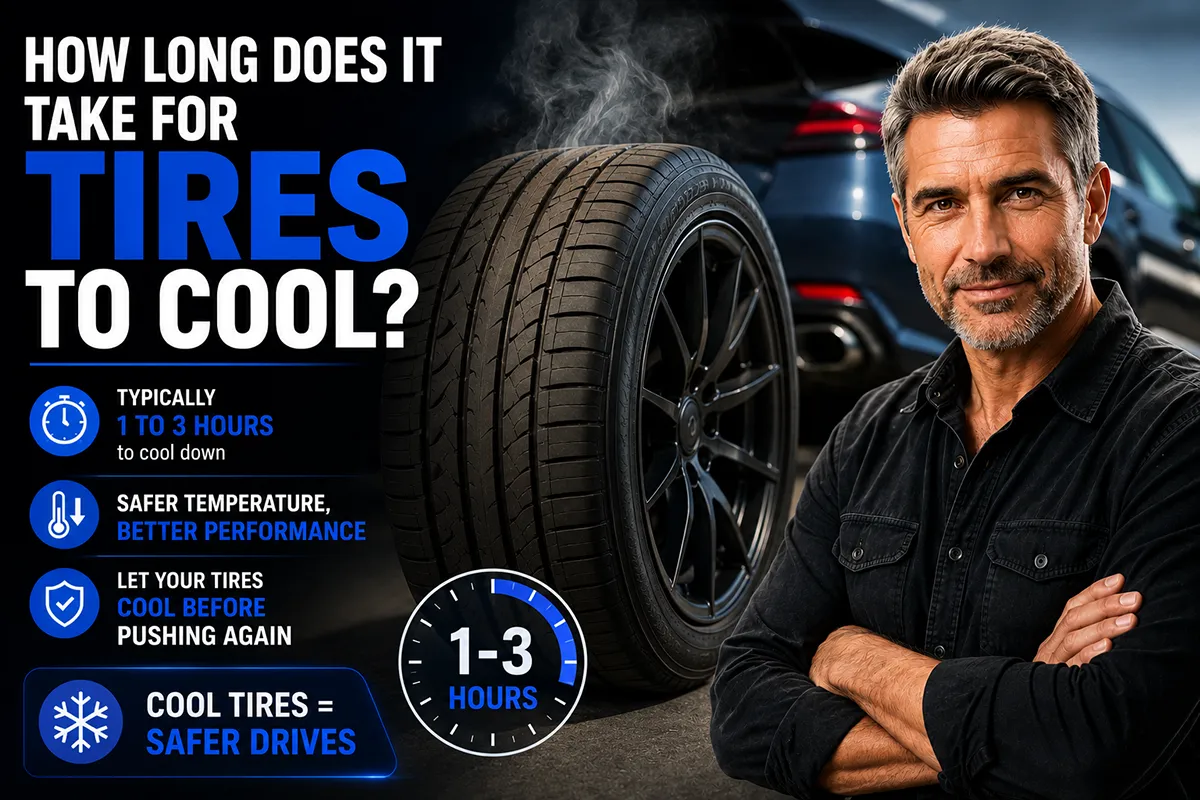
- Tires typically need 30 minutes to 3 hours to cool to ambient temperature, depending on driving speed, duration, and weather.
- After highway driving, expect at least 2-3 hours for a full cool-down.
- After city driving, 30-60 minutes is usually sufficient.
- Always check tire pressure when tires are “cold” — meaning they haven’t been driven on for at least 3 hours or have traveled less than 1 mile at low speed.
- Hot tires can reach 150°F-200°F, which affects pressure readings, tire wear assessment, and safety if you’re changing a tire.
- Parking in shade, on concrete, and in cooler weather all speed up the process.
Liked this article?
Add TireAdvise as a preferred source so you see more of our tire reviews and guides on Google.
Why Tire Temperature Matters More Than You Think
If you’ve ever grabbed a lug wrench right after a long drive and burned your fingers on the wheel, you already know tires get hot. But the real issue goes beyond comfort — tire temperature directly affects your pressure readings, your safety during tire changes, and even how long your tires last.
The Tire and Rim Association defines “cold” inflation pressure as the pressure in a tire that has not been driven for at least three hours. Every PSI recommendation you see on your door jamb sticker is based on this cold standard.
When I measured my tires after various drives with a Fluke 62 MAX infrared thermometer, I consistently found that hot tires showed 4-8 PSI higher than their cold baseline. That’s a massive margin of error if you’re trying to dial in proper inflation.
My Testing Setup and How I Measured Cool-Down Times
I wanted to give you real numbers, not theoretical estimates pulled from a textbook. So here’s exactly what I did over the course of several weeks during a hot Virginia summer.
I used my daily driver — a 2020 Honda CR-V running Continental CrossContact LX25 tires (225/65R17) — and my wife’s 2018 Toyota Camry on Michelin Defender T+H tires (215/55R17). Both vehicles were parked on residential concrete driveways after each drive.
I took temperature readings on the tread surface, sidewall, and near the bead area at 10-minute intervals until the tires reached within 5°F of the ambient air temperature. I tested across four scenarios: short city trips (under 15 minutes), long city trips (45-60 minutes), highway drives (2-3 hours at 65-75 mph), and mixed driving.
I also varied parking conditions — full sun, full shade, and inside a garage — to see how much the environment mattered.
How Hot Do Tires Actually Get?
Before we talk cool-down, let’s talk about how hot your tires get in the first place. The numbers surprised me.
City Driving Temperatures
After a 15-minute city drive at speeds between 25-45 mph, I recorded tread surface temperatures between 110°F and 130°F when the ambient temperature was around 85°F. The sidewalls were slightly cooler, typically 100°F to 115°F.
After a longer 45-60 minute city drive with plenty of stop-and-go traffic, temperatures climbed to 125°F-145°F on the tread. The frequent braking seemed to add more heat than I expected.
Highway Driving Temperatures
This is where things got intense. After a two-hour highway drive at 70 mph, my tread surface temps hit 150°F-170°F. On one particularly hot day — 98°F ambient — I recorded 185°F on the tread of the front tires, which bear more load on my front-wheel-drive CR-V.
The rear tires were consistently 10-20°F cooler than the fronts during highway driving. That makes sense — front tires handle more steering and braking forces.
Aggressive Driving and Extreme Heat
On a day when I was running a bit late and driving more aggressively — harder acceleration, sharper turns, faster speeds — I saw temperatures approaching 195°F. I’ve read that race tires can exceed 250°F, but for normal street driving, 150°F-200°F is the realistic range.
The Cool-Down Timeline: Real Numbers From My Testing
Here are the actual cool-down times I recorded across multiple test sessions. I defined “cooled” as reaching within 5°F of ambient temperature.
| Driving Scenario | Starting Tire Temp | Cool-Down (Shade) | Cool-Down (Sun) | Cool-Down (Garage) |
|---|---|---|---|---|
| Short city trip (15 min) | 110°F-130°F | 20-35 minutes | 30-50 minutes | 25-40 minutes |
| Long city trip (45-60 min) | 125°F-145°F | 35-60 minutes | 50-80 minutes | 40-65 minutes |
| Highway drive (2-3 hours) | 150°F-185°F | 90-150 minutes | 120-180 minutes | 80-130 minutes |
| Aggressive/spirited driving | 170°F-200°F | 120-180 minutes | 150-200+ minutes | 100-150 minutes |
A few things jumped out at me from the data.
First, the cool-down curve isn’t linear. Tires lose heat quickly in the first 15-20 minutes — often dropping 30-40°F — then the rate slows dramatically as the tire temperature approaches ambient. That last 15-20°F can take as long as the first 60°F of cooling.
Second, parking in direct sun on a hot day can actually stall cooling or even raise tire temps slightly. On a 95°F day, my sun-facing tires were being heated by asphalt radiation and direct sunlight even as they were trying to shed driving heat. I recorded instances where tires in direct sun on blacktop hadn’t fully cooled after three hours.
Third, garage parking was surprisingly effective. Even though my garage was warmer than outdoor shade (about 5-8°F warmer), the lack of solar radiation and heated asphalt meant more consistent cooling.
The 3-Hour Rule: Why the Industry Standard Exists
Now I understand why the tire industry settled on the three-hour rule. In my testing, three hours was almost always sufficient for tires to reach ambient temperature, regardless of driving conditions. The only exception was extreme summer heat combined with direct sun exposure on dark asphalt.
The Tire Pressure Monitoring System (TPMS) in modern vehicles uses the same logic. Your car’s recommended tire pressure — found on the placard inside your driver’s door jamb — assumes cold tires. I always recommend checking pressure first thing in the morning before you’ve driven anywhere.
If you absolutely need to check or adjust pressure after driving, most tire professionals I’ve spoken with suggest adding 3-4 PSI to your target cold pressure as a rough compensation for heat. But honestly, I’d rather just wait. Getting it wrong can lead to underinflation problems that are much more expensive than being patient.
What Affects How Fast Your Tires Cool Down?
Through my testing, I identified several factors that significantly influence cooling speed. Some of these you can control; others you can’t.
Ambient Temperature
This is the biggest factor by far. When I repeated my highway test on a 55°F fall day versus a 95°F summer day, the fall cool-down was roughly 40% faster. The greater the temperature differential between your tire and the surrounding air, the faster heat transfers away.
For drivers in Arizona, Texas, and the southern states, expect longer cool-down times during summer months. Northern drivers in states like Minnesota or Wisconsin will see much faster cooling, especially in fall and winter.
Tire Color and Composition
All-season tires with harder rubber compounds (higher treadwear ratings, like 700-800) seemed to retain heat slightly longer in my tests than softer performance-oriented compounds. I noticed about a 10-15 minute difference, which isn’t huge but is measurable.
Every passenger tire is black, so color variation isn’t really a factor. But I did notice that tires with more exposed sidewall rubber (less rim coverage) seemed to cool a touch faster, likely due to increased surface area exposure.
Parking Surface
This was a bigger deal than I expected. When I parked on dark asphalt in the sun, the surface temperature was 140°F+ — actually hotter than my tires after a short city drive. The pavement was heating the tires from below while the sun heated them from above.
Concrete driveways were much cooler, typically 20-30°F less than asphalt in direct sun. Grass and dirt were cooler still. If you’re in a hurry to get accurate pressure readings, park on a light-colored concrete surface in the shade.
Wind and Airflow
A light breeze made a noticeable difference — roughly 10-15% faster cooling in my observations. Tires are essentially large, round heat exchangers, and moving air carries heat away much more efficiently than still air. Even a 5-10 mph breeze helped.
This is why I always leave my car in an open area when I want tires to cool quickly rather than parking right next to a wall or in a tight garage bay where air can’t circulate.
Tire Size and Load
Bigger tires have more rubber mass and more stored thermal energy. My CR-V’s 225/65R17 tires consistently took about 10-15 minutes longer to cool than my wife’s Camry’s 215/55R17 tires after identical drive routes.
If you’re running larger aftermarket wheels with low-profile performance tires, the thinner sidewalls might cool faster, but the wider tread contact patch could offset that. In my experience, overall size matters more than profile.
How Tire Temperature Affects Pressure Readings
Let me put some hard numbers on this because I think it’s the most practical reason to care about tire cool-down times.
The general rule of thumb is that for every 10°F change in tire temperature, pressure changes by about 1 PSI. In my testing, this held up almost perfectly.
When my CR-V’s tires were set to 35 PSI cold (per the door jamb sticker) and I drove for two hours on the highway, I measured 41-43 PSI while the tires were hot. That’s a 6-8 PSI swing, which corresponds to the roughly 70-80°F temperature increase I recorded.
Here’s why this matters for everyday drivers:
- If you set pressure while hot, you’ll be underinflated when cold. This leads to increased tread wear on the shoulders, worse fuel economy, and potentially dangerous handling. I’ve seen this mistake cause premature tire replacement.
- If you add air when hot to match the cold spec, you’ll be overinflated. Once the tires cool, they’ll be significantly below the target. Overinflation causes center tread wear and a harsher ride.
- TPMS alerts can be misleading when hot. Your TPMS warning light triggers at 25% below recommended pressure. If your cold target is 35 PSI, the light comes on at about 26 PSI cold. But if you’re driving and the tires are hot, they could be reading 30+ PSI and masking a real underinflation problem.
I recommend making tire pressure checks part of your morning routine, even if it’s just once a month. Before you start the car, when everything has been sitting overnight — that’s your window.
Practical Scenarios: When Cool-Down Time Really Matters
Let me walk through some real-world situations where understanding tire cool-down becomes especially important.
Filling Up Air at a Gas Station
This is probably the most common scenario. You notice your tires look low, or your TPMS light comes on, and you pull into a gas station to use the air pump. But you’ve been driving for 20 minutes just to get there.
In my experience, the best approach is to either check your pressure at home in the morning and then drive to the station (keeping the drive under a mile), or to know your hot offset. I keep a note in my phone: “CR-V hot offset: add 5-6 PSI to cold target.” So if my target is 35 PSI cold, I inflate to 40-41 PSI when the tires are warm. It’s not perfect, but it’s better than guessing.
A better long-term solution? I bought a portable tire inflator — a Viair 88P — for about $35. It lives in my trunk, and I use it in my driveway in the morning when the tires are truly cold. Best tire-related purchase I’ve ever made.
Changing a Flat Tire Roadside
If you get a flat on the highway during summer, your other three tires are going to be extremely hot — potentially 170°F or higher. The flat tire itself might be cooler since it’s been deflated and has less internal pressure generating heat, but the wheel and brake components behind it are scorching.
I always recommend waiting 10-15 minutes before handling the tire if you safely can. Use gloves. The lug nuts and wheel rim can cause burns. I once grabbed a lug wrench that had been sitting against a hot rotor and learned this lesson painfully.
Before Storing Seasonal Tires
If you swap between summer and winter tires (common here in the Mid-Atlantic and northern states), don’t immediately bag and stack your tires in the garage after driving home from the shop. Let them cool completely — I’d say wait at least three hours.
Storing hot tires in airtight bags can trap moisture and accelerate rubber degradation. I let mine cool on the garage floor overnight before bagging them.
Getting a Tire Rotation or New Tires Installed
If you’re driving to a shop like Discount Tire, Tire Rack installer, or Costco Tire Center for a rotation or new tire install, the technician should be aware that your tires are warm. Reputable shops will either adjust for temperature or set pressure based on their own cold baseline.
I always mention to the tech that I’ve been driving for a while and ask them to account for it. Most experienced techs at national chains like Discount Tire already do this automatically, but it doesn’t hurt to ask.
Can Excessive Heat Damage Your Tires?
This is a question I get asked a lot, and the short answer is yes — but not from normal driving in most cases.
Modern tires are engineered to handle temperatures well above what typical driving produces. The Department of Transportation requires passenger tires to pass a high-speed test at sustained temperatures. Your tires are designed for this.
However, there are situations where heat becomes a genuine enemy:
- Chronic underinflation: An underinflated tire flexes excessively, generating far more internal heat than a properly inflated one. This is the number one cause of heat-related tire failures on US highways. NHTSA data consistently links blowouts to underinflation, especially during summer.
- Overloading your vehicle: Packing your SUV to the roof for a family road trip puts extra load on the tires, generating more heat. Always check the max load rating and don’t exceed it. I once overloaded my old Dodge Durango for a move and the rear tires were noticeably hotter than I’d ever measured — well over 190°F.
- Extended high-speed driving in extreme heat: If you’re doing 80+ mph across Texas or Arizona in July, your tires are working hard. Take breaks. I recommend stopping every 2-3 hours not just for your own fatigue, but to let the tires shed some heat.
- Old or degraded tires: Tires older than 6 years (check the DOT date code on the sidewall) have rubber that’s less resilient to heat cycling. The plasticizers that keep rubber flexible break down over time. I always recommend replacing tires older than 6 years, regardless of tread depth.
Tips to Help Your Tires Cool Down Faster
Based on my testing, here are actionable things you can do:
- Park in the shade. This alone can cut cool-down time by 20-30% compared to direct sun on dark pavement. Even partial shade helps.
- Park on concrete or light-colored surfaces. Avoid dark asphalt when possible. In my tests, concrete surfaces were 20-30°F cooler.
- Don’t park right against a curb or wall. Allow air to circulate around the tires. Open areas with even slight breezes cool tires faster.
- Don’t cover or touch the tires. I’ve seen people throw a car cover on immediately after parking. This traps heat. Let the tires breathe first.
- Never spray cold water on hot tires. I know this is tempting, but rapid thermal shock can stress the rubber and, more importantly, the steel belts inside. I’ve spoken with tire engineers who say this isn’t a major risk for modern tires, but there’s no upside, and the tire will still need to equalize to ambient before you can get an accurate pressure reading.
What About Winter? Do Tires Still Need to Cool Down?
Absolutely, though the dynamics change. In winter, your tires start colder and the ambient temperature is lower, so the temperature differential during driving is larger but the cooling happens faster afterward.
I tested this during a January drive in Virginia when it was 30°F outside. After an hour of highway driving, my tread temps were around 110°F — much lower than summer readings. And the cool-down? About 40 minutes to get back near ambient. That’s roughly half the time it took during summer for a comparable drive.
Winter also brings a different pressure concern. Cold overnight temperatures can drop your tire pressure significantly by morning — that 1 PSI per 10°F rule works in reverse. So if it was 50°F when you set your pressure and overnight it drops to 20°F, you’ve lost about 3 PSI. Your TPMS light might greet you on a cold morning even if your tires are fine.
I recommend checking pressure more frequently during fall and early winter as temperatures drop. Weekly checks in October and November have saved me from running underinflated several times.
How I Use This Information When Reviewing Tires
As someone who tests and reviews tires regularly, understanding heat behavior is part of my process. When I’m evaluating a new set of tires — whether it’s a budget option like the Cooper CS5 Grand Touring or a premium pick like the Michelin Defender 2 — I pay attention to how they manage heat.
Some tires run noticeably hotter than others. In my experience, ultra-high-performance summer tires with softer tread compounds (treadwear ratings in the 300-400 range) tend to heat up faster and reach higher temperatures. They also cool slightly faster due to their softer compound being more responsive to thermal exchange.
Touring and all-season tires with harder compounds (500-700 treadwear ratings) heat up more slowly but retain that heat longer. For the average commuter, this means all-season tires generally need the full three-hour cool-down after any significant driving.
I’ve noticed that some tire designs with deeper, more open tread patterns seem to run slightly cooler — likely because the grooves increase surface area and promote airflow. But the difference is usually only 5-10°F, so I wouldn’t choose a tire based on this alone.
The Bottom Line on Tire Cool-Down Times
After weeks of testing and hundreds of temperature readings, my advice is simple.
If you’ve driven any meaningful distance, wait at least three hours before checking tire pressure or making any inflation adjustments. For a quick trip to the grocery store, 30-45 minutes is usually enough. For highway driving, give it the full three hours — or better yet, check pressure the next morning.
Park in the shade on a light surface whenever you can. Invest in a $30-40 portable tire inflator so you can check and adjust pressure in your own driveway before you ever start driving for the day.
And don’t stress about tire heat during normal driving — your tires are designed to handle it. Just keep them properly inflated, don’t overload your vehicle, and replace them when they’re worn or aged. Those basics will keep you safe no matter how hot the road gets.
If this article helped you understand tire temperature better, explore our other guides on tire pressure, tire rotation schedules, and tire buying tips. Getting the fundamentals right is the best way to get the most out of whatever tires you choose.
Frequently Asked Questions
How long does it take for tires to cool down after driving?
After normal highway driving, tires typically take 30 minutes to 3 hours to cool down to ambient temperature, depending on outside conditions and how far you drove. In hot US summer climates like Arizona or Texas, cooling can take closer to 3 hours since pavement and air temperatures stay elevated. I always recommend waiting at least 30 minutes before checking tire pressure, as even a short drive can raise tire temps by 10-15°F and give you an inaccurate PSI reading.
Why do tires get hot while driving and how does heat affect tire life?
Tires generate heat through friction with the road surface, internal flexing of the rubber compounds, and ambient road temperatures that can exceed 150°F on US highways in summer. Excessive heat breaks down the rubber and accelerates tread wear, potentially shortening tire life by thousands of miles. This is why brands like Michelin and Bridgestone engineer heat-resistant compounds into their tires, and why maintaining correct inflation pressure is critical to preventing dangerous heat buildup.
Should I wait for tires to cool before checking tire pressure?
Yes, you should always check tire pressure when tires are cold, meaning they haven’t been driven on for at least 3 hours or have traveled less than 1 mile. Hot tires can read 4-6 PSI higher than their true cold pressure, which could lead you to underinflate them if you adjust based on a warm reading. I check my tire pressure first thing in the morning before driving to get the most accurate measurement against the recommended PSI listed on the driver’s door placard.
Do tires cool down faster in winter versus summer?
Tires cool down significantly faster in winter because the lower ambient air temperature and cooler pavement draw heat away more quickly, often reaching cold pressure in as little as 15-20 minutes. In contrast, during US summer months when road surfaces can hit 130-160°F, tires retain heat much longer and may take 2-3 hours to fully cool. This seasonal difference is important to remember when checking tire pressure, especially if you’re switching between all-season and winter tires.
Can driving on hot tires cause a blowout?
Yes, driving on overheated tires is one of the leading causes of blowouts, especially on long highway trips during summer across states like California, Florida, and Texas. Underinflated tires generate even more heat because the sidewalls flex excessively, and combined with high-speed driving, internal temperatures can exceed the tire’s design limits. I recommend checking your tires before any road trip and ensuring they’re inflated to the manufacturer’s recommended PSI—not the maximum listed on the tire sidewall—to reduce blowout risk.
How long should I let my tires cool before adding air?
Wait at least 30 minutes after a short drive or a full 3 hours after extended highway driving before adding air to your tires. If you must inflate tires while they’re warm, add 3-4 PSI above the recommended cold pressure as a temporary measure, then recheck and adjust when they’ve fully cooled. Most US gas station air pumps are used right after driving, so I keep a portable tire inflator at home to top off in the morning when tires are truly cold.
Does tire size or type affect how quickly tires cool down?
Larger, wider tires like those on trucks and SUVs retain more heat and take longer to cool than smaller passenger car tires because they have more rubber mass and a larger contact patch generating friction. Performance tires with softer rubber compounds also run hotter and cool more slowly compared to standard all-season tires from brands like Goodyear or Cooper. If you’re shopping for replacement tires in a hot climate, look for tires rated with lower rolling resistance, as they generate less heat and can improve fuel economy by 3-5%.
