

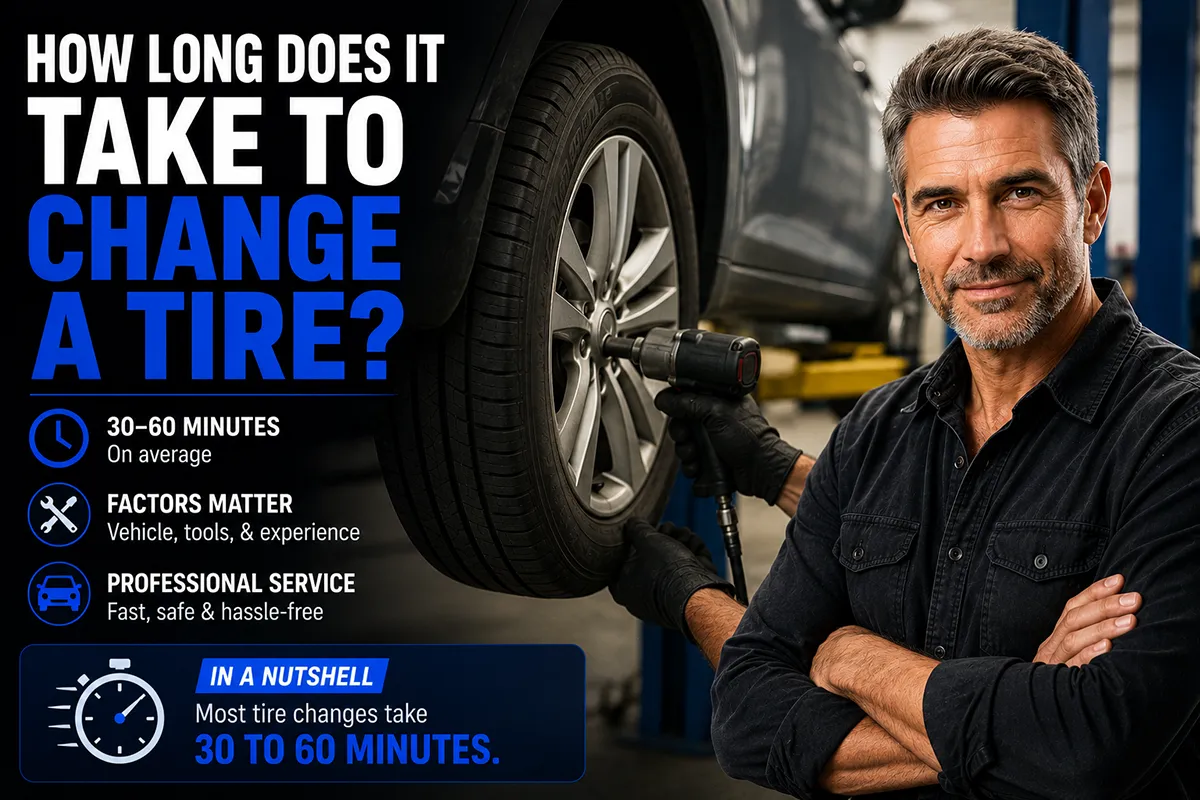
You’re standing in the rain on the shoulder of I-95, staring at a flat tire, and the only thing running through your mind is: how long is this going to take?
It’s a question I’ve answered hundreds of times — both personally and professionally — and the real answer depends on a lot more than most people think.
Whether you’re changing a tire yourself on the roadside, waiting at a tire shop for a full set of replacements, or calling roadside assistance and hoping for the best, the timeline can range from 15 minutes to well over an hour. I’ve been through every one of these scenarios, and I’m going to break down exactly what to expect so you’re never caught off guard.
- Changing a single tire yourself (roadside spare swap): 15–30 minutes if you know what you’re doing
- Tire shop — single tire mount and balance: 30–45 minutes on average
- Tire shop — full set of four tires: 45 minutes to 1.5 hours
- Roadside assistance arrival + tire change: 30 minutes to 2+ hours total
- Key factors: experience level, equipment, lug nut condition, and whether you have a spare
- Having the right tools and a little practice can cut your time in half
Liked this article?
Add TireAdvise as a preferred source so you see more of our tire reviews and guides on Google.
The Short Answer: It Depends on How You’re Changing the Tire
I know that’s not what you want to hear, but it’s the truth. In my experience, a confident person with basic tools can swap a flat for a spare in about 15 to 20 minutes on a flat, safe surface. I’ve done it in under 15 minutes in my driveway, and I’ve also spent 40 frustrating minutes on a gravel shoulder in the dark.
The method matters enormously. A professional tire technician with pneumatic tools and a lift can have a single tire off, a new one mounted and balanced, and your car back on the ground in 20 minutes flat. Compare that to you and me crouching next to a scissor jack with a lug wrench that’s too short for proper leverage.
Let me walk you through every scenario so you know exactly what to plan for.
Scenario 1: Changing a Tire Yourself (Roadside Spare Swap)
This is the scenario most people are thinking about when they ask this question. You’ve got a flat, you’ve pulled over safely, and you’re going to put on the spare tire that’s (hopefully) in your trunk.
Realistic Time Estimate: 15–40 Minutes
In my experience, the range here is wide because so many variables come into play. If you’ve practiced this before, you have a solid jack and lug wrench, the ground is level, and your lug nuts aren’t seized — you can genuinely get this done in 15 to 20 minutes.
But here’s what actually happens to most people: they haven’t touched their spare tire since they bought the car. They spend five minutes just figuring out where the jack goes. The lug nuts haven’t been removed since the last tire shop visit, where a technician tightened them with an impact gun to about 150 ft-lbs — way beyond what you can easily break loose with the flimsy lug wrench that came with the car.
I once spent nearly 10 minutes on a single lug nut because the previous shop had over-torqued it. That’s not unusual. It’s actually one of the most common complaints I hear from readers.
Step-by-Step Timeline Breakdown
Here’s roughly how I break down the time when I’m doing a roadside tire change:
- Pulling over safely, turning on hazards, setting up reflective triangles or flares: 2–5 minutes
- Locating the spare tire, jack, and lug wrench: 2–3 minutes
- Loosening the lug nuts (before jacking): 2–5 minutes
- Positioning the jack and raising the vehicle: 3–5 minutes
- Removing the flat tire and mounting the spare: 2–3 minutes
- Hand-tightening lug nuts in a star pattern: 1–2 minutes
- Lowering the vehicle and final torquing: 2–3 minutes
- Stowing the flat tire and cleaning up: 2–3 minutes
Total: roughly 16 to 29 minutes for someone who knows the process. Add another 10 to 15 minutes if this is your first time or conditions are difficult.
What Slows You Down
I’ve done enough roadside tire changes to know exactly what eats up your time. Here are the biggest culprits:
- Over-torqued lug nuts: This is the #1 time killer. If the shop used an impact gun and didn’t torque to spec, you may need a breaker bar or even a cheater pipe to break them loose. The factory lug wrench often isn’t enough.
- Corroded or seized lug nuts: Common in northern states where road salt attacks everything. I’ve seen lug nuts that literally wouldn’t budge without penetrating oil and a 4-way lug wrench.
- Soft or uneven ground: Your scissor jack is designed for pavement. On grass, gravel, or a sloped shoulder, the jack can shift or sink, and that’s dangerous. I always carry a small piece of plywood to place under the jack base.
- Unfamiliarity with jack points: Every car has specific jack points on the frame or body. Using the wrong spot can damage your vehicle or cause the jack to slip. Check your owner’s manual — ideally before you’re standing in the rain.
- A spare tire that’s flat: This is more common than you’d think. Spare tires lose air over time, and most people never check them. I recommend checking your spare’s pressure every time you check your regular tires — or at least every few months.
Scenario 2: Getting a Tire Changed at a Tire Shop
If you’re not dealing with a roadside emergency but instead heading to a tire shop for a replacement, the timeline is different — and generally more predictable.
Single Tire Replacement: 30–45 Minutes
When I’ve taken my vehicles to shops like Discount Tire, Tire Rack-affiliated installers, or local independent shops, a single tire mount and balance typically takes 30 to 45 minutes from the time they pull my car in. This includes removing the old tire from the rim, mounting the new tire, balancing it, reinstalling the wheel, and torquing the lug nuts to spec.
The catch? That’s active service time. If the shop is busy — and most are, especially on weekends — you might wait 30 minutes to an hour before they even start on your car. I’ve walked into a Discount Tire on a Saturday morning and waited over an hour just for a single tire because they had a backlog.
Pro tip from my experience: Call ahead. Many shops let you schedule an appointment, and some — like Costco Tire Center — require it. Walk-ins are hit or miss.
Full Set of Four Tires: 45 Minutes to 1.5 Hours
Replacing all four tires obviously takes longer. In my experience, most shops can do a full four-tire swap (mount, balance, and install) in about 45 minutes to an hour of active work time. But with check-in, waiting, and quality checks, plan to be at the shop for 1 to 2 hours total.
If you’re adding services like an alignment (which I recommend whenever you replace all four tires), add another 30 to 60 minutes.
Tire Shop Time Comparison Table
| Service | Active Service Time | Total Time (Including Wait) | Typical Cost |
|---|---|---|---|
| Single tire change (mount & balance) | 20–30 min | 30–60 min | $15–$30 labor + tire cost |
| Two tires (mount & balance) | 25–40 min | 45–75 min | $30–$60 labor + tire cost |
| Four tires (mount & balance) | 45–60 min | 1–2 hours | $60–$120 labor + tire cost |
| Four tires + alignment | 1.5–2 hours | 2–3 hours | $160–$250 labor + tire cost |
| Flat tire repair (patch/plug) | 15–30 min | 30–60 min | $15–$40 (often free with warranty) |
| Tire rotation | 15–20 min | 30–45 min | $20–$50 (often free with purchase) |
Scenario 3: Calling Roadside Assistance
If you can’t change the tire yourself — or you simply don’t want to — roadside assistance is a solid option. But it’s the least predictable in terms of timing.
Realistic Time Estimate: 30 Minutes to 2+ Hours Total
In my experience, the actual tire change by the roadside tech takes 10 to 15 minutes. These guys do this all day long, they have better tools, and they’re efficient. The problem is the wait time for them to arrive.
I’ve called AAA in urban areas and had someone show up in 20 minutes. I’ve also called on a holiday weekend in a rural part of Virginia and waited over 90 minutes. The national average response time for roadside assistance services is about 30 to 60 minutes, but it varies wildly depending on location, time of day, weather, and demand.
Roadside Assistance Options and Typical Response Times
- AAA: Typically 30–60 minutes. I’ve been a member for over a decade, and most of my experiences have been in the 30–45 minute range. Annual membership costs around $60–$125 depending on the tier.
- Insurance-provided roadside: Most major auto insurers (GEICO, State Farm, Progressive) offer roadside assistance as an add-on for $2–$5/month. Response times are similar to AAA — about 30–60 minutes in most areas.
- Manufacturer roadside assistance: Many new cars come with complimentary roadside assistance for the first few years. Hyundai, Kia, and BMW all offer this. Response times vary but are generally comparable to AAA.
- App-based services (Urgent.ly, Honk): These Uber-like platforms connect you with nearby providers and often give you a live ETA. In my testing, they can be faster than traditional services in urban areas — sometimes under 20 minutes.
Scenario 4: Run-Flat Tires — No Immediate Change Needed
If your car is equipped with run-flat tires — common on BMW, MINI, and some Mercedes-Benz models — you may not need to stop and change anything immediately. Run-flats are designed to support the vehicle at reduced speeds (usually up to 50 mph) for a limited distance (typically 50 miles) after a complete loss of air pressure.
In my experience testing run-flat tires, this doesn’t eliminate the tire change — it just delays it. You’ll still need to get to a tire shop, and the timeline at the shop is the same as I outlined above: 30 to 45 minutes for a single tire replacement.
The trade-off? Run-flats tend to cost more — typically $30 to $100 more per tire than comparable standard tires — and they often have a firmer ride quality. I’ve reviewed several run-flat options on TireAdvise, and while I appreciate the convenience, they’re not for everyone.
What About Tire Plug or Patch Repairs?
Not every flat tire needs to be replaced. If you’ve picked up a nail or screw in the tread area, a professional plug-patch repair can get you back on the road without buying a new tire.
Repair Time: 15–30 Minutes (Active Service)
A proper plug-patch repair — where the tire is removed from the rim, inspected from the inside, and repaired with a combination plug-patch — takes about 15 to 30 minutes of active work. With shop wait times, plan for 30 minutes to an hour total.
I want to stress something here: the quick plug-only repairs that some gas stations or mobile tire services offer (the kind where they don’t remove the tire from the rim) are not recommended by the Tire Industry Association. I’ve seen these fail. A proper internal patch-plug is the only repair I’d trust for long-term safety.
Also, not every puncture is repairable. If the damage is in the sidewall, near the shoulder, or if the hole is larger than about 1/4 inch, the tire needs to be replaced. I’ve had shops tell me a tire is repairable only to find the internal damage was worse than it appeared from the outside. A good shop will always inspect from the inside before making that call.
Tools That Make DIY Tire Changes Faster
If you want to be prepared — and I strongly recommend that you are — having the right tools can cut your roadside tire change time in half. Here’s what I personally carry in my vehicles beyond the factory kit:
My Recommended Tire Change Kit
- 4-way lug wrench (also called a cross wrench): These give you far more leverage than the factory L-shaped wrench. I use a 14-inch 4-way from Craftsman — it costs about $15–$20 and has saved me from over-torqued lug nut nightmares multiple times.
- Hydraulic bottle jack (2-ton): Factory scissor jacks are slow and unstable. A small hydraulic bottle jack lifts faster and feels much more secure. I use a Torin brand one I bought for around $20. It’s compact enough to fit in the trunk alongside the factory tools.
- 12V portable air compressor: Spare tires lose air over time. Having a small compressor that plugs into your cigarette lighter or power outlet means you can inflate the spare before mounting it — or sometimes reinflate the flat tire enough to limp to a shop. I keep a VIAIR 77P in my trunk. It runs about $30 and is worth every penny.
- Torque wrench: After changing a tire, you should always re-torque the lug nuts after driving for a few days. Most passenger cars require 80–100 ft-lbs. A basic torque wrench from EPAuto costs about $25 and ensures your wheels are safe.
- Gloves and a headlamp: Flat tires don’t always happen in daylight. A cheap LED headlamp ($8–$12) and a pair of mechanic’s gloves make the job dramatically easier and keep your hands clean.
- Piece of plywood (12″x12″, 3/4″ thick): This goes under the jack on soft ground. I learned this the hard way after a scissor jack sank into wet grass and dumped my car off the jack. Nobody got hurt, but it scared me enough that I never skip this step now.
How to Speed Up Your Tire Change: Tips from Experience
Over the years, I’ve picked up some habits that consistently shave minutes off the process. Here are the ones that make the biggest difference:
1. Practice in Your Driveway First
This is the single best thing you can do. Spend 20 minutes on a weekend practicing a tire change in your driveway. Locate your jack points, practice the sequence, and time yourself. I did this when I bought my current vehicle, and it made a massive difference when I had to do it for real a few months later.
2. Break the Lug Nuts Loose Before Jacking
This is the most common mistake I see. People jack the car up first, then try to loosen the lug nuts — and the wheel just spins because it’s off the ground. Always loosen the lug nuts (about a quarter turn each) while the tire is still on the ground and the vehicle’s weight holds it in place.
3. Use a Star (Criss-Cross) Pattern
When tightening lug nuts, don’t go in a circle. Use a star pattern to ensure even pressure across the wheel hub. This prevents warping the brake rotor and ensures the wheel seats properly. I do this every single time, whether I’m on the roadside or in a shop.
4. Check Your Spare Regularly
I check my spare tire’s air pressure every time I get an oil change — so roughly every few months. A flat spare is useless, and I’ve seen it happen to other drivers more times than I can count. Most compact spares require 60 PSI, which is higher than your regular tires. Check the sticker on the spare or your owner’s manual.
5. Know Your Lug Nut Size and Torque Spec
Before you need this information in a crisis, write down two things and keep them in your glove box: your lug nut socket size (most common are 17mm, 19mm, and 21mm) and your torque specification (usually between 80 and 100 ft-lbs for passenger cars). This saves fumbling and guessing.
How Long Can You Drive on a Spare Tire?
This is a question that always comes up in the conversation about changing tires, so I want to address it directly.
Compact (Donut) Spare
Most modern cars come with a compact temporary spare — the “donut.” These are designed for short-term use only. The general rule is no more than 50 mph and no more than 50–70 miles. I always tell readers to treat the donut like a bandage, not a solution. Get to a tire shop as soon as possible.
I’ve driven on a donut spare, and the handling difference is immediately noticeable. The car feels unstable, especially in turns, and braking distances increase. It’s fine for getting you to safety, but I wouldn’t want to be on one during a highway merge in rush hour traffic.
Full-Size Spare
Some trucks, SUVs, and older vehicles still carry a full-size spare that matches the other four tires. If yours is in good condition and properly inflated, you can drive on it normally. But check the tread depth and age — spare tires that have been sitting for years can dry rot even if they look fine from the outside.
When to Replace vs. Repair a Flat Tire
This is another timing question I get often: is it faster (and smarter) to repair the tire or just replace it?
Repair Makes Sense When:
- The puncture is in the tread area (not the sidewall or shoulder)
- The hole is smaller than 1/4 inch in diameter
- The tire has plenty of remaining tread life
- There are no previous repairs in the same area
Replacement Is Necessary When:
- The damage is in the sidewall or shoulder area
- The puncture is too large to safely repair
- The tire has been driven on while flat (which damages the internal structure)
- The tire is already worn close to the tread wear indicators
- There’s visible internal damage (bulges, cords showing, separation)
A repair takes 15–30 minutes and costs $15–$40. A replacement takes 30–45 minutes and costs significantly more depending on the tire. In my experience, it’s always worth having a professional inspect the tire before deciding. I’ve seen tires that looked fine on the outside but had severe internal damage from running underinflated.
Does the Type of Vehicle Affect How Long It Takes?
Absolutely. In my experience, the vehicle type has a meaningful impact on tire change time, whether you’re doing it yourself or at a shop.
Sedans and Compact Cars
These are the easiest and fastest to change. The tires are lighter (usually 20–30 lbs each), the lug nuts are accessible, and the jack points are straightforward. A confident person can do a spare swap in 15–20 minutes.
SUVs and Crossovers
Slightly longer due to heavier tires and wheels (30–50 lbs each) and higher ride height. The spare is often mounted under the vehicle (like on the Chevy Tahoe or Ford Explorer), which adds time for lowering it. Budget 20–30 minutes.
Trucks
Full-size truck tires are heavy — sometimes 60 lbs or more — and the spare under the bed can be corroded into its mount after years of road salt and grime. I’ve spent 10 minutes just trying to get a spare down from under a pickup truck because the cable mechanism was seized. Budget 25–40 minutes for a DIY change on a truck.
Performance and Luxury Cars
Many performance cars and luxury vehicles don’t carry a spare at all. Instead, they have a tire mobility kit (sealant and compressor) or run-flat tires. If you have a sealant kit, using it takes about 10–15 minutes, but it only works for small tread punctures and it’s a temporary fix. You’ll still need to visit a shop.
Mobile Tire Change Services: A Growing Option
Over the past few years, I’ve noticed a growing trend toward mobile tire installation services. Companies like Tire Rack’s mobile installation network, mobile tire services offered through apps, and even some local tire shops now offer to come to your location — whether that’s your home, office, or a parking lot — and change your tires on-site.
In my testing of two mobile tire services during the past year, the experience was solid. One service showed up within two hours of booking, and the technician changed all four tires in about an hour using professional equipment brought in a service van. The convenience is hard to beat, especially if you can’t afford to sit in a waiting room for two hours.
The cost is usually comparable to a traditional shop — sometimes slightly higher by $10–$20 per tire for the convenience fee. I think this is a great option for busy people and one that’s worth considering if it’s available in your area.
Final Thoughts: Be Prepared and Know Your Options
After years of changing tires myself, reviewing tires professionally, and helping readers navigate these exact situations, my biggest piece of advice is simple: don’t wait until you have a flat to figure this out.
Know where your spare is. Know where your jack goes. Have the right tools. Practice once in your driveway so the process feels familiar, not foreign, when you’re stressed and standing in a parking lot at 10 PM.
If you’d rather leave it to the pros — and there’s absolutely no shame in that — keep a roadside assistance number in your phone and know which tire shops near your home and workplace take appointments. The peace of mind is worth it.
Changing a tire isn’t complicated, and it doesn’t have to take long. With a little preparation, you can turn a stressful breakdown into a 15-minute pit stop. And in my book, that’s time well spent.
Frequently Asked Questions
How long does it take to change a tire on the side of the road?
Changing a spare tire on the side of the road typically takes 15 to 30 minutes if you have the right tools and some basic experience. For beginners, it can take closer to 45 minutes, especially in poor weather or on uneven ground. I always recommend practicing a tire change in your driveway before you actually need to do one during a roadside emergency.
How long does it take a tire shop to change all four tires?
Most tire shops in the US, including chains like Discount Tire, Tire Rack, and Firestone, can mount and balance all four tires in about 45 minutes to an hour. If the shop is busy or you don’t have an appointment, wait times can push the total visit to 1.5 to 2 hours. Scheduling ahead online usually cuts your total time significantly and many shops offer free tire installation when you buy through them.
Can I drive on a spare tire and how long does it last?
A compact temporary spare, often called a donut, is designed to get you to the nearest tire shop at speeds under 50 mph and should not be driven more than 50 to 70 miles. Full-size spares can last longer, but I still recommend replacing your damaged tire as quickly as possible. Driving on a spare for extended periods puts extra stress on your differential and can affect braking performance, especially in rain or snow common across US highways.
How much does it cost to have a tire changed at a shop near me?
Tire mounting and balancing at most US shops runs between $15 and $45 per tire, with national chains like Walmart Auto Care starting around $15 per tire and independent shops averaging $25 to $40. If you also need a new tire, expect to pay anywhere from $60 to $200 per tire depending on the size and brand. Many retailers bundle free lifetime rotation and balancing when you purchase a full set, which saves money over the life of the tires.
Do I need an alignment after changing a tire?
You don’t always need a wheel alignment after a simple tire swap, but it’s strongly recommended if you’re installing a new set of tires or if your old tires showed uneven tread wear. A proper alignment costs between $75 and $120 at most US shops and protects your new tire investment by ensuring even contact with the road. I personally get an alignment every time I buy new tires because skipping it can void mileage warranties and cause premature wear within just a few thousand miles.
What tools do I need to change a tire by myself?
At a minimum you need a jack, a lug wrench that fits your lug nuts, and your vehicle’s spare tire, all of which usually come with your car and are stored in the trunk or under the cargo area. I also keep a flashlight, wheel wedges, gloves, and a torque wrench in my roadside kit for safer and faster tire changes. If you drive an SUV or truck with larger wheels, a breaker bar can help loosen over-torqued lug nuts that a standard wrench struggles with.
Is it faster to use a mobile tire change service instead of going to a shop?
Mobile tire installation services like those offered by Tire Rack’s certified installers or companies like TreadConnection can save you significant time because a technician comes to your home or workplace and typically completes the job in 30 to 45 minutes. You avoid drive time and waiting room delays, which is why mobile services have become popular in metro areas across the US. Prices are comparable to in-shop service, usually ranging from $25 to $40 per tire, and many include balancing in that cost.
