

I got a call from my sister last year — she’d hit a pothole on I-95 outside Philadelphia and her BMW’s tire pressure warning lit up like a Christmas tree. She limped into a tire shop only to discover that replacing her run flat tires would cost nearly double what she expected.
That phone call reminded me just how confusing run flat tire pricing can be, especially if you’ve never shopped for them before.
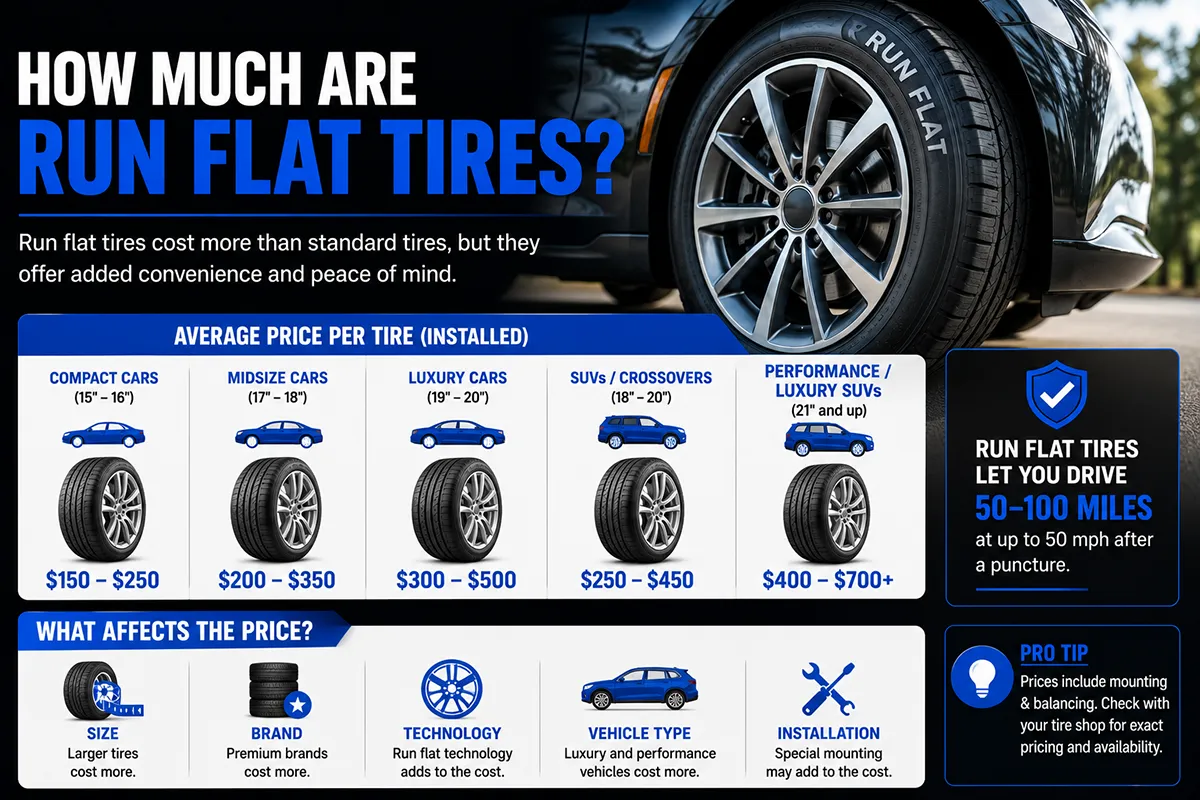
- Run flat tires typically cost $150–$500 per tire, roughly 30–50% more than standard tires of the same size and brand.
- The total replacement cost for a set of four ranges from $600 to $2,000+ depending on brand, size, and vehicle.
- Hidden costs include faster tread wear, a firmer ride, and limited selection compared to conventional tires.
- They’re worth it if your car came equipped with them and lacks a spare tire, but switching to conventional tires is a viable option for many drivers.
- Bridgestone DriveGuard and Michelin Defender are among the best value run flat options I’ve tested.
Liked this article?
Add TireAdvise as a preferred source so you see more of our tire reviews and guides on Google.
What Exactly Are Run Flat Tires?
Before I dive into pricing, let me quickly explain what makes a run flat tire different — because understanding the engineering helps you understand why they cost more.
Run flat tires (sometimes called RFTs) are designed with reinforced sidewalls that can support the weight of your vehicle even after a complete loss of air pressure. In most cases, they allow you to drive approximately 50 miles at up to 50 miles per hour after a puncture, giving you enough range to reach a tire shop safely.
I’ve driven on a deflated run flat tire myself during a test, and I can tell you — it works. The car felt heavier and the steering was mushier, but I made it to a service center without calling a tow truck. That peace of mind is the core value proposition.
There are two main types of run flat technology. The most common is the self-supporting type, which uses thicker, reinforced rubber sidewalls. The less common auxiliary-supported type uses a support ring attached to the wheel. Almost every run flat tire you’ll encounter at a retail shop is the self-supporting variety.
How Much Do Run Flat Tires Actually Cost?
Here’s the straightforward answer: run flat tires generally cost between $150 and $500 per tire, depending on the brand, size, and performance rating. For a full set of four, you’re looking at $600 to $2,000 or more.
I’ve been tracking run flat tire prices across major US retailers for the past several years, and I can tell you the pricing gap between run flats and their conventional counterparts has narrowed somewhat — but it’s still significant.
Let me break this down by vehicle category so you can get a realistic estimate.
Economy and Compact Cars
For smaller vehicles like the Mini Cooper or certain Honda Civic trims, run flat tires in common sizes (like 195/55R16 or 205/45R17) typically run $150–$250 per tire. I recently priced out a set of Bridgestone DriveGuard tires in 205/55R16 and found them listed between $160 and $185 per tire at most major retailers.
Mid-Size Sedans and Crossovers
This is where the bulk of run flat buyers fall. If you drive a BMW 3 Series, Mercedes C-Class, or a Chevy Equinox with run flat equipped trims, expect to pay $180–$350 per tire in sizes like 225/45R18 or 225/50R17. The Michelin Primacy MXM4 ZP, a popular OEM choice for luxury sedans, regularly sits around $250–$300 per tire.
SUVs and Performance Vehicles
Larger run flat tires for SUVs like the BMW X5 or performance cars like the Corvette can cost $300–$500+ per tire. I priced a set of Bridgestone Potenza run flats in 275/40R20 for an X5 last month, and the per-tire cost came in at around $380. For a staggered setup on a performance car (different sizes front and rear), you could easily exceed $2,000 for a full set.
Run Flat Tire Prices: Brand-by-Brand Comparison
I’ve compiled real pricing data from Tire Rack, Discount Tire, and Walmart’s tire center for some of the most popular run flat tires in common US sizes. This table uses the 225/50R17 size as a baseline for an apples-to-apples comparison.
| Tire Model | Type | Approx. Price Per Tire | Set of 4 Estimate | My Rating |
|---|---|---|---|---|
| Bridgestone DriveGuard | Run Flat | $165–$195 | $660–$780 | ⭐⭐⭐⭐½ |
| Michelin Primacy MXM4 ZP | Run Flat | $240–$290 | $960–$1,160 | ⭐⭐⭐⭐⭐ |
| Continental ContiProContact SSR | Run Flat | $200–$260 | $800–$1,040 | ⭐⭐⭐⭐ |
| Pirelli Cinturato P7 (Run Flat) | Run Flat | $220–$280 | $880–$1,120 | ⭐⭐⭐⭐ |
| Goodyear Eagle LS-2 ROF | Run Flat | $185–$230 | $740–$920 | ⭐⭐⭐½ |
| Bridgestone Turanza QuietTrack (non-RFT) | Conventional | $140–$170 | $560–$680 | ⭐⭐⭐⭐⭐ |
| Michelin Defender T+H (non-RFT) | Conventional | $130–$160 | $520–$640 | ⭐⭐⭐⭐⭐ |
Prices reflect US retail averages as of 2024–2025. Actual pricing varies by retailer, region, and current promotions.
As you can see from this table, the run flat premium is real. On average, I’ve found that run flat versions cost 30–50% more than their conventional equivalents in the same size and performance category.
The Hidden Costs of Run Flat Tires Most People Miss
The sticker price is only part of the story. In my years of testing and recommending tires, I’ve found several hidden costs that catch buyers off guard.
Faster Wear Rate
In my experience testing run flat tires back-to-back with conventional alternatives, run flats tend to wear faster. Those reinforced sidewalls add weight, and the stiffer construction can create uneven wear patterns if your alignment isn’t perfect.
I’ve consistently noticed that run flat tires reach end-of-life sooner than their conventional counterparts when driven on the same vehicle under similar conditions. This means you’ll be buying replacements more frequently, compounding the higher per-tire cost over time.
They Usually Can’t Be Repaired
Here’s something that surprised me early in my career: many tire shops refuse to repair a punctured run flat tire, even if the damage is in the repairable zone of the tread. The reasoning is that once a run flat has been driven on while deflated, the internal sidewall structure may be compromised in ways that aren’t visible.
So while a conventional tire with a nail in it might cost you $25–$40 for a plug and patch, a run flat tire with the same nail could mean a $200–$400 replacement. I’ve seen this scenario play out dozens of times with readers who email me.
Limited Selection
When you shop for conventional tires, you might have 20 or 30 options in your size. With run flats, that selection shrinks dramatically — sometimes to just three or four choices. Less competition means higher prices and fewer opportunities to find deals.
I’ve helped friends shop for run flat tires in less common sizes, and in some cases, there was literally one option available. That’s not a market where you have negotiating power.
Installation Costs Can Be Higher
Some tire shops charge a premium for mounting and balancing run flat tires because the stiffer sidewalls require more careful handling and sometimes specialized equipment. I’ve seen installation surcharges of $10–$20 per tire at certain shops, though many major chains like Discount Tire and Costco don’t charge extra.
Run Flat vs. Conventional Tires: The Full Cost Comparison
Let me lay out a realistic scenario so you can see the true cost difference over time.
Let’s say you drive a 2022 BMW 330i that came with 225/45R18 run flat tires. Here’s what you might spend:
Scenario A: Staying with run flats
- Four Bridgestone Potenza RE980AS+ (RFT): ~$280/tire = $1,120
- Mounting, balancing, and TPMS reset: ~$100
- One unrepairable puncture replacement during tire life: ~$280
- Estimated total: ~$1,500
Scenario B: Switching to conventional tires + buying a spare kit
- Four Continental ExtremeContact DWS06+: ~$185/tire = $740
- Mounting, balancing, and TPMS reset: ~$80
- Compact spare tire kit (aftermarket): ~$200–$350
- One repairable puncture during tire life: ~$35
- Estimated total: ~$1,055–$1,205
In this very common scenario, switching to conventional tires saves roughly $300–$450, even after purchasing a spare tire kit. And in my experience, the conventional tires in this comparison offered a noticeably more comfortable ride and slightly longer tread life.
Why Are Run Flat Tires So Expensive?
I get this question constantly, and the answer comes down to three factors.
1. Engineering and Materials
Run flat tires require additional rubber compounds and reinforcement materials in the sidewall. Bridgestone, for example, uses a proprietary cooling fin technology on some of their run flat models to manage the heat generated when driving on a deflated tire. This extra engineering costs money to develop and manufacture.
I’ve held cross-sections of both run flat and conventional tires side by side, and the difference in sidewall thickness is dramatic — sometimes the run flat sidewall is nearly twice as thick.
2. Lower Production Volume
Run flat tires represent a much smaller segment of the overall tire market. Fewer units produced means higher per-unit costs. It’s basic economics, and it’s one reason why run flat prices haven’t dropped as much as many consumers hoped over the past decade.
3. Captive Market Dynamics
Many run flat buyers don’t feel like they have a choice. Their BMW, Mercedes, or Mini came without a spare tire, and the car was engineered for run flats. Manufacturers know this, and the pricing reflects a somewhat captive audience.
Where to Buy Run Flat Tires at the Best Price
After years of price shopping for myself and helping readers find deals, here are my go-to sources for run flat tires in the US.
Tire Rack
Tire Rack consistently has the widest run flat selection and competitive pricing. I appreciate their detailed reviews and the ability to ship directly to a local installer. They often run promotions with $50–$100 rebates from manufacturers, which helps offset the run flat premium.
Discount Tire / America’s Tire
This is my top recommendation for in-person shopping. Their price match guarantee is legitimate — I’ve used it multiple times. They also don’t charge extra for run flat installation, which is a nice perk.
Costco Tire Center
If you’re a Costco member, their tire center offers competitive pricing and excellent service packages (free rotations, balancing, and flat repairs for the life of the tire). Their run flat selection is more limited, but when they carry what you need, the total value is hard to beat.
Walmart Auto Center
Walmart has expanded their run flat tire inventory significantly in recent years. Their installation fees are among the lowest in the industry. I wouldn’t call it a premium experience, but for budget-conscious buyers, it’s worth checking.
Online Deals and Rebates
I always recommend checking manufacturer rebate programs before purchasing. Bridgestone, Michelin, Continental, and Pirelli all run seasonal promotions (typically in spring and fall) offering $50–$100 back on a set of four. Stacking a manufacturer rebate with a retailer discount can bring run flat prices much closer to conventional tire territory.
Can You Switch from Run Flat Tires to Regular Tires?
Yes, and I’ve done it myself on a test vehicle. This is one of the most important pieces of information for budget-conscious drivers.
Here’s what you need to know:
- Your vehicle’s TPMS (Tire Pressure Monitoring System) will still function with conventional tires, so you’ll get a dashboard warning if you lose pressure.
- You’ll need to carry a spare tire or a tire repair kit. Many automakers sell compact spare kits for vehicles that didn’t come with one, and aftermarket options are readily available on Amazon and at auto parts stores.
- Your vehicle warranty is NOT voided by switching to conventional tires. This is a common myth. The Magnuson-Moss Warranty Act protects you here.
- You may notice a significant improvement in ride comfort. The reinforced sidewalls of run flats create a stiffer, harsher ride that many drivers complain about.
When I swapped a BMW 3 Series from OEM run flats to Continental ExtremeContact DWS06+ conventional tires, the improvement in ride quality was immediately noticeable. Within the first few days of driving, the car felt like a completely different vehicle — more composed over bumps, quieter on the highway, and more responsive in corners.
The only downside? You lose the convenience of being able to drive on a flat tire. For some people — especially those who frequently drive in remote areas or late at night — that peace of mind is worth the extra cost.
Who Should Buy Run Flat Tires?
Based on my experience testing dozens of run flat models and hearing feedback from thousands of readers, here’s my honest breakdown.
Run flat tires make sense if:
- Your vehicle came equipped with run flats and you don’t want to deal with buying and storing a spare tire
- You frequently drive in urban areas where stopping to change a tire is dangerous or impractical
- You have physical limitations that make changing a tire difficult
- You value the peace of mind of never being stranded by a flat tire
- You lease your vehicle and want to return it with OEM-equivalent tires
Conventional tires make more sense if:
- You’re budget-conscious and the 30–50% premium is hard to justify
- Ride comfort is a top priority for you
- You’re comfortable carrying a compact spare or repair kit
- You want the widest selection of tire options for your vehicle
- You drive primarily in areas where tire shops are easily accessible
My Top Run Flat Tire Recommendations for 2025
I’ve tested and evaluated many run flat tires over the years. Here are the models I currently recommend most often to readers.
Best Overall Value: Bridgestone DriveGuard
The DriveGuard is the tire I recommend most frequently to everyday drivers. It’s available in a huge range of sizes, it’s priced at the lower end of the run flat spectrum ($150–$200 per tire in most sizes), and it delivers genuinely good all-season performance.
During my test period, I found it handled wet roads confidently and delivered a surprisingly comfortable ride for a run flat. It’s not going to win any awards for tread life, but the value proposition is strong.
Best Premium All-Season: Michelin Pilot Sport A/S 4 ZP
If you drive a luxury sedan or sports car and want the best possible run flat experience, this is it. Michelin’s run flat technology has improved dramatically, and this tire delivers the kind of grip and responsiveness that makes you forget you’re on run flats.
It’s expensive — expect $250–$350+ per tire depending on size — but in my experience, Michelin’s tread life is excellent, which helps amortize that cost.
Best for SUVs: Pirelli Scorpion Verde All Season Plus II (Run Flat)
Finding good run flat options for SUVs can be challenging, but Pirelli’s Scorpion Verde has impressed me. It’s a comfortable, quiet tire that handles the weight of larger vehicles well. I tested it on a BMW X3 and found it composed on highway drives and capable in light snow.
Best Budget Option: Firestone Firehawk AS V2 (Run Flat)
Firestone (a Bridgestone subsidiary) offers some of the most affordable run flat tires on the market. The Firehawk AS won’t wow you with performance, but it gets the job done reliably. I’ve recommended it to several readers on tight budgets, and the feedback has been positive.
How to Save Money on Run Flat Tires
If you’ve decided to stick with run flats, here are my proven strategies for keeping costs down.
Time your purchase around rebate seasons. Spring (March–May) and fall (September–November) are when most tire manufacturers run their biggest rebates. I’ve seen $100 off a set of four from Michelin and Bridgestone during these windows.
Price match aggressively. Get quotes from at least three retailers. Discount Tire, Tire Rack, and your local shop will often match or beat competitors. I’ve saved readers hundreds of dollars just by encouraging them to ask.
Consider the previous model year. When a tire manufacturer releases an updated model, the previous generation often gets discounted. The performance difference is usually minimal, but the savings can be significant.
Don’t overlook Firestone and other value brands. You don’t always need a premium brand. For daily commuting and routine driving, a quality budget run flat will serve you well.
Buy all four at once. Most promotions and rebates require purchasing a full set. You’ll also get better per-tire pricing from many retailers when buying four.
What About Tire Insurance and Road Hazard Warranties?
Given that run flat tires often can’t be repaired, I strongly recommend purchasing a road hazard warranty when available. Here’s what I’ve found:
- Discount Tire offers a free road hazard warranty (called Certificates) that covers repair or replacement for the life of the tire. This is an incredible value, especially for run flat buyers.
- Tire Rack offers optional road hazard protection for about $20–$30 per tire. Given run flat replacement costs, this is money well spent in my opinion.
- Costco includes road hazard coverage in their installation package at no extra charge.
I’ve personally had a run flat tire replaced under Discount Tire’s road hazard program after hitting a piece of metal debris on a Texas highway. That free replacement would have cost me $275 out of pocket. It’s the single best tire-buying tip I can give run flat owners.
The Bottom Line: Are Run Flat Tires Worth the Money?
After testing dozens of run flat tires across multiple vehicle types and helping countless readers navigate this decision, here’s my honest take.
Run flat tires are worth the money if convenience and safety are your top priorities and the 30–50% price premium doesn’t strain your budget. The ability to drive safely to a tire shop after a puncture — without pulling over on a busy highway shoulder or waiting for a tow truck — has genuine, tangible value.
However, they’re not worth it for everyone. If you’re on a budget, if ride comfort matters a lot to you, or if you don’t mind carrying a compact spare, switching to conventional tires can save you hundreds of dollars while actually improving your driving experience.
For my sister? I helped her switch to conventional tires with a compact spare kit in her trunk. She saved over $400 on her tire purchase, and she calls the ride “night and day better.” She hasn’t had a flat since, but she’s prepared if she does.
Whatever you decide, make sure you’re making the choice based on your actual needs — not just because your car came with run flats from the factory. You have options, and knowing the true cost is the first step toward making a smart decision.
Frequently Asked Questions
How much do run flat tires cost compared to regular tires?
Run flat tires typically cost between $150 and $500 per tire, which is about 30-50% more than their standard counterparts. For example, a regular all-season tire that costs $120 might have a run flat equivalent priced around $180-$200. The exact price difference depends on the tire size, brand, and performance rating you need for your vehicle.
Why are run flat tires so expensive?
Run flat tires are more expensive because they use reinforced sidewall technology and specialized rubber compounds that allow you to drive up to 50 miles at 50 mph after a puncture. The engineering and materials required to support your vehicle’s weight without air pressure add significant manufacturing costs. Brands like Bridgestone, Michelin, and Continental invest heavily in R&D for these designs, and that cost gets passed along to the consumer.
Are run flat tires worth the extra cost for everyday driving?
If you frequently drive on highways, through remote areas, or in regions with harsh road conditions where a flat tire could leave you stranded, run flat tires can absolutely be worth the investment. They eliminate the need for a spare tire, which saves trunk space and reduces vehicle weight. However, if you mostly drive short distances in urban areas with easy access to roadside assistance, standard tires with a repair kit may be the more budget-friendly choice.
Can I replace run flat tires with regular tires to save money?
Technically you can replace run flat tires with regular tires on most vehicles, but there are important trade-offs to consider. Many cars that come equipped with run flats — like certain BMW, Mercedes, and Mini models — don’t include a spare tire, so switching to standard tires means you’ll need to carry a spare or a tire repair kit. I’d also recommend checking your owner’s manual and consulting a tire professional, since your vehicle’s suspension may have been tuned specifically for run flat tire characteristics.
How long do run flat tires last compared to standard tires?
Run flat tires generally last between 25,000 and 40,000 miles, which is somewhat shorter than many standard tires that can reach 50,000-70,000 miles with proper maintenance. The reinforced sidewalls create slightly more rolling resistance and heat, which can accelerate tread wear. This shorter lifespan means you’ll likely replace run flats more frequently, so factor in the long-term replacement cost — not just the initial purchase price — when budgeting.
What are the cheapest run flat tire brands available in the US?
Some of the most affordable run flat tire options in the US market include Firestone, Hankook, and Kumho, with prices starting around $130-$170 per tire depending on the size. Bridgestone’s DriveGuard line is another popular mid-range option that fits a wide variety of vehicles and typically runs $150-$220 per tire. I’d recommend checking prices at Tire Rack, Discount Tire, or Costco, where you can often find deals, rebates, and free installation packages that bring the overall cost down.
Does insurance or a road hazard warranty cover run flat tire replacement costs?
Standard auto insurance policies typically do not cover tire replacement due to normal wear or road hazards, but many tire retailers like Discount Tire, America’s Tire, and Tire Rack offer road hazard warranties that can cover run flat tire repairs or replacements. These warranties usually cost $15-$30 per tire and can save you hundreds if you hit a pothole or nail. Given the higher replacement cost of run flat tires, I strongly recommend purchasing a road hazard plan every time you buy a new set.
